These sessions explore different formats with which artistic tools enable other possible worlds to be imagined: mapping networks of activism, drawing up manifestos, creating spaces of assembly in the framework of art and developing collective dramaturgies as modes of investigating the present. Researchers, artists and activists from the Institute of Radical Imagination will share their experiences on artistic platforms as strategies of subjectivation and political action in the projects Art for UBI (Universal Basic Income) and Art for Radical Ecologies, in addition to studying the approach to radical pedagogies via projects such as The School of Emergencies, Kirik and Raising Care. Finally, the Centro Revolucionario de Arqueología Social (Revolutionary Centre of Social Archaeology, CRAS), alongside the Institute of Radical Imagination (IRI), will raise issues around the situation of CSA La Tabacalera in Lavapiés after thirteen years of free culture and self-management.
![Maja Bajevic, Arts, Crafts and Facts (Top 10%, 90%) [Artes, artesanías y datos (Ricos 10%, 90%)], 1967. Museo Reina Sofía](https://recursos.museoreinasofia.es/styles/small_landscape/public/Actividades/nim.jpg.webp)
Held on 20, 21 Apr, 25, 26 May, 05, 06 Jul 2023
Inside the framework of the Critical Node Militant Research, from the Museo Reina Sofía’s Study Programme Connective Tissue, the Foundation of the Commons, the Institute of Radical Imagination and La Laboratoria, in collaboration with the Museo en Red team, put forward a space of training and study on the specificity of forms of militant research. Situated outside academic frameworks, these investigations pick up the legacy of workers’ co-research from the 1960s, feminist epistemologies and theories of research-action. Therefore, more than establishing a method, they seek to generate devices in order for social struggles to read each other and find causes that lead to action.
This Critical Node looks to reflect on (and from) tools and learnings from networks with which the Museo has been collaborating over the past fifteen years, in relation to those processes of knowledge production which ultimately aim not to interpret the world but to organise its transformation.
[dropdown]
The Institute of Radical Imagination (IRI) is a Mediterranean-wide network founded in 2017 by artists, activists, academics and cultural producers with a shared interest in co-producing knowledge, artistic and political research and interventions aimed at implementing post-capitalist ways of life. With the vocation of joining art, activism and pedagogy, the IRI emerges as a post-capitalist institution — a "quasi-institution" — which operates as an interface between diverse spaces and agents, causing mutual contamination between academic institutions, museums and self-managed social centres.
La Laboratoria. Spaces of Feminist Research is a transnational device of feminist activist research, that which is developed by those involved in different territories, involved in specific conflicts and struggles, with different yet common languages and questions. The research applies the lens of feminist contempt to diverse processes, flowing beyond any drawer or pigeonhole of so-called "women’s" issues. With participation from four cities — Buenos Aires, Quito, New York and Madrid — La Laboratoria promotes activist research inside the feminist tide as situated theoretical practice allowing maps of position and analysis to be constructed collectively.
Foundation of the Commons is a laboratory of discourse and political action, entangling a series of research, publishing, training and bookshop groups that pool resources to drive the development of critical culture and social democratisation. The structure of the network is made up of social and research spaces (La Casa Invisible, Ateneo La Maliciosa, Traficantes de Sueños, IDRA, Ateneu Candela, Synusia and Katakrak) from different corners of the Iberian Peninsula (Málaga, Madrid, Barcelona, Terrassa, Iruñea-Pamplona).
[/dropdown]
Organised by
Inside the framework of
Connective Tissue. The Museo Reina Sofía’s Study Programme: Critical Node, Militant Research



Participants
Participants
-
Thursday, 20 April 2023 Nouvel Building, Protocol Room
Session 1
6pm Approach to Radical Pedagogies: The School of Emergencies and Kirik
— With the participation of Dimitry Vilensky and Zeyno Pekünlü (Institute of Radical Imagination)7:30pm Artistic Platforms as Strategies of Subjectivation and Political Action: Art for UBI and Art for Radical Ecologies
— With the participation of Marco Baravalle, Gabriella Riccio and Emanuele Braga (Institute of Radical Imagination) -
Friday, 21 April 2023 CSA La Tabacalera (calle de Embajadores 51, Madrid)
Session 2
11am Research and Artistic Practices from Self-management
— With the participation of Pablo García Bachiller, Gabriella Riccio and Marco Baravalle (Institute of Radical Imagination) -
Friday, 21 April 2023 Nouvel Building, Protocol Room
Session 3
Tickets6pm Approach to Radical Pedagogies: Raising Care
— With the participation of Maddalena Fragnito, Elena Blesa Cábez and Theo Prodromidis (Institute of Radical Imagination)7:30pm The Common and the Legal: Tools and Strategies
— With the participation of Giuseppe Micciarelli, Gabriella Riccio and Pablo García Bachiller (Institute of Radical Imagination)
Can a summer camp be considered a militant research practice? And the list of organic suppliers who stock a social centre’s canteen? In the following sessions, the Foundation of the Commons explores how spaces of knowledge production forged in the heat of social movements’ political and organisational practices are shaped. To this end, keys to two research devices are shared: Encuesta Inquilina (The Tenant Survey) — propelled with Sindicat de Llogaters from Barcelona — and the line of work around the eco-social crisis, articulated through the series of self-training and encounters The Future Is Unwritten. Organising in the Capitalocene Crisis. Drawing from these experiences, the aim is to put into practice possible militant research.
-
Thursday, 25 May 2023 Nouvel Building, Protocol Room and Online platform
Session 4
Online platform6:30pm La Encuesta Inquilina (The Tenant Survey)
— With the participation of IDRA (The Urban Research Institute of Barcelona) (Foundation of the Commons)7:45pm The Future Is Unwritten
— With the participation of Synusia, Katakrak and Traficantes de Sueños (Foundation of the Commons) -
Friday, 26 May 2023 Ateneo La Maliciosa (calle de las Peñuelas 14, Madrid)
Session 5
Online platform11am How Do We Conduct Militant Research?
— With the participation of IDRA, Synusia, Katakrak and Traficantes de Sueños (Foundation of the Commons)
This session sees La Laboratoria look to apply situated research to the systemic dimension and the interconnection between different forms of violence: social, sexual, economic, judicial. It looks to explore the potential of the situated epistemological perspective to deploy a radical critique of hegemonic discourses on violence or the role of States in legitimising and concealing some forms of violence and criminalising others, raising, from collective practices, the possibilities of transformative feminist justice. Alongside feminist researchers and collectives from Quito, Porto Alegre, Buenos Aires, New York and Madrid, and at the crossroads of movements for prison abolition, against the criminalisation of poverty, and dissident street feminisms, a space is opened from which to reflect on the possibilities of thinking about justice as a collective practice, where mutual protection, support, accountability and remediation go hand in hand with a critique of patriarchal, racist and class-biased logics.
-
Wednesday, 5 July 2023 Nouvel Building, Auditorium 200 and online platform
Session 6
Tickets5pm Introduction. What Does Investigating Violence from a Situated Perspective Mean?
— With the participation of Susana Draper (Madres Protectoras) and Itzell Sánchez (Técnicas Rudas / Colectiva Acción Directa Autogestiva). Supported by Débora Ávila7pm All that Crushes Us. Intersecting Violence
— With the participation of María José Barrera (Colectivo de Prostitutas de Sevilla), Luci Cavallero (Ni Una Menos) and Ana Pinto (Jornaleras de Huelva en lucha). Supported by Constanza CisnerosThis activity offers a play centre for children to help parents with childcare. The registration form can be found at this link.
-
Thursday, 6 July 2023 Nouvel Building, Protocol Room and online platform
Session 7
Tickets5pm Debates around (Anti)Punitivism from Situated Feminist Struggles
— With the participation of Vicky García (La Laboratoria Nodo Europa Sur), Fernanda Martins and Laia Serra. Supported by Justa Montero7pm Beyond Victimisation. Feminist Self-defence and Strategies of Community Responsibility
— With the participation of Jazmin Sofia Escuntar Chavez (Mujeres de Frente), Martha Cecilia Collaguazo Velasco (Mujeres de Frente), Maria Jose "Guru" Jiménez Cortiñas (Asociación Gitanas Feministas por la Diversidad), Aida Elizabeth Pino Naranjo (Mujeres de Frente) and Helena Silvestre (Escola Feminista Abya Yala). Supported by Tatiana RomeroThis activity offers a play centre for children to help parents with childcare. The registration form can be found at this link.

Más actividades
![Isabel Coixet, 100 Years and You Everywhere [100 años y tú en todos los sitios], 2026, película](https://recursos.museoreinasofia.es/styles/small_landscape/public/Actividades/2.diseminar-mundo.jpg.webp)
John Berger and Isabel Coixet. Continued Ways of Seeing
Thursday, 17 September 2026 at 7pm
Ways of Seeing (1972) is one of the most revolutionary television series on art history, the museum and contemporary critical culture. Across four episodes, an articulate, enthusiastic John Berger unpacks the relationships between classical art through the gaze and new technology, the nude and feminism, the oil painting and commodity fetichism, advertising and consumerism. In essence, a level of critical commitment only comparable to its capacity for dissemination. Unsurprisingly, the series, and the book that would distil it, continues to forge vocations. This session sees art historians Alberto López Cuenca and Modesta Di Paola carry out an analysis of Berger’s audiovisual work, placing the stress on episodes one and four of the series. In the first episode, Berger reflects on the connection between the act of seeing, looking and being in light of new technology, such as the film camera. At the same time, it analyses how the culture of reproduction is turning paintings into messages or fragments of communication while stressing the importance of silence when observing historical paintings. In the fourth and final episode, he introduces advertising as a new iconic-verbal language that shares certain principles with the message of oil painting as a luxury item.
The session opens with the premiere of a filmic letter from Isabel Coixet, one of Spain’s most internationally acclaimed directors, to John Berger, with whom she maintained a long friendship and deep admiration. The short film is testament to the ubiquitous and long-lasting presence of the author of Ways of Seeing, even after his death in 2017.
![Chantal Akerman, Woman Sitting after Killing [Mujer sentada después de matar], 2001, instalación. Museo Reina Sofía](https://recursos.museoreinasofia.es/styles/small_landscape/public/Actividades/chantal-akerman-mujer-sentada-despues-matar.jpg.webp)
On Your Screen: Art History and the Museum Facing the Audiovisual Challenge
18, 19 SEP 2026
The conference On Your Screen: Art History and the Museum Facing the Audiovisual Challenge sparks debate around the transformations of art history and museum space upon embracing the audiovisual format. Its starting point is John Berger’s emblematic television series Ways of Seeing (1972), a landmark in the democratisation of art-historical discourse. In the series, Berger illustrated how the transfer of a work such as Goya’s Los fusilamientos del 3 de mayo (The Third of May 1808 or the Executions) from museum gallery to home TV screen completely changed the viewer’s experience, allowing the image to travel to straight to the viewer.
In the twenty-first century, this screen-based ecosystem has expanded exponentially, with museums not only physically integrating screenings and devices into their galleries— following in the wake of many exhibitions on the moving image — but also deploying complex virtual strategies. Equally, numerous en vez de a multitudeof historians, students and creators use digital platforms to circulate their ideas and projects. This audiovisual shift opens access to ignored materials and democratises knowledge, as well as challenging traditional hierarchies and the interpretive authority of institutions. The conference, promoted by the research project ATLAS AV: The Audiovisualisation of Art History and the Museum, seeks to analyse this vast audiovisual material, its archives, and its capacity to transform the memory of art.
Godard and Miéville: Time and Ruin
Friday, 18 September 2026 - 7pm
Inside the framework of the conference On Your Screen: Art History and the Museum Facing the Audiovisual Challenge, this film series sets forth three critical visions of the museum via three sessions featuring the works of John Berger, Jean-Luc Godard and Anne-Marie Miéville, Ariella Azoulay, Alan Resnais and Chris Marker, Kwate Nee-Owoo, and the premiere of short films by Isabel Coixet and La Vulcanizadora (Maria Rojas Arias and Andrés Jurado). In classical theory, the museum gives the world meaning; it contains fragments of the past, granting them a history, a narrative that explains preterite time and the present. Today, there is an implicit assumption that this function hides and legitimises forms of power, yet what if the museum, instead of explaining the world, multiplied it through radical ideas, silenced periods and repressed subjects? Such is the approach of the film-makers and artists in this film season.
In 1972 the writer John Berger opened the landmark television series Ways of Seeing with an iconoclastic gesture: slicing Sandro Botticelli’s painting Venus and Mars (1485) in London’s National Gallery. A transgressive act that recalls contemporary attacks on the museum by dissident youth and with which Berger, after revealing it was a reproduction, sought to ignite debate around the idea of an original artwork and a copy. In this, the hundredth anniversary of his birth, the first session pays homage to one of the great art writers of the twentieth century. Starting with a review of Berger’s audiovisual work by art historians Alberto López Cuenca and Modesta Di Paola, the series begins with the premiere of 100 Years and You Everywhere (2026), an unreleased short film by Isabel Coixet composed as a beautifully crafted letter to Berger, and continues with an analysis of fragments of Ways of Seeing in relation to the museum and contemporary art.
The second session screens two medium-length films by Jean-Luc Godard and Anne-Marie Miéville on time, ruin and museum. In The Old Place. Small Notes Regarding the Arts at Fall of 20th Century (1999), both film-makers consider what remains of that “old place”, the museum, at the close of a century of wars and totalitarianism, and ask whether it should be more of a legend or desire than a place. This same driving principle leads Godard to build his own imaginary museum in Reportage amateur (maquette expo) (2006), a rickety toy museum which, paradoxically, contains the great film-maker’s full power of thought on history and images.
Finally, the third session explores one of the major challenges of recent years: the decolonisation of the museum, the recognition of its link to imperialist discourses of power and the need to situate a new silenced or repressed subject at the centre of the Western narration of history. Under the title Museums and Restitution, it includes the film Undocumented. Unlearning Imperial Plunder (2019), by theorist Ariella Azoulay, Statues Also Die, by Alan Resnais and Chris Marker (1953), Kwate Nee-Owoo’s You Hide Me (1970) and the first screening of the short film Quinto verso, parte de Tonada (Fifth Verse, Part of Tonada), by La Vulcanizadora (Maria Rojas Arias and Andrés Jurado), filmed at the Museo de América in Madrid.
![Ariella Azoulay, Un-documented. Unlearning Imperial Plunder [Indocumentados. Desaprendiendo el saqueo imperial], 2019, película](https://recursos.museoreinasofia.es/styles/small_landscape/public/Actividades/5.diseminar-mundo.jpg.webp)
Museums and Restitution
Saturday, 19 September 2026 - 7pm
Centuries of plundering, decades of amnesia, years of living with unmitigated extractivist power… Does a museum, as we know it, have a raison d'être in a postcolonial society?
This session expounds the operations of the museum as a colonial machine, while putting forward ideas, in narration, for a more just, equal and inclusive institution of the future via society’s marginalised and minority voices. The session begins with the international premiere of Quinto verso, parte de Tonada (Fifth Verse, Part of Tonada), which presents a vision of the Quimbaya Collection (fifth and sixth centuries CE) from the Museo de América in Madrid. It is constructed with the voices and chants of Wayúu mourners and guides, not only as a way of reinstating the role of these gold idols — anthropomorphic figures of men and women used as vessels in ritual practices — but also to imagine that what must be exhibited is not the gold itself. It is the ritual’s own chant. In the classic film You Hide Me (1970), Ghanaian film-maker Kwate Nee-Owoo accesses the British Museum’s collection of African art, located in the building’s basement, to question the meaning behind a museum plundering and nullifying. A fine exercise of first-person institutional critique screened for the first time in Spain. Almost seventy years since Resnais and Marker made Statues Also Die (1953), a reflection on the aura-bearing value of the museum opposite the identity-based and cultural belonging of African art, theorist Ariella Azoulay films the same statues again at the Musée du Trocadéro (today the Musée du Quai Branly), which survive and wait to be reunited with their people. Azoulay, whose wholly original undertaking is a lesson to the museum of the future, connects the forced migration of these sculptures with the mass transit of people crossing borders artificially imposed by the same system that has plundered their culture.
The School of Transformative Institutionalism and Local Organisation
From 21 to 24 September 2026
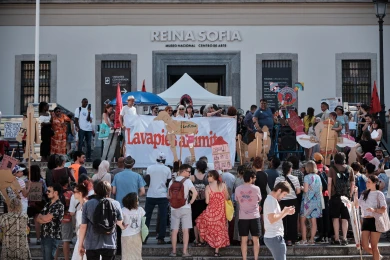
The School of Transformative Institutionalism and Local Organisation (S.T.I.L.O.) is a programme of joint learning and join strategy which sets in motion a process for the exchange of questions, methodologies and experiences between cultural organisations. The overall aim is to create, circulate and prototype tactics, tools and collective knowledge on institutional practices that open new channels for defending culture and advocating structural transformation in divergent geographical contexts.
The project is part of the Laboratorio de Institucionalidad Compartida (The Laboratory of Shared Institutionalism, LIC), a space for the Museo Reina Sofía’s research, work and advocacy centred on developing, experimenting with and systemising practices, protocols and tools which contribute to a fairer and more liveable cultural ecosystem.
For many years now, so-called infrastructural critique in museums questions material, legal and economic infrastructures, among others, as well as the forms of solidarity and practices required to sustain the cultural ecosystem. By approaching current debates, S.T.I.L.O. raises questions on the ways in which organisations define and interpret their practices, organise their relations and respond to the social contexts in which they operate.
The school gathers four cultural organisations that work via different institutional models – scale, contexts, conditions, different working models — with the goal of pooling common strategies and tools of organisation, advocacy and relationships with local communities.
The programme is conceived as a collaborative process with the participation of Arika, La Revuelta, BAK Basecamp and The Tentacular Museum (Museo Reina Sofía) and is structured around preparatory online sessions and an in-person seminar in Madrid.
S.T.I.L.O. is an activity framed inside the working strand of Situated Organisations from L'Internationale’s Museum of the Commons project, which reflects on the role of museums and art organisations as actors within complex social networks and ecosystems, with a view to exploring new ways to democratise institutions and make them more open, inclusive and useful.