On the Art of Occupying Spaces and Curating Film Programmes
Cinema Commons #1
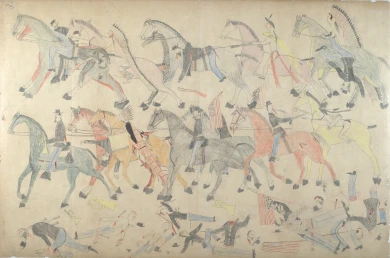
Red Horse, Red Horse’s depiction of the destruction of Custer’s command at the Battle of the Little Bighorn, 1881
Graphite, coloured in pencil and ink
Held on 23, 24, 25, 30, 31 Oct 2025
On the Art of Occupying Spaces and Curating Film Programmes is a film programme overseen by Miriam Martín and Ana Useros, and the first within the project The Cinema and Sound Commons. The activity includes a lecture and two films screened twice in two different sessions: John Ford’s Fort Apache (1948) and John Gianvito’s The Mad Songs of Fernanda Hussein (2001).
“By virtue of a group of film curator enthusiasts, small plazas and vacant lots in Madrid’s Lavapiés neighbourhood became cinemas with the arrival of summer. The city streets made room for everyone: the local residents who came down with their seats tucked under their arms, or those who simply came across the Lavapiés Film Festival with no prior knowledge of it, but knowing how to recognise a free and convivial film screening, as enticing as light is to moths. The Festival’s film curators had to first reach a consensus with one another, by assembly, and then with others, addressing issues ranging from electricity to the transfer of rights to show the films.
Whereas the annually organised Festival resembled a camp, the weekly CSOA (Squatted Self-managed Social Centre) La Morada film society looked more like a settlement. In each squatted social centre, a micro civilisation is founded, and nestled among its infrastructures is always a film society. Why? We’ll see. A direct outcome of the 15M anti-austerity movement, this film society was contentless in form (the content, the films, were decided upon from session to session). Anyone was free to enter, and therefore free to curate the line-up, although not haphazardly — there was a method, ultimately devised so the community would not close, so it would never have one set image of itself.
Part of this method entailed relating the film from the following week to the recently viewed one, and the same method has gone into putting together this two-session programme. The Festival and the film society were, moreover, attempts at rectification: the festival logic and the very same film-club logic, according to which film boils down to an excuse for debating serious issues. There would be nothing to debate but much to ponder. For instance, about the manufacturing of enemies by a nation that chooses enemies in the world, with one film from the year the State of Israel was proclaimed and another from the year the Twin Towers were razed to the ground. The USA manufactures functional enemies and heroes and American cinema, in addition to showing us this, manufactures unforgettable characters: the Apache chief, Cochise, and mother courage, Fernanda Hussein. We’ll see”.
Miriam Martín and Ana Useros
Inside the framework of
Organised by
Museo Reina Sofía

Accessible activity
This activity has two spaces reserved for people with reduced mobility
Agenda
jueves 23 oct 2025 a las 19:00
Session 1. Lecture by Miriam Martín and Ana Useros
—Encounter with Miriam Martín and Ana Useros to discuss the CSOA La Morada film society and the Lavapiés Film Festival.
viernes 24 oct 2025 a las 19:00
Session 2. John Ford. Fort Apache
USA, 1948, black and white, 35mm, original version in English with Spanish subtitles, 127’
—With a presentation by and conversation with Miriam Martín and Ana Useros
Men who are not afraid of dying are often afraid of living. The soldiers in Fort Apache ward off this fear with dancing, jokes and drink. Lieutenant Colonel Owen Thursday, assigned to be in command of these soldiers, averts this fear by living for posterity; that is, for death. He gives orders, and they obey, for “the uniform is not a subject for individual expression”. The newspaper headlines he dreams of come to declare war on another people. The Apaches perhaps could have shown the border outpost community what a stateless people can look like, yet the possibility of founding something new is reached by the past, by European civilisation, by Boston civilisation. Thursday lets his wrath rain down with overwhelming force and Ford, a realist film-maker and here with his version of the Battle of Little Bighorn, conveys at once the facts and the legend.
sábado 25 oct 2025 a las 19:00
Session 3. John Gianvito. The Mad Songs of Fernanda Hussein
USA, 2001, colour, DA, original version in English with Spanish subtitles, 168’
—With a presentation by and conversation with Miriam Martín and Ana Useros
A woman who takes the surname Hussein by marriage, a teenager, and a former soldier are the three characters whom the Gulf War removes from their homes and turns them into nomadic figures. Set on the frontier, like Fort Apache, the film begins with the bodies of two children floating on Río Grande. As with Ford’s supporting roles, we soon encounter them fleetingly but with intensity, enough for their deaths to matter. By the 1990s, the enemy had shifted from Indians to Arabs. The here of fiction mixes with the there of documentary; fiction in the USA wraps and preserves the records of Iraq: a musical composition on the bombing of the al-Amiriyah shelter, photos of the “highway of death” that nobody wanted to publish. The roaming figures wander and beauty and terror occur, yet no feeling is definitive.
jueves 30 oct 2025 a las 19:00
Session 2 (second screening). John Ford. Fort Apache
USA, 1948, black and white, 35mm, original version in English with Spanish subtitles, 127’
viernes 31 oct 2025 a las 19:00
Session 3 (second screening). John Gianvito. The Mad Songs of Fernanda Hussein
USA, 2001, colour, DA, original version in English with Spanish subtitles, 168’
Participants
Miriam Martín has devoted her whole adult life to film, and part of her pre-adult life. First as a viewer, then as a film curator at different institutions. For just shy of six years, she organised the Chantal film society, an aesthetic and political experience organised weekly. In 2019, she made the film La espada me la ha Regalado, and in 2023 premiered Vuelta a Riaño.
Ana Useros is a translator and activist who has been part of the organising assembly of the Lavapiés Film Festival for seventeen years.


Activity within the program...
Cinema Commons
Cinema Commons is a research, programming and publishing project which explores how film and sound experiences articulate interpretive communities, fostering collective debate and devising proposals for common spaces. Constructed in two annual editions, this year it will explore three core strands: the alternative film society as a place of utopia and resistance, with film curators Miriam Martín and Ana Useros; the work of artist Christian Nyampeta and the École du soir, a learning collective focused on African diaspora and inspired by the trailblazing Senegalese film-maker Ousmane Sembène; and the union between activism and celluloid, machine and poetry, in the L’Abominable Laboratory, located on the outskirts of Paris.
The project addresses processes of socialisation and film’s potential beyond the image, with this edition bringing together different practices which explore film’s capacity to assemble and produce common spaces, understood in architectural, social and political terms. Film has always been a decisive tool in struggles for emancipation and, setting out from this genealogy, the proposals in this edition look to understand the role it can play in today’s cultural and political context, overcoming the dominant forms of representation and its modes of distribution to advance towards an ethics of life in common.
Ver programa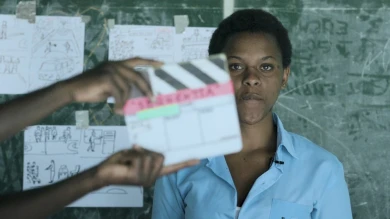
Christian Nyampeta and the École du soir
Past activity
This second instalment of Cinema Commons, a research, programming and publishing project which explores how film articulates interpretive communities, fosters collective debate and devises proposals for common space, comprises three sessions with Rwandan artist, musician and film-maker Christian Nyampeta and Ècole du soir. The programme’s first session screens video works made by Nyampeta, while the second sets forth a dialogue on the creative processes of Ècole du soir. The third brings proceedings to a close with the screening of a film selected by the artist: Ousmane Sembène’s Guelwaar (1992).
The work of Christian Nyampeta encompasses pedagogies and community forms of knowledge production and transmission. His Ècole du soir (Evening School) is an art project conceived as a mobile space of collective learning and is named in homage to Ousmane Sembène (1923–2007), a pioneer of African cinema who defined his films as “evening classes” for the people, a medium of education and emancipation through culture.
The New York-based artist from Rwanda uses art and museums to create spaces of encounter and common learning that predate colonial education models. Via popular culture frames of reference like comics, music and film, Nyampeta develops dynamics and spaces from which to build experiences which redress the wounds of diaspora and its consequences; further, his work recovers, makes visible and heals — through a pedagogical and artistic process — the social divides of the African people. With Ècole du soir he also works on creations without authorship and uses the counter-ethnographic legacy of novelist and film-maker Ousmane Sembène as a tool to deconstruct the Western view of Africa.
Long Live L’Abo! Celluloid and Activism
Past activity
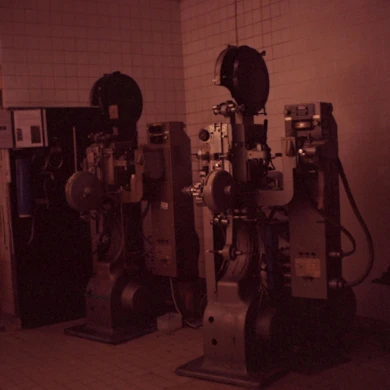
The third instalment of Cinema Commons, a research, programming and publishing project which explores how film articulates interpretive communities, fosters collective debate and devises proposals for common spaces, presents L’Abominable, an artist- and film-maker-run independent film-lab founded in 1996 on the outskirts of Paris. The programme is structured around three sessions: a lecture-workshop on L’Abominable, conducted by film-makers Pilar Monsell and Camilo Restrepo; a session of short films in 16mm produced in L’Abominable; and the feature-length film Une île et une nuit (An Island and One Night), made by the Les Pirates des Lentillères collective.
Better known by the shortened version of L’Abo, the artist-run laboratory emerged in response to disappearing infrastructures in artisan film-making and endeavours to offer the creative community a self-managed space in which to produce, develop and screen films in analogue formats such as Super8, 16mm and 35mm. With this underpinning, L’Abo champions the aesthetic and political experimentation of analogue cinema opposite digital hegemony.
L'Abominable, more than a simple work tool, has become a space of artistic and social exchange which has knitted together a community. It is characterised by endowing technique with a poetic dimension, in a community that manufactures its own film devices, and situates pedagogy at its core — the film-makers and artists train one another on common ground. Further, it seeks to forge an opening to all experimental languages around celluloid, for instance installation and film performance, while constituting a place of preservation and conservation in the history of the medium.
L'Abominable is an example of how, at the height of the digital age, artists and film-makers are recovering cinematography and vindicating the production process in its entirety. This autonomy invents alternative routes in the industry as it creates new tools, develops other forms of expression and explores unknown cinematic territories.
On the Art of Occupying Spaces and Curating Film Programmes
Past activity
On the Art of Occupying Spaces and Curating Film Programmes is a film programme overseen by Miriam Martín and Ana Useros, and the first within the project The Cinema and Sound Commons. The activity includes a lecture and two films screened twice in two different sessions: John Ford’s Fort Apache (1948) and John Gianvito’s The Mad Songs of Fernanda Hussein (2001).
“By virtue of a group of film curator enthusiasts, small plazas and vacant lots in Madrid’s Lavapiés neighbourhood became cinemas with the arrival of summer. The city streets made room for everyone: the local residents who came down with their seats tucked under their arms, or those who simply came across the Lavapiés Film Festival with no prior knowledge of it, but knowing how to recognise a free and convivial film screening, as enticing as light is to moths. The Festival’s film curators had to first reach a consensus with one another, by assembly, and then with others, addressing issues ranging from electricity to the transfer of rights to show the films.
Whereas the annually organised Festival resembled a camp, the weekly CSOA (Squatted Self-managed Social Centre) La Morada film society looked more like a settlement. In each squatted social centre, a micro civilisation is founded, and nestled among its infrastructures is always a film society. Why? We’ll see. A direct outcome of the 15M anti-austerity movement, this film society was contentless in form (the content, the films, were decided upon from session to session). Anyone was free to enter, and therefore free to curate the line-up, although not haphazardly — there was a method, ultimately devised so the community would not close, so it would never have one set image of itself.
Part of this method entailed relating the film from the following week to the recently viewed one, and the same method has gone into putting together this two-session programme. The Festival and the film society were, moreover, attempts at rectification: the festival logic and the very same film-club logic, according to which film boils down to an excuse for debating serious issues. There would be nothing to debate but much to ponder. For instance, about the manufacturing of enemies by a nation that chooses enemies in the world, with one film from the year the State of Israel was proclaimed and another from the year the Twin Towers were razed to the ground. The USA manufactures functional enemies and heroes and American cinema, in addition to showing us this, manufactures unforgettable characters: the Apache chief, Cochise, and mother courage, Fernanda Hussein. We’ll see”.
Miriam Martín and Ana Useros
Más actividades
![Mike Nichols, The Graduate [El graduado], 1967, película](https://recursos.museoreinasofia.es/styles/small_landscape/public/Actividades/ciclocine-piscinas-9_0.jpg.webp)
Mike Nichols. The Graduate
Friday, 31 July 2026
Benjamin Braddock (Dustin Hoffman) is a young graduate from a wealthy California family. After returning home he meets Mrs Robinson (Anne Bancroft), who seduces him in successive encounters and shows him things that can’t be read in books. Mrs Robinson’s daughter, Elaine (Katharine Ross), enters his life to turn his feelings upside down.
Anne Bancroft’s remarkable performance shows the need to feel alive in a world gone stale, and the weapons sex possesses opposite romantic love. This is the learning curve young Ben experiences, and it is the time he spends drifting in the swimming pool that takes him from bewilderment to lucidity. He goes from a fool in a wetsuit lost at the bottom of the pool, to letting himself sway on the waters of pleasure or to see the mantle of the pool covered in fallen leaves with the arrival of love. The swimming pool is the place that initiates a change of state: an awakening of life forces.
Sol Iglesias. The Swimmers
Saturday, 1 August 2026
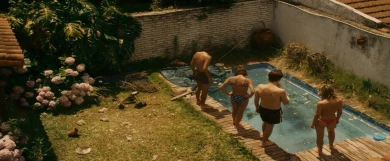
The end of the world, caused by climate change, is here and a group of friends wander from swimming pool to swimming pool at the height of a long, hot summer in Buenos Aires. From pool to pool, they cross the city, drifting leisurely and agreeably. In this transit they encounter different survivors searching desperately for water until their journey ends.
In echoing Frank Perry and Sydney Pollack’s film The Swimmer, Sol Iglesias’s The Swimmers is, equally, a path towards first light. The swimming pools symbolise, on this sunburnt stage, a metaphor at once for shelter and death by asphyxiation. It is the extreme heat that turns it into a fresh and pleasurable ending. The swimming pool, moreover, represents the lethargy of a youth tired of fighting against something they see as “inevitable”. As the young people trespass on a neighbourhood’s private property — rather than in public space — the pool is a stronghold of intimacy that must be seized: the false paradise of a collapsed society. The film brings the viewer closer to another film to feature in this series, La ciénaga (The Swamp, 2001) by Lucrecia Martel, in which bodies search for recesses of stagnant water.
Jack Hazan. A Bigger Splash
Friday, 7 August 2026
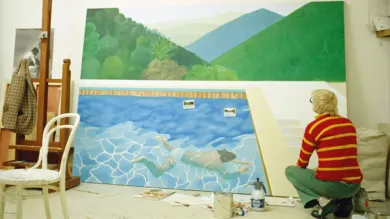
Painting endows a fleeting and unique moment with permanence and stability. This was the vision of the late David Hockney when, brushstroke by brushstroke, he returned to the swimming pool in A Bigger Splash: the great dive into a Californian pool which freezes a sense of happiness. A splash made by Peter Schlesinger, the painter’s partner from whom he has just separated.
In the film A Bigger Splash, Jack Hazan portrays the world of a successful artist, art-market and art-dealer pressure, the tension between the ego and personal frailty, and the obligation to continue with a style and iconography which, despite its instantly recognisable artistic imprint, creates doubts for the painter. In a grey, rainy London, a glum Hockney, the victim of soured love, keeps returning to the Californian swimming pool that holds the promise of happiness, in the form of a homosexual Arcadia in which the painter lives with his young partner and a group of equally glowing and attractive friends. Ultimately, the pool, as Jack Hazan recalls in this pioneering artist’s documentary, is a simile for the same painting in its original intention: hang onto fleetingness to lend it a permanence for the beholder, despite it not existing. Hockney, as one of the last great painters, knew his medium remained largely unchanged across hundreds of years of history.
Six Swimming Pools. A Dive into Experimental Film
Saturday, 8 August 2026
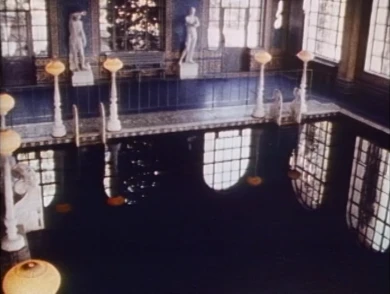
For the first time, the Museo’s summer cinema programme includes an experimental film section, centred on the experience and feeling of bodies under water. This session glides between the ostentatious aquatic architecture of Barbara Hammer and Barbara Klutinis and Jakobois’s fantasies, fleeting contact and wet, sexualised bodies. Six completely different swimming pools — private, public, transparent, bottomless, indoor, outdoor — all designed for leisure, competition and desire, nonetheless. A journey ranging from the monumentality of architecture to the intimacy of wet bodies.
Pools, by Barbara Hammer and Barbara Klutinis, turns swimming pools designed by pioneering architect Julia Morgan for the castle of tycoon William Randolph Hearst — the inspiration for Citizen Kane — into a space of play, bodily exploration and queer appropriation, an excuse to dive into a scene reserved for privilege. In An Algorithm, Bette Gordon fragments a series of headfirst dives and turns the sporting gesture into a visual score of repetitions, variations and rhythms. Tony Hill’s Water Work seduces with perspective, reflections and depth — the swimming pool as optical illusion, as an unstable surface which distorts and multiplies the gaze. Cheap Imitation “They Walk and I Walk”, by Rickard Eklund, submerges the camera to capture a choreography of synchronized bodies, a dance suspended under water. Naked bodies that dodge, twist and embrace in a space seemingly with no gravity combine in Gunilla Leander’s All Under. Passage du désir, by Jakobois, closes the programme with a montage in which water is no longer an environment, becoming instead a territory of desire.
Dominga Sotomayor. Debajo and Thais Fujinaga. A Felicidade das Coisas
Friday 14 August 2026
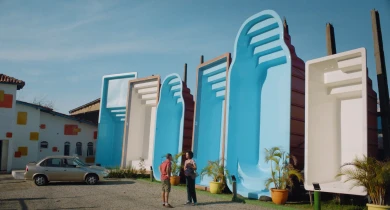
Two gems, from two new voices in Latin American cinema, which swing between families, swimming pools, reencounters and status. In Debajo, a short film on youth by Chilean director Dominga Sotomayor, an abstract yet powerful bird’s-eye view of a swimming pool co-exists with the relationships of a crisis-stricken family, gathered to see an eclipse. Sotomayor’s distinctive film-making of care and affects shares a similar space to the daily naturalism of Thais Fujinaga’s A Felicidade das Coisas. In the director’s first feature film, the swimming pool is not a horizontal basin for swimmers’ immersion; rather it is a huge vertical monolith, a kind of an anti-monument, anchored in the garden of a middle-class family. The film conveys the efforts and challenges of a mother of two children to build a swimming pool in their modest summer house, a mother who, alone, comes up against a hypermasculine world. Equally, the film speaks of family love, and the search for status, with the swimming pool a languishing totem of the Brazilian middle class during the years of Bolsonarism.