-
Wednesday, 18 November 2020
Feminisms and Intersectional Alliances Opposite Hate as Politics
5pm / online Platform
A conversation between Renata Souza and Esther Solano Gallego
Over the past decade, the political changes in Brazil have been at the forefront of global analyses as a sign of this new century’s global shift. This framework of mass inequality has seen women acting as life’s support pillars. This conversation between journalist and congresswoman, Renata Souza, and professor of International Relations, Esther Solano, sets out a framework of discussion to analyse strategies of resistance from Brazil’s working classes and, more specifically, black women for the right to life and democratic legitimacy, in addition to their role in upholding the community during the pandemic.

-
Thursday, 19 November 2020
Femonationalism in Europe
12pm / Nouvel Building, Study Centre and online Platform
Work session
Length: 2 hoursConceived as preparatory work ahead of the afternoon’s public activity, this session collectively approaches a series of textual and audiovisual materials handed out to participants previously, with the aim of pooling experiences, reflections and questions around femonationalism.
7pm / Nouvel Building, Auditorium 400 and online Platform online
A conversation between Fatiha El Mouali and Sara R. Farris, accompanied by Brigitte Vasallo
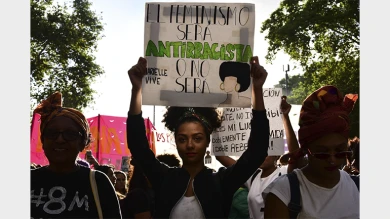
Strategies of rising conservatism have found a point of contact among certain sectors of white and Western-centric feminism and are condensed in the notion of “femonationalism”. The term designates certain discourses that stereotype racialised women as victims without the capacity for agency, and with decisions made in their name and determined by men in their family sphere, along with the constraint of being foreign.
This session looks to analyse the convergence of discourses from the extreme right, those belonging to self-titled feminists and neoliberal public policies of “integration” inside the European framework. What material consequences hide pleas centred on remedying and emancipating Muslim women, putting them to work in a privatised sector that conceals and segregates domestic and care work?

-
Friday, 20 November 2020
Demonizing Feminism: An Instrumental Use of Women’s Rights
12pm / Nouvel Building, Study Centre and online Platform
Work session
Length: 2 hoursConceived as preparatory work ahead of the afternoon’s public activity, this session collectively approaches a series of textual and audiovisual materials handed out to participants previously, with the aim of pooling experiences, reflections and questions around the demonisation of feminism.
19:00 h / Nouvel Building, Protocol Room and online Platform
A conversation between Nuria Alabao, Marisa Pérez Colina and Fernanda Rodríguez
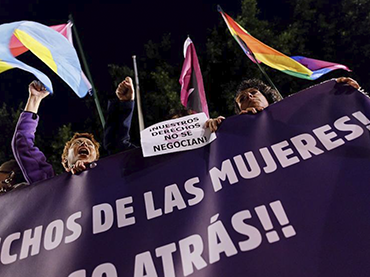
Tras la heterogeneidad de las propuestas políticas del giro conservador subyace un sólido nexo común: el odio contra todo aquello que parezca provenir del feminismo, identificado como “ideología de género”. Desde ciertos espacios de poder se defiende In the wake of heterogeneous political proposals in the conservative shift lies a common thread: hate against all that which appears to stem from feminism, identified as a “gender ideology”. From certain spaces of power, a purported formal equality is upheld, while certain policies are propelled against reproductive rights and already consolidated sexual liberties, or migrant or racialised people are hounded and stigmatised. What relationship is there between the fight against so-called “gender ideology” and the racialisation of these right-wing movements’ sovereignist projects? How can we upend strategies that misrepresent the political discourse of feminisms with the pretext of defending legal equality or women’s rights? These are some of the questions with which to analyse the causes behind attacks on migrant, racialised and feminist groups by the new Right, and with the aim of revealing the power of alliances in anti-racist feminisms. ya consolidadas, o se persiguen y estigmatizan a las personas migrantes y racializadas. ¿Qué relación existe entre el combate contra la denominada “ideología de género” y la radicalización de los proyectos soberanistas de estas derechas? ¿Cómo revertir las estrategias que tergiversan el discurso político de los feminismos con la excusa de defender la igualdad jurídica o los derechos de las mujeres?, son algunas de las preguntas para analizar las causas de ataques a los grupos migrantes, racializados y feministas por parte de las nuevas derechas, con el objetivo de desvelar la potencia de las alianzas de los feminismos antirracistas.
Held on 18 Nov 2020
In the current social climate, the existence of political and cultural forces which appear to be handed down from fascism and historical extreme right movements are today a tangible reality. These forces call into question the continued existence of consolidated emancipatory conquests after centuries of struggle.
The programme The New Reaction. Antidotes and Synergies sets out to explore and pinpoint the means that mobilise these forces, understanding the place from which they emanate, the designated enemies and why they are so, and the differences and similitudes they reveal in different geographies. Thus, knowing the characteristics of these new forms of fascism becomes necessary, for they can denote a long-lasting democratic recession in a context defined by expansion and the global surge of neoliberal politics.
Each of the sessions that make up this programme seeks to create spaces of thought rooted in new feminisms, struggles for recognition and the equality of post-colonial and racialised subjects or migratory social movements, as well as other aspects.
With the aim of hybridising forms and putting forward other modes of approaching the political and the collective, sound artist Mattin will perform Towards an Anti-Fascist Musical Score, a performance intervention which seeks to activate a collective reflection with the audience in order to work on the power of rituals and catharsis to generate, from the body, non-theological and anti-fascist social interactions.
[dropdown]
Nuria Alabao is a journalist and researcher who holds a PhD in Anthropology. She is part of Foundation of the Commons and coordinates the section on feminisms in the digital publication Ctxt. Currently, she is researching connections between feminism and post-fascism movements, collaborating with various media, and has participated in collective publications with articles such as “Why Neo-fascism is Anti-Feminist” in Neofascismo. La Bestia neoliberal (Siglo XXI, 2019) and “Gender and Fascism: The Renewal of the Extreme Right in Europe”, in Un feminismo del 99% (Lengua de Trapo, 2018), to mention but a few.
Fatiha El Mouali is an anti-racist activist who works to provide refuge for migrant people. With a degree in Economic Science, she is also a doctoral student at the Autonomous University of Barcelona. She is a spokesperson for Unity Against Fascism and Racism in Catalonia and is part of the Granollers Table of Equality and vice-president of the Mothers’ Association Against Racism. Furthermore, she is co-author of the volume Combatir la Islamofobia. Una guía antirracista (Combatting Islamophobia. An Anti-Racist Guide, Icaria, 2016).
Mattin is a sound artist. His work focuses on the conceptual investigation into noise and improvisation, exploring strands that include the role of listening in relation to the immeasurable accumulation of digital information and at a time of mounting polarisation and social fragmentation; or the potential non-verbal communication can activate between bodies participating in a reflexive encounter. Moreover, he has co-edited, with Anthony Iles, Ruido y capitalismo (Noise and Capitalism, 2011) and participated in documenta14 (2017) with the “durational” concert Disonancia social (Social Dissonance).
Marisa Pérez Colina is a political scientist and activist whose work is linked to projects and collective experiences of feminist research-action — Precarias a la Deriva — and to defending the right to mobility and the rights of migrant people — Asociación Sin Papeles de Madrid and Papeles por Derecho. She also participates in the movement for the right to housing and the city — Lavapiés ¿dónde Vas? and Asamblea de Bloques en Lucha — in addition to the municipal commitment La Bancada, previously Municipalia-Ganemos. She is also a coordinator in Foundation of the Commons.
Sara R. Farris is a lecturer of Sociology at Goldsmiths University (London). Her research centres on the theoretical constructions of racism and nationalism, the Orientalist/Westocentric representation of women in the Western context, and gender, race and social reproduction theories, primarily focused on female migrants from Eastern Europe.
Fernanda Rodríguez López is a philosopher and member of Foundation of the Commons. She has participated as a speaker in the training space Nociones Comunes on numerous occasions, and her work encompasses themes such as the history of sexuality and bourgeois culture, the formation of gender and the analysis of the hetero-patriarchal family.
Renata Silva de Souza is a journalist, writer and feminist who was born and grew up in Favela da Maré, in the Zona Norte neighbourhood of Río de Janeiro. She holds a PhD in Communication and Culture and has participated in social movements, in addition to being part of the Human Rights Commission of the Legislative Assembly of the State of Río de Janeiro. She was chief of staff for Marielle Franco, the councillor murdered in 2018. At the present time, she is a representative in the Legislative Assembly of Río de Janeiro for the Socialism and Liberty Party (PSOL).
Esther Solano Gallego holds a PhD in Sociology from the Complutense University of Madrid (UCM). She is a lecturer in International Relations at the Federal University of São Paulo and lectures on the UCM’s International Interuniversity MA in Contemporary Latin American Studies. She specialises in political sociology and has put together a number of books on the situation in Brazil, including ¿Hay salida? Ensayos sobre Brasil (Is There a Way Out? Essays on Brazil, 2017) and El odio como política (Hate as Politics, 2018).
Brigitte Vasallo is a writer, professor and anti-racist, feminist and LGBTI activist. Her work is defined by her critical stance on gender Islamophobia, the denouncement of purplewashing and homo- and femonationalism, in addition to her defence of polyamory in affective relationships.
[/dropdown]
The project Our Many Europes is organised by the L’internationale museum confederation and co-funded by the European Union’s Creative Europe programme. L'Internationale comprises seven major European art institutions: Moderna galerija (MG+MSUM, Ljubljana, Slovenia); Museo Reina Sofía (Madrid, Spain); MACBA, Museu d'Art Contemporani de Barcelona (Spain); Museum van Hedendaagse Kunst Antwerpen (M HKA, Antwerp, Belgium); Muzeum Sztuki Nowoczesnej w Warszawie (Warsaw, Poland), SALT (Istanbul and Ankara, Turkey) and Van Abbemuseum (VAM, Eindhoven, Netherlands), and collaborates in the project with the HDK-Valand Academy (Gothenburg, Sweden) and the National College of Art and Design (NCAD, Dublin, Ireland). Together, these institutions will present a programme with over 40 public activities (lectures, exhibitions, workshops) until May 2022.
Inside the framework of
Force line
Action and Radical Imagination; Contemporary Disturbances
Organised by
Museo Reina Sofía, Fundación de los Comunes and L’Internationale


Encounters: free, with prior ticket collection from Monday 16 November. Doors open at 6:30pm. Activity streamed live.
Work sessions: free, until full capacity is reached, with prior registration by filling out the following form from 4 November (capacity — in-person: 12 people; online: 20 people). Aimed at people and collectives who either work or have a special interest in the spheres of feminism or anti-racism. Given the limited number of places, priority will be given to migrant and/or racialised people and collectives.
Language: Spanish, Italian and Portuguese, with simultaneous interpretation
Participants
Más actividades
![Blake Edwards, The Party [El guateque], 1968, película](https://recursos.museoreinasofia.es/styles/small_landscape/public/Actividades/ciclocine-piscinas-14.jpg.webp)
Blake Edwards. The Party
Thursday, 20 August 2026
In The Party, actor Hrundi V. Bakshi (Peter Sellers) is mistakenly invited to a glamorous dinner party in Hollywood. His curiosity and two left feet lead to one funny mishap after the other. During the soiree he consoles Michèle, a young actress who has been fired by her producer, and the chaos gathers momentum when Bakshi accidentally opens a retractable floor, making the guests fall into a swimming pool. A small hippie-style elephant gatecrashes the party, brought by a group of young people, and Bakshi asks the guests to wash the elephant as it is a sacred animal in his country. The house fills with soap suds, culminating in a wackily chaotic party.
When Stanley Kubrick was once asked who Peter Sellers was, he replied: “There is no such person as Peter Sellers”. The Party is one of the most widely recognised comedies in the history of film, its director Blake Edwards and the English actor making an entertaining critique of a fading conservative society. The cultural revolutions of the 1960s fit into the container of a choppy swimming pool: people from high society, an elephant, a Russian ballet, waiters, beatnik youth… similar to Sellers’s own identity: an empty vessel that can be refilled. In the film, Edwards tapped into the ingenious actor’s innate improvisation and the swimming pool as a container for revolutionary intent.

Lucrecia Martel. La ciénaga (The Swamp)
Viernes 21 de agosto, 2026
A couple of families spend the summer in a country cottage. The relationship between them exposes a crisis. The alcoholism of Mecha (Graciela Borges) and Gregorio (Martín Adjemián) becomes clear, leading to a drift in the education of their children and impacting relationships of respect and affect. Weariness expresses the lackadaisical environment.
In La ciénaga Lucrecia Martel approaches the decadence of a middle-class Argentinian family. The pool of dirty, stagnant water reflects the economic and social collapse of a whole country, yet reflects more than economic crisis as it becomes a murky well feeding off the pain of those living in the house. An erstwhile space of joy, the swimming pool becomes a reflection of adult depression, resulting in apathy. And the children, especially the girls, seem to be the only people awake in this drift. Barring a flicker of unawareness, the young people immerse themselves in rainwater or the water from the river, in water that flows, but are cautious of getting too close to the swimming pool.
![Yorgos Lanthimos, Kynodontas [Canino], 2009, película](https://recursos.museoreinasofia.es/styles/small_landscape/public/Actividades/ciclocine-piscinas-16_00.jpg.webp)
Yorgos Lanthimos. Dogtooth
Saturday, 22 August 2026
A couple with three adult children live in a modern country cottage. A large swimming pool takes centre stage in a sizeable garden. The property is skirted by a large fence that blocks a view of the outside. Here, the father has educated his children without outside contact, maintaining their belief in a false world: aeroplanes fall in the garden like toys and they must act like dogs to defend themselves from the ferocious cats that surround the house. The promise of going out into the world when they lose their dogtooth is proof of their maturity.
Lanthimos builds a world that is surreal, comical and terrible. The swimming pool is the house’s central element, a limited, controlled space assimilated like the sea, yet under the father’s supervision. A space of imagination, but with sinister intentions: the children are indoctrinated under the water as they believe in a better world. Far from reality. The swimming pool’s limits are the limits of their freedom, a false state of well-being expressed in the weightless bodies in the water. The liquid element is an analgesic magma with the power to educate offspring under the latent fear of a shark bite.
![Binka Zhelyazkova, Baseynat [La piscina], 1977, película](https://recursos.museoreinasofia.es/styles/small_landscape/public/Actividades/ciclocine-piscinas-17_00.png.webp)
Binka Zhelyazkova. The Swimming Pool
Viernes 28 de agosto, 2026
The young, bright Bella (Yanina Kasheva), after unforeseen heartbreak at her graduation party, meets Apostol (Kosta Tsonev), a reserved architect, and Boyan (Kliment Denchev), a comedy actor who is cynical about his country. The three characters climb up to a diving board in a municipal swimming pool, where they begin a strange relationship of friendship, love and despair which reflects a generational clash.
Binka Zhelyazkova, the great enfant terrible of Eastern European cinema, critic of the communist system and widely acclaimed film-maker beyond Bulgarian borders, made in The Swimming Pool a masterly metaphor for a country in decline. The public pool symbolises a closed, immovable enclosure where society is festering. From the height of a diving board she sees, in a panoptic view, the different generations living underneath a limited space. On one side, older people attempt to preserve the old revolutionary spirit with constant collective swimming exercises while, on the other, young people don’t hide the desire for freedom that remains unrealised. The result is an ideological clash in how to act and move in the enclosure, unearthing vast hypocrisy in the lost ideals of socialism, reflected in the total apathy of youth. The Swimming Pool for Zhelyazkova is a reflection of the disillusionment and existential void of a whole country and system.
![Jacques Deray, La piscine [La piscina], 1969, película](https://recursos.museoreinasofia.es/styles/small_landscape/public/Actividades/ciclocine-piscinas-18.jpg.webp)
Jacques Deray. The Swimming Pool
Saturday, 29 August 2026
The characters played by Alain Delon (Jean-Paul) and Romy Schneider (Marianne) experience their love in apparent splendour. A sun-drenched house, a blissful swimming pool, beautiful bodies, sexuality in abundance. The visit of Harry (Maurice Ronet), a successful musician, friend of Jean-Paul and ex-lover of Marianne, accompanied by his young and beautiful daughter Penélope (Jane Birkin), rocks their relationship, bringing to light the jealousy and insecurities of each one in a dark game of possession and male rivalry.
If there was a definition of the glistening blue pool in this sexual thriller, it would be the paradise of Adam and Eve, represented by the shots of happiness of Romy Schneider and Alain Delon in this swimming pool on France’s Côte d’Azur. The appearance of these two beautiful creatures kissing semi-naked by the water is one of film’s resonant images. The paradise cannot be fractured, not even by death. As in the crossing of the Tigris and Euphrates rivers, where humanity’s first lovers bathed naked in the water, innocent to their imminent end, the reflection of the crystalline water of The Swimming Pool shows this game, and the deep traumas which, under this mantle, are hidden in the amorous relationships and limits that only love is capable of breaking to solve.
In this session both endings to the film are screened: the original version, open and symbolic, and the Spanish version, marked by censorship during Francoism, and its sequence for a Spanish premiere — a stereotypical and reductive vision reflecting the sociological condition of the country.