We Will No Longer Be Slaves
A Choreographed Reading of Guyotat’s Eden, Eden, Eden
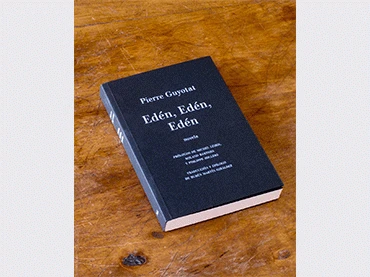
Pierre Guyotat, Edén, Edén, Edén, Madrid, Malas Tierras, 2020
Held on 09 sep 2020
When Pierre Guyotat (Bourg-Argental, France, 1940 – Paris, France, 2020) published his book Eden, Eden, Eden in 1970 he already knew how far a clear conscience, the law and the army can hit. The writer had been enlisted at the end of the Algerian War of Independence and shortly afterwards was arrested in Kabylie accused of attacking the moral of the Army, inciting desertion and being in possession of and distributing banned publications.
The controversial publication Eden, Eden, Eden, a novel set in a polluted area of the Algerian desert, was released with a decree banning its sale to minors, as well as its exhibition and publicity. Perhaps the most salient aspect, in the broadest sense of the word in relation to Guyotat’s work given that it had brought him into contact with prison and repression, was that it prompted intellectuals and artists to defend it vehemently.
Eden, Eden, Eden could be seen as a dramaturgy, in which characters’ movements are sketched on a feverish set. Everything seems to be there for somebody to choreograph the type of unique phrase which happens in a seemingly unique stage space. The Choreography is executed with reading.
On 9 September 2020, in conjunction with the 50th anniversary of the novel’s publication, the Museo Reina Sofía presents We Will No Longer Be Slaves
A choreographed reading of Guyotat’s Eden, Eden, Eden, a public activity designed by Javier Pérez Iglesias. Five people — a writer, a visual artist, a choreographer, an art historian and a librarian activist — will read excerpts from Eden, Eden, Eden, inviting choreographed listening followed by a conversation on this piece of skewed language and hallucinated punctuation that wounds, excites and stains.
Línea-fuerza
Vanguardias
Organised by
Museo Reina Sofía
Participants
Selina Blasco is a professor in the Fine Arts Department of the Complutense University of Madrid. She harnesses her passion for literature and writing through what she calls “bizarre experiences”, researching with voluntarily restricted bibliographies, studying through the markings of vandalised books or exploring systems of non-normative literacy in the protracted world of the textile.
María Jerez’s work lies “between” choreography, film and the visual arts. Since 2004, she has made pieces that explore the relationship with the spectator as the space in which modes of representation enter into crisis. From El Caso del Espectador (2004) to her most recent pieces Blob (2016), Yabba (2017) and The Stain (2019), this relationship has mutated from an “understanding” of theatre and film conventions; that is, from “expertise” in the deliberate loss of references where the artist, the piece and the spectator mutually behave as strangers.
Javier Pérez Iglesias is a librarian activist who relates to reading from a space that combines research, the access to knowledge and artistic practice. He has one foot in the Desiderata publishing house, where he started publishing contributions on art, performing arts, artistic research and (risky) practices in archives and libraries. His work entails programming, listening, writing and sharing knowledge, and tasks from the Library in the Fine Arts Department at the Complutense University of Madrid.
Andrés Senra defines himselves, in first person plural, as “artivists”. His latest works present the individual and the community as ephemeral assemblages, in which political, economic and social tensions in the contemporary world are cast and somatised. In recent works, he has addressed issues such as economic migration in Spain after the economic crisis in 2008, the archive as an artwork and the political and affective history of the queer community in Madrid in the 1990s. Moreover, he has recently carried out a critical review of post-humanism from positions of sexual dissidence, putting forward a defence of the monster, hybridisation, miscegenation and post-gender via speculative sci-fi as a means to rethink the contemporary world during times of pandemic.
Sabina Urraca is a writer who works as a contributor with different publications, including El País, El diario.es, Vice, Hoy por hoy, El Estado Mental and Cinemanía. She is author of the novel Las niñas prodigio, published by Fulgencio Pimentel (2017), and has participated in the anthologies La errabunda (Primer tratado ibérico de deambulología heterodoxa), published by Lindo&Espinosa (2018), and Tranquilas. Historias para ir solas de noche, published by Lumen (2019). She currently runs workshops in different writing schools and cultural institutions, and in 2020 she will be the resident editor at Editorial Barrett (Seville). Moreover, she was recently awarded a writing scholarship from the University of Iowa (USA).


![Miguel Brieva, ilustración de la novela infantil Manuela y los Cakirukos (Reservoir Books, 2022) [izquierda] y Cibeles no conduzcas, 2023 [derecha]. Cortesía del artista](https://recursos.museoreinasofia.es/styles/small_landscape/public/Actividades/ecologias_del_deseo_utopico.jpg.webp)
![Ángel Alonso, Charbon [Carbón], 1964. Museo Reina Sofía](https://recursos.museoreinasofia.es/styles/small_landscape/public/Actividades/perspectivas_ecoambientales.jpg.webp)
Más actividades

CLINIC 2628. A Community of Writing and Research in the Arts
February – October 2026
Clinic 2628 is a project which supports and brings together writings which stem from the intention to offer a space and sustainable time for research work in art and culture. Framed within an academic context which is increasingly less receptive to the forms in which thinking happens and is expressed, the aim is to rescue the academic from its neoliberal trappings and thus recover the alliance between precision and intuition, work and desire. A further goal is to return writing to a commons which makes this possible through the monitoring of processes and the collectivisation of ideas, stances, references and strategies.
The endeavour, rooted in a collaboration between the Museo Reina Sofía’s Studies Directorship and the Artea research group, via the i+D Experimenta project, is shaped by three annual editions conceived as spaces of experimentation, discussion and a demonstration of writings critical of what is put forward by today’s academia.
What forces, forms and processes are at play when writing about art and aesthetics? In academia, in museums and in other cultural institutions, the practice of writing is traversed by productivist logics which jeopardise rhythms of research and experimentation. The imposition of both scientism inherent in the structure of “the paper” and the quantifying of results which demand a criterion of quality and visibility sterilise and smoothen, from the outset, the coarseness that is particular to writing understood from the concrete part of language: phonic, graphic, syntactic and grammatical resistance connecting the language user to the community the language unites and activates. They also sterilise the roughness enmeshed in the same desire to write, the intuitive, clear and confusing pathways that once again connect the writer to those reading and writing, participating in a common good that is at once discovered and produced.
The progressive commercialisation of knowledge propelled by cognitive capitalism moves further away from the research and production of knowledge in artworks and artistic languages and practices. The work of curators and archive, criticism, performances and essays formerly saw a horizon of formal and emotional possibilities, of imagination that was much broader when not developed in circumstances of competition, indexing and impact. Today, would it be possible to regain, critically not nostalgically, these ways; namely, recovering by forms, and by written forms, the proximity between art thinking and its objects? How to write in another way, to another rhythm, with no more demands than those with which an artwork moves towards different ways of seeing, reading and being in the world?
The (legal) person and the legal form. Chapter II
8, 12, 15 January, 2026 – 16:00 to 19:00
As part of the Studies Constellation, the Study Directoship’s annual fellowship, art historian and theorist Sven Lütticken leads the seminar The (Legal) Person and the Legal Form: Theoretical, Artistic, and Activist Commitments to foster dialogue and deepen the hypotheses and questions driving his research project.
This project, titled Unacting Personhood, Deforming Legal Abstraction, explores the dominance of real abstractions—such as exchange value and legal form—over our processes of subjectivation, and asks how artistic practices can open up alternative ways of representing or performing the subject and their legal condition in the contemporary world.
The seminar consists of eight sessions, divided into three chapters throughout the academic year. While conceived as non-public spaces for discussion and collective work, these sessions complement, nourish, and amplify the public program of the Studies Constellation.
In this second chapter of the seminar, the inquiry into the aesthetics and politics of legal form continues with three sessions that pick up the discussions held in Chapter I but propose new lines of flight. The first session focuses on international law via the writings of the British author China Miéville, which allows us to reconsider the notion of the legal form –following Evgeny Pashukanis— and, through it, a variety of (people’s) tribunals. While the crucial concept of the legal person –as the right-holder central to the form of law— was debated in Chapter I, the second session focuses on attempts to extend personhood not (just) to corporations, but rather to nonhuman animals or ecosystems. Finally, the third session poses the question: how can groups and networks use officially recognized organizational forms (such as the foundation or the cooperative) and/or use a collective persona (without necessarily a legal “infrastructure” to match) to act and represent themselves?

Oliver Laxe. HU/هُوَ. Dance as if no one were watching you
Tuesday, 16 December 2025 – 7pm
As a preamble to the opening of the exhibition HU/هُوَ. Dance as if no one were watching you, film-maker Oliver Laxe (Paris, 1982) engages in conversation with the show’s curators, Julia Morandeira and Chema González, touching on the working processes and visual references that articulate this site-specific project for the Museo Reina Sofía. The installation unveils a new programme in Space 1, devoted from this point on to projects by artists and film-makers who conduct investigations into the moving image, sound and other mediums in their exhibition forms.
Oliver Laxe’s film-making is situated in a resilient, cross-border territory, where the material and the political live side by side. In HU/هُوَ. Dance as if no one were watching you, this drift is sculpted into a search for the transcendency that arises between dancing bodies, sacred architectures and landscapes subjected to elemental and cosmological forces. As a result, this conversation seeks to explore the relationship the piece bears to the imagery of ancient monotheisms, the resonance of Persian Sufi literature and the role of abstraction as a resistance to literal meaning, as well as looking to analyse the possibilities of the image and the role of music — made here in collaboration with musician David Letellier, who also works under the pseudonym Kangding Ray — in this project.
These inaugural conversations, part of the main working strands of the Museo’s Public Programmes Area, aim to explore in greater depth the exhibition narratives of the shows organised by the Museo from the perspective of artists, curators and specialists.
Manuel Correa. The Shape of Now
13 DIC 2025
The Shape of Now is a documentary that explores the challenges and paradoxes of memory, reparation and post-conflict justice, extending a defiant and questioning gaze towards the six-decade armed conflict in which the Colombian State, guerrillas and paramilitary groups clashed to leave millions of victims in the country. The screening is conducted by the Aesthetics of Peace and Desertion Tactics study group and includes a presentation by and discussion with the film’s director, Manuel Correa.
The film surveys the consequences of the peace agreements signed in 2016 between the Colombian State and the FARC guerrilla organisation through the optics of different victims. It was recorded shortly after this signing, a time in which doubts lingered over the country’s future, with many groups speculating in the narration. Correa harnesses the power of images, visual and bodily memory, fiction and re-staging as tools for understanding the conflict, memory and healing, as well as for the achievement of a just peace that acknowledges and remembers all victims.
The activity is framed inside the research propelled by Aesthetics of Peace and Desertion Tactics, a study group developed by the Museo’s Study Directorship and Study Centre. This annual group seeks to rethink, from a theoretical-critical and historical-artistic perspective, the complex framework of concepts and exercises which operate under the notion of pacifism. A term that calls on not only myriad practices ranging from anti-militarism and anti-war movements to activism for non-violence, but also opens topical debates around violence, justice, reparation and desertion.
Framed in this context, the screening seeks to reflect on propositions of transitional and anti-punitive justice, and on an overlapping with artistic and audiovisual practices, particularly in conflicts that have engendered serious human rights violations. In such conflicts, the role played by audiovisual productions encompasses numerous challenges and ethical, aesthetic and political debates, among them those related to the limits of representation, the issue of revictimisation and the risks involved in the artistic commitment to justice. These themes will be addressed in a discussion held after the session.
Francisco López and Barbara Ellison
Thursday, 11 December - 8pm
The third session in the series brings together two international reference points in sound art in one evening — two independent performances which converse through their proximity here. Barbara Ellison opens proceedings with a piece centred on the perceptively ambiguous and the ghostly, where voices, sounds and materials become spectral manifestations.
This is followed by Francisco López, an internationally renowned Spanish sound artist, who presents one of his radical immersions in deep listening, with his work an invitation to submerge oneself in sound matter as a transformative experience.
This double session sets forth an encounter between two artists who, from different perspectives, share the same search: to open ears to territories where sound becomes a poetic force and space of resistance.