-
Monday 29 and Tuesday 30 June, 2020
Graphic Outbreak 4. Dissident Masks Workshop
Every New Normality Has its Dissidence
This workshop, conducted by artist and activist Kaioia Luco, to make proud, irreverent, dislocated masks, to practice new involvement, is structed around two sessions: the first on revising the current forms of social distancing and its languages, and what is entailed when inhabiting a public space cross-cut with notions and habits related to “health”, “hygiene”, and “individuality”; and a second which sets out a re-reading of daily objects and old materials prone to being re-assembled in this exercise to imagine and tailor dissident masks, moving away from the concept of “mouth coverings” to become forms of critical expression.
Force line: Action and Radical Imagination
Organised by: Museo Situado
Coordinator: Kaioia Luco
Programme: Graphic OutbreakDate: Monday, 29 and Tuesday, 30 June 2020
Time: 5pm
Place: Taller de Diógenes - C/ Fernando Mora, 8, bajo (next to Parque de San Isidro, Carabanchel), Madrid
Admission: free, with prior registration by filling out the following form, until 26 June.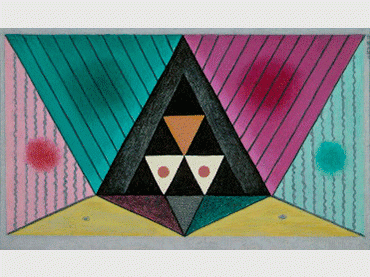
-
Wednesday 1 July, 2020 - 7pm / Live stream from the Nouvel Auditorium 400
Sexyalities. Identity Dictatorships in a State of Emergency
Mama Lynch (Lyncoln Diniz) has developed the performance action Basket de las excluidas (Basket of the Excluded) since 2015. With editions in Brazil, Portugal and Mexico, this self-managed activity surfaced in Madrid after a group of people decided to occupy a public court to play transvestite basketball. In these “games” they sought to break the oppressive cis hetero culture that predominates sports practices, as well as celebrating cultural diversity, gender transgression and sexuality.
The encounter sets out to debate, from performance practices, concepts such as “sexuality”, “exile”, “migration” and “guerrilla art”. The present lockdown has spotlighted how the restrictions imposed by the state of emergency are only something new for those considered “normal” — isolation, hyper-surveillance and control of movement are customary experiences in the daily life of marginal subjects and bodies.
Force line: Action and Radical Imagination
Coordinated by: Mama Lynch (Lyncoln Diniz)Date and hour: Wednesday, 1 July 2020 - 7pm
Location: Live stream from the Nouvel Auditorium 400. Link on 1 July
Access: free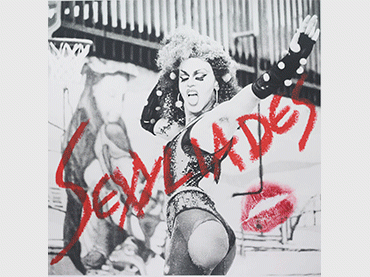
-
From 26 June to 2 July, 2020 / Museo Reina Sofía’s Vimeo Channel
Uncertain Times II. Representing the Pandemic
Session 1. AIDS, the Other Pandemic
The first session of the audiovisual series Uncertain Times II is framed inside the special programme offered by the Museo during LGTBIQ+ Pride week. Bearing the title AIDS, the Other Pandemic it shows examples of activism in the experimental video and film made in conjunction with the AIDS epidemic: the vindication for the visibility of LGTBIQ+ desire in the face of the public authorities’ criminalisation of it; the media-created paranoia surrounding the disease; the involvement of the public sphere to fight the pandemic; the artist as an icon in the slogan “the personal is political”. Salient among collectives such as Gran Fury and artists such as Pepe Espaliú are Barbara Hammer, whose work replaces sight with tactile experience in her investigations of lesbian experimental film, and David Wojnarowicz, a gay artist whose work and life were an exercise in against-the-grain survival in Reagan’s America.
Force line: Contemporary Disturbances
Curator: Chema GonzálezDate: from 26 June to 2 July, 2020
Lugar: Museo Reina Sofía’s Vimeo Channel
Access: free
-
Video
Pink Triangle: A Project on LGTBIQ+ Activism in Schools
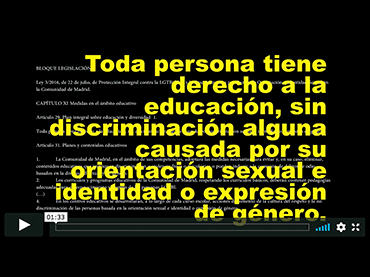
The Pink Triangle project looks to consolidate a space of convergence between different agents working in the sphere of sexual diversity and gender in schools, aiming to develop, in accordance with the legislation in force, comprehensive programmes against LGTBIphobia and discrimination of sexual orientation and identity.
Two editions, Pink Triangle 1 and 2, held in July and October 2019 respectively, witnessed the exchange of methodology and practices between different types of programmes, for instance LGTBIQ+ tutoring, diversity classrooms, and so on. In order to prepare the programme’s return for the 2020–2021 school year and to celebrate LGTBIQ+ Pride, the Museo Reina Sofía shares this diagram, which was worked upon in previous editions and condenses the issues, urgencies and objectives explored.
-
Video
Diego del Pozo, Untitled (Eroticism Casts Everything)
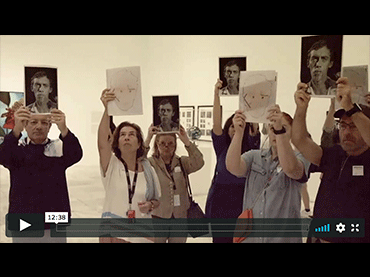
In conjunction with the 2019 exhibition David Wojnarowicz. History Keeps Me Awake at Night, artist Diego del Pozo carried out the performance Untitled (Eroticism Casts Everything) in the form of a walk around the show. During the routes, participants read texts and statements from artist and activist David Wojnarowicz, embodying his voice through myriad other voices. This approach, which started from the question of how to love collectively under the fear of contact after the AIDS crisis, and also a meditation on how to celebrate love, friendship and eroticism, gains even greater weight in relation to a new health emergency like the present one.
-
Online documentary exhibition
Queer Archive?
A Virtual Activation
The Library and Documentation Centre offers a virtual exhibition on a collaborative project propelled by the Museo entitled Queer Archive?: a documentary ensemble which, since its creation in 2012, has undergone numerous reactivations to collectively explore, from queer standpoints, the traditional notion of the archive. More specifically, the touchstone of the show is the activist struggle the queer movement developed in facing up to the AIDS pandemic in the 1990s in Madrid via collectives such as La Radical Gai and LSD. Thus, the materials and documents in the show suggest certain convergences, parallels and divergencies with the present health emergency, addressing questions such as the fear of infection, unfamiliarity with the illness, stigmatisation of the sick, the blame placed on certain collectives and minorities, the call for social responsibility and the demand for an emphatic and globalised institutional response.
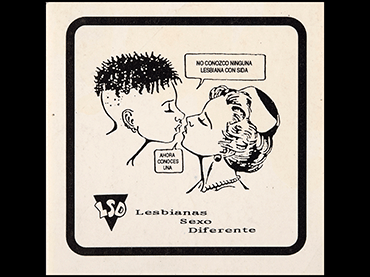
Every New Normality Has its Dissidence
LGTBIQ+ 2020 Programme

Held on 26 Jun 2020
Amid the deeply unusual context brought about by the COVID-19 pandemic, the Museo Reina Sofía joins the LGTBIQ+ Pride celebration by examining the legacies of sexual and gender dissidence. More than ever, such dislocated, irreverent and rebellious legacies materialise as vectors of the imagination and critical resistance to the naturalised “return to normality”, with our collective experience in facing the current health emergency bearing a relation to the HIV/AIDS pandemic, bolstering the importance of rescue and a revision of forms of resistance and care historically formulated by the LGTBIQ+ collective.
From the crossroads of sexual and gender dissidence with the migrant condition, can we question forms of control and discourse around social distancing, based largely on a univocal idea of subject, body and desire? How can we activate and articulate this dissident knowledge to invent other possibilities of supporting and caring for ourselves, and, most importantly, to continue fighting for the right to non-standard lives?
This programme assembles highly diverse affections and intensities, uttered from equally distinctive voices and contexts, expressing pain, rage, delirium, and pride. Despite this disparity, the common denominator lies in declarations from indifference, an irreducible difference that denounces and rebels before the violence of processes of normalisation and homogenisation, to which the art institution is no stranger either.
Organised by
Museo Reina Sofía
Más actividades
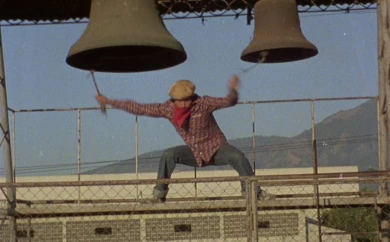
Files of Tropical Revolutions
Sábado 20 y 27 de junio, 2026 - 19:00 H
The Reframing Banana Imagery series concludes with two works that condense the height and twilight of this period in history, epic sagas that cross borders and registers to embody experiences of armed struggle in the region. Cameras mix with firearms, borders between nations blur and patience reaches breaking point. This is where the tipping point lies, where the bloodshed weighs heavy and the murmurings of regional brotherhood are buried in the ground again.
Pan y dignidad (Carta abierta de Nicaragua) [Bread and Dignity (An Open Letter to Nicaragua)] recounts the historical records and process of national reconstruction in Nicaragua via the Sandinista popular uprising. Historias prohibidas de Pulgarcito (Forbidden Tales of Tom Thumb) places the camera at the heart of the El Salvador revolutionary struggle, interspersing testimonies of daily violence with the verses of the poet Roque Dalton.
Both works understand the armed revolution as an open file under construction. The insurgent brotherhood, although dissolved, still resounds in regional history.
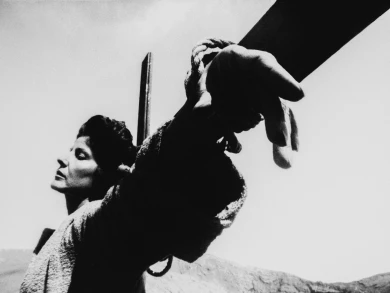
Circling Over Exploited Bodies
Friday, 19 and 26 June 2026 - 7pm
When forms of violence are inflicted on society, film responds from urgency. Images become abstract, sounds fade and the register of dissidence comes from the gut. La zona intertidal (The Intertidal Zone) is an essayistic and poetic approach to the repression of teachers in El Salvador in the 1970s — a teacher studies the biodiversity of the El Salvador coast as a boy finds a body on the same beach. A propósito de la mujer (About Women) interweaves testimonies of misery and rage towards patriarchal structures with fictional scenes of a symbolic procession through a harsh desert.
Both films understand the body as a target of violence and a territory of insurrection, a space where the blood shed by militancy and the patriarchal yoke turn pain into denouncement and existence outside the status quo into an act of political dissidence.
Robert Capa
Friday, 26 June 2026 – 6pm
This international encounter centred on the figure of Robert Capa (Budapest, 1913 — Thai Binh, Vietnam, 1954), one of photojournalism’s pre-eminent figures, is held within the framework of the government initiative Spain and Freedom. Fifty Years and in conjunction with a cluster of three locations — the building on number 10 Calle Peironcely, the Plaza del Fotógrafo Robert Capa and the San Carlos Borromeo Parish in Vallecas — declared as a Place of Democratic Memory.
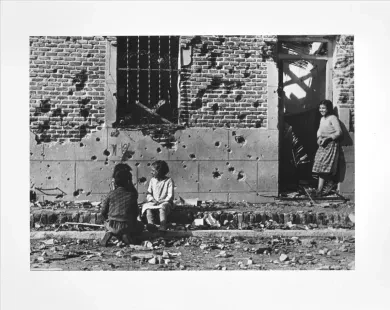
The emblematic photo Robert Capa took in 1936 of this area of Republican Madrid, featuring anonymous children talking in front of a bullet-riddled building attacked by Nazi-fascist air forces, has, in recent years, become a catalyst for impassioned collective action vindicating memory and denouncing the horrors and brutality of wars, past and present.
Within this context, representatives from cultural and academic spheres and civil society organisations from Germany, the USA and Spain discuss the legacy of Capa and photojournalism in European democratic memory, exploring in greater depth two citizen initiatives constructed by Europe from its shared memory: #SalvaPeironcely10 (#SavePeironcely10), in Entrevías (Puente de Vallecas), and the Capa Haus Initiative in the Lindenau neighbourhood of Leipzig, both united by the protection and conservation of historical heritage and by the defence of peace.
The round-table discussion features the participation of Cynthia Young, Juan Miguel Sánchez Vigil, Ulf-Dietrich Brumann and José María Uría Fernández and is moderated by Myriam Soto Lucas. Carmina Gustrán Loscos, the commissioner of Spain and Freedom. Fifty Years, will also join the discussion.
Central American Designation of Origin
Thursday, 18 and 25 June 2026 - 7pm
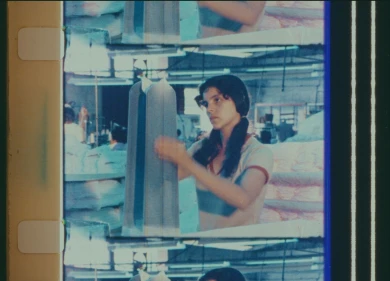
Fertile lands, farmers’ hands, rural faces. This first programme in the series Reframing Banana Imagery understands the foundations of the Central American experience from exploitation, extractivism and displacement, and from the organisation and resistance that emerged as a reaction. The four films within extend from a lyrical documentary on farmers’ solidarity to the playful subversion of the institutional format of the United Fruit Company.
Bananeras (Banana Growers) is a combative portrait of the inhumane conditions of the American banana plantations located in Nicaragua through much of the twentieth century. Costa Rica Banana Republic is a perspicacious satire via an institutional documentary of banana production, spotlighting the extractive nature of this agro-exporting model in the 1970s. Organización Campesina (Farmers’ Organisation) frames rural resistance in Honduras from a direct depiction and lyrical documentary, while Dos veces mujer (Two Times a Woman) dissects the invisibility of the double-shift working day Central American women farmers endure: working in the countryside and working in the home. As a whole, the works here present the earth at once as a wounded body and a space of dignity.
Inclusive Policies and Practices
19, 20 JUN 2026
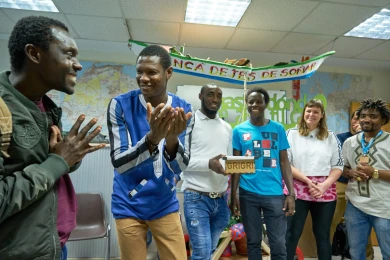
In conjunction with World Refugee Day, which takes place on 20 June 2026, Museo Situado and GRIGRI jointly organise this international encounter to foster the discussions, debates and exchange of practices which uphold solidarity with migrant people in European Union countries.
The programme, conceived as a space of exchange and the collective construction of knowledge, comprises a workshop of collaborative creation, discussions, a community meal and a film forum — activities designed by a local committee made up of young people under the age of thirty from different territories in Europe. The policy recommendations on welcoming people with migrant backgrounds and hospitality in urban contexts that arise from this encounter will be presented in Brussels at the end of 2026.
These sessions are developed within the context of the European cooperation project Bridging Borders and are framed inside the tenth anniversary of the GRIGRI Pixel project.