-
December 11, 2013
Information / Counter-information
Agustí Camps, Jordi Castañé, Jordi Guillemot and Pere Roca. TV-SIDA
Video, 1993. 36’ [screening of extracts]. Copy provided by the Documentation Centre at Museo Reina Sofía
Carrying Society / Prospecciones Urbanas S.A. ¿Sabes si...? Prospecciones # 700-738
Video, 1997? 27’ [screening of extracts]. Copy courtesy of a private archive
Guillermo Moscoso. Geno-Sida
Video, 2009. 10’. Copy courtesy of the artist
This block looks at one of the main battlefields of AIDS-related critical practices, an area that would mark an important aspect of the micropolitics taking place in the 21st century: information as an object of struggle. -
December 11, 2013
Displacing the Espaliú paradigm
Las Pekinesas (Miguel Benlloch, Tomás Navarro and Rafael Villegas). SIDA DA
Video, 1985. 8’ 49”. Copy courtesy of Ático Siete, Granada
Virginia Villaplana and Liliana Couso (for LSD). Retroalimentación
Video, 1998. 5’. Copy courtesy of Hamaca, Barcelona
Águeda Bañón. El tajo
Video, 1996. 3’. Copy courtesy of the artist
Pepe Miralles. Despedida circular
Video, 1995. 1’ 58”. Copy courtesy of the artistThis block adds further nuances to the usual characterisation of Pepe Espaliú (1955-1993) as a paradigmatic figure in the critical forms of AIDS cultural production. It does so by introducing a series of pieces that are less visible and that together make up a more complex cartography of AIDS policies in Spain. This block is not intended to be a “critique of Espaliú” but rather a deeper analysis of this subject’s foundational narratives.
-
December 11, 2013
Ritualities / rejection of “bare death”
Gloria Camiruaga. Yeguas del apocalipsis
Betacam SP, 1990. 6’ 20’’. Copy courtesy of Heure Exquise!, France
Gloria Camiruaga. Casa particular
Betacam SP, 1990. 9’ 30’’. Copy courtesy of Heure Exquise!, France
Francisco Copello. Hello Again
Video, 2005. 13’. [screening of extract]. Copy courtesy of Francisca Vargas (Archivo Copello) and Claudio Marcone
Rafael França. Prelúdio de uma morte anunciada
Video, 1991. 5’. Copy courtesy of the Jacqueline Martins Gallery, Sao Paulo
This block proposes the ritualisation and signification of death as an interpretive key to large part of the artistic production related to AIDS which, according to the postcolonial theorist Jean Comaroff, is an attempt to avoid the ultimate abjection of "bare death."
Video as an AIDS counter-archive

Guillermo Moscoso. Geno-Sida. Vídeo, 2009
Held on 11 Dec 2013
AIDS Anarchive began within the framework of the 2012-2013 research residencies at Museo Reina Sofía, as part of the production process of a “counter-archive” or an anarchive of AIDS policies, with attention being paid for the first time to practices occurring outside of the Anglo-Saxon or Western and Central European settings. This activity, a video session accompanied by the commentary of the researchers and curators, Aimar Arriola and Nancy Garín, partially explains the research project and marks the end of the project’s research visit at the Museum.
As one of the initial hypotheses, the researchers examined specific case studies as a means to explore the functions of the archive and of archival practices within the array of critical forms of cultural production related to AIDS since the late 1980s. In them we find an opportunity to radically question the logic of access or exclusion and of archival representation privileges. [dropdown]
AIDS cultural activism soon came to occupy archival space. According to queer theorist Roger Hallas (Reframing Bodies, 2009) in his discussion of what he describes as queer AIDS media, it would do so considering the archive not just a space for the preservation of material and memory but rather as a tool that gives evidence of the demands of the present. Following Hallas, but taking the matter a step further, the intention here is to propose that AIDS-related critical videographic production should be viewed as one of its possible counter-archives.
While video as an artistic medium and form of counter-information appeared in North America and Western Europe during the early gay liberation movements and second-wave feminism of the late 1960s, in Spain and other contexts with post-dictatorial regimes, such as Chile and Brazil, it would take another two decades or more for the critical use of video among artists and activists to gain strength. In fact, the consolidation of video would take place in parallel with the expansion of globalisation and its economic driving force, neoliberal policies; in other words, the very context in which AIDS appeared.
In this regard, the alignment of AIDS and video has favoured the emergence of local responses to the global dimension of the pandemic, as shown, in part, by this selection of videos, in which, as the Chilean writer and essayist Lina Meruane (Viajes Virales, 2012) puts it, the AIDS body no longer appears as a prominent sign of globalisation, but rather as its counter-face, its negative figuration, that which is capable of declaring checkmate on the deceptive semantics of the global flow. [/dropdown]
Organised into three critical blocks, the program is conceived as an initial manifestation of this counter-archive, albeit limited to the time and extension of one day of video, and it includes the work of the following artists, collectives and initiatives:
Activity organised in connection with
In collaboration with
Fundación Banco Santander and CRUMA


Más actividades
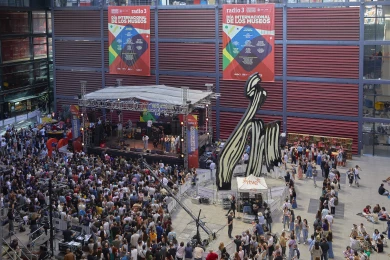
International Museum Day 2026 with Radio 3
22 MAY 2026
On Friday, 22 May 2026 the Museo Reina Sofía celebrates International Museum Day by way of a vibrant music programme conducted by Radio 3.
From 9am to 11pm, the Museo’s Nouvel Courtyard will host the live broadcast of Radio 3’s day-long programme —also available on a video streaming on the Radio3 website and app, on RTVEPlay and on the Museo’s social media accounts. The programme comprises more than twenty live acts, including artists such as Carlangas, Shego, Soleá Morente, Kokoshca, La Tania, La Pegatina, Pipiolas, Ángel Stanich, Triángulo de Amor Bizarro and Zahara, and many others.
With this programme the Museo Reina Sofía concludes its celebration of International Museum Day, which takes place on Monday, 18 May. Both on 18 May, from 10am to 9pm, and 22 May admission to the Museo will be free of charge.
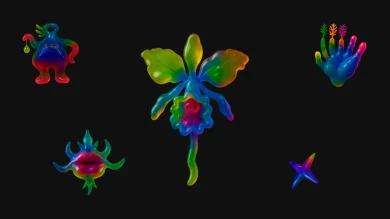
Institutional Decentralisation
Thursday, 21 May 2026 – 5:30pm
This series is organised by equipoMotor, a group of teenagers, young people and older people who have participated in the Museo Reina Sofía’s previous community education projects, and is structured around four themed blocks that pivot on the monstrous.
This fourth and final session centres on films that take the museum away from its axis and make it gaze from the edges. Pieces that work with that which is normally left out: peripheral territories, unpolished aesthetics, clumsy gestures full of intent. Instead of possessing an institutional lustre, here they are rough, precarious and strange in appearance, legitimate forms of making and showing culture. The idea is to think about what happens when central authority is displaced, when the ugly and the uncomfortable are not hidden, when they are recognised as part of the commons. Film that does not seek to be to one’s liking, but to open space and allow other ways of seeing and inhabiting the museum to enter stage.
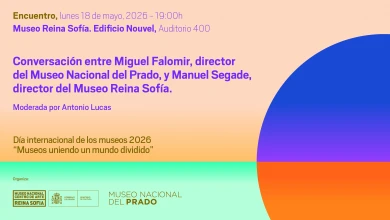
Miguel Falomir, Director of the Museo Nacional del Prado, in Conversation with Museo Reina Sofía Director Manuel Segade
18 MAY 2026
Museo del Prado and Museo Reina Sofía directors, Miguel Falomir and Manuel Segade, respectively,engage in conversation on Monday, 18 May in the Museo Reina Sofía’s Auditorium 400, in conjunction with International Museum Day 2026, the theme of which is “Museums Uniting a Dividing World”. The discussion, moderated by journalist and poet Antonio Lucas, will see the two heads of these major cultural institutions share their reflections on the role they play in today’s society.
In addition to addressing the management of art, the conversation seeks to explore in greater depth museums’ potential as meeting points to face today’s social tensions, thereby fulfilling the international mandate of this year’s edition.
The activity will be live-streamed and is available at this link.
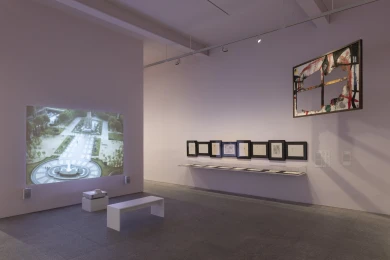
Collection. Contemporary Art: 1975–Present
Miércoles 13 de mayo, 2026 - 19:00 h
In this lecture, Museo Reina Sofía director Manuel Segade outlines the key readings of the new presentation of the Collection on Floor 4 of the Sabatini Building. This new arrangement is framed inside an ambitious rehang that harnesses the uses of the Museo’s architecture, in a plan that will continue in 2027 with the opening of Floor 3 in the same building, culminating with Floor 2 in 2028.
The new rehang of the Collections, unveiled on 16 February 2026, sets forth a journey through contemporary art history over the past fifty years in Spain. Rather than an unambiguous narrative, the floor recounts the same period — from the Transition to democracy in Spain to the present — in three different ways, starting back at the 1970s time and again.
The exhibition route gets under way with a prologue that travels through the affections, material culture and institutionalism of the Spanish Transition, serving as a starting point for the three routes that follow. The first, A History of Affect in Contemporary Art, advances from affective systems in artmaking linked to the second wave of feminism, arriving at grief as a tool to interpret new realities. The second route, The Powers of Fiction: Sculpture, New Materialisms, and Relational Aesthetics, is conceived as a sculpture gallery in which the artworks engage with the public, focusing on the performance side of the discipline. This route shows, among other aspects, how Spanish sculpture has gained significant international visibility since the 1980s, with women artists playing a key role in this display. The third route, A New Framework. The Institution, the Market, and the Art that Transcends Both, zooms in on the origins of the Museo and its role in the process of art’s institutionalisation in Spain. In May 1986 the Centro de Arte Reina Sofía opened, occupying the first and second floors of the former hospital: the forty years that have elapsed since then enable a re-evaluation of the effects of the Museo on Spanish art and art on the institution.
This talk strengthens the goal of socially integrating the narratives produced by the Museo at a time when the Collections are under permanent review.
Patricia Falguières
Tuesday May 12th 2026 – 19:00 h
Art historian Patricia Falguières inaugurates the María Luisa Caturla Chairwith the lecture Art History in Dark Times. This Chair, dedicated to the reflection on art in times «sick with uncertainty», is aimed at dismounting, digressing and imagining multiple temporalities and materialities in art history and cultural studies from an eccentric gaze, in the sense of being displaced, off-centre or with a centre that is different.
The lecture’s title references Hannah Arendt’s collection of essays Men in Dark Times, which in turn paraphrases a Bertol Brecht poem. In it, Arendt asserts «dark times are not only not new, they are no rarity in history».
Patricia Falguières also claims history knows many periods when the public realm has been obscured, when the world becomes so uncertain that people cease to ask anything of politics except to relieve them of the burden of their vital interests and their private freedom. The art historian —whose expertise is in the field of Renaissance art and philosophy but paying close attention to contemporaneity— invites us to a «chaotic and adventurous journey», from the Italian Renaissance to Fukushima, through which to delve into the questions: What can the practice of art history mean today, in a world ablaze with ominous glimmers and even more ominous threats, if not as mere entertainment or social ornament? Of what vital interests, of what freedom can it bear witness and serve as an instrument?