-
Friday, 11 March 2022 – 6pm / Second session: Friday, 15 April 2022 – 6pm Sabatini Building, Auditorium
Session 1. Assia Djebar I
TicketsLa Zerda ou les chants de l'oubli (The Zerda and the Songs of Forgetting)
Algeria, 1982, b/w and colour, original version in Arabic and French with Spanish subtitles, DA, 60'—With a presentation by Stoffel Debuysere, co-curator of the series and head programmer of the Courtisane Festival, in the first session.
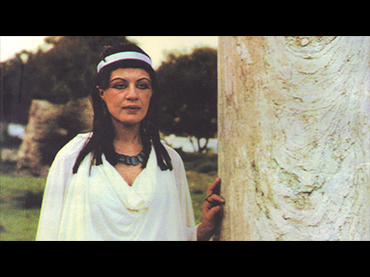
As a historian, Assia Djebar was commissioned by Pathé-Gaumont to sift through old reels which turned out to be discarded newsreels from the French colonies reflecting the everyday lives of Magreb peoples from the beginning of the twentieth century to the Second World War. Out of these discards, Djebar, in collaboration with poet Malek Alloula and composer Ahmed Essyad, weaves together a work in which images of the Zerda ceremony co-exist with a poetic voice-over recounting experiences of the Algerian people and are interspersed with the “songs of forgetting” to recognise traditions that have been progressively lost because of colonialism, even when they are integrated symbolically and subjugated by the colonial gaze.
“In a region of Magreb subjugated by colonial domination and reduced to silence, photographers and film-makers invaded with the sole aim of capturing us in images. The Zerda is their bleak ‘celebration’ of our society. Opposite images with their piercing gaze, we attempted to create an alternative vision, offering glimpses of a daily life held in contempt until that point… But, above all, behind the veil of that now-exposed reality, we collected anonymous voices that reformulated the soul of a re-unified Magreb, and of our own past”. Assia Djebar.

-
Saturday, 12 March 2022 – 6pm / Second session: Saturday, 16 April 2022 – 6pm Sabatini Building, Auditorium
Session 2. Assia Djebar II
TicketsLa Nouba des femmes du Mont Chenoua (The Nubah of the Women of Mount Chenoua)
Algeria, 1977, colour and b/w, original version in Arabic with Spanish subtitles, DA, 115'— With a presentation by Stoffel Debuysere, co-curator of the series and head programmer of the Courtisane Festival, in the first session.
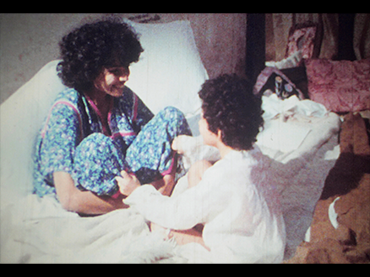
This film borrows its structure from nubah, a music genre from Andalusian tradition divided into five movements, to tell the story of a woman who returns to her childhood town fifteen years after the bloody Algerian War of Independence. The history of the country is written in the accounts that shape the lives of its women; thus, La Nouba des femmes du Mont Chenoua (The Nubah of the Women of Mount Chenoua) fashions a heartfelt portrait of word and silence, memory and creation, before erecting an indispensable document in which past and present co-exist.
“This film, in the form of a nubah, is devoted posthumously to Béla Bartók, who arrived in 1913 in a practically mute Algeria to study its musical folklore, and to Yaminai Echaïb, better known as Zhoulikha Oudai, who organised a resistance network in the city of Cherchell and its mountains between 1955 and 1956. She was arrested in the mountains in her mid-forties, with her name later added to the list of those missing. Lila, the film’s protagonist, could be Zhoulikha’s daughter. The voices of the other Chenoua women reconstruct fragments of their lives — ‘the nubah of the women’ is their chance, and is also the nubah of Andalusi music in its recognisable rhythmic beats”. Assia Djebar.
-
Thursday, 17 March 2022 – 6pm / Second session: Thursday, 21 April 2022 – 6pm Sabatini Building, Auditorium
Session 3. Jocelyne Saab I. Medium-length films
TicketsLes Femmes palestiniennes (Palestinian Women)
France, 1974, b/w and colour, original version in Arabic, French and English with Spanish subtitles, DA, 11',Madinat Al-Mawta (Egypt, City of the Dead)
Lebanon, 1977, colour, original version in Arabic and French with Spanish subtitles, DA, 37'Lettre de Beyrouth (A Letter from Beirut)
Lebanon, 1978, colour, original version in Arabic, French and English with Spanish subtitles, DA, 47'—With a video presentation by Mohanad Yaqubi, curator of this series and a film-maker and producer, in the first session.
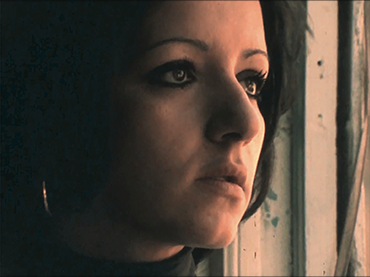
Palestinian women, often the forgotten victims in the Palestinian-Israeli conflict, find a voice in Jocelyne Saab’s short film, a commission from French national television that was never broadcast. “I wanted to show images — almost inexistent at the time — of Palestinian women fighting in Syria. We’re talking about that moment just prior to Sadat’s visit to Israel and how the situation was very tense. While I was editing the film in the studios of Antenne 2, Paul Nahon, then senior editor of the foreign editorial department, grabbed me by the collar and threw me out of the editing suite. Palestinian Women was canned and was never aired on television”, Saab wrote.
The second film is a portrait of the City of the Dead, an inhabited cemetery on the outskirts of Cairo, on the fringes of the city’s dumping ground, a place which develops into a compendium of reproaches and bad consciences. Starting from this place, the film portrays the densely populated neighbourhoods of the Egyptian capital, hostage to their own overcrowding and misery and threatened, on a daily basis, by the passiveness of the authorities. “I still ask myself how I was able to combine surrealism and social realism in this film. The great poet Ahmed Fouad Negm was in prison at that time, simply because the regime was displeased with his anti-establishment texts and, in that era, anybody was imprisoned for no apparent reason. So I followed his companion Azzam at the foot of the prison windows to pick up the poems Negm would throw through the bars of his cell. Sheikh Imam sang his poems to the revolutionary students who gathered in the City of the Dead. It was exhilarating — we still believed we could change the world”, Saab said.
In the final film, made three years after the start of the Lebanese Civil War, Jocelyne Saab returns to Beirut and witnesses irrevocable change. She travels through its streets, climbs on buses and talks to refugees and members of the peacekeeping forces, enabling her to reflect on, in that brief interlude of peace, the toll of war.
-
Friday, 18 March 2022 – 6pm / Second session: Friday, 22 April 2022 – 6pm Sabatini Building, Auditorium
Session 4. Jocelyne Saab II. Medium-length films
TicketsLes Enfants de la guerre (Children of War)
Lebanon, 1976, colour and b/w, original version in Arabic and French with Spanish subtitles, DA, 11'Beyrouth, jamais plus (Beirut, Never Again)
France and Lebanon, 1976, colour, original version in Arabic and French with Spanish subtitles, DA, 25'Beyrouth, ma ville (Beirut, My City)
Lebanon, 1982, colour, original version in Arabic and French with Spanish subtitles, DA, 35'— With a video presentation by Mohanad Yaqubi, curator of this series and a film-maker and producer, in the first session.
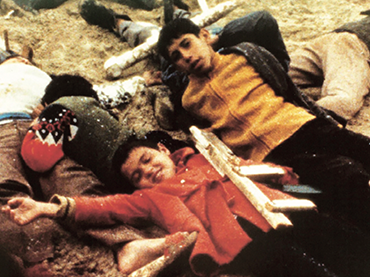
Just days after the Karantina massacre, in a predominantly Muslim shanty town in Beirut, Jocelyne Saab met some children who had found safety but were deeply traumatised after seeing the bloody fighting with their own eyes. Saab gave the children crayons and encouraged them to draw what they wished as her camera kept rolling. She made a bitter discovery: the only games the children engaged in were war games — the war would also become a way of life for them. As the film-maker asserts: “Les Enfants de la guerre (Children of War) denounces the violence inflicted on ten-year-old children who can no longer speak, think and draw other than in terms of war: they mimic war”.
In Beyrouth, jamais plus (Beirut, Never Again), gunshots and songs mix with the poetic voiceover of Lebanese writer and painter Etel Adnan (who also wrote the text for Lettre de Beyrouth [A Letter from Beirut]). The film is the first instalment in Saab’s Beirut Trilogy, through which she looks for signs of life among buildings bombed and sodden by the flames of a ghost city, the same city in which children have become soldiers, looters and scrap dealers.
Beyrouth, ma ville (Beirut, My City) sees Saab and her collaborator, playwright and film-maker Roger Assaf, returning to their old home after the Israeli 1982 invasion and finding glimmers of hope amid the chaos of refugee camps and the rubble of decimated neighbourhoods.
-
Saturday, 19 March 2022 – 6pm / Second session: Saturday, 23 April 2022 – 6pm Sabatini Building, Auditorium
Session 5. Jocelyne Saab III
TicketsLe Sahara n'est pas à vendre (The Sahara Is Not for Sale)
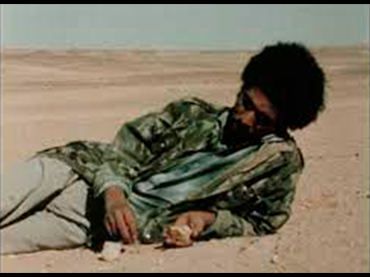
France, 1977, colour, original version in Arabic, French and Spanish with Spanish subtitles, DA, 93'Extending across anthropological documentary and political reportage, Le Sahara n'est pas à vendre (The Sahara Is Not for Sale) is one of the first and most incisive investigations into the peoples, territory and histories that shape the conflict hanging over this African region. Every actor appears in the film: the Moroccan authorities, Algerian women and the ghost of Spanish colonial presence which, at the time of filming, in the two years previous and at the height of the Green March, had left the territory. It was also the first time leaders of the Polisario Front had been given a voice. Today the film is still banned in Morocco. In 1989, Saab was invited to the Tetouan Film Encounters to present her fictional film Kanya ya ma kan, Beyrouth (Once Upon a Time in Beirut), but was immediately arrested, with her nine-year-old son, and deported from the country following the intervention of Morocco’s secret services. The reasons for such an arrest? The still-open wounds inflicted by her untamed gaze in The Sahara Is Not for Sale.
-
Friday, 25 March 2022 – 6pm / Second session: Friday, 29 April – 6pm Sabatini Building, Auditorium
Session 6. Heiny Srour I
TicketsSaat el Tahrir Dakkat, Barra ya Isti Mar (The Time of Liberation Has Come)
United Kingdom, France and Lebanon, 1974, colour, original version in Arabic with Spanish subtitles, DA, 62'. Restored version— With a video presentation by Reem Shilleh, curator of this series and a researcher and artist, in the second session.
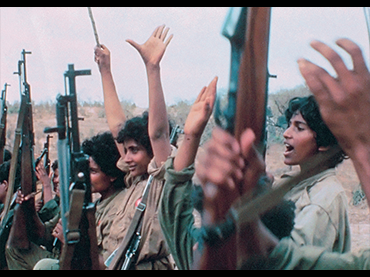
At the end of the 1960s, the Dhofar Governate rose up in rebellion against the British-backed Sultanate of Oman in a pro-democratic and feminist guerrilla movement. Heiny Srour and her team crossed 800 kilometres of desert and mountains on foot, under the bombing of Britain’s Royal Air Force, to access the war zone and capture this rare record of a war that today is all but forgotten. The Dhofar Popular Liberation Front members (barefoot and with no military rank or wages) liberated a third of the territory while undertaking a wide-reaching programme of social reforms and a series of infrastructure projects. They built schools, farms, hospitals and roads as illiterate teenage shepherdesses became more combative feminists than Simone de Beauvoir and Germaine Greer and eight-year-old schoolchildren learned to put democracy into practice with more maturity than many adults. In Srour’s words: “In the Arab world, it is the first time that an organised political force considers the liberation of women as an end in itself and not only as a way to quickly get rid of imperialism. In the Arab world, it is the first time that practice goes beyond mere proclamations”. A still-topical portrait of a liberated society and an exploration of how oil determined British and American involvement in the Middle East, Saat el Tahrir Dakkat, Barra ya Isti Mar (The Time of Liberation Has Come) was also the first film directed by an Arab woman to be screened at Cannes.
-
Saturday, 26 March 2022 – 6pm / Second session: Saturday, 30 April 2022 – 6pm Sabatini Building, Auditorium
Session 7. Heiny Srour II
TicketsLeila wa al ziap (Leila and the Wolves)
Lebanon, 1984, colour, original version in Arabic with Spanish subtitles, DA, 90'. Restored version—With a video presentation by Reem Shilleh, curator of this series and a researcher and artist, in the second session.
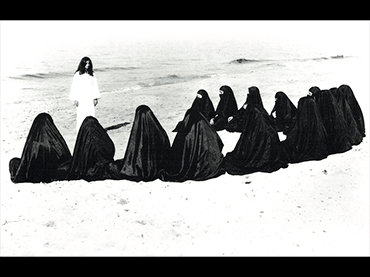
A survey of the historical and political identity of women in the Middle East, Leila wa al ziap (Leila and the Wolves) calls into question the glorification of violence. Across the film, an Arab woman wanders around real and imagined places in Lebanon and Palestine, encountering voices unconnected to the hegemonic discourse of the region: the submerged and solemn yearnings of Arab women’s own form of resistance. On her journey, she returns time and again to Lebanon — the “jewel in the crown” of the old French colonies — a country in which honour crimes in the 1970s took the lives of two women a week. As film-maker John Akomfrah writes, “the film is not an anthropological journey but a survey of mythic and symbolic protest. Through her ‘eye’ comes a search for political character in a Lebanon now permanently stained by the massacre of Sabra and Chatila; caught in the throes of bitter civil war; Israel’s ‘backyard’. Leila prods these moments of loss and discovers ghosts of a very different life before the wolves”. “The visual leitmotiv of the film is Arab women sitting immobile under the high sun, while half-naked men bathe joyfully on the beach. Gradually, women start getting impatient, as historic events go by, and move towards the water for a dip... But in the Middle-East, the dance of death still continues”, he writes.
-
Friday, 1 April 2022 – 6pm / Second session: Friday, 6 May 2022 – 6pm Sabatini Building, Auditorium
Session 8. Atteyat Al-Abnoudy I. Medium-length films
TicketsHusan al-Tin (Horse of Mud)
Egypt, 1971, b/w, original version in Arabic with Spanish subtitles, DA, 12',Ughniyat Touha al-Hazina (Sad Song of Touha)
Egypt, 1972, b/w, original version in Arabic with Spanish subtitles, DA, 12'Al-Sandawich (The Sandwich)
Egypt, 1975, colour, original version in Arabic with Spanish subtitles, DA, 12'Bihar al-’Attash (Seas of Thirst)
Egypt, 1980, colour, original version in Arabic with Spanish subtitles, DA, 44'In her first film, made with borrowed equipment and on a shoestring budget, Atteyat Al-Abnoudy captures the basic process of mud brick-making on the shores of the River Nile. Husan al-Tin (Horse of Mud) was initially rejected through censorship, which sought to blot out the poverty of local people after twenty years of revolution in Egypt. Eventually it was granted permission to be screened for non-commercial purposes, after which the film went on to win more than twenty international awards.
In many ways, Ughniyat Touha al-Hazina (Sad Song of Touha) complements Husan al-Tin (Horse of Mud). Al-Abnoudy’s second film and graduation piece at Cairo’s Higher Institute of Film is a portrait of street performers from the Egyptian capital. The artistry of this community of fire-eaters, child contortionists and other artists is captured by Al-Abnoudy’s unobtrusive lens, along with a measured and haunting narration by poet Abdel Rahman el-Abnoudy.
Al-Sandawich (The Sandwich) explores the daily life and work of children from Abnoud, a village located 600 kilometres south of Cairo and a place where trains carrying tourists towards the south of the Egyptian capital pass through without stopping. A boy evades hardship by dripping goat’s milk on a piece of stale bread, turning it into a special sandwich.
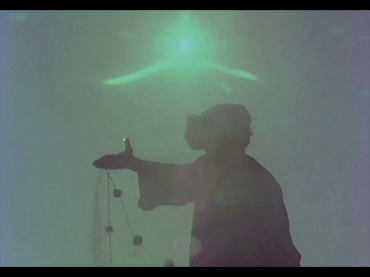
In the last film, Bihar al-’Attash (Seas of Thirst), Al-Abnoudy moves away from her customary exploration of southern Egypt to shine a light on the north of the country, capturing a series of communities which — amid a perilous drought — inhabit the areas around the salt lakes of El Borolos. Contrasting starkly with the arid landscape surrounding them, the rich character of the locals provides keys to a moving narrative of a social class that has to face countless hardships.
-
Saturday, 2 April 2022 – 6pm / Second session: Saturday, 7 May 2022 – 6pm Sabatini Building, Auditorium
Session 9. Atteyat Al-Abnoudy II. Medium-length films
TicketsAl-Ahlam al-Mumkinna (Permissible Dreams)
Egypt, 1983, colour, original version in Arabic with Spanish subtitles, DA, 31'Iqa’ al-Haya (Rhythm of Life)
Egypt, 1988, colour, original version in Arabic with Spanish subtitles, DA, 60'Al-Ahlam al-Mumkinna (Permissible Dreams) traces the life of Oum Said, a woman farmer living in a small town on the Suez Canal. Although she doesn’t read or write, the woman in question is the economist, doctor and future planner of her entire family and dreams “to the limits of her possibilities”, as the film-maker states. The film, which reflects one woman’s struggle against societal and gender inequalities, is part of the German-produced series As Women See It by Pierre Hoffman.
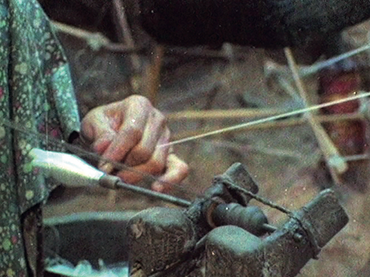
Iqa’ al-Haya (Rhythm of Life) is a key innovative piece in Al-Abnoudy’s oeuvre. The film can be seen as a kind of symphony of rural life played out in four acts. This beautiful portrait of the daily life of a group of farmers is a living example of the humble and profoundly human way the film-maker undertakes her work. As Al-Abnoudy puts it: “I was thinking of taking on this huge project to recount the daily lives of the Egyptian people for some time. I try to play on contradictions, and I think I have something to say within the documentary form, a way of bringing to it a sense of narrative — a dramatic way of showing life. I try to re-arrange reality in an artistic way”.
-
Saturday, 9 April 2022 - 6pm / Second session: Saturday, 14 May 2022 - 6pm Sabatini Building, Auditorium
Session 10. Selma Baccar
TicketsFatma 75
Tunisia, 1975, colour, original version in Arabic with Spanish subtitles, DA, 60'— With a video presentation by Stefanie Van de Peer, a film programmer and historian, and author of the monograph Negotiating Dissidence: The Pioneering Women of Arab Documentary (2017)
University student Fatma embarks on a historical journey for feminism upon compiling a series of interviews with iconic women from history: women from the aristocracy of a remote past, as well as contemporary revolutionaries involved in the fight for Tunisian independence deep into the twentieth century. The film’s gaze rests on the events that occurred between the 1930s and the 1950s, when Tunisian women fought progressively for emancipation, attaining the promulgation of the Code of Personal Status in Tunisia and its aim for institutionalised equality between men and women. The innovative language of this fictional documentary enables its director, Selma Baccar, to set forth a narrative element of her creation, while interweaving it with images of real interviews, recreations of historical circumstances and archive material. With a tone that pays heed to didactic and even instructive undertakings, Fatma 75 has progressively gained mythical status owing to the influence of its originality and the censorship it was under for many years.
Out of the Shadows
The Pioneering Films of Atteyat Al-Abnoudy, Selma Baccar, Assia Djebar, Jocelyne Saab and Heiny Srour
![Jocelyn Saab. Beyrouth, ma ville [Beirut, mi ciudad]. Película, 1982](https://recursos.museoreinasofia.es/styles/small_landscape/public/Actividades/entre_sombras.png.webp)
Held on 11 Mar 2022
“All of us, all of us from the world of women in the shadows, are reversing the process: finally, it is we who are looking, we who are making a beginning”.
Assia Djebar
An exploration of film-making from Mediterranean Arab countries, as rich as it is vast, offers a though-provoking array of forms and manifestations. From the silent film era to the present today, film work from Magreb and the Mashriq has contributed a large number of standout productions to film history, yet a survey of canonical historiography casts, surprisingly, more darkness than light and is even more striking where films made by women are concerned. Despite a considerable rise in recent decades of women directors in Arab film, the work of many female pioneers regrettably tends to fall into obscurity.
Therefore, this series aims to address this darkness while also fortifying the work of five film-makers whose films unfortunately remain neglected and enjoy limited screening time: Atteyat Al-Abnoudy (Egypt, 1939–2018), Assia Djebar (Algeria, 1936–2015), Jocelyne Saab (Lebanon, 1948–2019), Heiny Srour (Lebanon, 1945) and Selma Baccar (Tunisia, 1945). Despite hailing from different regions and origins, their careers all started in the 1970s, at a time of political and cultural ebullience. Often working against the grain, these film-makers set out to be mindful of voices and stories at risk of being smothered by official history, and although each would go on to develop their own focus, there is a common thread running through their work, an exploration of themes such as memory and identity, oppression and liberation, violence and exclusion, and the role, in social and political terms, women represent in Arab culture.
The work of these five directors — shown together for the first time in this series — stems from different traditions and realities. A female Arab film-maker cannot be separated from their being an Arab woman. Therefore, this programme seeks to follow Assia Djebar’s appeal “not to presume to ‘speak for’ — or worse still — ‘speak on’, but to speak ‘near to’ and, if possible, ‘next to’”. With the aim of delving into the uniqueness and echoes that weave the different works in this programme together, a series of experts have been invited to speak ‘next to’ these films.
Curators
Stoffel Debuysere, Reem Shilleh and Mohanad Yaqubi (Subversive Film), in collaboration with Céline Brouwez and Christophe Piétte (Cinematek Brussels)
Organised by
Museo Reina Sofía and Courtisane Festival
With the support of
Arab Funds for Art and Culture (AFAC)
Acknowledgements
Tewfik Abdelkader Mahi, Mai Abu ElDahab, Salim Aggar, Ahmed Bedjaoui, Céline Brouwez, Mireille Calle-Gruber, Yasmin Desouki, Matthieu Grimault, Olivier Hadouchi, Emma Hedditch, Tobias Hering, Alexander Horwath, Omar Jabary Salamanca, Mary Jirmanus Saba, KASK & Conservatorium. School of the Arts (Gante), Aziz Kourta, Natasha Marie Llorens, Viktoria Metschl, Léa Morin, Colleen O'Shea, Christophe Piette, Mathilde Rouxel, Regina Schlagnitweit, Louise Shelley, Heiny Srour, Stephanie Van De Peer, Asmaa Yehia El-Taher and Debra Zimmerman
Más actividades
![Isabel Coixet, 100 Years and You Everywhere [100 años y tú en todos los sitios], 2026, película](https://recursos.museoreinasofia.es/styles/small_landscape/public/Actividades/2.diseminar-mundo.jpg.webp)
John Berger and Isabel Coixet. Continued Ways of Seeing
Thursday, 17 September 2026 at 7pm
Ways of Seeing (1972) is one of the most revolutionary television series on art history, the museum and contemporary critical culture. Across four episodes, an articulate, enthusiastic John Berger unpacks the relationships between classical art through the gaze and new technology, the nude and feminism, the oil painting and commodity fetichism, advertising and consumerism. In essence, a level of critical commitment only comparable to its capacity for dissemination. Unsurprisingly, the series, and the book that would distil it, continues to forge vocations. This session sees art historians Alberto López Cuenca and Modesta Di Paola carry out an analysis of Berger’s audiovisual work, placing the stress on episodes one and four of the series. In the first episode, Berger reflects on the connection between the act of seeing, looking and being in light of new technology, such as the film camera. At the same time, it analyses how the culture of reproduction is turning paintings into messages or fragments of communication while stressing the importance of silence when observing historical paintings. In the fourth and final episode, he introduces advertising as a new iconic-verbal language that shares certain principles with the message of oil painting as a luxury item.
The session opens with the premiere of a filmic letter from Isabel Coixet, one of Spain’s most internationally acclaimed directors, to John Berger, with whom she maintained a long friendship and deep admiration. The short film is testament to the ubiquitous and long-lasting presence of the author of Ways of Seeing, even after his death in 2017.
![Chantal Akerman, Woman Sitting after Killing [Mujer sentada después de matar], 2001, instalación. Museo Reina Sofía](https://recursos.museoreinasofia.es/styles/small_landscape/public/Actividades/chantal-akerman-mujer-sentada-despues-matar.jpg.webp)
On Your Screen: Art History and the Museum Facing the Audiovisual Challenge
18, 19 SEP 2026
The conference On Your Screen: Art History and the Museum Facing the Audiovisual Challenge sparks debate around the transformations of art history and museum space upon embracing the audiovisual format. Its starting point is John Berger’s emblematic television series Ways of Seeing (1972), a landmark in the democratisation of art-historical discourse. In the series, Berger illustrated how the transfer of a work such as Goya’s Los fusilamientos del 3 de mayo (The Third of May 1808 or the Executions) from museum gallery to home TV screen completely changed the viewer’s experience, allowing the image to travel to straight to the viewer.
In the twenty-first century, this screen-based ecosystem has expanded exponentially, with museums not only physically integrating screenings and devices into their galleries— following in the wake of many exhibitions on the moving image — but also deploying complex virtual strategies. Equally, numerous en vez de a multitudeof historians, students and creators use digital platforms to circulate their ideas and projects. This audiovisual shift opens access to ignored materials and democratises knowledge, as well as challenging traditional hierarchies and the interpretive authority of institutions. The conference, promoted by the research project ATLAS AV: The Audiovisualisation of Art History and the Museum, seeks to analyse this vast audiovisual material, its archives, and its capacity to transform the memory of art.
Godard and Miéville: Time and Ruin
Friday, 18 September 2026 - 7pm
Inside the framework of the conference On Your Screen: Art History and the Museum Facing the Audiovisual Challenge, this film series sets forth three critical visions of the museum via three sessions featuring the works of John Berger, Jean-Luc Godard and Anne-Marie Miéville, Ariella Azoulay, Alan Resnais and Chris Marker, Kwate Nee-Owoo, and the premiere of short films by Isabel Coixet and La Vulcanizadora (Maria Rojas Arias and Andrés Jurado). In classical theory, the museum gives the world meaning; it contains fragments of the past, granting them a history, a narrative that explains preterite time and the present. Today, there is an implicit assumption that this function hides and legitimises forms of power, yet what if the museum, instead of explaining the world, multiplied it through radical ideas, silenced periods and repressed subjects? Such is the approach of the film-makers and artists in this film season.
In 1972 the writer John Berger opened the landmark television series Ways of Seeing with an iconoclastic gesture: slicing Sandro Botticelli’s painting Venus and Mars (1485) in London’s National Gallery. A transgressive act that recalls contemporary attacks on the museum by dissident youth and with which Berger, after revealing it was a reproduction, sought to ignite debate around the idea of an original artwork and a copy. In this, the hundredth anniversary of his birth, the first session pays homage to one of the great art writers of the twentieth century. Starting with a review of Berger’s audiovisual work by art historians Alberto López Cuenca and Modesta Di Paola, the series begins with the premiere of 100 Years and You Everywhere (2026), an unreleased short film by Isabel Coixet composed as a beautifully crafted letter to Berger, and continues with an analysis of fragments of Ways of Seeing in relation to the museum and contemporary art.
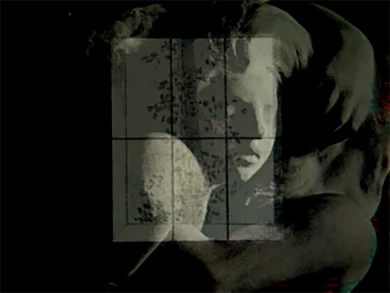
The second session screens two medium-length films by Jean-Luc Godard and Anne-Marie Miéville on time, ruin and museum. In The Old Place. Small Notes Regarding the Arts at Fall of 20th Century (1999), both film-makers consider what remains of that “old place”, the museum, at the close of a century of wars and totalitarianism, and ask whether it should be more of a legend or desire than a place. This same driving principle leads Godard to build his own imaginary museum in Reportage amateur (maquette expo) (2006), a rickety toy museum which, paradoxically, contains the great film-maker’s full power of thought on history and images.
Finally, the third session explores one of the major challenges of recent years: the decolonisation of the museum, the recognition of its link to imperialist discourses of power and the need to situate a new silenced or repressed subject at the centre of the Western narration of history. Under the title Museums and Restitution, it includes the film Undocumented. Unlearning Imperial Plunder (2019), by theorist Ariella Azoulay, Statues Also Die, by Alan Resnais and Chris Marker (1953), Kwate Nee-Owoo’s You Hide Me (1970) and the first screening of the short film Quinto verso, parte de Tonada (Fifth Verse, Part of Tonada), by La Vulcanizadora (Maria Rojas Arias and Andrés Jurado), filmed at the Museo de América in Madrid.
![Ariella Azoulay, Un-documented. Unlearning Imperial Plunder [Indocumentados. Desaprendiendo el saqueo imperial], 2019, película](https://recursos.museoreinasofia.es/styles/small_landscape/public/Actividades/5.diseminar-mundo.jpg.webp)
Museums and Restitution
Saturday, 19 September 2026 - 7pm
Centuries of plundering, decades of amnesia, years of living with unmitigated extractivist power… Does a museum, as we know it, have a raison d'être in a postcolonial society?
This session expounds the operations of the museum as a colonial machine, while putting forward ideas, in narration, for a more just, equal and inclusive institution of the future via society’s marginalised and minority voices. The session begins with the international premiere of Quinto verso, parte de Tonada (Fifth Verse, Part of Tonada), which presents a vision of the Quimbaya Collection (fifth and sixth centuries CE) from the Museo de América in Madrid. It is constructed with the voices and chants of Wayúu mourners and guides, not only as a way of reinstating the role of these gold idols — anthropomorphic figures of men and women used as vessels in ritual practices — but also to imagine that what must be exhibited is not the gold itself. It is the ritual’s own chant. In the classic film You Hide Me (1970), Ghanaian film-maker Kwate Nee-Owoo accesses the British Museum’s collection of African art, located in the building’s basement, to question the meaning behind a museum plundering and nullifying. A fine exercise of first-person institutional critique screened for the first time in Spain. Almost seventy years since Resnais and Marker made Statues Also Die (1953), a reflection on the aura-bearing value of the museum opposite the identity-based and cultural belonging of African art, theorist Ariella Azoulay films the same statues again at the Musée du Trocadéro (today the Musée du Quai Branly), which survive and wait to be reunited with their people. Azoulay, whose wholly original undertaking is a lesson to the museum of the future, connects the forced migration of these sculptures with the mass transit of people crossing borders artificially imposed by the same system that has plundered their culture.
The School of Transformative Institutionalism and Local Organisation
From 21 to 24 September 2026
The School of Transformative Institutionalism and Local Organisation (S.T.I.L.O.) is a programme of joint learning and join strategy which sets in motion a process for the exchange of questions, methodologies and experiences between cultural organisations. The overall aim is to create, circulate and prototype tactics, tools and collective knowledge on institutional practices that open new channels for defending culture and advocating structural transformation in divergent geographical contexts.
The project is part of the Laboratorio de Institucionalidad Compartida (The Laboratory of Shared Institutionalism, LIC), a space for the Museo Reina Sofía’s research, work and advocacy centred on developing, experimenting with and systemising practices, protocols and tools which contribute to a fairer and more liveable cultural ecosystem.
For many years now, so-called infrastructural critique in museums questions material, legal and economic infrastructures, among others, as well as the forms of solidarity and practices required to sustain the cultural ecosystem. By approaching current debates, S.T.I.L.O. raises questions on the ways in which organisations define and interpret their practices, organise their relations and respond to the social contexts in which they operate.
The school gathers four cultural organisations that work via different institutional models – scale, contexts, conditions, different working models — with the goal of pooling common strategies and tools of organisation, advocacy and relationships with local communities.
The programme is conceived as a collaborative process with the participation of Arika, La Revuelta, BAK Basecamp and The Tentacular Museum (Museo Reina Sofía) and is structured around preparatory online sessions and an in-person seminar in Madrid.
S.T.I.L.O. is an activity framed inside the working strand of Situated Organisations from L'Internationale’s Museum of the Commons project, which reflects on the role of museums and art organisations as actors within complex social networks and ecosystems, with a view to exploring new ways to democratise institutions and make them more open, inclusive and useful.