-
17 and 18 May, 2014
Guided tours
The Museo offers guided tours along the course of its opening hours on both Saturday 17 May and Sunday 18 May, with visits being held every hour from 10.30 a.m. onwards. The programme of visits includes tours around the diverse sections that compose the Collection, a tour through Guernica and its historical contextualisation and a visit to the Playgrounds exhibition.
Aimed at: the general public
Date: 17 and 18 May
Meeting point: the connection between Buildings, Floor 1
Time: From 10.30 a.m. onwards
Length : A maximum of one hour and thirty minutes per visit
Admission : Free, until full capacity is reached
Capacity: 25 people per visitSaturday 17
10.30 a.m. Guernica. A tour through Guernica and its historical contextualisation.
11.30 a.m. Collection 1. A tour around historical Avant-garde movements from the perspective of women as motifs and artists.
12.30 p.m. Collection 2. Body tour, a journey through this core theme to post Second World War artistic creation.
1.30 p.m. Collection 3. A tour that recounts artistic creation from the 1960s to the 1980s, emphasising the new role of art and the artist.4.30 p.m. Guernica. A tour through Guernica and its historical contextualisation.
5.30 p.m. Collection 1. A tour around historical Avant-garde movements from the perspective of women as motifs and artists.6.30 p.m. Collection 2. Body tour, a journey through this core theme to post Second World War artistic creation.
7.30 p.m. Collection 3. A tour that recounts artistic creation from the 1960s to the 1980s, emphasising the new role of art and the artist.
Sunday 18
10.30 a.m. Guernica. A tour through Guernica and its historical contextualisation.
11.30 a.m. Collection 1. A visit that highlights the diversity of the work explored by artists along the first three decades of the 20th century.
12.30 p.m. Collection 2. Body tour, a journey through this core theme to post Second World War artistic creation.
1.30 p.m. Playgrounds. A guided tour of the temporary exhibition Playgrounds. Reinventing the Square.
4.30 p.m. Guernica. A tour through Guernica and its historical contextualisation.
5.30 p.m. Collection 1. A visit that highlights the diversity of the work explored by artists along the first three decades of the 20th century.
5.30 p.m. Playgrounds. A guided tour of the temporary exhibition Playgrounds. Reinventing the Square. -
17 May, 2014
Workshop-Encounter for young people
Admission: free
Capacity: 20 young people from 13 to 18 years of age
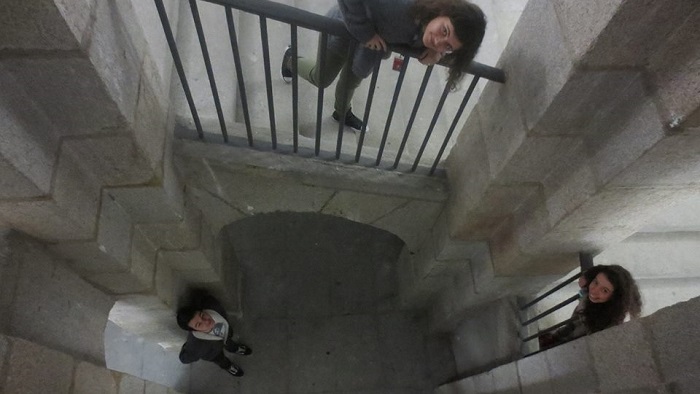
Registration: Via email at: hastadieciocho@museoreinasofia.es or by phone: +34 91 774 10 00 Ext. 2096Based around the theme proposed by the IMD, in reference to the bonds created by museum collections, the Team, a group of young people that collaborate with the Museo Reina Sofía, will prepare a special activity that aims to explore the relationship between young people, both male and female aged between 13 and 18, and the Museo Reina Sofía, making it a space for encounters and exchanges.
Therefore, the young participants will have the chance to discover, through performances and different group dynamics, spaces that go unnoticed by the average visitor, as well as alternative ways of approaching the works inside the Museo. The rediscovery of the Museo in a group will take place over two hours on the afternoon of Saturday 17 May. After this journey around the spaces inside the Museo, the young people will be able to enjoy an afternoon snack organised by members of the Team.
-
18 May, 2014 Nouvel Building, Auditorium 400
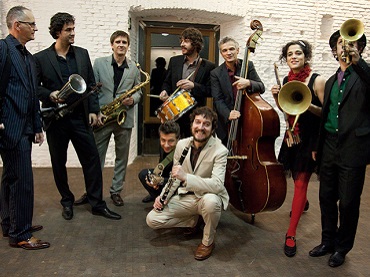
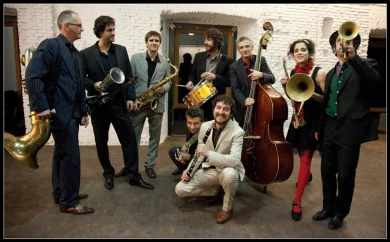
Mastretta and his band. Family concert
Admission: Free, with prior ticket collection at the Museo Ticket Offices from 5 May, up to thirty minutes before the performance. A maximum of five tickets (two adults and three children) will be allocated to each person. Places for wheelchair users and hearing loops are available. If you require any of these services, please write to: accesibilidad@museoreinasofia.es
A family-oriented concert that brings together the extensive experience of Nacho Mastretta, a renowned multi-instrumentalist and composer, and the backdrop of the stimulating collections inside the Museo. Mastretta’s band, made up of eight musicians that effortlessly move between different musical styles – from jazz to rock via fusion – will perform a set created specifically for the Museo, where the music will enter into dialogue with a selection of audiovisual pieces from the Collection.
The combination of the visual experience with sound, improvisation and the trust and familiarity between the band and its audience, not to mention the playfulness and humour involved, are the keys to a show that will see an audience made up of children and adults of all ages as the focal point.
-
18 May, 2014 Nouvel Building, Auditorium 400
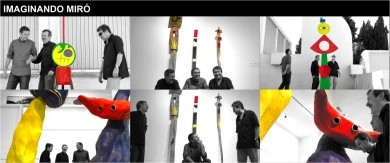
Imagining Miró. Concert and audiovisual performance by the Ignasi Terraza Trio
Admission: Free, with prior ticket collection at the Museo Ticket Offices from 5 May, up to thirty minutes before the performance. A maximum of two tickets will be allocated to each person.
Places for wheelchair users and hearing loops are available. If you require any of these services, please write to: accesibilidad@museoreinasofia.esJazz and painting shake hands in the Suite Miró, a series of pieces inspired by works from the Catalan artist, composed by Ignasi Terraza and played by his Trio. The Suite Miró premiered last year at the National Gallery of Art, Washington, and is presented in Madrid for the first time.
In 1966 Duke Ellington visited Joan Miró in his Nice studio, and played a couple of tunes surrounded by some of his sculptures. This meeting, captured on film, serves as an introduction to the performance created by Ignasi Terraza: a production to make the mind wonder as it imagines Miró’s work through music and poetic description.In a secluded hall cloaked in semi-darkness, the rhythms and sounds produced by the Trio are submerged in the imagery of Miró’s work, recreated through poetic descriptions and thought-provoking pieces written by Carlota Polo, as well as images created by the video artist David Cid.
The performance is offered to visitors free of charge thanks to the support of the Orange Foundation and the ONCE Foundation and represents an inclusive cultural initiative aimed at people with or without visual impairments. One and all are invited to share the mental images and sound creations composed by the blind pianist Ignasi Terraza via the world of Miró.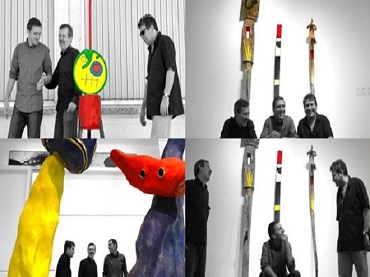
-
17 and 18 May, 2014 Nouvel Patio
Privolva Landing
Admission: Free
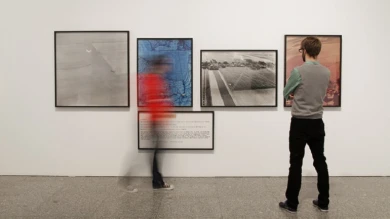
Privolva means the other side of the moon, the face never seen from the Earth. Three bodies move between the individual and the collective, and are interdependent and functional, like an efficient and unique body that creates the opportunity for survival or limitation. Privolva sets forth a choreographed hypothesis of bodies that become homogenised and work in series in a possible dystopian future, comprehending homogenisation as a safe, but equally limiting, place that dilutes identities. Privolva Landing is found within an undefined space, one that is multi-dimensional and poetic. And what if in the future we had shared individualities? And what if in the future bodies became homogenous? And what if to take a step forward meant we needed another to take that step? This dance piece, based around sci-fi imagery, is created and directed by Olatz de Andrés, who won First Prize in the Choreography Competition in Madrid.
Olatz de Andrés is a choreographer, dancer and art manager. Since 2010 she has co-managed the dance and creation space Muelle 3, in Bilbao.
Held on 17 May 2014
Once again, the Museo Reina Sofía joins the annual celebration of International Museum Day (IMD) with two open days and a selection of activities that aim to take a deeper look at the dialogue between the collections and the public, as well as reinforcing the idea of the museum as a space for non-disciplinary education and collective learning. The theme proposed by IMD this year, the ties created by museum collections, is a reminder of how museums are living institutions that allow bonds to be created between visitors and their collections, maintaining and reviving the relationship of a community and its history, and presenting spaces for dialogue between generations.
Along with other activities, the Museo presents an extensive programme of guided tours, a family concert performed by Mastretta and his band, the concert and audiovisual performance Imagining Miró, by the Ignasi Terraza Trio, and the dance piece Privolva Landing by the choreographer and dancer Olatz de Andrés.
Admission to the Museo is free on 17 and 18 May.
Organised by
Museo Reina Sofía
Educational program developed with the sponsorship of

Más actividades
![Mike Nichols, The Graduate [El graduado], 1967, película](https://recursos.museoreinasofia.es/styles/small_landscape/public/Actividades/ciclocine-piscinas-9_0.jpg.webp)
Mike Nichols. The Graduate
Friday, 31 July 2026
Benjamin Braddock (Dustin Hoffman) is a young graduate from a wealthy California family. After returning home he meets Mrs Robinson (Anne Bancroft), who seduces him in successive encounters and shows him things that can’t be read in books. Mrs Robinson’s daughter, Elaine (Katharine Ross), enters his life to turn his feelings upside down.
Anne Bancroft’s remarkable performance shows the need to feel alive in a world gone stale, and the weapons sex possesses opposite romantic love. This is the learning curve young Ben experiences, and it is the time he spends drifting in the swimming pool that takes him from bewilderment to lucidity. He goes from a fool in a wetsuit lost at the bottom of the pool, to letting himself sway on the waters of pleasure or to see the mantle of the pool covered in fallen leaves with the arrival of love. The swimming pool is the place that initiates a change of state: an awakening of life forces.
Sol Iglesias. The Swimmers
Saturday, 1 August 2026
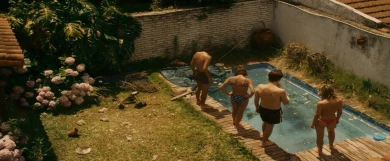
The end of the world, caused by climate change, is here and a group of friends wander from swimming pool to swimming pool at the height of a long, hot summer in Buenos Aires. From pool to pool, they cross the city, drifting leisurely and agreeably. In this transit they encounter different survivors searching desperately for water until their journey ends.
In echoing Frank Perry and Sydney Pollack’s film The Swimmer, Sol Iglesias’s The Swimmers is, equally, a path towards first light. The swimming pools symbolise, on this sunburnt stage, a metaphor at once for shelter and death by asphyxiation. It is the extreme heat that turns it into a fresh and pleasurable ending. The swimming pool, moreover, represents the lethargy of a youth tired of fighting against something they see as “inevitable”. As the young people trespass on a neighbourhood’s private property — rather than in public space — the pool is a stronghold of intimacy that must be seized: the false paradise of a collapsed society. The film brings the viewer closer to another film to feature in this series, La ciénaga (The Swamp, 2001) by Lucrecia Martel, in which bodies search for recesses of stagnant water.
Jack Hazan. A Bigger Splash
Friday, 7 August 2026
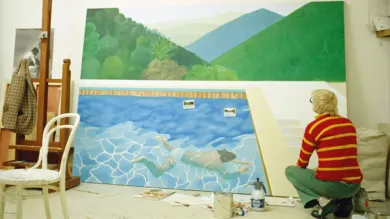
Painting endows a fleeting and unique moment with permanence and stability. This was the vision of the late David Hockney when, brushstroke by brushstroke, he returned to the swimming pool in A Bigger Splash: the great dive into a Californian pool which freezes a sense of happiness. A splash made by Peter Schlesinger, the painter’s partner from whom he has just separated.
In the film A Bigger Splash, Jack Hazan portrays the world of a successful artist, art-market and art-dealer pressure, the tension between the ego and personal frailty, and the obligation to continue with a style and iconography which, despite its instantly recognisable artistic imprint, creates doubts for the painter. In a grey, rainy London, a glum Hockney, the victim of soured love, keeps returning to the Californian swimming pool that holds the promise of happiness, in the form of a homosexual Arcadia in which the painter lives with his young partner and a group of equally glowing and attractive friends. Ultimately, the pool, as Jack Hazan recalls in this pioneering artist’s documentary, is a simile for the same painting in its original intention: hang onto fleetingness to lend it a permanence for the beholder, despite it not existing. Hockney, as one of the last great painters, knew his medium remained largely unchanged across hundreds of years of history.
Six Swimming Pools. A Dive into Experimental Film
Saturday, 8 August 2026
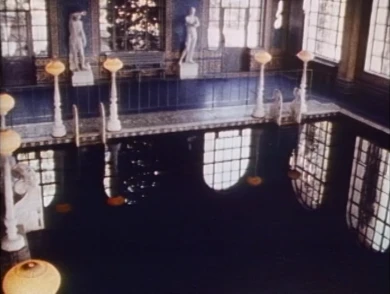
For the first time, the Museo’s summer cinema programme includes an experimental film section, centred on the experience and feeling of bodies under water. This session glides between the ostentatious aquatic architecture of Barbara Hammer and Barbara Klutinis and Jakobois’s fantasies, fleeting contact and wet, sexualised bodies. Six completely different swimming pools — private, public, transparent, bottomless, indoor, outdoor — all designed for leisure, competition and desire, nonetheless. A journey ranging from the monumentality of architecture to the intimacy of wet bodies.
Pools, by Barbara Hammer and Barbara Klutinis, turns swimming pools designed by pioneering architect Julia Morgan for the castle of tycoon William Randolph Hearst — the inspiration for Citizen Kane — into a space of play, bodily exploration and queer appropriation, an excuse to dive into a scene reserved for privilege. In An Algorithm, Bette Gordon fragments a series of headfirst dives and turns the sporting gesture into a visual score of repetitions, variations and rhythms. Tony Hill’s Water Work seduces with perspective, reflections and depth — the swimming pool as optical illusion, as an unstable surface which distorts and multiplies the gaze. Cheap Imitation “They Walk and I Walk”, by Rickard Eklund, submerges the camera to capture a choreography of synchronized bodies, a dance suspended under water. Naked bodies that dodge, twist and embrace in a space seemingly with no gravity combine in Gunilla Leander’s All Under. Passage du désir, by Jakobois, closes the programme with a montage in which water is no longer an environment, becoming instead a territory of desire.
Dominga Sotomayor. Debajo and Thais Fujinaga. A Felicidade das Coisas
Friday 14 August 2026
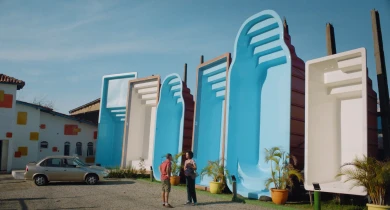
Two gems, from two new voices in Latin American cinema, which swing between families, swimming pools, reencounters and status. In Debajo, a short film on youth by Chilean director Dominga Sotomayor, an abstract yet powerful bird’s-eye view of a swimming pool co-exists with the relationships of a crisis-stricken family, gathered to see an eclipse. Sotomayor’s distinctive film-making of care and affects shares a similar space to the daily naturalism of Thais Fujinaga’s A Felicidade das Coisas. In the director’s first feature film, the swimming pool is not a horizontal basin for swimmers’ immersion; rather it is a huge vertical monolith, a kind of an anti-monument, anchored in the garden of a middle-class family. The film conveys the efforts and challenges of a mother of two children to build a swimming pool in their modest summer house, a mother who, alone, comes up against a hypermasculine world. Equally, the film speaks of family love, and the search for status, with the swimming pool a languishing totem of the Brazilian middle class during the years of Bolsonarism.