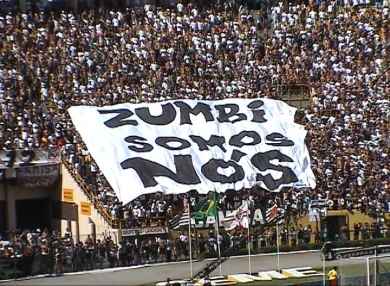
Frente 3 de Fevereiro, Bandeiras (Flags), 2006, action, video
Museo Reina Sofía Collection
Held on 22 Nov 2025
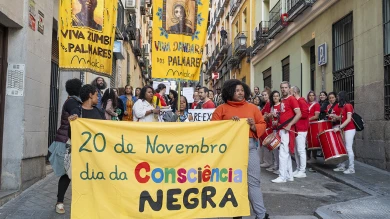
Museo Situado and the Maloka Brazilian Cultural Association come together to offer this artistic, historical and social activity in conjunction with Black Consciousness Day in Brazil, which pays homage to Dandara and Zumbi dos Palmares, universal symbols of Afro-Brazilian resistance and the fight against slavery.
In the activity, dance, poetry and performance become tools of memory and resistance via a programme which surveys the history of samba, from its origins in Bahia to its consolidation in Rio de Janeiro. It features the participation of more than ten Brazilian artists and pays homage to key figures in samba such as Tia Ciata, Clementina de Jesús, Cartola, Dona Ivone Lara, Elza Soares, Martinho da Vila and Alcione.
Further, the event seeks to shine a light on the richness of Afro-Brazilian culture while opening a space of reflection on resistance to racism throughout history and today, as well as inequality and disregard. In the words of philosopher Sueli Carneiro (2000), “the fight for the rights of black women and the community of African descent is inseparable from the rescue of history and the memory of our ancestors”. It is an artistic and vindicatory celebration that invites the whole community to aquilombarse: to come together, celebrate and affirm collective memory, for, as sociologist Florestan Fernandes (1976) affirmed, “the history of peoples of African descent can only be understood through the active resistance to oppression”. Long live Dandara. Long live Zumbi. Long live Afro-Brazilian ancestry.
Organised by
Museo Situado and the Maloka Brazilian Cultural Association
With the support of
The Brazilian Embassy and the Guimarães Rosa Foundation

Accessible activity
Access information
Free personal magnetic induction loop service. This equipment can be requested from the designated points in the Museo. More information
Participants
Asociación Cultural Brasileira Maloka
is an organisation, based in the Lavapiés neighbourhood, which works to disseminate Brazilian culture in Madrid. Over the past twenty-one years, it has organised activities to promote the richness and diversity of Brazilian Afro-Indigenous culture, and to offer a space where artists and communities can share their creations and traditions. Their main initiatives include: Black Consciousness Day, the Pachamama Carnival, the Música Brasileira de Autor Festival (FEMBA) and the Lxs Niñxs Traditional Fiesta.
Alabê
is a percussionist and multi-instrumentalist with a solid professional trajectory developed between Brazil and Spain for more than three decades. Alabê’s talent, versatility and in-depth knowledge of percussion have led to collaborations with salient samba groups, with a style that fuses the rhythmic wealth of Brazilian tradition with contemporary influences.
Jeane Bonfim
is a dancer, percussionist and capoeirista. In Madrid she previously worked as a percussion teacher and contributed to forming the Batucada Feminista da Maloka group. She is currently working on different Afro-Brazilian dance projects, where she researches and interprets the dance genre to rescue ancestry and recover artistic forms rendered invisible over a long period. She is part of the Black Women’s March Steering Committee in Madrid.
Caroline Ferreira
holds a degree in Psychology and has aligned her trajectory towards dance, culture and activism. She trains in Brazilian and Latin ballroom dance and cultivates rhythms such as gafieira, no pé samba and forró, with an understanding of dance as a medium that connects to her roots and celebrates Brazilian identity. She is also the creator of the project Muvuca Brasil, focused on disseminating Brazilian artistic and cultural expression, and is part of the Black Women’s March Steering Committee in Madrid.
Carlos Mankuzo
arrived in Madrid from Pernambuco and soon integrated into Madrid’s music scene, collaborating with different artists. A maracatu teacher, he is an arts researcher by nature and one of the most respected percussion teachers in the Iberian Peninsula, as reflected in his myriad collaborations with bands and ensembles in Spain.
Eduardo Marreta
is a musician with a command not only of cavaquinho and the guitar, but also an array of percussion instruments. He also performs his own compositions. Marreta has participated in different cultural shows in Spain, including in the Teatro Real, and currently performs with Samba y Algo Más in Café Berlín in Madrid, as well as different samba projects and with Roda de Choro de Madrid.
Muzzangue
is a multidisciplinary visual artist, dancer, choreographer and social and cultural anthropologist with a post-graduate degree in the Culture and Thought of Black People and Gender Equality. In 2002, he received the “Best of Brazil in Europe” award from High Profile magazine and has collaborated with renowned national and international artists.
Wellington Nego Tinho
is a singer, composer, guitarist and percussionist. Since his arrival in Madrid, he has played and danced with different ensembles while developing his solo work, which encompasses samba, bossa nova and popular Brazilian music. For many years he has performed on different stages in the Spanish capital, most notably participating in different editions of FITUR, the International Tourism Trade Fair, and with different Spanish television channels during carnival.
Vane O. (Oliveira, Vanessa)
is a deep-voiced and mixed-race-soul singer. Her music fuses Afro and Indigenous roots with contemporary sound that celebrates life and nature. After stints with choral ensembles and the music school from Madrid’s Sierra Norte, she pays homage to the female figure in samba, evoking the voices of Black people and ancestral women and mothers who sing from memory to be heard, recognised and exalted. An activist for racial and gender justice, she is part of the Black Women’s March Steering Committee in Madrid.
Edimundo Santos
is a singer, composer and guitarist. In 2014, he was invited by the Teatro Defondo company to be the musical director on the work La ópera del malandro, by Chico Buarque, performed at Madrid’s Teatro Fernán Gómez. He also participated at FITUR 2024.
Georgina Santos da Silva
is a Brazilian art educator, curator and cultural researcher who lives in Madrid. She also holds a PhD in Education from the Autonomous University of Barcelona. Her work connects art, film and popular culture as tools of mediation and social transformation as she focuses her practice on cultural diversity, the creation of networks and the collective construction of memory. She has created projects such as the Cine de Andada and Cine Caipirinha film societies, and has collaborated with institutions such as Patrimonio Nacional, the Galería Capibaribe and the Museo Nacional de Arte in Bolivia.
Roberta Xavier, Robertiña
grew up around the Beija-Flor de Nilópolis samba school in Rio de Janeiro, the source of her passion for samba. She has lived in Madrid since the age of nineteen, graduating in Labour Relations and Human Resources at the Complutense University of Madrid. She combines her work with dance.


Más actividades
![Mike Nichols, The Graduate [El graduado], 1967, película](https://recursos.museoreinasofia.es/styles/small_landscape/public/Actividades/ciclocine-piscinas-9_0.jpg.webp)
Mike Nichols. The Graduate
Friday, 31 July 2026
Benjamin Braddock (Dustin Hoffman) is a young graduate from a wealthy California family. After returning home he meets Mrs Robinson (Anne Bancroft), who seduces him in successive encounters and shows him things that can’t be read in books. Mrs Robinson’s daughter, Elaine (Katharine Ross), enters his life to turn his feelings upside down.
Anne Bancroft’s remarkable performance shows the need to feel alive in a world gone stale, and the weapons sex possesses opposite romantic love. This is the learning curve young Ben experiences, and it is the time he spends drifting in the swimming pool that takes him from bewilderment to lucidity. He goes from a fool in a wetsuit lost at the bottom of the pool, to letting himself sway on the waters of pleasure or to see the mantle of the pool covered in fallen leaves with the arrival of love. The swimming pool is the place that initiates a change of state: an awakening of life forces.
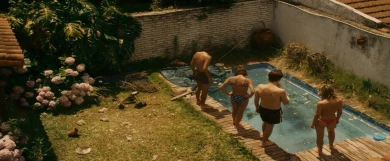
Sol Iglesias. The Swimmers
Saturday, 1 August 2026
The end of the world, caused by climate change, is here and a group of friends wander from swimming pool to swimming pool at the height of a long, hot summer in Buenos Aires. From pool to pool, they cross the city, drifting leisurely and agreeably. In this transit they encounter different survivors searching desperately for water until their journey ends.
In echoing Frank Perry and Sydney Pollack’s film The Swimmer, Sol Iglesias’s The Swimmers is, equally, a path towards first light. The swimming pools symbolise, on this sunburnt stage, a metaphor at once for shelter and death by asphyxiation. It is the extreme heat that turns it into a fresh and pleasurable ending. The swimming pool, moreover, represents the lethargy of a youth tired of fighting against something they see as “inevitable”. As the young people trespass on a neighbourhood’s private property — rather than in public space — the pool is a stronghold of intimacy that must be seized: the false paradise of a collapsed society. The film brings the viewer closer to another film to feature in this series, La ciénaga (The Swamp, 2001) by Lucrecia Martel, in which bodies search for recesses of stagnant water.
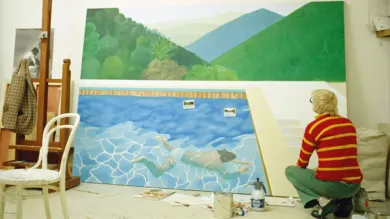
Jack Hazan. A Bigger Splash
Friday, 7 August 2026
Painting endows a fleeting and unique moment with permanence and stability. This was the vision of the late David Hockney when, brushstroke by brushstroke, he returned to the swimming pool in A Bigger Splash: the great dive into a Californian pool which freezes a sense of happiness. A splash made by Peter Schlesinger, the painter’s partner from whom he has just separated.
In the film A Bigger Splash, Jack Hazan portrays the world of a successful artist, art-market and art-dealer pressure, the tension between the ego and personal frailty, and the obligation to continue with a style and iconography which, despite its instantly recognisable artistic imprint, creates doubts for the painter. In a grey, rainy London, a glum Hockney, the victim of soured love, keeps returning to the Californian swimming pool that holds the promise of happiness, in the form of a homosexual Arcadia in which the painter lives with his young partner and a group of equally glowing and attractive friends. Ultimately, the pool, as Jack Hazan recalls in this pioneering artist’s documentary, is a simile for the same painting in its original intention: hang onto fleetingness to lend it a permanence for the beholder, despite it not existing. Hockney, as one of the last great painters, knew his medium remained largely unchanged across hundreds of years of history.
Six Swimming Pools. A Dive into Experimental Film
Saturday, 8 August 2026
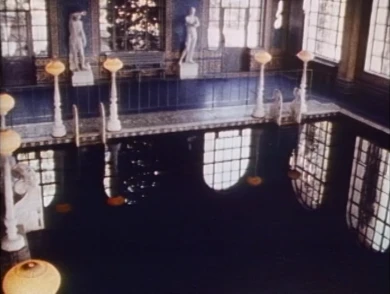
For the first time, the Museo’s summer cinema programme includes an experimental film section, centred on the experience and feeling of bodies under water. This session glides between the ostentatious aquatic architecture of Barbara Hammer and Barbara Klutinis and Jakobois’s fantasies, fleeting contact and wet, sexualised bodies. Six completely different swimming pools — private, public, transparent, bottomless, indoor, outdoor — all designed for leisure, competition and desire, nonetheless. A journey ranging from the monumentality of architecture to the intimacy of wet bodies.
Pools, by Barbara Hammer and Barbara Klutinis, turns swimming pools designed by pioneering architect Julia Morgan for the castle of tycoon William Randolph Hearst — the inspiration for Citizen Kane — into a space of play, bodily exploration and queer appropriation, an excuse to dive into a scene reserved for privilege. In An Algorithm, Bette Gordon fragments a series of headfirst dives and turns the sporting gesture into a visual score of repetitions, variations and rhythms. Tony Hill’s Water Work seduces with perspective, reflections and depth — the swimming pool as optical illusion, as an unstable surface which distorts and multiplies the gaze. Cheap Imitation “They Walk and I Walk”, by Rickard Eklund, submerges the camera to capture a choreography of synchronized bodies, a dance suspended under water. Naked bodies that dodge, twist and embrace in a space seemingly with no gravity combine in Gunilla Leander’s All Under. Passage du désir, by Jakobois, closes the programme with a montage in which water is no longer an environment, becoming instead a territory of desire.
Dominga Sotomayor. Debajo and Thais Fujinaga. A Felicidade das Coisas
Friday 14 August 2026
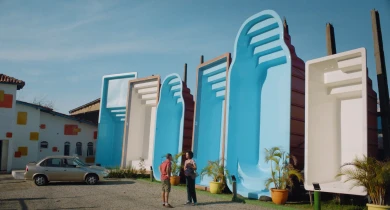
Two gems, from two new voices in Latin American cinema, which swing between families, swimming pools, reencounters and status. In Debajo, a short film on youth by Chilean director Dominga Sotomayor, an abstract yet powerful bird’s-eye view of a swimming pool co-exists with the relationships of a crisis-stricken family, gathered to see an eclipse. Sotomayor’s distinctive film-making of care and affects shares a similar space to the daily naturalism of Thais Fujinaga’s A Felicidade das Coisas. In the director’s first feature film, the swimming pool is not a horizontal basin for swimmers’ immersion; rather it is a huge vertical monolith, a kind of an anti-monument, anchored in the garden of a middle-class family. The film conveys the efforts and challenges of a mother of two children to build a swimming pool in their modest summer house, a mother who, alone, comes up against a hypermasculine world. Equally, the film speaks of family love, and the search for status, with the swimming pool a languishing totem of the Brazilian middle class during the years of Bolsonarism.