-
February 22, 2013 ECAM (Calle Juan de Orduña, 3. Ciudad de la Imagen. 28223 Pozuelo de Alarcón, Madrid)
Eduardo Coutinho. Masterclass
Time: 12 noon
The filmmaker looks back at his work, which he has built over the years with the idea that documentary is always a marginalized genre. On the one hand, in the sense of it being a minor genre that is usually side-lined with respect to fiction film; and on the other hand, because of its ability to merge with an idea about reality and the subject that is very distinct from the resources of deception and idealization that characterise fiction film.
Presented and moderated by Sergio Oksman
-
February 23 and March 11, 2013 Sabatini Building, Auditorium
Cabra marcado para morrer
1984, colour/BW, 116’. Screening format: 35mm and DVD
Time: 7 p.m.
*February 23: Encounter with Eduardo Coutinho and Berta SichelAt the beginning of the 1960s, the peasant leader João Pedro Teixeira was killed by order of the landowners of north-eastern Brazil. Coutinho decided to make a film about his life, starring the peasants themselves, but he had to stop filming because of the military coup that took place in 1964. Seventeen years later he returned to the project, seeking out Teixeira's widow and ten children, and examining the lives of each of them during the long years of the military regime.
-
February 27 and March 20, 2013 Sabatini Building, Auditorium
Santa Marta – Duas semanas no morro and Boca do Lixo
Time: 7 p.m.
Santa Marta – Duas semanas no morro
1987, colour, 54’. Screening format: DVD
and
Boca do Lixo. 1993, colour, 49’. Screening format: Blu-ray
Coutinho and his crew spent two weeks in Morro Santa Marta, a favela in the southern part of Río de Janeiro, filming the daily lives of its inhabitants. Religiosity, music, violence, racism and the dreams of young people are treated with the sensitivity characteristic of Coutinho's interviews.
Boca do Lixo reveals the extreme economic inequalities existing in Brazil, with its portrayal of the waste pickers of the region of São Gonçalo, 40km from Río de Janeiro. There, the lack of any real employment opportunity leads many families to try to make a living from garbage, in deplorable conditions.
-
March 1 and March 21 Sabatini Building, Auditorium
Santo Forte
1999, colour, 49’. Screening format: DVD
Time: 7 p.m.
In the time elapsing between the Pope's visit to Río de Janeiro and, a few months later, the festivities of the Christmas season, Coutinho interviews Catholics, Evangelicals and practitioners of Umbanda, all from a favela in Rio. They talk about their communication with the supernatural through intervention by saints, deities or orishas.
-
March 2 and April 1 Sabatini Building, Auditorium
Babilônia 2000
2000, colour, 80’. Screening format: DVD
Time: 7 p.m.
Babilônia 2000, a documentary filmed on the last day of 1999, shows the preparations underway for New Year's Eve in the favelas Chapéu Mangueira and Babilônia. With over 4000 inhabitants, these are the only favelas located on the edge of Copacabana Beach where, at midnight, nearly one million people gather to watch the fireworks and celebrate. The people in the film talk about their expectations for the year 2000.
-
March 6 and April 3 Sabatini Building, Auditorium
Edifício Master
2002, colour, 110’. Screening format: DVD
Time: 7 p.m.
Over a period of seven days, a film crew recorded the lives of the residents of Edifício Master, an apartment building located one block from Copacabana Beach. The building has 12 floors and 23 units on each floor, with a total of almost 500 residents. Thirty-seven of these residents share their life stories, opening the doors to their homes and their private lives for the cameras.
-
March 7 and April 4 Sabatini Building, Auditorium
Peões
2004, colour, 85’. Screening format: DVD
Time: 7 p.m.
Documentary about the former metallurgical workers of the ABC Region of São Paolo, who took part in the strikes of the 1980s along with Luiz Inácio Lula da Silva. They talk about their origins, their participation in the workers' rights movement, their lives since then and their personal vision of the Lula government.
-
March 9 and April 5 Sabatini Building, Auditorium
O Fim e o Princípio
2005, colour, 110’. Screening format: DVD
Time: 7 p.m.
Coutinho and his crew travel to the inland areas of Paraíba – in north-eastern Brazil – in search of people who have a story to tell. Thanks to the mediation of a young man from the region, the inhabitants (mostly elderly people) talk about their lives, marked by popular Catholicism, hierarchy, the sense of family and honour - reflecting a world that has almost disappeared.
-
March 13 and April 6 Sabatini Building, Auditorium
Jogo de Cena
2007, colour, 106’. Screening format: DVD
Time: 7 p.m.
Responding to a newspaper ad, eighty-three women came to a film studio to tell their life-stories. Coutinho selected twenty-three of these testimonies and sent them to well-known Brazilian actresses who had been chosen to interpret these women's stories.
-
March 15 and April 8 Sabatini Building, Auditorium
Moscou
2009, colour, 78’. Screening format: DVD
Time: 7 p.m.
A film of the rehearsing process of Anton Chekhov's work The Three Sisters by the theatre group Galpão, directed by Enrique Díaz. The film includes fragments of workshops, improvisations and rehearsals of a play that did not, and never will, have a premiere.
-
March 16 and April 12 Sabatini Building, Auditorium
As Cançoes
2011, colour, 94’. Screening format: DVD
Time: 7 p.m.
Eduardo Coutinho and his crew go in search of ordinary people in downtown Río Janeiro, asking them to talk and sing the songs that have marked their lives. At the end, an interview with 42 people in a theatre, who tell stories related to those songs.
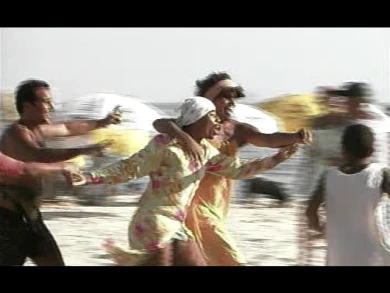
Held on 22, 23, 27 Feb, 01, 02, 06, 07, 09, 11, 13, 15, 16, 20, 21 Mar, 01, 03, 04, 05, 06, 08, 12 Apr 2013
Eduardo Coutinho (São Paulo, 1933) is an essential name in Latin American documentary film. His work is shaped by political issues but manages to avoid propaganda, as he addresses the everyday lives and the subjectivities of marginal majorities with a sensibility not altered by melodrama. Coutinho has performed his professional activity in several fields, including law, theatre, and both print and television journalism. His first contact with film occurred when he was the editor of the magazine Visão. His work with the television staff of Globo Repórter, for decades the most popular documentary program in Brazil, enabled him, despite the censorship in place at the time, to conduct in-depth documentation on numerous topics: the drought and the harshness of agricultural work, the banditry plaguing the north-eastern part of the country, the lives of public figures, such as Colonel Teodorico Bezerra and the painter Cándido Portinari, among others.
After the success of his documentary Cabra marcado para morrer (1984), highly praised by critics all over the world (and the winner of the Grand Coral, the top prize at the Havana Film Festival as well as the Golden Toucan in Río de Janeiro), Coutinho left the staff of Globo Repórter to work in the production of video documentaries and to write scripts for series made by TV Manchete. At the same time, he made his own documentaries, creating works such as O Fio da Memória which, coinciding with the centennial of the abolition of slavery, analyses the presence of black people in Brazilian culture and history. Other films of his include Boca do Lixo, Santa Marta-duas semanas no Morro, O Jogo da Dívida and Romeiros do Padre Cícero. Starting in 1999, Coutinho returned to feature-length films in digital video (later transferred to 35 mm) and he directed films such as Santo Forte, Babilônia 2000, Edifício Master, Jogo de cena and As Cançoes.
Coutinho's cinema has been defined by Consuelo Lins from the perspective of "the ethics of cruelty" but not in the sense of maintaining or showing suffering, but rather in that of rejecting complacency in his relationship with the subjects or situations he shows throughout his filmmaking career.
Distributed by
Videofilmes, Brasil
35 mm copy of Cabra marcado para morrer from the Cinemateca Brasileira
Organised by
Museo Reina Sofía
In collaboration with
Festival Punto de Vista, the Embassy of Brazil, Spanish-Brazilian Culture Foundation and ECAM (Film and Audiovisual School of the Community of Madrid)
Curatorship
Berta Sichel

Más actividades
![Joseph Kosuth. One and Three Chairs [Una y tres sillas]](https://recursos.museoreinasofia.es/styles/small_landscape/public/Actividades/joseph_kosuth.jpg.webp)
The (legal) person and the legal form. Chapter III
Monday 11, Wednesday 13 and Thursday 14 May 2026
As part of the Studies Constellation, the Study Directoship’s annual fellowship, art historian and theorist Sven Lütticken leads the seminar The (Legal) Person and the Legal Form: Theoretical, Artistic, and Activist Commitments to foster dialogue and deepen the hypotheses and questions driving his research project.
The seminar consists of eight sessions, divided into three chapters throughout the academic year. While conceived as non-public spaces for discussion and collective work, these sessions complement, nourish, and amplify the public program of the Studies Constellation.
First session of the third chapter focuses on the transformation of the artwork in the context and wake of Conceptual art. The very notion of the artwork, together with its ownership and authenticity, is reconsidered from a broad perspective open to new and alternative models of management, which could ultimately transform the relationship between artist, artwork and owner. Can some of the practices in question serve as critical models? To what extent is it possible to think and act with them, and extrapolate from them, beyond a beautiful niche?
The second session turns to the question of representation. While many (but not all) human natural persons can, in principle, represent themselves in legal matters, other needs representatives. This goes for minors as well for adults who have been placed under legal guardianship; it applies to fictitious persons such as corporations and states, who need human representatives to sign contracts or defend them in court. We will look into the question of legal representation in conjunction with other forms of representation, in the cultural as well as political register—taking cues from Spivak’s distinction between portrait (Darstellung) and proxy (Vertretung), which is an unstable and historically mutable one.
The seminar concludes with a closing session dedicated to collectively revisiting and reflecting on the themes and discussions that have emerged throughout the first Studies Constellation Residency Program.
Patricia Falguières
Tuesday May 12th 2026 – 19:00 h
Art historian Patricia Falguières inaugurates the María Luisa Caturla Chairwith the lecture Art History in Dark Times. This Chair, dedicated to the reflection on art in times «sick with uncertainty», is aimed at dismounting, digressing and imagining multiple temporalities and materialities in art history and cultural studies from an eccentric gaze, in the sense of being displaced, off-centre or with a centre that is different.
The lecture’s title references Hannah Arendt’s collection of essays Men in Dark Times, which in turn paraphrases a Bertol Brecht poem. In it, Arendt asserts «dark times are not only not new, they are no rarity in history».
Patricia Falguières also claims history knows many periods when the public realm has been obscured, when the world becomes so uncertain that people cease to ask anything of politics except to relieve them of the burden of their vital interests and their private freedom. The art historian —whose expertise is in the field of Renaissance art and philosophy but paying close attention to contemporaneity— invites us to a «chaotic and adventurous journey», from the Italian Renaissance to Fukushima, through which to delve into the questions: What can the practice of art history mean today, in a world ablaze with ominous glimmers and even more ominous threats, if not as mere entertainment or social ornament? Of what vital interests, of what freedom can it bear witness and serve as an instrument?
![Tracey Rose, The Black Sun Black Star and Moon [La luna estrella negro y negro sol], 2014.](https://recursos.museoreinasofia.es/styles/small_landscape/public/Obra/AD07091_2.jpg.webp)
On Black Study: Towards a Black Poethics of Contamination
27, 28, 29 ABR 2026
The seminar On Black Study: Towards a Black Poethics of Contamination proposes Black Study as a critical and methodological practice that has emerged in and against racial capitalism, colonial modernity and institutional capture. Framed through what the invited researcher and practitioner Ishy Pryce-Parchment terms a Black poethics of contamination, the seminar considers what it might mean to think Blackness (and therefore Black Study) as contagious, diffuse and spreadable matter. To do so, it enacts a constellation of diasporic methodologies and black aesthetic practices that harbor “contamination” -ideas that travel through texts, geographies, bodies and histories- as a method and as a condition.
If Blackness enters Western modernity from the position of the Middle Passage and its afterlives, it also names a condition from which alternative modes of being, knowing and relating are continually forged. From within this errant boundarylessness, Black creative-intellectual practice unfolds as what might be called a history of touches: transmissions, residues and socialities that unsettle the fantasy of pure or self-contained knowledge.
Situated within Black radical aesthetics, Black feminist theory and diasporic poetics, the seminar traces a genealogy of Black Study not as an object of analysis but as methodological propositions that continue to shape contemporary aesthetic and political life. Against mastery as the horizon of study, the group shifts attention from what we know to how we know. It foregrounds creative Black methodological practices—fahima ife’s anindex (via Fred Moten), Katherine McKittrick’s expansive use of the footnote, citation as relational and loving labour, the aesthetics of Black miscellanea, and Christina Sharpe’s practices of annotation—as procedures that disorganise dominant regimes of knowledge. In this sense, Black Study is approached not as a discrete academic field but as a feel for knowing and knowledge: a constellation of insurgent practices—reading, gathering, listening, annotating, refusing, world-making—that operate both within and beyond the university.
The study sessions propose to experiment with form in order to embrace how ‘black people have always used interdisciplinary methodologies to explain, explore, and story the world.’ Through engagements with thinkers and practitioners such as Katherine McKittrick, C.L.R. James, Sylvia Wynter, Christina Sharpe, Fred Moten, Tina Campt, Hilton Als, John Akomfrah, fahima ife and Dionne Brand, we ask: What might it mean to study together, incompletely and without recourse to individuation? How might aesthetic practice function as a poethical intervention in the ongoing work of what Sylvia Wynter calls the practice of doing humanness?

Mediations of the Archive: Art, Community, and Political Action
Tuesday 7, and Thursday 23, April, 2026 – 17:00 h
The online seminar Archival Mediations: Art, Community, and Political Action, curated by Sofía Villena Araya, examines the role of archival practices in caring for, dignifying, and activating memory in Central America. As part of the Cáder Institute for Central American Art’s first line of research, driven by the question “What Art Histories does Central America produce?”, this seminar proposes an approach to the archive as a mediator that articulates relationships between art, community, and political action, while engaging with the historiographical questions raised by their intersections.
Although the proposal is not limited to discussions of the Central American isthmus, it is framed by the particular conditions under which memory has been constructed in the region. Central America is a territory vulnerable to natural and geological disasters, marked by political violence exercised by authoritarian states and fragile institutions, a persistent colonial and imperial legacy, and the social fragmentation resulting from these factors. It is also a context in which the archive does not necessarily refer to a specific place —such as a building or documentary collection— nor does it primarily follow the protocols of a discipline such as archival science. Rather, the seminar explores how the archive operates, through art, as a dispositif that forges connections, generates forms of belonging, and opens spaces for political action.
The encounter unfolds across two sessions: the first focuses on archival practices addressing questions of memory, violence, and war; the second examines community-based practices surrounding queer and sex-dissident archives. In the face of the systematic destruction of memory, the archival practices discussed in these sessions demonstrate how the archive emerges in other spaces and according to different logics. Within this framework, the proposed space for exchange and research explores the role of art as a productive medium for constructing archives through images, affects, intimacy, performativity, the body, orality, and fiction, as well as through other materialities that challenge the centrality of the document and of writing.
Intergenerationality
Thursday, 9 April 2026 – 5:30pm
This series is organised by equipoMotor, a group of teenagers, young people and older people who have participated in the Museo Reina Sofía’s previous community education projects, and is structured around four themed blocks that pivot on the monstrous.
The third session gazes at film as a place from which to dismantle the idea of one sole history and one sole time. From a decolonial and queer perspective, it explores films which break the straight line of past-present-future, which mix memories, slow progress and leave space for rhythms which customarily make no room for official accounts. Here the images open cracks through which bodies, voices and affects appear, disrupting archive and questioning who narrates, and from where and for whom. The proposal is at once simple and ambitious: use film to imagine other modes of remembering, belonging and projecting futures we have not yet been able to live.