-
Museo Reina Sofía. Sabatini Building, Auditorium
Programme 1. Film-Essays
-
Monday, 4 November 2019 – 7pm / Museo Reina Sofía. Sabatini Building, Auditorium
Session 1
Second session: Wednesday, 4 December 2019 – 7pm
No Home Movie
Belgium and France, 2015, colour, original version in French with Spanish subtitles, digital archive, 115’With a recorded presentation by Claire Atherton, editor on many of Akerman’s films.
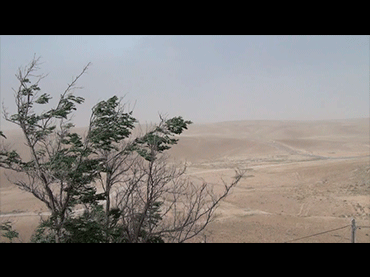
The last film made by Chantal Akerman. In No Home Movie, two worlds at odds reconcile: at one end there is the unchanging house of the mother in Brussels and the workload of traditions and customs; at the other is the life of Akerman, a nomadic, internationally renowned artist. Yet over the film hovers an awareness that both realities are necessarily complementary, resulting in a declaration of love from the film-maker to her mother, Natalia Akerman (1928–2014), an Auschwitz survivor and a powerful influence on her daughter. This is a highly intimate work, punctuated with autobiographical references and, after the death of the mother and the film-maker just months before it premiered, lauded as a masterly epilogue of an entire life.
-
Wednesday, 6 November 2019 – 7pm / Museo Reina Sofía. Sabatini Building, Auditorium
Session 2
Second session: Thursday, 5 December 2019 – 7pm
La chambre [The Room]
Belgium, 1972, colour, silent, digital archive, 11’Hotel Monterey
Belgium, 1972, colour, silent, digital archive, 63’With a recorded presentation by Babette Mangolte, cinematographer on many of Akerman’s films.
Chantal Akerman was just 21 when she arrived in New York. Two events were key to her life and professional experience: the city in the early 1970s, a place of economic bust and, therefore, a natural habitat for outsider lifestyles, for instance those that were part of the art scene she took an interest and became involved in; and her coming into contact with American structuralist film — with exponents like Michael Snow, Stan Brakhage and Jonas Mekas — through cinematographer and artist Babette Mangolte. It was from this movement that she learned about film-making with no point of view or narrative, a new language that was inextricably linked to the underground lives mentioned above. La chambre is a portrait of Akerman through a rotating camera panning a sublet apartment she lived in, representing a glimpse of life inside a structured visual system. Hotel Monterey, meanwhile, is centred on a welfare hotel, occupied by artists and social outcasts, akin to New York’s famous Hotel Chelsea. Akerman topographically shoots its architecture — taking in hallways, lobbies and rooms — articulating a portrait of the city through this site.
![Chantal Akerman. La chambre [The room]. Película, 1972](https://recursos.museoreinasofia.es/legacy_programs/2_4.gif "Chantal Akerman. La chambre [The room]. Película, 1972")
-
Thursday, 7 November 2019 – 7pm / Museo Reina Sofía. Sabatini Building, Auditorium
Session 3
Second session: Friday, 6 December 2019 – 7pm
News from Home
Belgium and France, 1976, colour, original version in French with Spanish subtitles, digital archive, 89’Tombée de nuit sur Shanghaï [Nightfall in Shanghai], episode from O Estado do Mundo [State of the World]
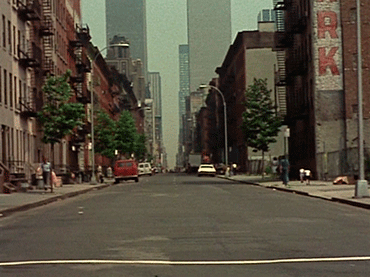
Portugal, 2017, colour, original version without dialogue, digital archive, 15’Regarded by Susan Sontag and Douglas Crimp as one of the most beautiful and sincere portraits of the city of New York, News from Home shows how personal experience intermingles with urban life, or how nostalgia for the past reverberates in the voracity of the present. Akerman reads real long-distance letters her mother wrote her from Brussels as she “draws” a personal map of New York’s streets and neighbourhoods. The analytical gaze and long takes by artist and cinematographer, Babette Mangolte, create the impression that the city is “acting” for the camera in a choreography of people, architecture and feelings.
-
Monday, 11 November 2019 – 6pm / Museo Reina Sofía. Sabatini Building, Auditorium
Session 4
Second session: Saturday, 7 December 2019 – 6pm
Dis-moi [Tell Me]
France, 1982, colour, original version in French with Spanish subtitles, digital archive, 45’This film for television sees Akerman interview three Jewish women whose mothers were victims of the Holocaust. The work is linked both to her own experience — he mother, Natalia Akerman, was a Polish Jew who managed to escape from Auschwitz — and to idiosyncratic aspects of Jewish culture, for instance triviality opposite severity or comedy in the face of tragedy. There is daily domestic life: the first thing is what we are going to eat today, the women tell us, and, alongside the weight of historical testimony, the film threads together a portrait of a surviving community via three unique cases.
![Chantal Akerman. Dis-moi [Tell me]. Film, 1982. Courtesy of Institut National de l'Audiovisuel, INA](https://recursos.museoreinasofia.es/legacy_programs/4_1.gif "Chantal Akerman. Dis-moi [Tell me]. Film, 1982. Courtesy of Institut National de l'Audiovisuel, INA")
-
Thursday, 21 November 2019 – 7pm / Museo Reina Sofía. Sabatini Building, Auditorium
Session 5
Second session: Monday, 16 December 2019 – 7pm
D'Est [From the East]
France and Belgium, 1993, colour, original version without dialogue, digital archive, 110’The first session is presented by Ana Useros, researcher, film programmer and organiser of the Chantal Akerman retrospective held in the Filmoteca Española in 2005.
“While there’s still time, I would like to take a big trip across Eastern Europe. To Russia, Poland, Hungary, Czechoslovakia, the former East Germany and back to Belgium. I want to film there in my own documentary style, at the edges of fiction. I want to film everything. Everything that touches me […] Why should I go on this trip around Eastern Europe? For historical, social and political reasons, reasons highlighted in many documentaries and reportage and which rarely allow a calm and attentive gaze. And, although they are important, they are not the only reasons. I will not try to show the disintegration of a system or the problems with moving into another one, because the person that searches, searches too hard […]. There may be personal reasons for going, and for sure there are […]”. Chantal Akerman.
![Chantal Akerman. D'Est [From the East]. Film, 1993](https://recursos.museoreinasofia.es/legacy_programs/5_2.gif "Chantal Akerman. D'Est [From the East]. Film, 1993")
-
Monday, 25 November 2019 – 7pm / Museo Reina Sofía. Sabatini Building, Auditorium
Session 6
Second session: Wednesday, 18 December 2019 – 7pm
Sud [South]
France and Belgium, 1999, colour, original version in English with Spanish subtitles, Digibeta, 70’South and De l'autre côté [From the Other Side, 2002] make up a diptych on violence in the United States. South explores racial hatred through the murder in Jasper, Texas, of James Byrd Jr, who was dragged to his death by a pickup truck driven by three white supremacists. Akerman contemplates how landscape and place preserve the symbols of this secular racism, and the movement of the camera in long-held shots takes us along the victim’s journey. To this end, the film-maker wrote: “How do the trees and the whole natural environment evoke death, blood and the weight of history? How does the present remind the past? And how does this past, with a simple gesture or simple consideration, chase and torment you while you walk through an empty cotton field or down a dusty road?”.
![Chantal Akerman. Sud [South]. Film, 1999](https://recursos.museoreinasofia.es/legacy_programs/6_1.gif "Chantal Akerman. Sud [South]. Film, 1999")
-
Tuesday, 26 November 2019 – 7pm / Museo Reina Sofía. Sabatini Building, Auditorium
Session 7
Second session: Thursday, 19 December 2019 – 7pm
De l'autre côté [From the Other Side]
Belgium, 2002, colour, original version in English, French and Spanish with Spanish subtitles, Digibeta, 102’As an accompaniment to Sud [South, 1999], this film addresses illegal migration from Mexico to the United States, living conditions and survival, depending on which side of the border you stand. It uses long, lingering landscape shots, focusing on the testimonies of family histories cut short and a wall marking a divide with its near totemic presence. In this instance, and not in keeping with the rest of her filmography, Akerman interviews immigrants face to face and uses her own voice-over to create an ethical space for the Other, following the formulations of philosopher Emmanuel Levinas, a major point of reference. There is also the contemporary vision of the Wild West: sublime nature, the sheriff, the irrational fear of foreigners as the apparent carrier of illnesses that characterise underdevelopment. A coda to the film is the highway and the non-stop movement of goods, for which there is no border.
![Chantal Akerman. De l'autre côté [From the Other Side]. Film, 2002](https://recursos.museoreinasofia.es/legacy_programs/7_1.gif "Chantal Akerman. De l'autre côté [From the Other Side]. Film, 2002")
-
Wednesday, 27 November 2019 – 7pm / Museo Reina Sofía. Sabatini Building, Auditorium
Session 8
Second session: Friday, 20 December 2019 – 7pm
Là-bas [Down There]
Belgium and France, 2006, colour, original version in English and French with Spanish subtitles, Digibeta, 78’First session presented by Diana Toucedo, film-maker, film editor and professor.
D’Est [From the East, 1993], Sud [South, 1999], De l'autre côté [From the Other Side, 2002] and this session’s film, Down There, are at once the titles of documentary essays among Chantal Akerman’s later work and cardinal points or geographical references, as though the film-maker wanted to lose or find herself existentially. Down There is the upshot of a suggestion by one of Akerman’s producers to make a film on Israel and Jewish culture, a proposal fully rejected by the film-maker. Instead, she conceived an intimate portrait from the room of her temporary apartment in Tel-Aviv, where she spent some time teaching at the university. Outside world events mix with her own intimacy, and, using a beautiful and minimal formal resource, an open window, Down There inverts the mise en scène of Rear Window (1954): the transparency and male voyeurism of director Alfred Hitchcock fold inwards in a film that explores a women’s relationship with the world.
![Chantal Akerman. Là-bas [Down There]. Film, 2006](https://recursos.museoreinasofia.es/legacy_programs/8_1.gif "Chantal Akerman. Là-bas [Down There]. Film, 2006")
-
Filmoteca Española, Cine Doré, Screening room 1 and 2
Programme 2. Fictions and Biographies
-
Tuesday, 5 November 2019 – 8pm / Filmoteca Española, Cine Doré, Screening room 1
Session 1
Second session: Wednesday, 18 December 2019 – 10pm / Screening room 1
Saute ma ville [Blow Up My Town]
Belgium, 1968, b/w, original version in French with Spanish subtitles, restored DCP, 13’Je tu il elle [I You He She]
Belgium and France, 1974, b/w, original version in French with Spanish subtitles, restored DCP, 90’First session presented by Margarita Ledo, writer and professor.
This session comprises Chantal Akerman’s first short and first feature. In other words, an emphatic declaration of daring, desire, non-conformism and cinephilia that caught the world off guard. In Blow Up My Town, a young girl arrives home and enacts a choreography of clumsy, everyday movements as she eats, reads, feeds her cat and then takes her own life. The young girl is Akerman and, in this final act, there are visible similarities with Jean-Luc Godard’s Pierrot el loco (1965), a reference irreverently mixed with Buster Keaton and Charles Chaplin. In I You He She we witness the existential maladjustment of a young girl in three acts. In the first act, the girl, also played by Akerman, writes alone in her bedroom; in the second, she meets a truck driver; in the third she visits a female friend and lover. Three episodes which all constitute passages of her sexual experience.
![Chantal Akerman. Je tu il elle [Yo tú él ella]. Película, 1974](https://recursos.museoreinasofia.es/legacy_programs/9_1.gif "Chantal Akerman. Je tu il elle [Yo tú él ella]. Película, 1974")
-
Thursday, 7 November 2019 – 6pm / Filmoteca Española, Cine Doré, Screening room 2
Session 2
Second session: Tuesday, 10 December 2019 – 8:30pm / Screening room 2
L'Enfant aimé ou Je joue à être une femme mariée [The Beloved Child, or I Play at Being a Married Woman]
Belgium, 1971, b/w, original version in French with Spanish subtitles, 16mm, 35’Le 15/8 [The 15/8]
Belgium, 1973, b/w, original version in French with Spanish subtitles, DCP, 42’Two films from the early years of Akerman’s filmography which reflect different endeavours and pathways. The Beloved Child, or I Play at Being a Married Woman is her second feature — unfinished and lacking the irreverent freshness of the first — and deals with certain themes that would run right the way through her work. A young woman, alone at home with her daughter, gets support from a friend, played by Akerman in a brief role. Despite possessing certain flaws and being half finished, the film still conveys the melancholy feel of a day which appears to be empty but also holds great expectation. A memorable scene is the woman’s confession in front of the mirror, which Akerman turned into a video installation some years later. The 15/8 continues to portray a woman and her intimacy: a young Finnish girl, recently arrived in Paris and welcomed by some of Akerman’s friends, begins a monologue in which trivialities mix with angst.
![Chantal Akerman. L'Enfant aimé ou Je joue à être une femme mariée [The Beloved Child, or I Play at Being a Married Woman]. Film, 1971](https://recursos.museoreinasofia.es/legacy_programs/10_1.gif "Chantal Akerman. L'Enfant aimé ou Je joue à être une femme mariée [The Beloved Child, or I Play at Being a Married Woman]. Film, 1971")
-
Friday, 8 November 2019 – 5:30pm / Filmoteca Española, Cine Doré, Screening room 1
Session 3
Second session: Sunday, 15 December 2019 – 5:30pm / Screening room 1
Jeanne Dielman, 23, Quai du Commerce, 1080, Bruxelles [Jeanne Dielman, Quai du Commerce No. 23, 1080 Brussels]
Belgium and France, 1975, colour, original version in French with Spanish subtitles, restored DCP, 200’With a recorded presentation by Ivone Margulies, film historian and author of the book Nothing Happens: Chantal Akerman’s Hyperrealist Everyday (1996)
“For the feminist movement, this film was a jolt that is only comparable to the one produced by Citizen Kane (1941) in the general history of cinema,” wrote theorist Laura Mulvey. The film depicts the daily life of a widow looking after her son and working as a prostitute to get by. Over three days we witness the non-stop, regimented routine of care and housework until a gesture sets off an unforeseen collapse or liberation. The main character, Jeanne Dielman, is played by Delphine Seyrig, an acclaimed actress and prominent feminist activist who plays one of the most arresting roles in the history of cinema. Akerman sought to build an archetype through a female protagonist, but without idealising or sublimating her reality and by way of universal and mundane gestures that allow a whole community of women to relate. Cinematographer Babette Mangolte summed it up perfectly: “It’s like a film from 1940 with a gaze from 1970”.
![Chantal Akerman. Jeanne Dielman, 23 Quai du Commerce, 1080 Bruxelles [Jeanne Dielman, Quai du Commerce No. 23, 1080 Brussels]. Film, 1975](https://recursos.museoreinasofia.es/legacy_programs/11_1.gif "Chantal Akerman. Jeanne Dielman, 23 Quai du Commerce, 1080 Bruxelles [Jeanne Dielman, Quai du Commerce No. 23, 1080 Brussels]. Film, 1975")
-
Sunday, 10 November 2019 – 7:30pm / Filmoteca Española, Cine Doré, Screening room 2
Session 4
Second session: Friday, 27 December 2019 – 8pm / Screening room 1
Les Rendez-vous d'Anna [The Meetings of Anna]
Belgium, France and Germany, 1978, colour, original version in French with Spanish subtitles, restored DCP, 127’With a recorded presentation by Ivone Margulies, film historian and author of the book Nothing Happens: Chantal Akerman’s Hyperrealist Everyday (1996)
What do you do when your last film is acclaimed as the perfect manifestation of feminist film? The Meetings of Anna is a transitional work in which Akerman decided not to tread the same ground as a masterpiece like Jeanne Dielman, 23, Quai du Commerce, 1080, Bruxelles [Jeanne Dielman, Quai du Commerce No. 23, 1080 Brussels]. Whereas in that film alienation began in an interior space, in The Meetings of Anna it rests in the impossibility of connecting with the outside, and, with shades of biography, the main character is a successful film director who goes from festival to festival incapable of building meaningful relationships with the people, stories and situations that surround her. In this work we can see manifest references to the director Michelangelo Antonioni, yet filtered by Akerman’s signature long shots and minimalist settings.
![Chantal Akerman. Les Rendez-vous d'Anna [The Meetings of Anna]. Film, 1978](https://recursos.museoreinasofia.es/legacy_programs/12_1.gif "Chantal Akerman. Les Rendez-vous d'Anna [The Meetings of Anna]. Film, 1978")
-
Thursday, 14 November 2019 – 6pm / Filmoteca Española, Cine Doré, Screening room 2
Session 5
Second session: Tuesday, 3 December 2019 – 8pm / Screening room 2
Portrait d'une paresseuse/La Paresse [Sloth], an episode from Sept femmes, sept péchés [Seven Women, Seven Sins]
France, Austria, Belgium, USA and the Federal Republic of Germany, 1986, colour, original version in French with Spanish subtitles, digital archive, 14’L'Homme à la valise [Man with the Suitcase]
France, 1983, colour, original version in French with Spanish subtitles, DCP, 61’Le Jour où… [The Day When…]
Switzerland, 1997, colour, original version in French with Spanish subtitles, 35mm, 7’Here we come across three fictional works on interiors, the solitude of writing and the limits between creation and quotidian time. Sloth is a short film that belongs to a collective feature with an original subject matter: seven women film-makers explore the seven deadly sins from Christianity in the present day. Chantal Akerman participates in the project, along with Helke Sander, Bette Gordon, Maxi Cohen, Valie Export, Laurence Gavron and Ulrike Ottinger, embodying sloth — the film sees the director refuse to leave her bed in a beautiful domestic scene. L'Homme à la valise, meanwhile, is a take on Julio Cortázar’s Casa tomada (House Taken Over, 1946). The film-maker returns to her apartment after a two-month absence and finds that the acquaintance she has left the house to has spread progressively across the whole place, forcing her into furtive seclusion in her bedroom. Finally, talking about The Day When… Akerman wrote: “The day I decided to think about the future of cinema I got up on the wrong foot, spilt grapefruit juice and let my bath overflow. I threw my coffee away angrily and put my shirt on backwards”.
![Chantal Akerman. Portrait d'une paresseuse/La Paresse [Sloth]. Film, 1986](https://recursos.museoreinasofia.es/legacy_programs/13_1.gif "Chantal Akerman. Portrait d'une paresseuse/La Paresse [Sloth]. Film, 1986")
-
Friday, 15 November 2019 – 5:30pm / Filmoteca Española, Cine Doré, Screening room 1
Session 6
Chantal Akerman, Bernard Dubois, Philippe Garrel, Frédéric Mitterrand, Vincent Nordon and Philippe Venault. Paris vu par… 20 ans après [Paris Seen by… 20 Years Later]
France, 1984, colour, original version in French with Spanish subtitles, 35mm, 100’In 1964, director, actor and producer Barbet Schroeder had an idea to produce a collective film on the city of Paris that would assemble different views from French New Wave Cinema. To piece together this urban collage, first shown in 1965, he called upon Claude Chabrol, Jean Douchet, Jean-Luc Godard, Jean-Daniel Pollet, Éric Rohmer and Jean Rouch. Twenty years later, directors Bernard Dubois and Philippe Venault resumed the initiative with film-makers from the 1980s, this time with differing fortunes. According to American critic Jonathan Rosenbaum: “A sad lesson emerges with this film, that the French no longer have more ideas than we might have, except for the piece by Akerman, which is worth the price of entry alone”. On this occasion, the film is shown as a whole to appreciate the contrast between the different parts. J'ai faim, j'ai froid [I’m Hungry, I’m Cold], Akerman’s contribution, is a short and frenetic film with biographical reminiscences that humorously portrays the escape of two young girls from Brussels to Paris, becoming, in just 12 minutes, a superlative episode in teenage cinema.
![Chantal Akerman. J’ai faim, j’ai froid [I’m Hungry, I’m Cold]. Film, 1984](https://recursos.museoreinasofia.es/legacy_programs/14.gif "Chantal Akerman. J’ai faim, j’ai froid [I’m Hungry, I’m Cold]. Film, 1984")
-
Tuesday, 19 November 2019 – 8:30pm / Filmoteca Española, Cine Doré, Screening room 2
Session 7
Second session: Saturday, 14 December 2019 – 8:30pm / Screening room 2
Nuit et jour [Night and Day]
France, Belgium and Switzerland, 1991, colour, original version in French with Spanish subtitles, DVD, 90’Can a romantic comedy be subversive? That would appear to be the intention of Night and Day, an ostensibly light-hearted and gentle fictional film that focuses on a young couple’s arrival into adulthood in Paris. He works nights as a taxi driver; she waits for him at home. One day she meets a taxi driver working on a different shift and begins a passionate affair whilst remaining in love with her partner. Conversations are held about love and heartbreak as the apartment they live in transforms. We imagine polyamory as a natural practice, free from guilty consciences and moral codes: the theme of a film verging on allegory.
![Chantal Akerman. Nuit et jour [Night and Day]. Film, 1991](https://recursos.museoreinasofia.es/legacy_programs/15.gif "Chantal Akerman. Nuit et jour [Night and Day]. Film, 1991")
-
Wednesday, 20 November 2019 – 6pm / Filmoteca Española, Cine Doré, Screening room 2
Session 8
Second session: Sunday, 29 December 2019 – 8pm / Screening room 2
Portrait d'une jeune fille de la fin des années 60 à Bruxelles [Portrait of a Young Girl in the Late ‘60s in Brussels]
France, 1993, colour, original version in French with Spanish subtitles, DCP, 60’First session presented by Miriam Martín, writer and film programmer.
“Yes, I’m back in Brussels again, where I’m shooting this film. Produced in France, it is part of a series (Tous les garçons et les filles de leur âges, 1994) directed by a dozen film-makers (Jean-Claude) Brisseau, (André) Téchiné, Claire Denis, Olivier Assayas, etc., where each one tells a story from their adolescence. Brisseau looks at the 1950s, Téchiné 1961, and myself just before ’68. Although my film is not autobiographical, the emotions in it do belong to me. It is about a 15-year-old girl cast into the market of love and romance, and the desire she has for everything to explode around her […]. In 1993, young people have a feeling of helplessness that the generation of 1968 had absolutely no idea about. In contrast, I hope this film tells our contemporaries that they have to wake up from their apathy”. Chantal Akerman
![Chantal Akerman. Portrait d'une jeune fille de la fin des années 60 à Bruxelles [Portrait of a Young Girl in the Late ‘60s in Brussels]. Film, 1993](https://recursos.museoreinasofia.es/legacy_programs/16.gif "Chantal Akerman. Portrait d'une jeune fille de la fin des années 60 à Bruxelles [Portrait of a Young Girl in the Late ‘60s in Brussels]. Film, 1993")
-
Thursday, 21 November 2019 – 9pm / Filmoteca Española, Cine Doré, Screening room 2
Session 9
Second session: Tuesday, 17 December 2019 – 5:30pm / Screening room 1
Un divan à New York [A Couch in New York]
France, Belgium and Germany, 1996, colour, original version in French and English with Spanish subtitles, 35mm, 105’Akerman’s brush with commercial cinema, A Couch in New York is part screwball comedy, featuring an American psychologist (William Hunt) and a French dancer (Juliette Binoche), part homage to two cities, New York and Paris. Lying underneath are feminist notes on the construction of point of view, narration and situations, turning this film into a profoundly unique exception within a stereotyped genre. What is more, it features a classic strategy used by the film-maker: introducing moral and sexual disruptions in an agreeable format.
![Chantal Akerman. Un divan à New York [A Couch in New York]. Film, 1996](https://recursos.museoreinasofia.es/legacy_programs/17.gif "Chantal Akerman. Un divan à New York [A Couch in New York]. Film, 1996")
-
Friday, 22 November 2019 – 8pm / Filmoteca Española, Cine Doré, Screening room 2
Session 10
Second session: Friday, 13 December 2019 – 7:30pm / Screening room 1
Pour Febe Elisabeth Velasquez, El Salvador [For Febe Elisabeth Velásquez, El Salvador], an episode from Contre l’oubli [Against Oblivion]
France, Belgium and Switzerland, 1991, colour, original version in French with Spanish subtitles, Beta SP, 3’La Captive [The Captive]
France and Belgium, 2000, colour, original version in French with Spanish subtitles, 35mm, 107’Two films about two women, both with literary strands. In For Febe Elisabeth Velasquez, El Salvador, a short cinematic letter produced for Amnesty International on its 30th anniversary, the actress Catherine Deneuve recites a poem in memory of Febe, an activist committed to the rights of workers and the Secretary-General of the National Federation of Salvadoran Workers' Trade Unions (FENASTRAS) who was executed in El Salvador. La Captive is an adaptation of Marcel Proust’s La prisionnière [The Prisoner, 1923], a film about a young girl subjected to the compulsive and tyrannical desires of her (spoilt) watchman. This “captive” rebels by making her partner, and the viewer, see that despite his fixation, there is no love more intense that the love between two women. A feminist and lesbian plea in an intimist film with clear allusions to Michelangelo Antonioni and Roberto Rossellini.
![Chantal Akerman. . La Captive [The Captive]. Film, 2000](https://recursos.museoreinasofia.es/legacy_programs/18.gif "Chantal Akerman. . La Captive [The Captive]. Film, 2000")
-
Saturday, 23 November 2019 – 8pm / Filmoteca Española, Cine Doré, Screening room 2
Session 11
Second session: Wednesday, 4 December 2019 – 10pm / Screening room 1
Demain on déménage [Tomorrow We Move]
France and Belgium, 2004, colour, original version in French with Spanish subtitles, 35mm, 110’A burlesque comedy with an intellectual twist. A single mother, a piano teacher, is forced to move with her daughter, an independent writer who is finishing off an erotic novel. An ostensibly light-hearted smokescreen Akerman uses to explore her best-loved themes: mother-daughter relationships in domestic spaces, the uprooting and reuniting of families, and the burden of the past. Among episodes at once humorous and claustrophobic, the film-maker transforms this genre by conceiving it as filmed theatre.
![Chantal Akerman. Demain on déménage [Tomorrow We Move]. Film, 2004](https://recursos.museoreinasofia.es/legacy_programs/19.gif "Chantal Akerman. Demain on déménage [Tomorrow We Move]. Film, 2004")
-
Sunday, 24 November 2019 – 8pm / Filmoteca Española, Cine Doré, Screening room 2
Session 12
Second session: Thursday, 19 December 2019 – 8:30pm / Screening room 2
La Folie Almayer [Almayer’s Folly]
France and Belgium, 2011, colour, original version in French with Spanish subtitles, DCP, 127’In her last fictional film, Chantal Akerman was as much in uncharted territory, in European colonialism, as on well-trodden ground with the frustration inside family relationships. The film is an adaptation of Joseph Conrad’s first novel, Almayer’s Folly, and sees Akerman narrate the successive failures of a Dutch colonist, Kaspar Almayer, in his search for gold in the Malayan jungle. From this point of departure, Akerman perpetuates the tension between formal control and the sensorial overload and lushness of the jungle environment. Furthermore, she displaces the central theme of the novel to create a precise atmosphere, one that slowly brings on a hypnotic state, comparable to colonial fascination. As an epilogue, she presents the turbulent relationship between the father, Almayer, and his mixed-race daughter, Nina.
![Chantal Akerman. La Folie Almayer [Almayer’s Folly]. Film, 2011](https://recursos.museoreinasofia.es/legacy_programs/20.gif "Chantal Akerman. La Folie Almayer [Almayer’s Folly]. Film, 2011")
-
Museo Reina Sofía. Sabatini Building, Auditorium
Programme 3. Filming Theatre
-
Wednesday, 13 November 2019 – 7:30pm / Museo Reina Sofía. Sabatini Building, Auditorium
Session 1
Second session: Sunday, 8 December 2019 – 6pm
“Un jour Pina a demandé…” [“One Day Pina Asked…”]
France and Belgium, 1983, colour, original version in French with Spanish subtitles, digital archive, 57’One of the director’s least-known films and one of her most moving. Eschewing any form of sensationalism and grandiloquence, Akerman zooms in on the figure of the acclaimed German choreographer Pina Bausch to show who she is and what contemporary dance entails; that is: a new way we relate to one another. Bausch wrote in 1984: “First of all, why do we dance? There is danger in the way that things are developing now and in recent years. Everything has become a routine, and nobody knows why we use certain movements. We are only left with a strange form of vanity that moves further and further away from people. And I think we should be moving closer to each other mutually. […] Dance is related to consciousness […] and the way we form things”. Through the camera lens and with cinematographer Babette Mangolte, who filmed a number of performances by American choreographers Trisha Brown and Yvonne Rainer and Akerman’s early films in New York, the film-maker traces a bridge between new European dance and choreography experiences in the United States.
![Chantal Akerman. Un jour Pina a demandé… [“One Day Pina Asked…”]. Film, 1983. Courtesy of Institut National de l'Audiovisuel, INA](https://recursos.museoreinasofia.es/legacy_programs/21.gif "Chantal Akerman. Un jour Pina a demandé… [“One Day Pina Asked…”]. Film, 1983. Courtesy of Institut National de l'Audiovisuel, INA")
-
Friday, 15 November 2019 – 7pm / Museo Reina Sofía. Sabatini Building, Auditorium
Session 2
Second session: Wednesday, 11 December 2019 – 7pm
Letters Home
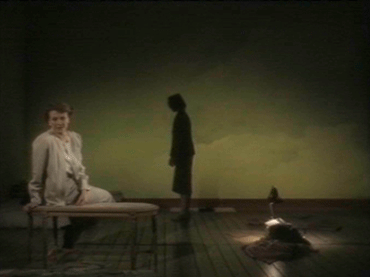
France, 1986, colour, original version in French with Spanish subtitles, digital archive, 104’The first screening in Spain of Chantal Akerman’s unseen and obscure film, in which key aspects of her film work coalesce. The film is a theatre piece by Rose Leiman Goldemberg, directed by playwright Françoise Merle and shot by Akerman; to wit, film as theatre and theatre as film. The storyline explores the relationship between the poet Sylvia Plath and her mother, Aurelia Plath, through their letters. The two characters are played by actress and director Delphine Seyrig and her niece, the actress Coralie Seyrig, and filmed by Akerman, who felt a filial attachment to Delphine. The film constitutes a portrait of the encounter of mother and daughter through their correspondence, a theme that bookends the film-maker’s filmography. Moreover, it is a pertinent example of films about women made by women.
-
Monday, 18 November 2019 – 6pm / Museo Reina Sofía. Sabatini, Auditorium
Session 3
Second session: Sunday, 15 December 2019 – 4pm
Les trois dernières sonates de Franz Schubert [Franz Schubert’s Last Three Sonatas]
France, 1989, colour, original version in English with Spanish subtitles, digital archive, 49’Trois strophes sur le nom de Sacher [Three Stanzas on the Name Sacher]
France, 1989, colour, original version without dialogue, Beta SP, 12’Chantal Akerman’s film-making cannot be understood without considering the group of women that accompanied and worked with her at different points in her career. Actresses Delphine Seyrig and Aurore Clément, editor Claire Atherton, and cinemaphotographer and artist Babette Mangolte, to mention but a few. Most notable among them, however, is the virtuoso cellist Sonia Wieder-Atherton, who not only scored the musical accompaniment to a number of her films, but also featured at the centre of four musical films in which she performed a broad repertoire. The session’s two films represent this relationship and collaborative work: two films about music and performance; two intimate and personal portraits of the performer, Akerman’s partner up until her death in 2015.
![Chantal Akerman. Trois strophes sur le nom de Sacher [Franz Schubert’s Last Three Sonatas]. Film, 1989](https://recursos.museoreinasofia.es/legacy_programs/23.gif "Chantal Akerman. Trois strophes sur le nom de Sacher [Franz Schubert’s Last Three Sonatas]. Film, 1989")
-
Wednesday, 20 November 2019 – 8pm / Museo Reina Sofía. Sabatini Building, Auditorium
Session 4
Second session: Monday, 16 December 2019 – 6pm
Le Déménagement [The Move]
France, 1993, colour, original version in French with English and Spanish subtitles, digital archive, 38’A film commissioned for Monologues (1992–1993), a five-episode French TV series, which sets out the clash of opposites between a refined mise en scène, an empty room, and a drama gushing with hope and heartbreak. The film is a lesson on how to film a theatre that is stripped back but still achieves huge dramatic intensity. The Move is a monologue performed by actor Sami Frey — Delphine Seyrig’s partner — whose minimalist description of the place to which he has just moved leads to a story about the fleeting desire of a man who, despite his expectations, is clearly alone. Literature, theatre and film combine in an intimist piece with echoes of the writer and playwright Samuel Beckett in the script (the words on feelings mutate into linguistic games) and director Éric Rohmer in the self-deluded character Frey.
![Chantal Akerman. Le Déménagement [The Move]. Film, 1993](https://recursos.museoreinasofia.es/legacy_programs/24.gif "Chantal Akerman. Le Déménagement [The Move]. Film, 1993")
-
Saturday, 30 November 2019 – 7pm / Museo Reina Sofía. Sabatini Building, Auditorium
Session 5
Second session: Sunday, 22 December 2019 – 4pm
Avec Sonia Wieder-Atherton [With Sonia Wieder-Atherton]
France, 2002, colour, original version in French with Spanish subtitles, Betacam, 52’À l'Est avec Sonia Wieder-Atherton [To the East with Sonia Wieder-Atherton]
France, 2009, colour, original version in French with Spanish subtitles, Betacam, 85’Avec Sonia Wieder-Atherton begins with a question raised by Chantal Akerman: “Who is this soloist, why did she choose the cello and how is she able to pass with such ease from one composer to another?” To the East with Sonia Wieder-Atherton, meanwhile, is a musical journey through Eastern Europe, inevitably recalling the documentary essay D’Est (From the East, 1993), in which Akerman searched for her Jewish roots in a long expedition through the Soviet bloc at the height of its disintegration. Cellist Sonia Wieder-Atherton, the focal point of both films, was the film-maker’s partner up until her death, yet upon filming the performer Akerman did not linger on the relationship uniting them. Rather, she sought to strike up a dialogue between music and film. The mix of pleasure and tension in the repertoire of Wieder-Atherton, the notion of duration, the cello’s ability to hold chords longer than any other instrument, and the link between sound and historical memory are the themes explored in these two works. Moreover, in them we see traces of the signature strands in Akerman’s film-making: tragicomic and absurd, as well as existential, elements, static long shots, held in time like the notes of a cello, and a reflection on historical memory through its fragments.
![Chantal Akerman. À l'Est avec Sonia Wieder-Atherton [To the East with Sonia Wieder-Atherton]. Film, 2009](https://recursos.museoreinasofia.es/legacy_programs/25.gif "Chantal Akerman. À l'Est avec Sonia Wieder-Atherton [To the East with Sonia Wieder-Atherton]. Film, 2009")
-
Museo Reina Sofía. Sabatini Building, Auditorium
Programme 4. Akerman by Akerman
-
Monday, 11 November 2019 – 7:15pm / Museo Reina Sofía. Sabatini Building, Auditorium
Session 1
Second session: Saturday, 7 December 2019 – 7:15pm
Vivian Ostrovsky. Mais ailleurs c'est toujours mieux [But Elsewhere is Always Better]
United States, 2016, colour and b/w, in English with Spanish subtitles, digital file, 4’Gustavo Beck and Leonardo Ferreira. Chantal Akerman, de cá [Chantal Akerman, From Here]
Brazil, 2010, colour, in English and Portuguese with Spanish subtitles, digital file, 60’Two tributes to Chantal Akerman from two very different places and in two very different formats. The artist Vivian Ostrovsky befriended Akerman during the first trip the filmmaker made to New York, in 1971. This short piece is a personal and poetic letter in which she remembers Akerman after her death, through fragments of her films. For their part, the Brazilians Gustavo Beck and Leonardo Ferreira interview the filmmaker in one long continuous shot. The minimalism of the visual composition and the intimate tone of the conversation remind viewers of one of the key elements of her filmography: the synthesis of formal discipline and subjective narration. The long interview thus becomes a homage to Akerman's cinema, through its shots, situations and declarations.
![Vivian Ostrovsky. Mais ailleurs c'est toujours mieux [But Elsewhere is Always Better]. Film, 2016](https://recursos.museoreinasofia.es/legacy_programs/27.gif "Vivian Ostrovsky. Mais ailleurs c'est toujours mieux [But Elsewhere is Always Better]. Film, 2016")
-
Thursday, 14 November 2019 – 7pm / Museo Reina Sofía. Sabatini Building, Auditorium
Session 2
Second session: Monday, 9 December 2019 – 7pm
Autour d'un marteau [The Hammer]
France, 1986, colour, in French with Spanish subtitles, digital file, 4’Lettre d'une cinéaste: Chantal Akerman [Letter from a Filmmaker: Chantal Akerman]
France, 1984, colour, in French with Spanish subtitles, digital file, 8’Family Business
United Kingdom, 1984, colour, in English and French with Spanish subtitles, digital file, 18’Chantal Akerman par Chantal Akerman [Chantal Akerman by Chantal Akerman]
France, 1996, colour, in French with Spanish subtitles, digital file, 63’A session of self-portraits in film, in a diversity of tones. The Hammer is an experimental video about the sculptor Jean-Luc Vilmouth, who lived with Akerman for a time and used this object in his work. In this piece the director links a series of references using comic and biographical allusions. Letter from a filmmaker: Chantal Akerman was a commission by the French television program Cinéma, cinémas (1982-1991), which asked different directors for a film letter in which they explained what is needed in order to make films. Akerman took it to the terrain of humour: “get out of bed, put on some clothes, eat…”, she says while performing these actions in front of the camera, along with the actress Aurore Clément. Commisioned by the British television program Visions (1982-1985), the film Family Business is an autobiographical cinema about cinema piece. In it, the artist films her trip to Hollywood in search of her aunt, to whom she is turning in hopes of obtaining funding for her film Golden Eighties (1986). Finally, Chantal Akerman by Chantal Akerman belongs to the Cinema of our time series, a historical series on auteur filmmakers that was begun in 1964 by Janine Bazin and André S. Labarthe, of French public radio and television, and resumed in 1989 by the channel ARTE. Instead of the usual report based on interviews, the predominant technique used in the series, here the filmmaker simply talks about herself in the first person.
![Chantal Akerman. Chantal Akerman par Chantal Akerman [Chantal Akerman by Chantal Akerman]. Film, 1996. Courtesy of Institut National de l'Audiovisuel, INA](https://recursos.museoreinasofia.es/legacy_programs/26.gif "Chantal Akerman. Chantal Akerman par Chantal Akerman [Chantal Akerman by Chantal Akerman]. Film, 1996. Courtesy of Institut National de l'Audiovisuel, INA")
-
Monday, 18 November 2019 – 7:30pm / Museo Reina Sofía. Sabatini Building, Auditorium
Session 3
Second session: Sunday, 15 December 2019 – 5:30pm
Sami Frey (director) and Chantal Akerman (editing). Autour de Jeanne Dielman [About Jeanne Dielman]
France, 1975, colour, in French with Spanish subtitles, digital file, 78’In an interview appearing in Film Quarterly (2016), B. Ruby Rich asked Chantal Akerman what it was like to work with the actress Delphine Seyrig. She answered: “Delphine always wanted to know the why behind everything, the reason for each word, she was a real feminist”. This video was recorded during the very intense shoot of the first film they made together, Jeanne Dielman, 23, Quai du Commerce, 1080, Bruxelles [Jeanne Dielman, Quai du Commerce no. 23, 1080, Brussels, 1975]. Seyrig, a successful actress who had already worked with well-known directors such as Alain Resnais, Luis Buñuel and François Truffaut, plays a widowed mother who turns tricks on the side and whose mood becomes more and more apparent during the daily routine of domestic chores. For many conservative critics, Akerman did not do as much as she could have with the star. Be that as it may, this video shows how the director and actress conceived of an interpretation based on everyday acts as a form of universal identification, and an example of realism, in which they thought all women would see themselves. This process went beyond the usual negotiation between actress and director or between two women of very different ages. Beyond any doubt, it is an example of how to make a film in which the representation of roles, identities and stereotypes becomes a political question of the highest order.
![Sami Frey and Chantal Akerman. Autour de Jeanne Dielman [About Jeanne Dielman]. Film, 1975](https://recursos.museoreinasofia.es/legacy_programs/28.gif "Sami Frey and Chantal Akerman. Autour de Jeanne Dielman [About Jeanne Dielman]. Film, 1975")
-
Friday, 29 November 2019 – 7pm / Museo Reina Sofía. Sabatini Building, Auditorium
Session 4
Second session: Saturday, 21 December 2019 – 7pm
Trois entretiens avec Aurore Clement, Babette Mangolte, Natalia Akerman [Three interviews with Aurore Clement, Babette Mangolte, Natalia Akerman]
Belgium, 2007, colour, in French with Spanish subtitles, digital file, 77’Three conversations with three women who are fundamental in Chantal Akerman's work. The actress Aurore Clément, the photographer Babette Mangolte and the filmmaker's mother, Natalia Akerman, who floats in one way or another over all her productions. These conversations are about the circumstances, stories and situations related to three films from the beginning of Akerman's filmography, so the film as a whole serves as a review of the early years of her career. Clément focuses on Les Rendez-vous d’Anna [The Meetings of Anna, 1978], a sort of "film bridge" between Jeanne Dielman, 23, Quai du Commerce, 1080, Bruxelles [Jeanne Dielman, Quai du Commerce no. 23, 1080, Brussels, 1975] and the reviews of film genres that Akerman embarked upon in the 1980s. In it the actress plays the role of a prestigious filmmaker, a surrogate of Akerman herself (whose middle name, it so happens, is Anna). With Mangolte, we shift our gaze to Hotel Monterrey (1972), to the analytical camera and the intense experiences of New York in the early 1970s. Last of all, with Natalia Akerman the conversation turns to Saute ma ville [Blow up my town, 1968], the filmmaker's very first film. The conversation takes place in a kitchen very similar to the one appearing in this irreverent debut film. This mother-daughter dialogue is a clear antecedent of her final film, No Home Movie (2015).
![Chantal Akerman. Trois entretiens avec Aurore Clement, Babette Mangolte, Natalia Akerman [Three interviews with Aurore Clement, Babette Mangolte, Natalia Akerman]. Film, 2007](https://recursos.museoreinasofia.es/legacy_programs/29.gif "Chantal Akerman. Trois entretiens avec Aurore Clement, Babette Mangolte, Natalia Akerman [Three interviews with Aurore Clement, Babette Mangolte, Natalia Akerman]. Film, 2007")
-
Filmoteca Española, Cine Doré, Screening rooms 1 and 2
Programme 5. Forms of Genre
-
Tuesday, 12 November 2019 – 8pm / Filmoteca Española, Cine Doré, Screening room 1
Session 1
Second session: Saturday, 21 December 2019 – 8pm / Screening room 1
Rue Mallet-Stevens [Mallet-Stevens Street]
Belgium, 1986, colour, in French with Spanish subtitles, digital file, 7’Toute une nuit [All Night Long]
Belgium and France, 1982, colour, in French with Spanish subtitles, 35 mm, 90’In Akerman's career the decade of the 80s was marked by experimentation with different film genres. Her motivations for this were: to avoid repeating her much-acclaimed Jeanne Dielman, 23, Quai du Commerce, 1080, Bruxelles [Jeanne Dielman, Quai du Commerce no. 23, 1080, Brussels, 1975], to explore the discourse and emotional effects of the various genres, and to allude, in a personal way, to the filmmakers she deemed her references. The two films in the session bring together all of these ideas. Mallet-Stevens Street is a short about a couple and the night, conceived as a defence of the Cinematek of Brussels, which was experiencing a temporary closure at the time. As for the melodrama All Night Long, this film brings together moments of love ‒and of love lost‒ during a single night in Brussels. Bars, hotel rooms and back streets are the sets for this film about lovers but that has no sex scenes. It is also a particular version of Jules et Jim (1962), by François Truffaut, and a melancholic interpretation of the lovers characterizing the work of Ernst Lubitsch.
![Chantal Akerman. Toute une nuit [All Night Long]. Film, 1982](https://recursos.museoreinasofia.es/legacy_programs/30.gif "Chantal Akerman. Toute une nuit [All Night Long]. Film, 1982")
-
Wednesday, 13 November 2019 – 9:30pm / Filmoteca Española, Cine Doré, Screening room 1
Session 2
Second session: Saturday, 7 December 2019 – 8 pm / Screening room 1
Les Années 80 [The Eighties]
France and Belgium, 1983, colour, in French with Spanish subtitles, restored DCP, 79’Welcome to the 1980s: sophistication, consumerism, fashion and seduction. This film depicts the symbols of the times and at the same time continually questions them, through another essential element of those years: critique of representation. Thus, The Eighties looks like a musical but it is really the scenography of a musical. The backstage of a film being made, where castings and rehearsals take place, as well as the process of cinematographic creation itself. In short, it is a film about how cinema seduces, unveiling the fabric and the functioning of the seduction and fascinating viewers all the while.
![Chantal Akerman. Les Années 80 [The Eighties]. Film, 1983](https://recursos.museoreinasofia.es/legacy_programs/31.gif "Chantal Akerman. Les Années 80 [The Eighties]. Film, 1983")
-
Saturday, 16 November 2019 – 7:30pm / Filmoteca Española, Cine Doré, Screening room 1
Session 3
Second session: Sunday, 8 December 2019 – 7:30pm / Screening room 1
Golden Eighties
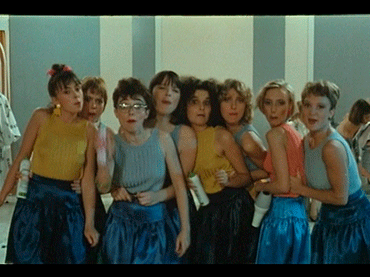
France, Belgium and Switzerland, 1986, colour, in French with Spanish subtitles, restored DCP, 96’Forming a diptych with Années 80 [The Eighties, 1986], Golden Eighties is a musical about love in a shopping mall, the place that celebrates, like no other place can, merchandise, window displays and shoppers. Hidden behind a love triangle is a bitter critique of marriage and the gender roles that mark the wars between the sexes characterizing this decade. The film maintains a constant level of happiness and permanent ecstasy which echo the psychopathological notes of the period, known for its euphoria and extreme enthusiasm. Another important thing about the film is that it brought together once again Akerman and Delphine Seyrig, the actress and feminist activist who starred in the renowned Jeanne Dielman, 23, Quai du Commerce, 1080, Bruxelles [Jeanne Dielman, Quai du Commerce no. 23, 1080, Brussels, 1975], and who had long been a close friend of the director.
-
DomSunday, 17 November 2019 – 8pm / Filmoteca Española, Cine Doré, Screening room 2
Session 4
Second session: Thursday, 26 December 2019 – 7:30pm / Screening room 1
Histoires d'Amérique: Food, Family and Philosophy [American Stories: Food, Family and Philosophy]
France and Belgium, 1988, colour, in French with Spanish subtitles, DCP, 92’“What's the difference between a psychotic and a neurotic? The psychotic thinks that two and two are five while the neurotic thinks that two and two are four but cannot deal with it”. American Stories: Food, Family and Philosophy revolves around Jewish American memory and identity, sharing elements of a long tradition in the form of jokes, like the one above, comic situations and absurd typical scenes. It is also the story of displacement, inadaptation and the survival of Central European Jews in the United States, because, just like Akerman's work, the Jewish condition moves between the tragic and the comic, between the existential and the mundane, as the subtitle so aptly conveys: food, family and philosophy. The film theorist Annette Michelson was involved, as a consultant, in the making of the film, which is also another beautiful tribute to the city of New York.
![Chantal Akerman. Histoires d'Amérique: Food, Family and Philosophy [American Stories: Food, Family and Philosophy]. Film, 1988](https://recursos.museoreinasofia.es/legacy_programs/33.gif "Chantal Akerman. Histoires d'Amérique: Food, Family and Philosophy [American Stories: Food, Family and Philosophy]. Film, 1988")

Held on 04, 06, 07, 11, 13, 14, 15, 18, 20, 21, 25, 26, 27, 29, 30 Nov, 04, 05, 06, 07, 08, 09, 11, 15, 16, 18, 19, 20, 21, 22, 23, 25, 26, 27 Dec 2019
Museo Reina Sofía and Filmoteca Española have come together every autumn since 2016 to organise an audiovisual programme. Following retrospectives devoted to Jean-Marie Straub and Danièle Huillet, Dziga Vertov and Early Soviet Cinema, and Chinese film-maker Wang Bing, this series offers the most comprehensive film exhibition to date on the oeuvre of Chantal Akerman (1950–2015). The Belgian film-maker’s work gives utterance to biography, a gaze which is mindful of women’s living conditions, the personal and historical memory of twentieth-century traumas, and the alienation involved in making against-the-grain cinema.
Her filmography explores the different possibilities of the film medium, from experimental documentary to audiovisual installation, via auteur fiction and biographical video, while managing to sustain a series of common traits that stretch across her entire body of work. These include formal rigour, a fascination with the passage of time, the tragicomic meaning of existence, life as a theme for art and art as a form of life, the gaze at the objectual world that confines women, sometimes from a critical standpoint, sometimes as a resource for invoking memories, in addition to a feminist and politically committed cinephilia that assimilates at the same time as it subverts points of reference such as Robert Bresson, Jean-Luc Godard, Michelangelo Antonioni, Rainer Werner Fassbinder and Michael Snow. Her final film, No Home Movie (2015), a declaration of love to her mother, takes us back to where it all began in 1968, inside a kitchen in a petit bourgeois house in Brussels with the contradictory impulses of home and exile. Akerman was born to a family of holocaust survivors, as the daughter of an Auschwitz survivor, a precedent that explains the existence of guilt and absence in her work, in a similar fashion to her denouncement of new contemporary historical traumas, from the misery of the old Soviet republics after the fall of the Berlin Wall, explored in D´Est [From the East, 1993], to the racist murders in the USA that she spotlights in her film Sud [South, 1999].
The series is divided into five programmes constituting cardinal points from which to move through the four decades of her output. On one side, Film-Essays, Filming Theatre and Akerman by Akerman in the Museo Reina Sofía and, on the other, Fictions and Biographies and Forms of Genre in the Filmoteca. Film-Essays examines her subjective and experimental documentary-making, from her early career and New York years to her return in the final decade; Filming Theatre comprises films on music, dance, performance and the stage, for instance pieces on theatre inspired by Sylvia Plath or devoted to Pina Bausch; and Akerman by Akerman, comprising the documentaries in which the film-maker commentates on her own work through words and images, as well as approaches to her as a director by other directors. Filmoteca Española concurrently presents Fictions and Biographies, a survey of her fictional films with screenings that explore the limits between representation, experience and life — Saute ma ville [Blow Up My Town, 1968], Je tu il elle [I You He She, 1974] and the acclaimed Jeanne Dielman, 23, Quai du Commerce, 1080, Bruxelles [Jeanne Dielman, Quai du Commerce No. 23, 1080 Brussels, 1976] — and other films which, despite investigating the sphere of auteur fiction with acclaimed actors and large-scale productions, also stand out for Akerman never losing sight of her obsessions and touchstones; and, finally, Forms of Genre, analysing transformations in the genres of melodramas, musicals and romantic comedies that Akerman put through their paces in the 1980s as an exercise on the hope and seduction of the film medium.
Furthermore, the series includes presentations with film-makers, theorists and historians, some of Akerman’s travel companions — for instance, her cinematographer Babette Mangolte and film editor Claire Atherton — and the participation of young voices, for instance film-makers Diana Toucedo and theorist Ivone Margulies.
Curatorship
Chema González
Framework
Organised by
Museo Reina Sofía and Filmoteca Española
Más actividades
![Isabel Coixet, 100 Years and You Everywhere [100 años y tú en todos los sitios], 2026, película](https://recursos.museoreinasofia.es/styles/small_landscape/public/Actividades/2.diseminar-mundo.jpg.webp)
John Berger and Isabel Coixet. Continued Ways of Seeing
Thursday, 17 September 2026 at 7pm
Ways of Seeing (1972) is one of the most revolutionary television series on art history, the museum and contemporary critical culture. Across four episodes, an articulate, enthusiastic John Berger unpacks the relationships between classical art through the gaze and new technology, the nude and feminism, the oil painting and commodity fetichism, advertising and consumerism. In essence, a level of critical commitment only comparable to its capacity for dissemination. Unsurprisingly, the series, and the book that would distil it, continues to forge vocations. This session sees art historians Alberto López Cuenca and Modesta Di Paola carry out an analysis of Berger’s audiovisual work, placing the stress on episodes one and four of the series. In the first episode, Berger reflects on the connection between the act of seeing, looking and being in light of new technology, such as the film camera. At the same time, it analyses how the culture of reproduction is turning paintings into messages or fragments of communication while stressing the importance of silence when observing historical paintings. In the fourth and final episode, he introduces advertising as a new iconic-verbal language that shares certain principles with the message of oil painting as a luxury item.
The session opens with the premiere of a filmic letter from Isabel Coixet, one of Spain’s most internationally acclaimed directors, to John Berger, with whom she maintained a long friendship and deep admiration. The short film is testament to the ubiquitous and long-lasting presence of the author of Ways of Seeing, even after his death in 2017.
![Chantal Akerman, Woman Sitting after Killing [Mujer sentada después de matar], 2001, instalación. Museo Reina Sofía](https://recursos.museoreinasofia.es/styles/small_landscape/public/Actividades/chantal-akerman-mujer-sentada-despues-matar.jpg.webp)
On Your Screen: Art History and the Museum Facing the Audiovisual Challenge
18, 19 SEP 2026
The conference On Your Screen: Art History and the Museum Facing the Audiovisual Challenge sparks debate around the transformations of art history and museum space upon embracing the audiovisual format. Its starting point is John Berger’s emblematic television series Ways of Seeing (1972), a landmark in the democratisation of art-historical discourse. In the series, Berger illustrated how the transfer of a work such as Goya’s Los fusilamientos del 3 de mayo (The Third of May 1808 or the Executions) from museum gallery to home TV screen completely changed the viewer’s experience, allowing the image to travel to straight to the viewer.
In the twenty-first century, this screen-based ecosystem has expanded exponentially, with museums not only physically integrating screenings and devices into their galleries— following in the wake of many exhibitions on the moving image — but also deploying complex virtual strategies. Equally, numerous en vez de a multitudeof historians, students and creators use digital platforms to circulate their ideas and projects. This audiovisual shift opens access to ignored materials and democratises knowledge, as well as challenging traditional hierarchies and the interpretive authority of institutions. The conference, promoted by the research project ATLAS AV: The Audiovisualisation of Art History and the Museum, seeks to analyse this vast audiovisual material, its archives, and its capacity to transform the memory of art.
Godard and Miéville: Time and Ruin
Friday, 18 September 2026 - 7pm
Inside the framework of the conference On Your Screen: Art History and the Museum Facing the Audiovisual Challenge, this film series sets forth three critical visions of the museum via three sessions featuring the works of John Berger, Jean-Luc Godard and Anne-Marie Miéville, Ariella Azoulay, Alan Resnais and Chris Marker, Kwate Nee-Owoo, and the premiere of short films by Isabel Coixet and La Vulcanizadora (Maria Rojas Arias and Andrés Jurado). In classical theory, the museum gives the world meaning; it contains fragments of the past, granting them a history, a narrative that explains preterite time and the present. Today, there is an implicit assumption that this function hides and legitimises forms of power, yet what if the museum, instead of explaining the world, multiplied it through radical ideas, silenced periods and repressed subjects? Such is the approach of the film-makers and artists in this film season.
In 1972 the writer John Berger opened the landmark television series Ways of Seeing with an iconoclastic gesture: slicing Sandro Botticelli’s painting Venus and Mars (1485) in London’s National Gallery. A transgressive act that recalls contemporary attacks on the museum by dissident youth and with which Berger, after revealing it was a reproduction, sought to ignite debate around the idea of an original artwork and a copy. In this, the hundredth anniversary of his birth, the first session pays homage to one of the great art writers of the twentieth century. Starting with a review of Berger’s audiovisual work by art historians Alberto López Cuenca and Modesta Di Paola, the series begins with the premiere of 100 Years and You Everywhere (2026), an unreleased short film by Isabel Coixet composed as a beautifully crafted letter to Berger, and continues with an analysis of fragments of Ways of Seeing in relation to the museum and contemporary art.
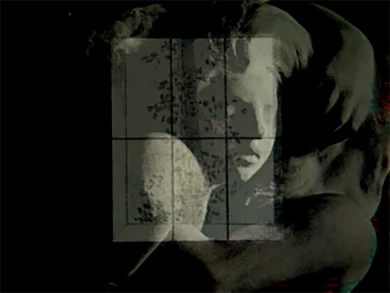
The second session screens two medium-length films by Jean-Luc Godard and Anne-Marie Miéville on time, ruin and museum. In The Old Place. Small Notes Regarding the Arts at Fall of 20th Century (1999), both film-makers consider what remains of that “old place”, the museum, at the close of a century of wars and totalitarianism, and ask whether it should be more of a legend or desire than a place. This same driving principle leads Godard to build his own imaginary museum in Reportage amateur (maquette expo) (2006), a rickety toy museum which, paradoxically, contains the great film-maker’s full power of thought on history and images.
Finally, the third session explores one of the major challenges of recent years: the decolonisation of the museum, the recognition of its link to imperialist discourses of power and the need to situate a new silenced or repressed subject at the centre of the Western narration of history. Under the title Museums and Restitution, it includes the film Undocumented. Unlearning Imperial Plunder (2019), by theorist Ariella Azoulay, Statues Also Die, by Alan Resnais and Chris Marker (1953), Kwate Nee-Owoo’s You Hide Me (1970) and the first screening of the short film Quinto verso, parte de Tonada (Fifth Verse, Part of Tonada), by La Vulcanizadora (Maria Rojas Arias and Andrés Jurado), filmed at the Museo de América in Madrid.
![Ariella Azoulay, Un-documented. Unlearning Imperial Plunder [Indocumentados. Desaprendiendo el saqueo imperial], 2019, película](https://recursos.museoreinasofia.es/styles/small_landscape/public/Actividades/5.diseminar-mundo.jpg.webp)
Museums and Restitution
Saturday, 19 September 2026 - 7pm
Centuries of plundering, decades of amnesia, years of living with unmitigated extractivist power… Does a museum, as we know it, have a raison d'être in a postcolonial society?
This session expounds the operations of the museum as a colonial machine, while putting forward ideas, in narration, for a more just, equal and inclusive institution of the future via society’s marginalised and minority voices. The session begins with the international premiere of Quinto verso, parte de Tonada (Fifth Verse, Part of Tonada), which presents a vision of the Quimbaya Collection (fifth and sixth centuries CE) from the Museo de América in Madrid. It is constructed with the voices and chants of Wayúu mourners and guides, not only as a way of reinstating the role of these gold idols — anthropomorphic figures of men and women used as vessels in ritual practices — but also to imagine that what must be exhibited is not the gold itself. It is the ritual’s own chant. In the classic film You Hide Me (1970), Ghanaian film-maker Kwate Nee-Owoo accesses the British Museum’s collection of African art, located in the building’s basement, to question the meaning behind a museum plundering and nullifying. A fine exercise of first-person institutional critique screened for the first time in Spain. Almost seventy years since Resnais and Marker made Statues Also Die (1953), a reflection on the aura-bearing value of the museum opposite the identity-based and cultural belonging of African art, theorist Ariella Azoulay films the same statues again at the Musée du Trocadéro (today the Musée du Quai Branly), which survive and wait to be reunited with their people. Azoulay, whose wholly original undertaking is a lesson to the museum of the future, connects the forced migration of these sculptures with the mass transit of people crossing borders artificially imposed by the same system that has plundered their culture.
The School of Transformative Institutionalism and Local Organisation
From 21 to 24 September 2026
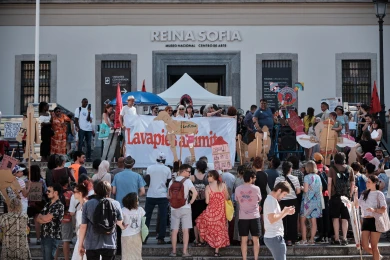
The School of Transformative Institutionalism and Local Organisation (S.T.I.L.O.) is a programme of joint learning and join strategy which sets in motion a process for the exchange of questions, methodologies and experiences between cultural organisations. The overall aim is to create, circulate and prototype tactics, tools and collective knowledge on institutional practices that open new channels for defending culture and advocating structural transformation in divergent geographical contexts.
The project is part of the Laboratorio de Institucionalidad Compartida (The Laboratory of Shared Institutionalism, LIC), a space for the Museo Reina Sofía’s research, work and advocacy centred on developing, experimenting with and systemising practices, protocols and tools which contribute to a fairer and more liveable cultural ecosystem.
For many years now, so-called infrastructural critique in museums questions material, legal and economic infrastructures, among others, as well as the forms of solidarity and practices required to sustain the cultural ecosystem. By approaching current debates, S.T.I.L.O. raises questions on the ways in which organisations define and interpret their practices, organise their relations and respond to the social contexts in which they operate.
The school gathers four cultural organisations that work via different institutional models – scale, contexts, conditions, different working models — with the goal of pooling common strategies and tools of organisation, advocacy and relationships with local communities.
The programme is conceived as a collaborative process with the participation of Arika, La Revuelta, BAK Basecamp and The Tentacular Museum (Museo Reina Sofía) and is structured around preparatory online sessions and an in-person seminar in Madrid.
S.T.I.L.O. is an activity framed inside the working strand of Situated Organisations from L'Internationale’s Museum of the Commons project, which reflects on the role of museums and art organisations as actors within complex social networks and ecosystems, with a view to exploring new ways to democratise institutions and make them more open, inclusive and useful.