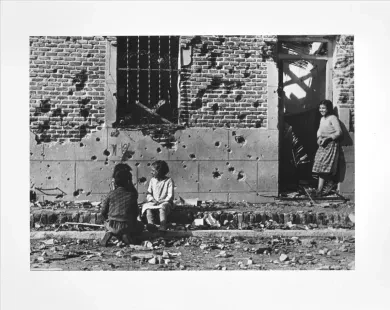
Robert Capa (Ernö Friedmann, André), Madrid, barrio de Vallecas, noviembre-diciembre 1936, 1936
Donation by Cornell Capa, New York, 1998
This international encounter centred on the figure of Robert Capa (Budapest, 1913 — Thai Binh, Vietnam, 1954), one of photojournalism’s pre-eminent figures, is held within the framework of the government initiative Spain and Freedom. Fifty Years and in conjunction with a cluster of three locations — the building on number 10 Calle Peironcely, the Plaza del Fotógrafo Robert Capa and the San Carlos Borromeo Parish in Vallecas — declared as a Place of Democratic Memory.
The emblematic photo Robert Capa took in 1936 of this area of Republican Madrid, featuring anonymous children talking in front of a bullet-riddled building attacked by Nazi-fascist air forces, has, in recent years, become a catalyst for impassioned collective action vindicating memory and denouncing the horrors and brutality of wars, past and present.
Within this context, representatives from cultural and academic spheres and civil society organisations from Germany, the USA and Spain discuss the legacy of Capa and photojournalism in European democratic memory, exploring in greater depth two citizen initiatives constructed by Europe from its shared memory: #SalvaPeironcely10 (#SavePeironcely10), in Entrevías (Puente de Vallecas), and the Capa Haus Initiative in the Lindenau neighbourhood of Leipzig, both united by the protection and conservation of historical heritage and by the defence of peace.
The round-table discussion features the participation of Cynthia Young, Juan Miguel Sánchez Vigil, Ulf-Dietrich Brumann and José María Uría Fernández and is moderated by Myriam Soto Lucas. Carmina Gustrán Loscos, the commissioner of Spain and Freedom. Fifty Years, will also join the discussion.
Organised by
The Ministry of Territorial Policy and Democratic Memory
Welcomed by
Museo Reina Sofía
Participants
Ulf-Dietrich Braumann
holds a PhD in Engineering. He has developed his professional career chiefly in the sphere of applied cybernetics and biomedicine, and currently works as a researcher at the Institut für Angewandte Informatik (Institute of Applied Computer Science) in Leipzig. Since 2012 he has coordinated the citizen initiative Capa-Haus (Capa House) in Leipzig, a building immortalised in Robert Capa’s photographic series The Last Man to Die, from April 1945, during the liberation of Leipzig from the Nazi regime, and the title of which refers to the dying moments of soldier Raymond J. Bowman. This citizen mobilisation managed to save the building from ruin, thereby avoiding real estate speculation.
Carmina Gustrán Loscos
holds a degree in History from the University of Zaragoza, a Master of Arts in Culture, Policy and Management from City-University of London (UK) and a European Doctorate in Contemporary History from the University of Zaragoza and the Université de Nantes (France). She is a postdoctoral researcher at the University of Zaragoza, centring her work on public history and the cultural representations of contemporary history in Spain. She combines her lecturing and research with her extensive experience as a cultural manager. Moreover, she has worked at the University of Leeds, Newcastle University and the University of Zaragoza and in institutions such as Spain’s Ministry of Culture and Sport, CaixaForum Zaragoza and the Centro de Cultura Contemporánea Condeduque. She is currently the commissioner of the government initiative Spain and Freedom. Fifty Years.
Juan Miguel Sánchez Vigil
is a lecturer in Documentation at the Complutense University of Madrid, a specialist in photographic documentation and director of the research group Fotodoc. He works in the recovery, conservation and dissemination of photographic heritage, in collaboration with institutions and companies, including the Spanish Institute of Cultural Heritage, the Biblioteca Nacional de España, the Community of Madrid’s Regional Archive, the Institute of Valencia de Don Juan and Acciona. He is the author of numerous publications, including Fotoperiodismo y República (Cátedra, 2014), with María Olivera Zaldua. He has also curated different exhibitions, most notably The Banco de España Photographic Archive. From Albumen to Pixel (Banco de España, 2024); María Goyri at University. Research and Creation (1892-1909) (Biblioteca Histórica Marqués de Valdecilla, Complutense University of Madrid, 2023); Kâulak: Photographer, Painter, Writer (Biblioteca Nacional de España, 2022) and Alfonso (1902–1990), Fine Arts Academic (Centro Cultural Conde Duque, 1990).
Myriam Soto Lucas
is a journalist with vast experience who started out on Antena 3 Radio, before continuing on Cadena SER, where she has worked for the bulk of her career. She has covered political, labour, cultural and social information and is currently part of the team on the radio programme Hoy por Hoy Madrid. She also takes a socially committed approach to journalism and has followed the #SalvaPeironcely10 platform since its inception, as well as developing different projects, for instance the establishment of a support group for families of prison inmates in Madrid.
José María Uría Fernández
holds a PhD in Information Science and heads the Culture Area and Documentary Centre of Fundación Manuel Fernández «Lito». He is also on the board of directors of the Spanish Society of Scientific Information and Documentation (SEDIC) and works as an adjunct professor in the Faculty of Information Science at the Complutense University of Madrid. Furthermore, he coordinates the #SalvaPeironcely10 platform and co-directs the Robert Capa estuvo aquí (Robert Capa Was Here) festival. Also of note is his work as the creator and coordinator of the initiative Los libros, a las fábricas, winner of the National Reading Promotion Award in 2021.
Cynthia Young
is the director of the Robert Capa and Cornell Capa Archive at the International Center of Photography (ICP) in New York and a board member of the Magnum Foundation. She has curated numerous exhibitions and published different studies on Capa and other pre-eminent contemporary photojournalists, for instance: Capa in Color (2014), We Went Back: Photographs from Europe 1933–1956 by Chim (2013) and The Mexican Suitcase: The Rediscovered Spanish Civil War Negatives of Robert Capa, Chim and Gerda Taro (2010), which toured internationally. She also curated the acclaimed show on Capa’s work in the Spanish Civil War, entitled Death in the Making: Reexamining the Iconic Spanish Civil War Photobook (2020). After more than twenty years collaborating with ICP, Young continues to contribute to the world debate on photography, art, memory and social responsibility.
Más actividades
Files of Tropical Revolutions
Sábado 20 y 27 de junio, 2026 - 19:00 H
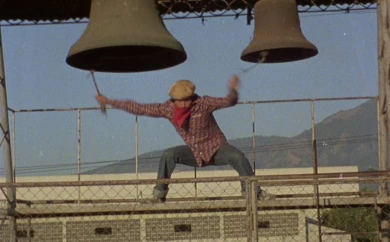
The Reframing Banana Imagery series concludes with two works that condense the height and twilight of this period in history, epic sagas that cross borders and registers to embody experiences of armed struggle in the region. Cameras mix with firearms, borders between nations blur and patience reaches breaking point. This is where the tipping point lies, where the bloodshed weighs heavy and the murmurings of regional brotherhood are buried in the ground again.
Pan y dignidad (Carta abierta de Nicaragua) [Bread and Dignity (An Open Letter to Nicaragua)] recounts the historical records and process of national reconstruction in Nicaragua via the Sandinista popular uprising. Historias prohibidas de Pulgarcito (Forbidden Tales of Tom Thumb) places the camera at the heart of the El Salvador revolutionary struggle, interspersing testimonies of daily violence with the verses of the poet Roque Dalton.
Both works understand the armed revolution as an open file under construction. The insurgent brotherhood, although dissolved, still resounds in regional history.
Circling Over Exploited Bodies
Friday, 19 and 26 June 2026 - 7pm
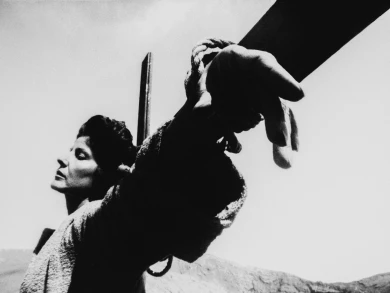
When forms of violence are inflicted on society, film responds from urgency. Images become abstract, sounds fade and the register of dissidence comes from the gut. La zona intertidal (The Intertidal Zone) is an essayistic and poetic approach to the repression of teachers in El Salvador in the 1970s — a teacher studies the biodiversity of the El Salvador coast as a boy finds a body on the same beach. A propósito de la mujer (About Women) interweaves testimonies of misery and rage towards patriarchal structures with fictional scenes of a symbolic procession through a harsh desert.
Both films understand the body as a target of violence and a territory of insurrection, a space where the blood shed by militancy and the patriarchal yoke turn pain into denouncement and existence outside the status quo into an act of political dissidence.
Robert Capa
Friday, 26 June 2026 – 6pm
This international encounter centred on the figure of Robert Capa (Budapest, 1913 — Thai Binh, Vietnam, 1954), one of photojournalism’s pre-eminent figures, is held within the framework of the government initiative Spain and Freedom. Fifty Years and in conjunction with a cluster of three locations — the building on number 10 Calle Peironcely, the Plaza del Fotógrafo Robert Capa and the San Carlos Borromeo Parish in Vallecas — declared as a Place of Democratic Memory.
The emblematic photo Robert Capa took in 1936 of this area of Republican Madrid, featuring anonymous children talking in front of a bullet-riddled building attacked by Nazi-fascist air forces, has, in recent years, become a catalyst for impassioned collective action vindicating memory and denouncing the horrors and brutality of wars, past and present.
Within this context, representatives from cultural and academic spheres and civil society organisations from Germany, the USA and Spain discuss the legacy of Capa and photojournalism in European democratic memory, exploring in greater depth two citizen initiatives constructed by Europe from its shared memory: #SalvaPeironcely10 (#SavePeironcely10), in Entrevías (Puente de Vallecas), and the Capa Haus Initiative in the Lindenau neighbourhood of Leipzig, both united by the protection and conservation of historical heritage and by the defence of peace.
The round-table discussion features the participation of Cynthia Young, Juan Miguel Sánchez Vigil, Ulf-Dietrich Brumann and José María Uría Fernández and is moderated by Myriam Soto Lucas. Carmina Gustrán Loscos, the commissioner of Spain and Freedom. Fifty Years, will also join the discussion.
Central American Designation of Origin
Thursday, 18 and 25 June 2026 - 7pm
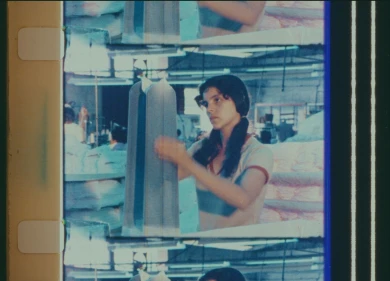
Fertile lands, farmers’ hands, rural faces. This first programme in the series Reframing Banana Imagery understands the foundations of the Central American experience from exploitation, extractivism and displacement, and from the organisation and resistance that emerged as a reaction. The four films within extend from a lyrical documentary on farmers’ solidarity to the playful subversion of the institutional format of the United Fruit Company.
Bananeras (Banana Growers) is a combative portrait of the inhumane conditions of the American banana plantations located in Nicaragua through much of the twentieth century. Costa Rica Banana Republic is a perspicacious satire via an institutional documentary of banana production, spotlighting the extractive nature of this agro-exporting model in the 1970s. Organización Campesina (Farmers’ Organisation) frames rural resistance in Honduras from a direct depiction and lyrical documentary, while Dos veces mujer (Two Times a Woman) dissects the invisibility of the double-shift working day Central American women farmers endure: working in the countryside and working in the home. As a whole, the works here present the earth at once as a wounded body and a space of dignity.
Inclusive Policies and Practices
19, 20 JUN 2026
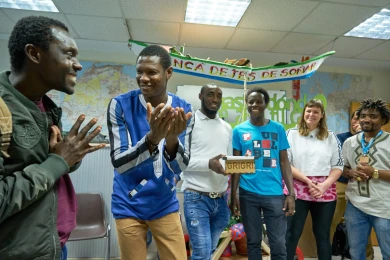
In conjunction with World Refugee Day, which takes place on 20 June 2026, Museo Situado and GRIGRI jointly organise this international encounter to foster the discussions, debates and exchange of practices which uphold solidarity with migrant people in European Union countries.
The programme, conceived as a space of exchange and the collective construction of knowledge, comprises a workshop of collaborative creation, discussions, a community meal and a film forum — activities designed by a local committee made up of young people under the age of thirty from different territories in Europe. The policy recommendations on welcoming people with migrant backgrounds and hospitality in urban contexts that arise from this encounter will be presented in Brussels at the end of 2026.
These sessions are developed within the context of the European cooperation project Bridging Borders and are framed inside the tenth anniversary of the GRIGRI Pixel project.