Six Swimming Pools. A Dive into Experimental Film
Saturday, 8 August 2026
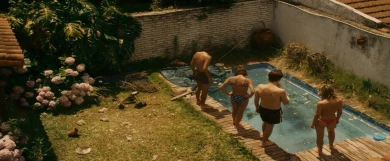
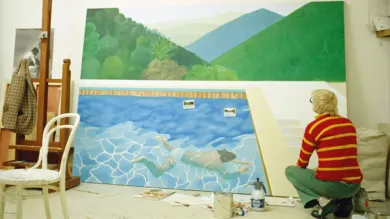
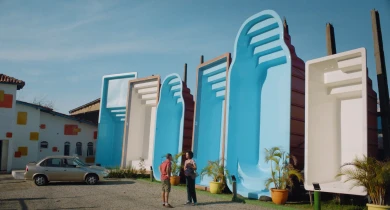
For the first time, the Museo’s summer cinema programme includes an experimental film section, centred on the experience and feeling of bodies under water. This session glides between the ostentatious aquatic architecture of Barbara Hammer and Barbara Klutinis and Jakobois’s fantasies, fleeting contact and wet, sexualised bodies. Six completely different swimming pools — private, public, transparent, bottomless, indoor, outdoor — all designed for leisure, competition and desire, nonetheless. A journey ranging from the monumentality of architecture to the intimacy of wet bodies.
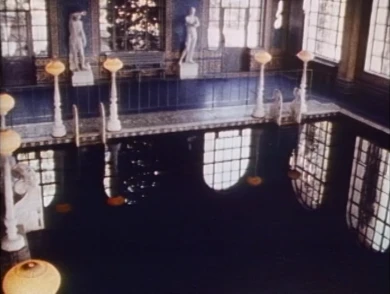
Pools, by Barbara Hammer and Barbara Klutinis, turns swimming pools designed by pioneering architect Julia Morgan for the castle of tycoon William Randolph Hearst — the inspiration for Citizen Kane — into a space of play, bodily exploration and queer appropriation, an excuse to dive into a scene reserved for privilege. In An Algorithm, Bette Gordon fragments a series of headfirst dives and turns the sporting gesture into a visual score of repetitions, variations and rhythms. Tony Hill’s Water Work seduces with perspective, reflections and depth — the swimming pool as optical illusion, as an unstable surface which distorts and multiplies the gaze. Cheap Imitation “They Walk and I Walk”, by Rickard Eklund, submerges the camera to capture a choreography of synchronized bodies, a dance suspended under water. Naked bodies that dodge, twist and embrace in a space seemingly with no gravity combine in Gunilla Leander’s All Under. Passage du désir, by Jakobois, closes the programme with a montage in which water is no longer an environment, becoming instead a territory of desire.

![Mike Nichols, The Graduate [El graduado], 1967, película](https://recursos.museoreinasofia.es/styles/small_landscape/public/Actividades/ciclocine-piscinas-9_0.jpg.webp)