Oliver Laxe
HU/هُوَ. Dance as if no one were watching you
HU/هُوَ. Dance as if No One Were Watching You is an installation conceived specifically for the Museo Reina Sofía by the Galician filmmaker Oliver Laxe (1982). With this work, the museum inaugurates the new program of Espacio 1, dedicated to projects by artists and filmmakers exploring exhibition-based cinema. The exhibition will be accompanied by a retrospective carte blanche program of Laxe’s filmography at the Museum’s Cinema in February 2026.
HU/هُوَ. Dance as if No One Were Watching You emerges from the research and footage of the film Sirāt (Jury Grand Prix, Cannes 2025). While the Islamic term sirāt designates the bridge that crosses over hell toward paradise, in Arabic HU/هُوَ refers to the primordial sonic manifestation of the deity: the divine breath and first utterance that inaugurate creation. The subtitle of the piece derives from a verse by Rūmī (1207–1273), the Persian mystic and scholar whose work and practice explored transcendence and the dissolution of the self into the divine through music, dance, poetry and prayer. In HU/هُوَ we enter a territory shaped by an austere monotheism, where the search for transcendence is grounded in the immanence of the dancing, remembering body and in the appearance of the sacred within the natural, architectural and sonic landscapes.
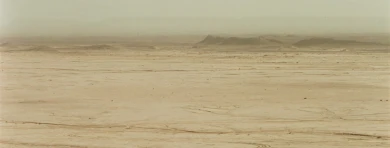
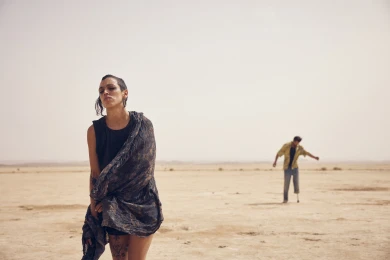
The installation unfolds across the two rooms of Espacio 1. In the first, a pyramid of loudspeakers from the rave milieu rises in semi-darkness like a totem. This monolith emits a sustained vibration devoid of melodic variation which — analogous to the preparatory chambers of ancient temples — produces a kind of sonic ablution before the viewer encounters the image in the main room. There, a three-channel projection introduces desert landscapes governed by an implacable sun, populated by the severe silhouettes of temples and loudspeakers, among which human figures dance. Filmed by the artist a decade ago in Iran, these architectures recall the concerns of those monk-architects who sought to make sacred geometry perceptible through forms and proportions — precisely where the threshold between the material world and the subtle one becomes manifest. The sound work by Kangding Ray approaches, through the structural materiality of sound, its mystery and inherent immateriality.
Through mist-laden fades and layered superpositions, HU/هُوَ composes a visual grammar that accentuates the spectral condition of the image. The piece also reveals a preference for an abstract aesthetic language — both sonic and visual — that addresses an interreligious experience through its formal texture rather than through literal iconographies or stabilized narratives. By translating expressive cinematic tools into the exhibition space, the spiritual and contemplative dimension that runs through Laxe’s artistic practice assumes explicit prominence here, summoning a physical, sensory and synaesthetic experience that gestures toward a re-enchantment of the world.
Oliver Laxe
HU/هُوَ. Dance as if no one were watching you
Artists
Oliver Laxe
(Paris, 1982) is a film-maker, screenwriter and actor. To date, he has made four feature-length films, all winning international awards. His debut You Are All Captains, a poetic exercise in film, pedagogy and emancipation, won the FIPRESCI Prize at Cannes in 2010. In 2016, he was awarded the Grand Prix of the Cannes Critics’ Week for Mimosas, shot in the Atlas Mountains. Upon his return to Galicia, he filmed O que arde (Fire Will Come) in the Ancares mountains. The film won the Jury Prize in the Certain Regard Section at the 2019 Cannes Festival, in addition to numerous international honours at the Chicago, Tesalónica, Mar del Plata and Belgrade Film Festivals. Fifteen years after its first Cannes premiere, his film Sirât, shot in the Sahara, was part of the Official Section at Cannes 2025, winning the Jury Prize.
Curatorship
Julia Morandeira Arrizabalaga and Chema González
Organised by
Museo Reina Sofía
Image gallery