-
Saturday, 25 March
Monster Institutions
17:30 hrs. Gerald Raunig. Technecologies. Milieus, Midstreams, Monsters
18:30 hrs. Florencio Cabello. Notions of Public in Collective Intelligence
19:30 hrs. Roberta Da Soller (S.a.L.E., Venice), Kelly Mulvaney (Transform-eiPCP, Berlin and Vienna) and Manuela Zechner (Barcelona). Moderated by: Raúl Sánchez Cedillo. European Cities, from Care and Shelter to Fear, War, and Debt
21:00 hrs. Debate with the session participantsParticipants:
Florencio Cabello has a PhD in Communication Studies and is a lecturer at the University of Málaga. His teaching and research focuses on ways of forming cooperatives inspired by the free software and culture movements, under the perspective of constructing a commons in communicative and cultural domains. He is coordinator of the Medialab-Prado project Traducciones del Laboratorio del Procomún (Translations of the Commons Laboratory).
Roberta Da Soller is an activist and member of the collective which operates S.a.L.E. Docks, an independent space of contemporary art and cultural practices in Venice which has been running since 2008. S.a.L.E. Docks programmes seminars, exhibitions, research projects, workshops and public actions that seek to create an environment in which art and culture are removed from the market value logic.
Kelly Mulvaney is an anthropologist, translator and activist. She is a member of eiPCP and the editorial board for transversal texts. Furthermore, she is a professor at the Faculty for Cultural Studies at the Leuphana University of Lüneburg, and actively participates in the networks of transnational anti-austerity movements in Europe.
Gerald Raunig is a philosopher and art theorist. He is a lecturer at Zürcher Hochschule der Künste (Zurich), and is co-editor of eiPCP and its online publication transversal text. His most recent publications include Producción cultural y prácticas instituyentes. Líneas de ruptura en la crítica institucional (2008), Mil máquinas. Breve filosofía de las máquinas como movimiento social (2008), Fabbriche del sapere, industrie della creatività (2012), and DIVIDUUM. Machinic Capitalism and Molecular Revolution (2016).
Raúl Sánchez Cedillo is a philosopher, activist and translator. He has collaborated with the Universidad Nómada and is currently a member of Fundación de los Comunes. He has also edited and translated theorists such as Paolo Virno, Antonio Negri, Felix Guattari, Luce Irigaray, Yan Moulier-Boutang and Luc Boltanski and Eve Chiapello into Spanish, and some of his writings appear in the book Producción cultural y prácticas instituyentes. Líneas de ruptura en la crítica institucional (2008) and in the prefaces to different essays by Antonio Negri and Paolo Virno.
Manuela Zechner is a researcher and independent cultural worker. Her work revolves around migration, micropolitics, care and pedagogy, with an emphasis on social movements. She is the coordinator of Future Archive (Intermediae-Matadero, Madrid), the Project for Radical Collective Care Practices, alongside Julia Wieger and Bue Rübner Hansern, and the free radio programme Sounds of Movement (Radio Orange, Radio Helsinki and live streaming). She has also worked as a lecturer at the Queen Mary University of London. -
Sunday, 26 March
The Artist in the City-Brand
17:30 hrs. Rogelio López Cuenca. In the Genius City
This presentation will lead on to a workshop with the artist and Elo Vega.
18:30 hrs. Isabell Lorey. Precarization, Indebtedness, Giving Time
19:30 hrs. Debate with the session participantsParticipants:
Rogelio López Cuenca. Artist. A member of the former direct action collective Agustín Parejo School between 1982 and 1984, his work stands at the crossroads between visual poetry, archival research and public intervention, exploring the relationships between art, memory and ideology. Málaga/Guernica 951 (2017), Ciudad Picasso (2011), Malagana (2000) and Sobrevivir a Picasso (2012) are some of his projects under construction and centre on contemporary interpretations of Pablo Picasso. He has exhibited at the Museo Reina Sofía, IVAM, MACBA, MUSAC, CGAC and Artium, among other institutions.
Isabell Lorey is a professor of International Gender Politics in the Institute for Political Science at the University of Kassel. She has taught feminist and post-colonial theory at the University of Humboldt, Berlin, and at the Universities of Vienna and Basel, and is also a member of eiPCP and co-editor of its online publication transversal text. She conducts research into the precariousness of work and life in neoliberal society, social movements, democracy and representation. Her most recent publication is Estado de Inseguridad. Gobernar la Precariedad (2016).
Elo Vega is an artist and researcher. Her work addresses social, political and gender issues through art projects which are at once cultural critique devices and a political instrument. In recent years she has worked with the artist Rogelio López Cuenca in workshops and collective projects related to history, memory and monumentalization as an element of ideological control, for instance Gitanos de papel (Cultural Centre of Spain in Montevideo), Historia de dos ciudades/Saharawhy (Museo de Arte Contemporáneo, Santiago de Chile), Efigies y fantasmas (Museo de Huelva) and Granada. Guía monumental (Centro José Guerrero).
Picasso in the Monster Institution
Art, the Culture Industry and the Right to the City
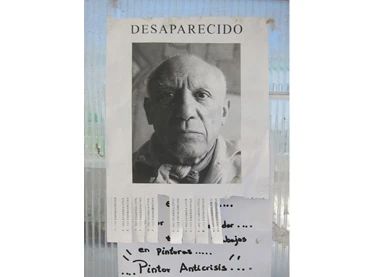
Held on 25 Mar 2017
Picasso in the Monster Institution. Art, the Culture Industry and the Right to the City strives to create distance from the predominant sense of celebrations and large-scale cultural commemorations which, in understanding art as an attractive resource, place history and artistic experience inside a frame with exclusive ties to tourism and urban leisure. It also calls into question these logics and explores possible alternatives.
This seminar unfolds inside the context of Midstream, a European network of university and institutional research into new audiences and devices of cultural mediation, comprising eiPCP (the European Institute for Progressive Cultural Policies), Museo Reina Sofía, and the Latvian Center for Contemporary Art, and seeks to reflect on and debate the role of culture and art in those social movements that vindicate uses of urban space outside a city model which looks towards art to strengthen tourist imaginaries, thus conditioning its institutions and reception.
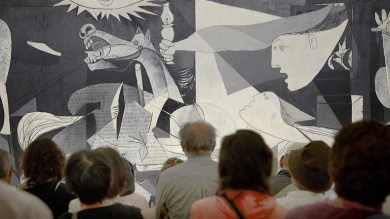
The recognition of Picasso’s work is one of the best examples to analyse the contradictions and complexities of these logics. Today, the work of the artist from Málaga is broadly appreciated and disseminated, yet, equally, such a reception cements stereotypes associated with the heroic and fetichized idea of artistic avant-garde movements and their most unrelenting myths, for instance the originality, brilliance and autonomy of art. These values obscure one of the 20th century’s most complex bodies of work.
How can the contemporary city fight against this integration of art, and its audiences and institutions, in the service economy and recover the potential of one of the most challenging oeuvres from the avant-gardes in its historical scope? What are the devices and anomalous or “monstrous” institutions which are able to place the work in a space which is alien to this integration? The seminar sets out to reflect on these questions via two round-table discussions and a workshop on the monumental imagary of Picasso and the contemporary city, conducted by Rogelio López Cuenca and Elo Vega, which will begin at the close of the lectures and shall be expanded upon in the future. The first session will debate monstrous institutionalism’s modes of relationship, calling upon different European networks and spaces (S.a.L.E., Venice; Transform-eiPCP, Berlin and Vienna; and La Invisible, Málaga), and theorists specialised in testing mediation experiments with these instituent machines. The second analyses the relationship between art and gentrification through the uses and abuses of Picasso’s work, putting forward a model of artistic experience which eludes the so-called creative industries and economies.
Framework
Midstream. New Ways of Audience Development in Contemporary Art, inside the Creative Europe programme
Organised by
eipcp (European Institute for Progressive Cultural Policies), Museo Reina Sofía and La Invisible



Más actividades
![Céline Sciamma, Naissance des pieuvres [Lirios de agua], 2007, película](https://recursos.museoreinasofia.es/styles/small_landscape/public/Actividades/ciclocine-piscinas-3.jpg.webp)
Céline Sciamma. Water Lilies
Friday, 10 July 2026
Céline Sciamma’s directorial debut, Naissance des pieuvres,depicts the emotional and sexual awakening of three teenagers around an indoor swimming pool in a Parisian suburb. Marie, a fifteen-year-old introvert, becomes fascinated by Floriane, the charismatic captain of a local synchronised swimming team. Driven by this attraction, Marie tries to get closer to her while observing the complex dynamics of desire, friendship and power that develops between the young girls. At the same time, Anne, one of Marie’s friends, has her own experience of insecurity and affective search, shaped by the pressure to fit in and belong. As the relationship between the three intensifies, contradictions surface between the image they outwardly project and their real feelings.
Standing away from the common places on adolescence, Céline Sciamma explores first love, burgeoning queer identity and the uncertainty of desire with an intimate, observational gaze, resulting in a sensitive and honest portrait of a time of transformation, in which each gesture leads to the passage from childhood to adulthood.
Sofia Coppola. Somewhere
Saturday, 11 July 2026
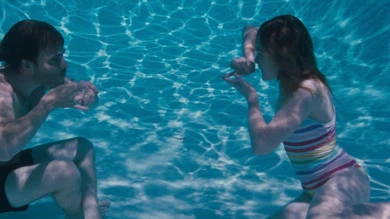
Johnny Marco (Stephen Dorff), a famous Hollywood actor, lives a life of pleasure in Hotel Chateau Marmont in Los Angeles, drifting aimlessly between vacuous relationships, punctuated by film shoots and commercial duties. Cleo (Elle Fanning), his eleven-year-old daughter, stays with him for a few weeks due to her mother’s absence, forcing him to rethink his life.
Sofia Coppola’s employment of swimming pools is carefully considered in the film — blue water in Somewhere is the only place where Marco can recover the meaning of his existence as the pool acts as a womb in which he finds balance. While living with his daughter Cleo and the reflection of these aquatic moments — diving under water, floating, playing or simply sunbathing with no real purpose — everything happens. Thus, Coppola explores in depth themes such as fame, loneliness and the complexity of human ties, putting forward an intimate and profound portrait full of the subtleties of life.
Jonathan Glazer. Sexy Beast
Friday, 17 July 2026
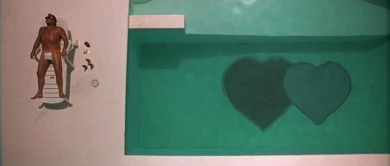
Gal Dove (Ray Winstone), a criminal for the British mafia, lives happily retired with his wife in an idyllic villa in southern Spain and a dazzling swimming pool. Their peace is shattered with the arrival of Don Logan (Ben Kingsley), a former gangster and criminal associate who wants to convince him to do one last job.
If a swimming pool can be at the heart of suspense, then Sexy Beast is the quintessence. The reflection of blue water in Gal’s idyllic seclusion symbolises the artificial paradise that can be broken at any time. This first feature-length film by British director Jonathan Glazer (also the director of The Zone of Interest, 2023) starts with one of the most striking swimming pool scenes, a symbol for the impending danger about to reach this whitewashed haven of peace. The perfect vision of recreated beauty — luxury pools on the Andalusian coast — which, in the depths of pristine water, conceals an unsettling fear of returning to the past.
![François Ozon, Swimming Pool [La piscina], 2003, película](https://recursos.museoreinasofia.es/styles/small_landscape/public/Actividades/ciclocine-piscinas-6.jpg.webp)
François Ozon. Swimming Pool
Saturday, 18 July 2026
Sarah Morton (Charlotte Rampling), a frustrated English writer paralysed by writer’s block, is invited by her editor to spend a few days in her summer house in the south of France. While there she meets Julie (Ludivine Sagnier), the editor’s uninhibited daughter. The young girl’s hypersexuality clashes with Morton’s cold nature, an initial hostility which turns into a fascination with the private life of the young girl, serving the writer as inspiration for her new novel and tugging the story to an ambiguous game between truth and imagination.
Being in crisis is wanting to be another person. Sarah wants to absorb the vitality of her young host, a process of metamorphosis triggered by the swimming pool. The pool is the film’s central character, the place where Julie shows her naked body and amorous acts, sending Sarah into a state of agitation. Through the pool and its water, the writer drinks in Julie’s wild passion. The aquatic enclosure thus acts as catharsis: the place where the subconscious of the writer flourishes, enabling her to unleash her creativity and free her fantasies. At the same time, water distorts the image, blurring fiction and reality; ultimately, the necessary medium to keep art afloat.
![Jean Vigo, Taris, ou la natation [Taris, rey del agua], 1931, película](https://recursos.museoreinasofia.es/styles/small_landscape/public/Actividades/ciclocine-piscinas-7.jpg.webp)
Leni Riefenstahl. Olympia, Part 2. Festival of Beauty and Jean Vigo. Taris, Swimming Champion
Friday, 24 July 2026
The body in water as an object of ideology. This is one of the major themes of the 1930s and this session, where Nazism and Anarchism dissolve into two different swimming pools. Two great films of counterposed ideologies which have gone down in history as examples of film’s power to represent a vision of the world. In Olympia, Part 2. Festival of Beauty, Leni Riefenstahl films the Olympic Games of Berlin in 1936, organised during the Third Reich. The camera leaves the athletics stadium to show the repertoire of modern sports — fencing, polo, cycling, pentathlon — before culminating in the Olympic pool with Adolf Hitler as the host, where the beautiful, disciplined, classical bodies of the swimmers bring to mind, as Susan Sontag wrote, the visual fascination that characterised fascism. Meanwhile, Jean Vigo, the son of an exiled Spanish anarchist, films French Olympic champion Jean Taris in a funny, playful exercise, where the swimming pool becomes a field of play without rules and where avant-garde film-making elements of the 1930s materialise, such as slow motion, superimposed images and dynamic editing. Two avant-garde films, two films on opposite poles that show, for a time, swimming not as an object of pleasure or desire, but as a space of contest from which to demonstrate the power of the twentieth century’s great ideologies.