Leni Riefenstahl. Olympia, Part 2. Festival of Beauty and Jean Vigo. Taris, Swimming Champion
Session 7. The Pool: Swim or Sink. Summer Cinema
![Jean Vigo, Taris, ou la natation [Taris, rey del agua], 1931, película](https://recursos.museoreinasofia.es/styles/small_landscape/public/Actividades/ciclocine-piscinas-7.jpg.webp)
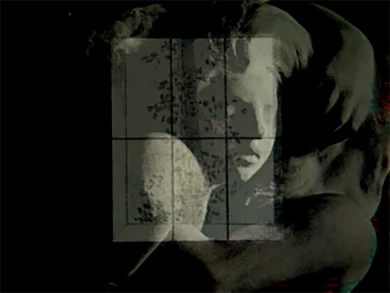
Jean Vigo, Taris, ou la natation (Swimming Champion), 1931, film
Held on 24 Jul 2026
The body in water as an object of ideology. This is one of the major themes of the 1930s and this session, where Nazism and Anarchism dissolve into two different swimming pools. Two great films of counterposed ideologies which have gone down in history as examples of film’s power to represent a vision of the world. In Olympia, Part 2. Festival of Beauty, Leni Riefenstahl films the Olympic Games of Berlin in 1936, organised during the Third Reich. The camera leaves the athletics stadium to show the repertoire of modern sports — fencing, polo, cycling, pentathlon — before culminating in the Olympic pool with Adolf Hitler as the host, where the beautiful, disciplined, classical bodies of the swimmers bring to mind, as Susan Sontag wrote, the visual fascination that characterised fascism. Meanwhile, Jean Vigo, the son of an exiled Spanish anarchist, films French Olympic champion Jean Taris in a funny, playful exercise, where the swimming pool becomes a field of play without rules and where avant-garde film-making elements of the 1930s materialise, such as slow motion, superimposed images and dynamic editing. Two avant-garde films, two films on opposite poles that show, for a time, swimming not as an object of pleasure or desire, but as a space of contest from which to demonstrate the power of the twentieth century’s great ideologies.
Organised by
Museo Reina Sofía
Curatorship
Chema González, Dídac Humà and Alberto Moreno
Sponsored by

Accessible activity
This activity has two spaces reserved for people with reduced mobility
Agenda
viernes 24 jul 2026 a las 22:00
Screenings
Leni Riefenstahl. Olympia 2. Teil - Fest der Schönheit (Olympia, Part 2. Festival of Beauty)
Germany, 1938, DA, black and white, sound, original version in German with Spanish subtitles, 104. Restoration by the International Olympic Committee
Jean Vigo. Taris, ou la natation (Swimming Champion)
France, 1931, DA, black and white, sound, original version in French with Spanish subtitles, 10’
![Jean Vigo, Taris, ou la natation [Taris, rey del agua], 1931, película](https://recursos.museoreinasofia.es/styles/small_landscape/public/Actividades/ciclocine-piscinas-7_1.jpg.webp)
![Leni Riefenstahl, Olympia 2. Teil - Fest der Schönheit [Olimpiada, parte 2. El festival de la belleza], 1938, película](https://recursos.museoreinasofia.es/styles/small_landscape/public/Actividades/ciclocine-piscinas-7_2.jpeg.webp)
![Leni Riefenstahl, Olympia 2. Teil - Fest der Schönheit [Olimpiada, parte 2. El festival de la belleza], 1938, película](https://recursos.museoreinasofia.es/styles/small_landscape/public/Actividades/ciclocine-piscinas-7_2_1.jpeg.webp)
![Leni Riefenstahl, Olympia 2. Teil - Fest der Schönheit [Olimpiada, parte 2. El festival de la belleza], 1938, película](https://recursos.museoreinasofia.es/styles/small_landscape/public/Actividades/ciclocine-piscinas-7_2_2.jpeg.webp)
![Leni Riefenstahl, Olympia 2. Teil - Fest der Schönheit [Olimpiada, parte 2. El festival de la belleza], 1938, película](https://recursos.museoreinasofia.es/styles/small_landscape/public/Actividades/ciclocine-piscinas-7_2_3.jpeg.webp)
Activity within the program...
The Pool: Swim or Sink
Summer Cinema
This year, Museo Reina Sofía devotes its summer film series to the existential, symbolic imagery of the swimming pool. The series embraces the act of watching films communally in the Sabatini Building’s neoclassical garden, a recently restored, verdant oasis inhabited by the sculptures of Dan Graham, Eduardo Chillida, Alejandra Riera and Alexander Calder, complemented by the large cinema screen that operates as a further contemporary work. The series is free of charge and unfolds every Friday and Saturday across July and August.
The programme, entitled The Pool: Swim or Sink, seeks to develop the existential ambiguity that characterises the swimming pool in its most diverse manifestations across the history of film. The pool imparts an exploration of ideas in the vicinity of summer identity: leisure, free time, hedonism, sensorial pleasure, extreme heat and bodily sensuality. Yet it is also associated with the verso of these emotions, for instance melancholy, the fleetingness of time and the search for something beyond reach, be it social status or unattainable desire, and their ill-fated outcomes. Therefore, it comes as no surprise that the swimming pool, the architecture of pleasure and enjoyment, is also the scene of shady, criminal activity. Sure enough, the pool, that middle-class extravagance that breaks a garden’s solidity, is much more than a sheltered space of summer hedonism: it is a symbolic threshold between reason and desire. Under its surface there is more than controlled water and an aquatic penchant for relaxation; there is an entire geography of desires at their most unrestrained.
The contained, transparent water acts as a social display that reflects at once the innocence of childhood and the most unsettling desires of adulthood. It is the theatrical stage for the outsider’s gaze and the search for the other, a mirror of false calm under an idealised image. The act of submergence alters these rules: noise is dampened, gravity is suspended. With sinking returns the metaphor for introspection, to a space where the mind echoes, where it frees itself from external structures and allows identity to be inhabited. There, deep down, the abyss and intrigue surface. The Pool: Swim or Sink is an invitation to have a blast, or not.
Ver programa![Jacques Deray, La piscine [La piscina], 1969, película](https://recursos.museoreinasofia.es/styles/small_landscape/public/Actividades/ciclocine-piscinas-18.jpg.webp)
Jacques Deray. The Swimming Pool
Past activity
The characters played by Alain Delon (Jean-Paul) and Romy Schneider (Marianne) experience their love in apparent splendour. A sun-drenched house, a blissful swimming pool, beautiful bodies, sexuality in abundance. The visit of Harry (Maurice Ronet), a successful musician, friend of Jean-Paul and ex-lover of Marianne, accompanied by his young and beautiful daughter Penélope (Jane Birkin), rocks their relationship, bringing to light the jealousy and insecurities of each one in a dark game of possession and male rivalry.
If there was a definition of the glistening blue pool in this sexual thriller, it would be the paradise of Adam and Eve, represented by the shots of happiness of Romy Schneider and Alain Delon in this swimming pool on France’s Côte d’Azur. The appearance of these two beautiful creatures kissing semi-naked by the water is one of film’s resonant images. The paradise cannot be fractured, not even by death. As in the crossing of the Tigris and Euphrates rivers, where humanity’s first lovers bathed naked in the water, innocent to their imminent end, the reflection of the crystalline water of The Swimming Pool shows this game, and the deep traumas which, under this mantle, are hidden in the amorous relationships and limits that only love is capable of breaking to solve.
In this session both endings to the film are screened: the original version, open and symbolic, and the Spanish version, marked by censorship during Francoism, and its sequence for a Spanish premiere — a stereotypical and reductive vision reflecting the sociological condition of the country.
![Binka Zhelyazkova, Baseynat [La piscina], 1977, película](https://recursos.museoreinasofia.es/styles/small_landscape/public/Actividades/ciclocine-piscinas-17_00.png.webp)
Binka Zhelyazkova. The Swimming Pool
Past activity
The young, bright Bella (Yanina Kasheva), after unforeseen heartbreak at her graduation party, meets Apostol (Kosta Tsonev), a reserved architect, and Boyan (Kliment Denchev), a comedy actor who is cynical about his country. The three characters climb up to a diving board in a municipal swimming pool, where they begin a strange relationship of friendship, love and despair which reflects a generational clash.
Binka Zhelyazkova, the great enfant terrible of Eastern European cinema, critic of the communist system and widely acclaimed film-maker beyond Bulgarian borders, made in The Swimming Pool a masterly metaphor for a country in decline. The public pool symbolises a closed, immovable enclosure where society is festering. From the height of a diving board she sees, in a panoptic view, the different generations living underneath a limited space. On one side, older people attempt to preserve the old revolutionary spirit with constant collective swimming exercises while, on the other, young people don’t hide the desire for freedom that remains unrealised. The result is an ideological clash in how to act and move in the enclosure, unearthing vast hypocrisy in the lost ideals of socialism, reflected in the total apathy of youth. The Swimming Pool for Zhelyazkova is a reflection of the disillusionment and existential void of a whole country and system.
![Yorgos Lanthimos, Kynodontas [Canino], 2009, película](https://recursos.museoreinasofia.es/styles/small_landscape/public/Actividades/ciclocine-piscinas-16_00.jpg.webp)
Yorgos Lanthimos. Dogtooth
Past activity
A couple with three adult children live in a modern country cottage. A large swimming pool takes centre stage in a sizeable garden. The property is skirted by a large fence that blocks a view of the outside. Here, the father has educated his children without outside contact, maintaining their belief in a false world: aeroplanes fall in the garden like toys and they must act like dogs to defend themselves from the ferocious cats that surround the house. The promise of going out into the world when they lose their dogtooth is proof of their maturity.
Lanthimos builds a world that is surreal, comical and terrible. The swimming pool is the house’s central element, a limited, controlled space assimilated like the sea, yet under the father’s supervision. A space of imagination, but with sinister intentions: the children are indoctrinated under the water as they believe in a better world. Far from reality. The swimming pool’s limits are the limits of their freedom, a false state of well-being expressed in the weightless bodies in the water. The liquid element is an analgesic magma with the power to educate offspring under the latent fear of a shark bite.
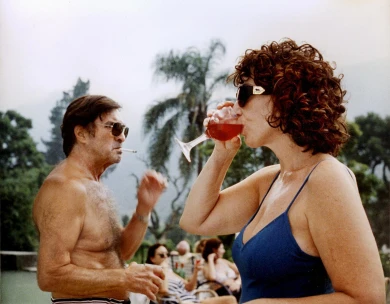
Lucrecia Martel. La ciénaga (The Swamp)
Past activity
A couple of families spend the summer in a country cottage. The relationship between them exposes a crisis. The alcoholism of Mecha (Graciela Borges) and Gregorio (Martín Adjemián) becomes clear, leading to a drift in the education of their children and impacting relationships of respect and affect. Weariness expresses the lackadaisical environment.
In La ciénaga Lucrecia Martel approaches the decadence of a middle-class Argentinian family. The pool of dirty, stagnant water reflects the economic and social collapse of a whole country, yet reflects more than economic crisis as it becomes a murky well feeding off the pain of those living in the house. An erstwhile space of joy, the swimming pool becomes a reflection of adult depression, resulting in apathy. And the children, especially the girls, seem to be the only people awake in this drift. Barring a flicker of unawareness, the young people immerse themselves in rainwater or the water from the river, in water that flows, but are cautious of getting too close to the swimming pool.
![Blake Edwards, The Party [El guateque], 1968, película](https://recursos.museoreinasofia.es/styles/small_landscape/public/Actividades/ciclocine-piscinas-14.jpg.webp)
Blake Edwards. The Party
Past activity
In The Party, actor Hrundi V. Bakshi (Peter Sellers) is mistakenly invited to a glamorous dinner party in Hollywood. His curiosity and two left feet lead to one funny mishap after the other. During the soiree he consoles Michèle, a young actress who has been fired by her producer, and the chaos gathers momentum when Bakshi accidentally opens a retractable floor, making the guests fall into a swimming pool. A small hippie-style elephant gatecrashes the party, brought by a group of young people, and Bakshi asks the guests to wash the elephant as it is a sacred animal in his country. The house fills with soap suds, culminating in a wackily chaotic party.
When Stanley Kubrick was once asked who Peter Sellers was, he replied: “There is no such person as Peter Sellers”. The Party is one of the most widely recognised comedies in the history of film, its director Blake Edwards and the English actor making an entertaining critique of a fading conservative society. The cultural revolutions of the 1960s fit into the container of a choppy swimming pool: people from high society, an elephant, a Russian ballet, waiters, beatnik youth… similar to Sellers’s own identity: an empty vessel that can be refilled. In the film, Edwards tapped into the ingenious actor’s innate improvisation and the swimming pool as a container for revolutionary intent.
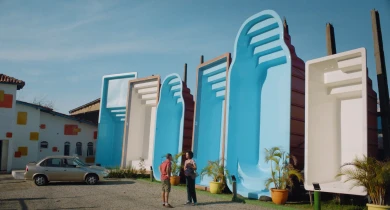
Dominga Sotomayor. Debajo and Thais Fujinaga. A Felicidade das Coisas
Past activity
Two gems, from two new voices in Latin American cinema, which swing between families, swimming pools, reencounters and status. In Debajo, a short film on youth by Chilean director Dominga Sotomayor, an abstract yet powerful bird’s-eye view of a swimming pool co-exists with the relationships of a crisis-stricken family, gathered to see an eclipse. Sotomayor’s distinctive film-making of care and affects shares a similar space to the daily naturalism of Thais Fujinaga’s A Felicidade das Coisas. In the director’s first feature film, the swimming pool is not a horizontal basin for swimmers’ immersion; rather it is a huge vertical monolith, a kind of an anti-monument, anchored in the garden of a middle-class family. The film conveys the efforts and challenges of a mother of two children to build a swimming pool in their modest summer house, a mother who, alone, comes up against a hypermasculine world. Equally, the film speaks of family love, and the search for status, with the swimming pool a languishing totem of the Brazilian middle class during the years of Bolsonarism.
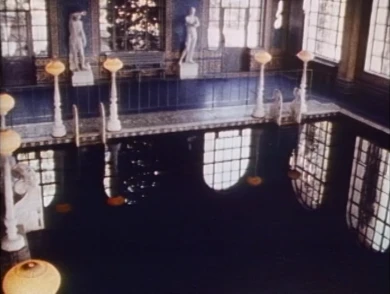
Six Swimming Pools. A Dive into Experimental Film
Past activity
For the first time, the Museo’s summer cinema programme includes an experimental film section, centred on the experience and feeling of bodies under water. This session glides between the ostentatious aquatic architecture of Barbara Hammer and Barbara Klutinis and Jakobois’s fantasies, fleeting contact and wet, sexualised bodies. Six completely different swimming pools — private, public, transparent, bottomless, indoor, outdoor — all designed for leisure, competition and desire, nonetheless. A journey ranging from the monumentality of architecture to the intimacy of wet bodies.
Pools, by Barbara Hammer and Barbara Klutinis, turns swimming pools designed by pioneering architect Julia Morgan for the castle of tycoon William Randolph Hearst — the inspiration for Citizen Kane — into a space of play, bodily exploration and queer appropriation, an excuse to dive into a scene reserved for privilege. In An Algorithm, Bette Gordon fragments a series of headfirst dives and turns the sporting gesture into a visual score of repetitions, variations and rhythms. Tony Hill’s Water Work seduces with perspective, reflections and depth — the swimming pool as optical illusion, as an unstable surface which distorts and multiplies the gaze. Cheap Imitation “They Walk and I Walk”, by Rickard Eklund, submerges the camera to capture a choreography of synchronized bodies, a dance suspended under water. Naked bodies that dodge, twist and embrace in a space seemingly with no gravity combine in Gunilla Leander’s All Under. Passage du désir, by Jakobois, closes the programme with a montage in which water is no longer an environment, becoming instead a territory of desire.
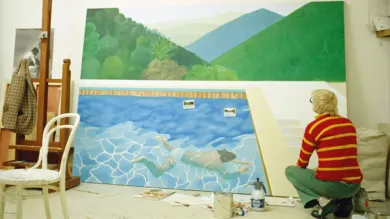
Jack Hazan. A Bigger Splash
Past activity
Painting endows a fleeting and unique moment with permanence and stability. This was the vision of the late David Hockney when, brushstroke by brushstroke, he returned to the swimming pool in A Bigger Splash: the great dive into a Californian pool which freezes a sense of happiness. A splash made by Peter Schlesinger, the painter’s partner from whom he has just separated.
In the film A Bigger Splash, Jack Hazan portrays the world of a successful artist, art-market and art-dealer pressure, the tension between the ego and personal frailty, and the obligation to continue with a style and iconography which, despite its instantly recognisable artistic imprint, creates doubts for the painter. In a grey, rainy London, a glum Hockney, the victim of soured love, keeps returning to the Californian swimming pool that holds the promise of happiness, in the form of a homosexual Arcadia in which the painter lives with his young partner and a group of equally glowing and attractive friends. Ultimately, the pool, as Jack Hazan recalls in this pioneering artist’s documentary, is a simile for the same painting in its original intention: hang onto fleetingness to lend it a permanence for the beholder, despite it not existing. Hockney, as one of the last great painters, knew his medium remained largely unchanged across hundreds of years of history.
Sol Iglesias. The Swimmers
Past activity
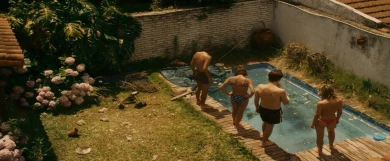
The end of the world, caused by climate change, is here and a group of friends wander from swimming pool to swimming pool at the height of a long, hot summer in Buenos Aires. From pool to pool, they cross the city, drifting leisurely and agreeably. In this transit they encounter different survivors searching desperately for water until their journey ends.
In echoing Frank Perry and Sydney Pollack’s film The Swimmer, Sol Iglesias’s The Swimmers is, equally, a path towards first light. The swimming pools symbolise, on this sunburnt stage, a metaphor at once for shelter and death by asphyxiation. It is the extreme heat that turns it into a fresh and pleasurable ending. The swimming pool, moreover, represents the lethargy of a youth tired of fighting against something they see as “inevitable”. As the young people trespass on a neighbourhood’s private property — rather than in public space — the pool is a stronghold of intimacy that must be seized: the false paradise of a collapsed society. The film brings the viewer closer to another film to feature in this series, La ciénaga (The Swamp, 2001) by Lucrecia Martel, in which bodies search for recesses of stagnant water.
![Mike Nichols, The Graduate [El graduado], 1967, película](https://recursos.museoreinasofia.es/styles/small_landscape/public/Actividades/ciclocine-piscinas-9_0.jpg.webp)
Mike Nichols. The Graduate
Past activity
Benjamin Braddock (Dustin Hoffman) is a young graduate from a wealthy California family. After returning home he meets Mrs Robinson (Anne Bancroft), who seduces him in successive encounters and shows him things that can’t be read in books. Mrs Robinson’s daughter, Elaine (Katharine Ross), enters his life to turn his feelings upside down.
Anne Bancroft’s remarkable performance shows the need to feel alive in a world gone stale, and the weapons sex possesses opposite romantic love. This is the learning curve young Ben experiences, and it is the time he spends drifting in the swimming pool that takes him from bewilderment to lucidity. He goes from a fool in a wetsuit lost at the bottom of the pool, to letting himself sway on the waters of pleasure or to see the mantle of the pool covered in fallen leaves with the arrival of love. The swimming pool is the place that initiates a change of state: an awakening of life forces.
![Lloyd Bacon, Footlight Parade [Desfile de candilejas], 1933, película](https://recursos.museoreinasofia.es/styles/small_portrait/public/Actividades/ciclocine-piscinas-8_0.jpg.webp)
Lloyd Bacon. Footlight Parade
Past activity
The swimming pool and dancing aquatic bodies as a place of reverie and fascination in the advent of Hollywood and the fledgling entertainment industry. A musical prior to the moralising Hays Code in which a visionary Busby Berkeley directs one of the most lavish mass-participation choreographies in the history of cinema. The main number is By a Waterfall, with a pool and hundreds of bathers front and centre. After observing this piece, Salvador Dalí considered Busby Berkeley an equal in his paranoid delirium and a major influence on his installations, for instance the work he made for the 1939 New York World’s Fair.
The story follows a brilliant theatre director who dreams up grandiose musical numbers to be performed in cinemas before each screening, saving live performance from the rise of spoken film. Therefore, he throws himself into a race to show the world the three most lavish musicals ever imagined. Along with Honeymoon Hotel and Shanghai Lil, By a Waterfall stands out and is considered the most striking film choreography focused on the plastic possibilities of the swimming pool. Hundreds of swimmers turn their bodies into monumental, abstract geometric figures in a crescendo of surprise and wonder which builds the swimming pool into the essential architecture for a Hollywood conceived as a new factory of dreams.
Leni Riefenstahl. Olympia, Part 2. Festival of Beauty and Jean Vigo. Taris, Swimming Champion
Past activity
The body in water as an object of ideology. This is one of the major themes of the 1930s and this session, where Nazism and Anarchism dissolve into two different swimming pools. Two great films of counterposed ideologies which have gone down in history as examples of film’s power to represent a vision of the world. In Olympia, Part 2. Festival of Beauty, Leni Riefenstahl films the Olympic Games of Berlin in 1936, organised during the Third Reich. The camera leaves the athletics stadium to show the repertoire of modern sports — fencing, polo, cycling, pentathlon — before culminating in the Olympic pool with Adolf Hitler as the host, where the beautiful, disciplined, classical bodies of the swimmers bring to mind, as Susan Sontag wrote, the visual fascination that characterised fascism. Meanwhile, Jean Vigo, the son of an exiled Spanish anarchist, films French Olympic champion Jean Taris in a funny, playful exercise, where the swimming pool becomes a field of play without rules and where avant-garde film-making elements of the 1930s materialise, such as slow motion, superimposed images and dynamic editing. Two avant-garde films, two films on opposite poles that show, for a time, swimming not as an object of pleasure or desire, but as a space of contest from which to demonstrate the power of the twentieth century’s great ideologies.
![François Ozon, Swimming Pool [La piscina], 2003, película](https://recursos.museoreinasofia.es/styles/small_landscape/public/Actividades/ciclocine-piscinas-6.jpg.webp)
François Ozon. Swimming Pool
Past activity
Sarah Morton (Charlotte Rampling), a frustrated English writer paralysed by writer’s block, is invited by her editor to spend a few days in her summer house in the south of France. While there she meets Julie (Ludivine Sagnier), the editor’s uninhibited daughter. The young girl’s hypersexuality clashes with Morton’s cold nature, an initial hostility which turns into a fascination with the private life of the young girl, serving the writer as inspiration for her new novel and tugging the story to an ambiguous game between truth and imagination.
Being in crisis is wanting to be another person. Sarah wants to absorb the vitality of her young host, a process of metamorphosis triggered by the swimming pool. The pool is the film’s central character, the place where Julie shows her naked body and amorous acts, sending Sarah into a state of agitation. Through the pool and its water, the writer drinks in Julie’s wild passion. The aquatic enclosure thus acts as catharsis: the place where the subconscious of the writer flourishes, enabling her to unleash her creativity and free her fantasies. At the same time, water distorts the image, blurring fiction and reality; ultimately, the necessary medium to keep art afloat.
Jonathan Glazer. Sexy Beast
Past activity
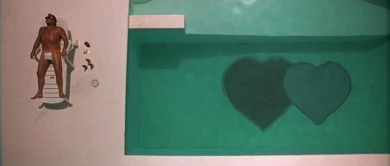
Gal Dove (Ray Winstone), a criminal for the British mafia, lives happily retired with his wife in an idyllic villa in southern Spain and a dazzling swimming pool. Their peace is shattered with the arrival of Don Logan (Ben Kingsley), a former gangster and criminal associate who wants to convince him to do one last job.
If a swimming pool can be at the heart of suspense, then Sexy Beast is the quintessence. The reflection of blue water in Gal’s idyllic seclusion symbolises the artificial paradise that can be broken at any time. This first feature-length film by British director Jonathan Glazer (also the director of The Zone of Interest, 2023) starts with one of the most striking swimming pool scenes, a symbol for the impending danger about to reach this whitewashed haven of peace. The perfect vision of recreated beauty — luxury pools on the Andalusian coast — which, in the depths of pristine water, conceals an unsettling fear of returning to the past.
Sofia Coppola. Somewhere
Past activity
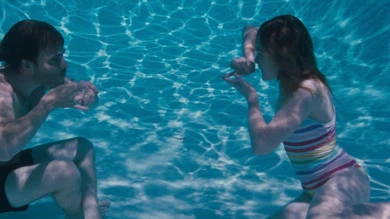
Johnny Marco (Stephen Dorff), a famous Hollywood actor, lives a life of pleasure in Hotel Chateau Marmont in Los Angeles, drifting aimlessly between vacuous relationships, punctuated by film shoots and commercial duties. Cleo (Elle Fanning), his eleven-year-old daughter, stays with him for a few weeks due to her mother’s absence, forcing him to rethink his life.
Sofia Coppola’s employment of swimming pools is carefully considered in the film — blue water in Somewhere is the only place where Marco can recover the meaning of his existence as the pool acts as a womb in which he finds balance. While living with his daughter Cleo and the reflection of these aquatic moments — diving under water, floating, playing or simply sunbathing with no real purpose — everything happens. Thus, Coppola explores in depth themes such as fame, loneliness and the complexity of human ties, putting forward an intimate and profound portrait full of the subtleties of life.
![Céline Sciamma, Naissance des pieuvres [Lirios de agua], 2007, película](https://recursos.museoreinasofia.es/styles/small_landscape/public/Actividades/ciclocine-piscinas-3.jpg.webp)
Céline Sciamma. Water Lilies
Past activity
Céline Sciamma’s directorial debut, Naissance des pieuvres,depicts the emotional and sexual awakening of three teenagers around an indoor swimming pool in a Parisian suburb. Marie, a fifteen-year-old introvert, becomes fascinated by Floriane, the charismatic captain of a local synchronised swimming team. Driven by this attraction, Marie tries to get closer to her while observing the complex dynamics of desire, friendship and power that develops between the young girls. At the same time, Anne, one of Marie’s friends, has her own experience of insecurity and affective search, shaped by the pressure to fit in and belong. As the relationship between the three intensifies, contradictions surface between the image they outwardly project and their real feelings.
Standing away from the common places on adolescence, Céline Sciamma explores first love, burgeoning queer identity and the uncertainty of desire with an intimate, observational gaze, resulting in a sensitive and honest portrait of a time of transformation, in which each gesture leads to the passage from childhood to adulthood.
![Frank Perry y Sidney Pollack, The Swimmer [El nadador], 1968, película](https://recursos.museoreinasofia.es/styles/small_landscape/public/Actividades/ciclocine-piscinas-2.jpg.webp)
Frank Perry and Sydney Pollack. The Swimmer
Past activity
Neddy Merrill (Burt Lancaster), a handsome and vigorous middle-aged man, decides to swim home via his neighbours’ swimming pools in an upscale gated community in Connecticut. He calls the waterway the “Lucinda River” in honour of his wife. Merrill is a high-profile advertising executive, seemingly loved and acknowledged by his neighbours, who invite him to embark upon his surreal idea.
The Swimmer, initiated by Frank Perry and realised by director Sidney Pollack, is a bitter metaphor for life, the pools here a reflection of the “river of life”, a course that runs from the affluence of bygone bourgeois status to present-day decadence. Outwardly jovial and bright, the film shows the transition towards the eclipse of the American dream, the decline of youth and the impossibility of admitting defeat to phantasy. The swimming pool, which, according to Orson Welles in a 1964 interview, represented the obsession with status and the reason why many ultimately betrayed their comrades during McCarthyism, underpins here this idea of the superficiality entailed in the destruction of social ties.
Ion de Sosa. Balearic
Past activity
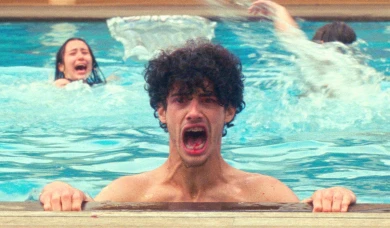
Ion de Sosa will open this fresh edition of the Museo Reina Sofía’s summer cinema series, a director whose film-making is counter-cultural, risqué and authentic, as well as fully alive and unpredictable. Balearic, one of the films of the year, is about a group of teenagers who are trapped in a swimming pool surrounded by a pack of ferocious dogs while an adult gathering gives over to the most decadent hedonism in a nearby pool. Images of pleasure and enjoyment that turn into feelings of horror and alienation, an antithetical reference point which gives form to this entire summer film season. Equally, the film mixes genres, where the lust of teenage cinema and the blood of the most insatiable slasher films co-exist with the social satire of neorealist social commentary.
Shot in a 16mm format, in which experiences proliferate to sprout beyond the screen, Balearic contains other traces of Ion de Sosa’s film-making, for instance the mix of professional and amateur actors, where a clutch of actors appears alongside icons from Spanish underground cinema such as Marta Bassols, Julián Génisson and Lorena Iglesias, regular companions on the film-maker’s cinematic journeys, and improvised scenes with no script, as with the dialogues of musician Christina Rosenvinge and artist María Llopis. The idea of Balearic has its roots in Ion de Sosa’s viewing of The Swimmer (1968) by Frank Perry and Sydney Pollack, also screened in this summer film series.
Más actividades
![Isabel Coixet, 100 Years and You Everywhere [100 años y tú en todos los sitios], 2026, película](https://recursos.museoreinasofia.es/styles/small_landscape/public/Actividades/2.diseminar-mundo.jpg.webp)
John Berger and Isabel Coixet. Continued Ways of Seeing
Thursday, 17 September 2026 at 7pm
Ways of Seeing (1972) is one of the most revolutionary television series on art history, the museum and contemporary critical culture. Across four episodes, an articulate, enthusiastic John Berger unpacks the relationships between classical art through the gaze and new technology, the nude and feminism, the oil painting and commodity fetichism, advertising and consumerism. In essence, a level of critical commitment only comparable to its capacity for dissemination. Unsurprisingly, the series, and the book that would distil it, continues to forge vocations. This session sees art historians Alberto López Cuenca and Modesta Di Paola carry out an analysis of Berger’s audiovisual work, placing the stress on episodes one and four of the series. In the first episode, Berger reflects on the connection between the act of seeing, looking and being in light of new technology, such as the film camera. At the same time, it analyses how the culture of reproduction is turning paintings into messages or fragments of communication while stressing the importance of silence when observing historical paintings. In the fourth and final episode, he introduces advertising as a new iconic-verbal language that shares certain principles with the message of oil painting as a luxury item.
The session opens with the premiere of a filmic letter from Isabel Coixet, one of Spain’s most internationally acclaimed directors, to John Berger, with whom she maintained a long friendship and deep admiration. The short film is testament to the ubiquitous and long-lasting presence of the author of Ways of Seeing, even after his death in 2017.
![Chantal Akerman, Woman Sitting after Killing [Mujer sentada después de matar], 2001, instalación. Museo Reina Sofía](https://recursos.museoreinasofia.es/styles/small_landscape/public/Actividades/chantal-akerman-mujer-sentada-despues-matar.jpg.webp)
On Your Screen: Art History and the Museum Facing the Audiovisual Challenge
18, 19 SEP 2026
The conference On Your Screen: Art History and the Museum Facing the Audiovisual Challenge sparks debate around the transformations of art history and museum space upon embracing the audiovisual format. Its starting point is John Berger’s emblematic television series Ways of Seeing (1972), a landmark in the democratisation of art-historical discourse. In the series, Berger illustrated how the transfer of a work such as Goya’s Los fusilamientos del 3 de mayo (The Third of May 1808 or the Executions) from museum gallery to home TV screen completely changed the viewer’s experience, allowing the image to travel to straight to the viewer.
In the twenty-first century, this screen-based ecosystem has expanded exponentially, with museums not only physically integrating screenings and devices into their galleries— following in the wake of many exhibitions on the moving image — but also deploying complex virtual strategies. Equally, numerous en vez de a multitudeof historians, students and creators use digital platforms to circulate their ideas and projects. This audiovisual shift opens access to ignored materials and democratises knowledge, as well as challenging traditional hierarchies and the interpretive authority of institutions. The conference, promoted by the research project ATLAS AV: The Audiovisualisation of Art History and the Museum, seeks to analyse this vast audiovisual material, its archives, and its capacity to transform the memory of art.
Godard and Miéville: Time and Ruin
Friday, 18 September 2026 - 7pm
Inside the framework of the conference On Your Screen: Art History and the Museum Facing the Audiovisual Challenge, this film series sets forth three critical visions of the museum via three sessions featuring the works of John Berger, Jean-Luc Godard and Anne-Marie Miéville, Ariella Azoulay, Alan Resnais and Chris Marker, Kwate Nee-Owoo, and the premiere of short films by Isabel Coixet and La Vulcanizadora (Maria Rojas Arias and Andrés Jurado). In classical theory, the museum gives the world meaning; it contains fragments of the past, granting them a history, a narrative that explains preterite time and the present. Today, there is an implicit assumption that this function hides and legitimises forms of power, yet what if the museum, instead of explaining the world, multiplied it through radical ideas, silenced periods and repressed subjects? Such is the approach of the film-makers and artists in this film season.
In 1972 the writer John Berger opened the landmark television series Ways of Seeing with an iconoclastic gesture: slicing Sandro Botticelli’s painting Venus and Mars (1485) in London’s National Gallery. A transgressive act that recalls contemporary attacks on the museum by dissident youth and with which Berger, after revealing it was a reproduction, sought to ignite debate around the idea of an original artwork and a copy. In this, the hundredth anniversary of his birth, the first session pays homage to one of the great art writers of the twentieth century. Starting with a review of Berger’s audiovisual work by art historians Alberto López Cuenca and Modesta Di Paola, the series begins with the premiere of 100 Years and You Everywhere (2026), an unreleased short film by Isabel Coixet composed as a beautifully crafted letter to Berger, and continues with an analysis of fragments of Ways of Seeing in relation to the museum and contemporary art.
The second session screens two medium-length films by Jean-Luc Godard and Anne-Marie Miéville on time, ruin and museum. In The Old Place. Small Notes Regarding the Arts at Fall of 20th Century (1999), both film-makers consider what remains of that “old place”, the museum, at the close of a century of wars and totalitarianism, and ask whether it should be more of a legend or desire than a place. This same driving principle leads Godard to build his own imaginary museum in Reportage amateur (maquette expo) (2006), a rickety toy museum which, paradoxically, contains the great film-maker’s full power of thought on history and images.
Finally, the third session explores one of the major challenges of recent years: the decolonisation of the museum, the recognition of its link to imperialist discourses of power and the need to situate a new silenced or repressed subject at the centre of the Western narration of history. Under the title Museums and Restitution, it includes the film Undocumented. Unlearning Imperial Plunder (2019), by theorist Ariella Azoulay, Statues Also Die, by Alan Resnais and Chris Marker (1953), Kwate Nee-Owoo’s You Hide Me (1970) and the first screening of the short film Quinto verso, parte de Tonada (Fifth Verse, Part of Tonada), by La Vulcanizadora (Maria Rojas Arias and Andrés Jurado), filmed at the Museo de América in Madrid.
![Ariella Azoulay, Un-documented. Unlearning Imperial Plunder [Indocumentados. Desaprendiendo el saqueo imperial], 2019, película](https://recursos.museoreinasofia.es/styles/small_landscape/public/Actividades/5.diseminar-mundo.jpg.webp)
Museums and Restitution
Saturday, 19 September 2026 - 7pm
Centuries of plundering, decades of amnesia, years of living with unmitigated extractivist power… Does a museum, as we know it, have a raison d'être in a postcolonial society?
This session expounds the operations of the museum as a colonial machine, while putting forward ideas, in narration, for a more just, equal and inclusive institution of the future via society’s marginalised and minority voices. The session begins with the international premiere of Quinto verso, parte de Tonada (Fifth Verse, Part of Tonada), which presents a vision of the Quimbaya Collection (fifth and sixth centuries CE) from the Museo de América in Madrid. It is constructed with the voices and chants of Wayúu mourners and guides, not only as a way of reinstating the role of these gold idols — anthropomorphic figures of men and women used as vessels in ritual practices — but also to imagine that what must be exhibited is not the gold itself. It is the ritual’s own chant. In the classic film You Hide Me (1970), Ghanaian film-maker Kwate Nee-Owoo accesses the British Museum’s collection of African art, located in the building’s basement, to question the meaning behind a museum plundering and nullifying. A fine exercise of first-person institutional critique screened for the first time in Spain. Almost seventy years since Resnais and Marker made Statues Also Die (1953), a reflection on the aura-bearing value of the museum opposite the identity-based and cultural belonging of African art, theorist Ariella Azoulay films the same statues again at the Musée du Trocadéro (today the Musée du Quai Branly), which survive and wait to be reunited with their people. Azoulay, whose wholly original undertaking is a lesson to the museum of the future, connects the forced migration of these sculptures with the mass transit of people crossing borders artificially imposed by the same system that has plundered their culture.
The School of Transformative Institutionalism and Local Organisation
From 21 to 24 September 2026
The School of Transformative Institutionalism and Local Organisation (S.T.I.L.O.) is a programme of joint learning and join strategy which sets in motion a process for the exchange of questions, methodologies and experiences between cultural organisations. The overall aim is to create, circulate and prototype tactics, tools and collective knowledge on institutional practices that open new channels for defending culture and advocating structural transformation in divergent geographical contexts.
The project is part of the Laboratorio de Institucionalidad Compartida (The Laboratory of Shared Institutionalism, LIC), a space for the Museo Reina Sofía’s research, work and advocacy centred on developing, experimenting with and systemising practices, protocols and tools which contribute to a fairer and more liveable cultural ecosystem.
For many years now, so-called infrastructural critique in museums questions material, legal and economic infrastructures, among others, as well as the forms of solidarity and practices required to sustain the cultural ecosystem. By approaching current debates, S.T.I.L.O. raises questions on the ways in which organisations define and interpret their practices, organise their relations and respond to the social contexts in which they operate.
The school gathers four cultural organisations that work via different institutional models – scale, contexts, conditions, different working models — with the goal of pooling common strategies and tools of organisation, advocacy and relationships with local communities.
The programme is conceived as a collaborative process with the participation of Arika, La Revuelta, BAK Basecamp and The Tentacular Museum (Museo Reina Sofía) and is structured around preparatory online sessions and an in-person seminar in Madrid.
S.T.I.L.O. is an activity framed inside the working strand of Situated Organisations from L'Internationale’s Museum of the Commons project, which reflects on the role of museums and art organisations as actors within complex social networks and ecosystems, with a view to exploring new ways to democratise institutions and make them more open, inclusive and useful.