-
Monday, 11 September 2023 – 7pm / Second session: Monday, 25 September 2023 – 7pm Sabatini Building, Auditorium
Session 1. José María Berzosa. Les pompiers de Santiago (The Firefighters of Santiago)
France, 1977, colour, original version in Spanish, DA, 75’
– Presented by Chema González and Daniel Berzosa, the film-maker’s son, in the first session
This first episode in the series addresses the ostensible normality of reactionary ideology among Chile’s middle class, represented by the Fourth Company of the Fire Department of Santiago. “There are no political prisoners in Chile”, Augusto Pinochet states at the beginning as Berzosa, in a counterpoint that is characteristic in his editing, shows, in a way that is both realist and measured, the painful testimonies of the mothers and wives of those who have disappeared or are prisoners under the dictatorship. In wilful ignorance of such a reality is the happy society under the restored order: the fire chief, Napoleonic and military, declaring himself apolitical like his department, or the landowner and ex-diplomat who renounces his land. In short, a theatre Berzosa exhibits in all its farse and artifice.

-
Wednesday, 13 September 2023 – 7pm / Second session: Thursday, 28 September 2023 – 7pm Sabatini Building, Auditorium
Session 2. José María Berzosa. Voyage au bout de la droite (Journey to the End of the Right)
France, 1977, colour, original version in Spanish, DA, 78’
– Presented by Luis E. Parés, the director of Cineteca, in the first session
In this second episode, different figures explain their political commitment, forming a portrait of Chile’s new ruling class. Monseñor Gilmore, chaplain-general of the Army, speaks about the advantages of the Army teaching young people, while Enrique Ortúzar, president of Chile’s Constitutional Commission in the wake of the coup d’état, describes a particular kind of authority-based democracy. Following these conversations, Berzosa employs a counter-shot: the situation of artists who have remained in Santiago and are under extreme surveillance, a farmer talking about the misery in rural Chile and a powerful extract of Pablo Neruda reciting his words.

-
Friday, 15 September 2023 – 7pm / Second session: Friday, 29 September 2023 – 7pm Sabatini Building, Auditorium
Session 3. José María Berzosa. Au bonheur des généraux (To the Generals’ Happiness)
France, 1977, colour, original version in Spanish, DA, 67’
Can a lack of ethics be reconciled with aesthetics? This appears to be the theme of this third episode, in which Berzosa films a grotesque and humorous portrait of three army officers who, along with commander-in-chief Augusto Pinochet, make up the Military Junta. Gustavo Leigh Guzmán, Air Force commander, Navy commander José Toribio Merino, and César Mendoza Durán, chief of Police, are interviewed in their homes alongside their wives, discussing issues of a literary, musical and philosophical nature. The efforts of all three to portray themselves as sensitive dilettantes, mentioning figures such as Picasso and Bach and even showing their artistic creations, reflect how the beginnings of major dictatorships — one such example being a young painter called Adolf Hitler — can be rooted in considerable artistic frustration.

-
Saturday, 16 September 2023 – 7pm / Second session: Saturday, 30 September 2023 – 7pm Sabatini Building, Auditorium
Session 4. José María Berzosa. Monsieur le président (Mr President)
France, 1977, colour, original version in Spanish, DA, 75’
This final episode shows the dictator in all his heroic guises: the peerless army officer, the intrepid explorer, the model citizen, the international geopolitics strategist, the concerned father, the faithful husband. The masks progressively peel away as Berzosa intersperses interviews with the mothers of those who have disappeared under the regime. In a typically Berzosa-esque sequence, we see Pinochet, dressed as a civilian, and his wife, Lucía Hiriart, sat in their home. After discussing film, music and family, the film-maker asks Hiriart: “Does your husband have any faults?”. “No, none”, she replies. “We all have our faults…”. She gives it some thought: “Okay, he can be a little domineering,” she says to the icy smile of the dictator. A simple phrase that dismantles the propaganda around a hero.

![José María Berzosa. Les pompiers de Santiago [Los bomberos de Santiago], película, 1977](https://recursos.museoreinasofia.es/styles/small_landscape/public/Actividades/berzosa_principal.jpg.webp)
Held on 11, 13, 15, 16, 25, 28, 29, 30 Sep 2023
José María Berzosa (Spain, 1928 — France, 2018) is a missing link in the history of Spanish cinema, his filmography, made entirely in France, characterised by the use of sarcasm and parody against despotic power. Coinciding with the fiftieth anniversary of the 1973 coup d’état in Chile, the Museo Reina Sofía screens the full version of his documentary series Chili Impressions (1977), following one sole screening in Spain, which took place in Filmoteca Española in 1981. The documentary’s four episodes unmask the monstrosities of Augusto Pinochet’s dictatorship, while also spotlighting film’s capacity to confront tyranny and represent the subjugated.
Berzosa, who made around a hundred documentaries for French television, came to occupy a unique position in the TV industry as he developed his own themes using a distinctive language and was lauded by the critics as one of the most original film-makers in the medium. Exiled to France from 1956, he was initially a director’s assistant for film-makers such as Jean Renoir and Luis Buñuel, but soon became a reference point in his own right due to his television reports, the aforementioned Chili Impressions among them. Berzosa stood out for conceiving documentary in a baroque style using words from the time and with the co-existence of complex narrative strategies ranging from the staging of direct interviews, the use of counterpoint and antithesis in the editing, the idea of filming malevolence and infamy head-on and, his most idiosyncratic trait, the use of humour as a weapon against a harsh and implacable reality.
Berzosa also centred his gaze on dismantling the myths of Spanishness that spread during Francoism, for instance in Rouge Greco Rouge (Red Greco Red, 1973) and Comment se débarrasser des restes du Cid? (How to Dispose of the Remains of el Cid? 1974), which is perhaps the reason why he went to great lengths to film the Chilean dictatorship, which, in the words of the chaplain of Augusto Pinochet, bore the most similarities to the Franco regime. In the four episodes of Chili Impressions, Berzosa pieces together a portrait of the regime from different angles: Les pompiers de Santiago (The Firefighters of Santiago), which presents a group from an alt-right corporation; Voyage au bout de la droite (Journey to the End of the Right), a route through the formation of the dictatorial State; Au bonheur des généraux (To the Generals’ Happiness), an approach to the Military Junta and its cultural tastes amid genocide; and Monsieur le président (Mr President), a portrait of the different sides of the dictator. The series was shot in January, February and March of 1977 and was first broadcast in France from April to May 1978 following a futile attempt at censorship by the Chilean Embassy. Today it constitutes one of the most powerful and astute examples of cinema against the brutality of dictatorship.
Organised by
Museo Reina Sofía
In collaboration with
Más actividades
All Time
Saturday, 25 April and 16 May 2026 — 7pm
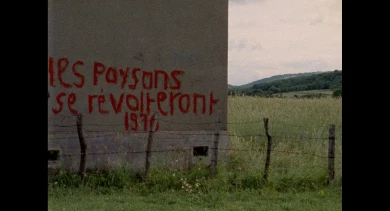
As a recap of the previous sessions, this screening considers a geography of past and present struggles: a refined formal approach, a portrait of popular life, the landscape testimony of working communities and the critique of accumulation and inequality. The monumental diptych Too Early, Too Late (1982) reflects Engels’s sharp analysis of the French Revolution, along with the enumeration of the distribution of taxes on different hamlets in the French countryside. In the second part, the account of Mahmoud Hussein — a pseudonym for Egyptian Marxist historians Bahgat El Nadi and Adel Rifaat — ranges across the memory of anti-imperialist citizen revolts in Egypt throughout the twentieth century. The film destabilises stereotypes and common places of political insurgency in the North African country. Recovering and circulating this latent memory helps to name that which still resists being named and, as Straub y Huillet indicate, “making the revolution is to put very old yet forgotten things back in their place”.
Framed inside The Collection Screened is the programme Present Time: Insurgent Images, curated by Luis López Carrasco, a key film-maker with a distinguished international career. The works in the programme, selected from the Museo’s film and video collection, interlink projects that are conceptual, refined, systematic — as an X-ray of their time in history — with firebrand domestic and activist films, comprehending different political emergencies from the second half of the twentieth century in Europe and Latin America. These works are viewed in light of a genealogy of revolt which buries its roots in the nineteenth century.
![Joan Colom, El carrer [La calle], 1960, película](https://recursos.museoreinasofia.es/styles/small_landscape/public/Actividades/coleccion-proyectada-5.jpg.webp)
Observation and Intervention
Friday, 24 April and 15 May 2026 — 7pm
If cinema does not set out to reach objectivity then each film takes a biased view of observed reality. The session begins with the seemingly neutral view of Cao Guimarães to observe a boy and girl playing in the rain in Da Janela do Meu Cuarto (From the Window of My Room, 2004). A work, deceptively relaxed, which prefigures one of the session’s constants: the place of childhood as a project of worlds to come. The boundless urban vitality of Barcelona Joan Colom portrays in El carrer (The Street, 1960) comes face to face with the extraordinary Niños (Children, 1974), by the Grupo de Cine Liberación sin Rodeos, a multi-voiced depiction of a group of friends in Cuzco whose citizen-focused schooling co-exists, just, with their daily work and reveals the limitations of the Revolutionary Government of the Armed Forces in Peru. Visión de la selva (View of the Jungle, 1973), by the same Peruvian collective, puts forward another model of representation and intervention on the public sphere with direct news activism, which denounces the plundering of the Amazon by multi-national companies.
Framed inside The Collection Screened is the programme Present Time: Insurgent Images, curated by Luis López Carrasco, a key film-maker with a distinguished international career. The works in the programme, selected from the Museo’s film and video collection, interlink projects that are conceptual, refined, systematic — as an X-ray of their time in history — with firebrand domestic and activist films, comprehending different political emergencies from the second half of the twentieth century in Europe and Latin America. These works are viewed in light of a genealogy of revolt which buries its roots in the nineteenth century.
![Video-Nou/Servei de Vídeo Comunitari, Ocaña. Exposició a la Galería Mec-Mec [Ocaña. Exposición en la Galería Mec-Mec], 1977, película](https://recursos.museoreinasofia.es/styles/small_landscape/public/Actividades/coleccion-proyectada-7.png.webp)
Daily Matter
Thursday, 23 April and 14 May 2026 — 7pm
Time, light, vision. What is an image? How does an image make us see the world? First, hypnosis, a reset: Paulino Viota’s Duración (Duration, 1970), the portrait of a clock face over sixty seconds. Next, a window into a slightly altered reality: Javier Aguirre’s Objetivo 40º (40 Degree Lens, 1968–1970). A minimum intervention that inspires a session considered as successive immersions in blocks of time, as well as a journey that starts from the intimacy of a candle, the movement of a car around abandoned peripheries and the traces of anti-Franco protestors, with night falling to the emotive, profound and sharp voice of Ocaña. Now in 1990, the journey ends at other street protests, those articulated by the Agustín Parejo School collective owing to the housing problem in Málaga. As Javier Aguirre states: “It is not about achieving the objective. It is about demystifying it”.
Framed inside The Collection Screened is the programme Present Time: Insurgent Images, curated by Luis López Carrasco, a key film-maker with a distinguished international career. The works in the programme, selected from the Museo’s film and video collection, interlink projects that are conceptual, refined, systematic — as an X-ray of their time in history — with firebrand domestic and activist films, comprehending different political emergencies from the second half of the twentieth century in Europe and Latin America. These works are viewed in light of a genealogy of revolt which buries its roots in the nineteenth century.
![Tracey Rose, The Black Sun Black Star and Moon [La luna estrella negro y negro sol], 2014.](https://recursos.museoreinasofia.es/styles/small_landscape/public/Obra/AD07091_2.jpg.webp)
On Black Study: Towards a Black Poethics of Contamination
27, 28, 29 ABR 2026
The seminar On Black Study: Towards a Black Poethics of Contamination proposes Black Study as a critical and methodological practice that has emerged in and against racial capitalism, colonial modernity and institutional capture. Framed through what the invited researcher and practitioner Ishy Pryce-Parchment terms a Black poethics of contamination, the seminar considers what it might mean to think Blackness (and therefore Black Study) as contagious, diffuse and spreadable matter. To do so, it enacts a constellation of diasporic methodologies and black aesthetic practices that harbor “contamination” -ideas that travel through texts, geographies, bodies and histories- as a method and as a condition.
If Blackness enters Western modernity from the position of the Middle Passage and its afterlives, it also names a condition from which alternative modes of being, knowing and relating are continually forged. From within this errant boundarylessness, Black creative-intellectual practice unfolds as what might be called a history of touches: transmissions, residues and socialities that unsettle the fantasy of pure or self-contained knowledge.
Situated within Black radical aesthetics, Black feminist theory and diasporic poetics, the seminar traces a genealogy of Black Study not as an object of analysis but as methodological propositions that continue to shape contemporary aesthetic and political life. Against mastery as the horizon of study, the group shifts attention from what we know to how we know. It foregrounds creative Black methodological practices—fahima ife’s anindex (via Fred Moten), Katherine McKittrick’s expansive use of the footnote, citation as relational and loving labour, the aesthetics of Black miscellanea, and Christina Sharpe’s practices of annotation—as procedures that disorganise dominant regimes of knowledge. In this sense, Black Study is approached not as a discrete academic field but as a feel for knowing and knowledge: a constellation of insurgent practices—reading, gathering, listening, annotating, refusing, world-making—that operate both within and beyond the university.
The study sessions propose to experiment with form in order to embrace how ‘black people have always used interdisciplinary methodologies to explain, explore, and story the world.’ Through engagements with thinkers and practitioners such as Katherine McKittrick, C.L.R. James, Sylvia Wynter, Christina Sharpe, Fred Moten, Tina Campt, Hilton Als, John Akomfrah, fahima ife and Dionne Brand, we ask: What might it mean to study together, incompletely and without recourse to individuation? How might aesthetic practice function as a poethical intervention in the ongoing work of what Sylvia Wynter calls the practice of doing humanness?
![Aurèlia Muñoz, Ocell estel S2 [Pájaro-cometa S2], 1982. Archivo Aurèlia Muñoz](https://recursos.museoreinasofia.es/styles/small_landscape/public/Actividades/aurelia-munoz-charlainaugura.jpg.webp)
Aurèlia Muñoz. Beings
28 ABR 2026
In conjunction with the opening of Aurèlia Muñoz. Beings, an exhibition curated by Fundación EINA via its einaidea platform, Manuel Cirauqui, einaidea’s founding director, and collaborators Rosa Lleó and Sílvia Ventosa engage in conversation around the curatorial approach to this anthological show devoted to Aurèlia Muñoz (Barcelona, 1926–2011). The exhibition, organised by the Museo Reina Sofía and the Museu d’Art Contemporani de Barcelona (MACBA), traces an extensive path through the artist’s career and revises the conceptual points that run through her work, points which are pivotal to understanding the development of contemporary textile art.
The encounter seeks to explore new perspectives imparted by the show and to offer a wider reading of Muñoz’s legacy, travelling through more than fifty years of artistic practice: from monumental textile structures to handmade paper sculptures, from her beginnings linked to Nouvelle Tapisserie and the Catalan Tapestry School to the consolidation of her own language, which flows beyond the limits of fabric and craft.
Furthermore, the conversation touches on the experimental nature of Muñoz’s work, defined by a constant investigation into techniques and materials that interlace ancestral knowledge and artisan traditions with contemporary resources, as well as her main points of reference, influences and unique concept of space. Thus, the focus rests on the concept of “beings”, which are key to understanding her semi-abstract sculptures and suspended structures, conceived as constantly evolving forms which inhabit space. Finally, her drawings, maquettes and personal archive are presented as keys to understanding the cohesiveness and depth of her creative universe.
These inaugural conversations, part of the main working strands of the Museo’s Public Programmes Area, aim to explore in greater depth the exhibition narratives of the shows organised by the Museo from the perspective of artists, curators and specialists.