All Time
Session 3. Present Time: Insurgent Images. The Collection Screened #3
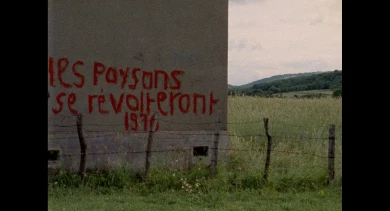
Danièle Huillet and Jean-Marie Straub, Too Early, Too Late, 1981, film
Held on 25 Apr, 16 May 2026
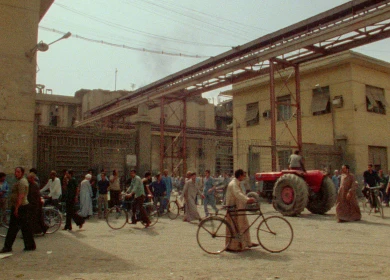
As a recap of the previous sessions, this screening considers a geography of past and present struggles: a refined formal approach, a portrait of popular life, the landscape testimony of working communities and the critique of accumulation and inequality. The monumental diptych Too Early, Too Late (1982) reflects Engels’s sharp analysis of the French Revolution, along with the enumeration of the distribution of taxes on different hamlets in the French countryside. In the second part, the account of Mahmoud Hussein — a pseudonym for Egyptian Marxist historians Bahgat El Nadi and Adel Rifaat — ranges across the memory of anti-imperialist citizen revolts in Egypt throughout the twentieth century. The film destabilises stereotypes and common places of political insurgency in the North African country. Recovering and circulating this latent memory helps to name that which still resists being named and, as Straub y Huillet indicate, “making the revolution is to put very old yet forgotten things back in their place”.
Framed inside The Collection Screened is the programme Present Time: Insurgent Images, curated by Luis López Carrasco, a key film-maker with a distinguished international career. The works in the programme, selected from the Museo’s film and video collection, interlink projects that are conceptual, refined, systematic — as an X-ray of their time in history — with firebrand domestic and activist films, comprehending different political emergencies from the second half of the twentieth century in Europe and Latin America. These works are viewed in light of a genealogy of revolt which buries its roots in the nineteenth century.
Curatorship
Luis López Carrasco
Organised by
Museo Reina Sofía
Accessible activity
This activity has two spaces reserved for people with reduced mobility
Agenda
sábado 25 abr 2026 a las 19:00
First Session
sábado 16 may 2026 a las 19:00
Second Session
PROGRAMME
Danièle Huillet and Jean-Marie Straub. Zu früh, zu spät — Trop tôt, trop tard — Troppo presto, troppo tardi (Too Early, Too Late)
France, 1981, DCP, colour, sound, original version in French and German with Spanish subtitles, 100’. Museo Reina Sofía Collection

Activity within the program...
Present Time: Insurgent Images
The Collection Screened #3
Framed inside The Collection Screened is the programme Present Time: Insurgent Images, curated by Luis López Carrasco, a key film-maker with a distinguished international career whose work deals with memory, activism and collectivity. The works in the programme, selected from the Museo’s film and video collection, interlink projects that are conceptual, refined, systematic — as an X-ray of their time in history — with firebrand domestic and activist films, comprehending different political emergencies from the second half of the twentieth century in Europe and Latin America. These works are viewed in light of a genealogy of revolt which buries its roots in the nineteenth century.
For theorist Siegfried Kracauer, one essential distinguishing feature of the film image is its capacity to depict daily life — film captures fragments of the lives of anonymous people with unprecedented closeness and intimacy. French critic Serge Daney also considered the moving image as an “art of the present”, a mode of representation which captures a specific segment of time, a time which unfolds before our eyes in each screening.
Present Time. Insurgent Images sets forth a micro-history of daily life under Franco’s dictatorship, from the popular and Cartesian depiction of the Puerta del Sol set out by Javier Aguirre in Objetivo 40º (1968–1970) to the revealing panoramic views of urban fringes by Dorothée Selz in Desplaçaments dels aparells d’imatges i so (1974), via street, child and proletarian expression rarely shown with the rawness with which Joan Colom portrays Barcelona in the 1960s in El carrer. This micro-history entwines the 1970s, rural ethnography and the anti-imperialist stance of the Grupo de Cine Liberación sin Rodeos from Peru, whose emancipatory message reverberates in the chronology of the anti-capitalist and anti-colonial movements of Danièle Huillet and Jean-Marie Straub, a session which concludes Luis López Carrasco’s essay based on the Museo’s audiovisual collection.
The series, moreover, shows private images that possess the will to be public. Images which project futures in which these insurgent energies can find audiences to proliferate through; images which seek, in conclusion, to recall that which must not be forgotten and to speak in an increasingly urgent way about our present.
Ver programa![Joan Colom, El carrer [La calle], 1960, película](https://recursos.museoreinasofia.es/styles/small_landscape/public/Actividades/coleccion-proyectada-5.jpg.webp)
Observation and Intervention
Past activity
If cinema does not set out to reach objectivity then each film takes a biased view of observed reality. The session begins with the seemingly neutral view of Cao Guimarães to observe a boy and girl playing in the rain in Da Janela do Meu Cuarto (From the Window of My Room, 2004). A work, deceptively relaxed, which prefigures one of the session’s constants: the place of childhood as a project of worlds to come. The boundless urban vitality of Barcelona Joan Colom portrays in El carrer (The Street, 1960) comes face to face with the extraordinary Niños (Children, 1974), by the Grupo de Cine Liberación sin Rodeos, a multi-voiced depiction of a group of friends in Cuzco whose citizen-focused schooling co-exists, just, with their daily work and reveals the limitations of the Revolutionary Government of the Armed Forces in Peru. Visión de la selva (View of the Jungle, 1973), by the same Peruvian collective, puts forward another model of representation and intervention on the public sphere with direct news activism, which denounces the plundering of the Amazon by multi-national companies.
Framed inside The Collection Screened is the programme Present Time: Insurgent Images, curated by Luis López Carrasco, a key film-maker with a distinguished international career. The works in the programme, selected from the Museo’s film and video collection, interlink projects that are conceptual, refined, systematic — as an X-ray of their time in history — with firebrand domestic and activist films, comprehending different political emergencies from the second half of the twentieth century in Europe and Latin America. These works are viewed in light of a genealogy of revolt which buries its roots in the nineteenth century.
All Time
Past activity
As a recap of the previous sessions, this screening considers a geography of past and present struggles: a refined formal approach, a portrait of popular life, the landscape testimony of working communities and the critique of accumulation and inequality. The monumental diptych Too Early, Too Late (1982) reflects Engels’s sharp analysis of the French Revolution, along with the enumeration of the distribution of taxes on different hamlets in the French countryside. In the second part, the account of Mahmoud Hussein — a pseudonym for Egyptian Marxist historians Bahgat El Nadi and Adel Rifaat — ranges across the memory of anti-imperialist citizen revolts in Egypt throughout the twentieth century. The film destabilises stereotypes and common places of political insurgency in the North African country. Recovering and circulating this latent memory helps to name that which still resists being named and, as Straub y Huillet indicate, “making the revolution is to put very old yet forgotten things back in their place”.
Framed inside The Collection Screened is the programme Present Time: Insurgent Images, curated by Luis López Carrasco, a key film-maker with a distinguished international career. The works in the programme, selected from the Museo’s film and video collection, interlink projects that are conceptual, refined, systematic — as an X-ray of their time in history — with firebrand domestic and activist films, comprehending different political emergencies from the second half of the twentieth century in Europe and Latin America. These works are viewed in light of a genealogy of revolt which buries its roots in the nineteenth century.
![Video-Nou/Servei de Vídeo Comunitari, Ocaña. Exposició a la Galería Mec-Mec [Ocaña. Exposición en la Galería Mec-Mec], 1977, película](https://recursos.museoreinasofia.es/styles/small_landscape/public/Actividades/coleccion-proyectada-7.png.webp)
Daily Matter
Past activity
Time, light, vision. What is an image? How does an image make us see the world? First, hypnosis, a reset: Paulino Viota’s Duración (Duration, 1970), the portrait of a clock face over sixty seconds. Next, a window into a slightly altered reality: Javier Aguirre’s Objetivo 40º (40 Degree Lens, 1968–1970). A minimum intervention that inspires a session considered as successive immersions in blocks of time, as well as a journey that starts from the intimacy of a candle, the movement of a car around abandoned peripheries and the traces of anti-Franco protestors, with night falling to the emotive, profound and sharp voice of Ocaña. Now in 1990, the journey ends at other street protests, those articulated by the Agustín Parejo School collective owing to the housing problem in Málaga. As Javier Aguirre states: “It is not about achieving the objective. It is about demystifying it”.
Framed inside The Collection Screened is the programme Present Time: Insurgent Images, curated by Luis López Carrasco, a key film-maker with a distinguished international career. The works in the programme, selected from the Museo’s film and video collection, interlink projects that are conceptual, refined, systematic — as an X-ray of their time in history — with firebrand domestic and activist films, comprehending different political emergencies from the second half of the twentieth century in Europe and Latin America. These works are viewed in light of a genealogy of revolt which buries its roots in the nineteenth century.
Más actividades
![Blake Edwards, The Party [El guateque], 1968, película](https://recursos.museoreinasofia.es/styles/small_landscape/public/Actividades/ciclocine-piscinas-14.jpg.webp)
Blake Edwards. The Party
Thursday, 20 August 2026
In The Party, actor Hrundi V. Bakshi (Peter Sellers) is mistakenly invited to a glamorous dinner party in Hollywood. His curiosity and two left feet lead to one funny mishap after the other. During the soiree he consoles Michèle, a young actress who has been fired by her producer, and the chaos gathers momentum when Bakshi accidentally opens a retractable floor, making the guests fall into a swimming pool. A small hippie-style elephant gatecrashes the party, brought by a group of young people, and Bakshi asks the guests to wash the elephant as it is a sacred animal in his country. The house fills with soap suds, culminating in a wackily chaotic party.
When Stanley Kubrick was once asked who Peter Sellers was, he replied: “There is no such person as Peter Sellers”. The Party is one of the most widely recognised comedies in the history of film, its director Blake Edwards and the English actor making an entertaining critique of a fading conservative society. The cultural revolutions of the 1960s fit into the container of a choppy swimming pool: people from high society, an elephant, a Russian ballet, waiters, beatnik youth… similar to Sellers’s own identity: an empty vessel that can be refilled. In the film, Edwards tapped into the ingenious actor’s innate improvisation and the swimming pool as a container for revolutionary intent.
Lucrecia Martel. La ciénaga (The Swamp)
Viernes 21 de agosto, 2026
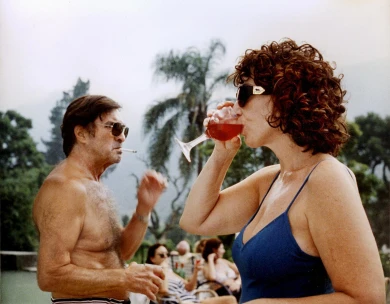
A couple of families spend the summer in a country cottage. The relationship between them exposes a crisis. The alcoholism of Mecha (Graciela Borges) and Gregorio (Martín Adjemián) becomes clear, leading to a drift in the education of their children and impacting relationships of respect and affect. Weariness expresses the lackadaisical environment.
In La ciénaga Lucrecia Martel approaches the decadence of a middle-class Argentinian family. The pool of dirty, stagnant water reflects the economic and social collapse of a whole country, yet reflects more than economic crisis as it becomes a murky well feeding off the pain of those living in the house. An erstwhile space of joy, the swimming pool becomes a reflection of adult depression, resulting in apathy. And the children, especially the girls, seem to be the only people awake in this drift. Barring a flicker of unawareness, the young people immerse themselves in rainwater or the water from the river, in water that flows, but are cautious of getting too close to the swimming pool.
![Yorgos Lanthimos, Kynodontas [Canino], 2009, película](https://recursos.museoreinasofia.es/styles/small_landscape/public/Actividades/ciclocine-piscinas-16_00.jpg.webp)
Yorgos Lanthimos. Dogtooth
Saturday, 22 August 2026
A couple with three adult children live in a modern country cottage. A large swimming pool takes centre stage in a sizeable garden. The property is skirted by a large fence that blocks a view of the outside. Here, the father has educated his children without outside contact, maintaining their belief in a false world: aeroplanes fall in the garden like toys and they must act like dogs to defend themselves from the ferocious cats that surround the house. The promise of going out into the world when they lose their dogtooth is proof of their maturity.
Lanthimos builds a world that is surreal, comical and terrible. The swimming pool is the house’s central element, a limited, controlled space assimilated like the sea, yet under the father’s supervision. A space of imagination, but with sinister intentions: the children are indoctrinated under the water as they believe in a better world. Far from reality. The swimming pool’s limits are the limits of their freedom, a false state of well-being expressed in the weightless bodies in the water. The liquid element is an analgesic magma with the power to educate offspring under the latent fear of a shark bite.
![Binka Zhelyazkova, Baseynat [La piscina], 1977, película](https://recursos.museoreinasofia.es/styles/small_landscape/public/Actividades/ciclocine-piscinas-17_00.png.webp)
Binka Zhelyazkova. The Swimming Pool
Viernes 28 de agosto, 2026
The young, bright Bella (Yanina Kasheva), after unforeseen heartbreak at her graduation party, meets Apostol (Kosta Tsonev), a reserved architect, and Boyan (Kliment Denchev), a comedy actor who is cynical about his country. The three characters climb up to a diving board in a municipal swimming pool, where they begin a strange relationship of friendship, love and despair which reflects a generational clash.
Binka Zhelyazkova, the great enfant terrible of Eastern European cinema, critic of the communist system and widely acclaimed film-maker beyond Bulgarian borders, made in The Swimming Pool a masterly metaphor for a country in decline. The public pool symbolises a closed, immovable enclosure where society is festering. From the height of a diving board she sees, in a panoptic view, the different generations living underneath a limited space. On one side, older people attempt to preserve the old revolutionary spirit with constant collective swimming exercises while, on the other, young people don’t hide the desire for freedom that remains unrealised. The result is an ideological clash in how to act and move in the enclosure, unearthing vast hypocrisy in the lost ideals of socialism, reflected in the total apathy of youth. The Swimming Pool for Zhelyazkova is a reflection of the disillusionment and existential void of a whole country and system.
![Jacques Deray, La piscine [La piscina], 1969, película](https://recursos.museoreinasofia.es/styles/small_landscape/public/Actividades/ciclocine-piscinas-18.jpg.webp)
Jacques Deray. The Swimming Pool
Saturday, 29 August 2026
The characters played by Alain Delon (Jean-Paul) and Romy Schneider (Marianne) experience their love in apparent splendour. A sun-drenched house, a blissful swimming pool, beautiful bodies, sexuality in abundance. The visit of Harry (Maurice Ronet), a successful musician, friend of Jean-Paul and ex-lover of Marianne, accompanied by his young and beautiful daughter Penélope (Jane Birkin), rocks their relationship, bringing to light the jealousy and insecurities of each one in a dark game of possession and male rivalry.
If there was a definition of the glistening blue pool in this sexual thriller, it would be the paradise of Adam and Eve, represented by the shots of happiness of Romy Schneider and Alain Delon in this swimming pool on France’s Côte d’Azur. The appearance of these two beautiful creatures kissing semi-naked by the water is one of film’s resonant images. The paradise cannot be fractured, not even by death. As in the crossing of the Tigris and Euphrates rivers, where humanity’s first lovers bathed naked in the water, innocent to their imminent end, the reflection of the crystalline water of The Swimming Pool shows this game, and the deep traumas which, under this mantle, are hidden in the amorous relationships and limits that only love is capable of breaking to solve.
In this session both endings to the film are screened: the original version, open and symbolic, and the Spanish version, marked by censorship during Francoism, and its sequence for a Spanish premiere — a stereotypical and reductive vision reflecting the sociological condition of the country.