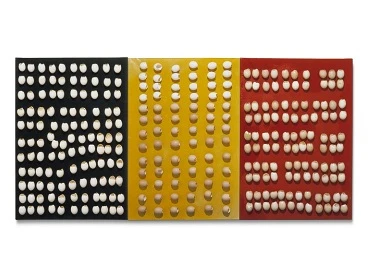
Marcel Broodthaers, Untitled (Triptych). 1965–66. Collection Sylvio Perlstein, Antwerp Image courtesy Maria Gilissen Archives of Marcel Broodthaers. © The Estate of Marcel Broodthaers c/o SABAM Belgium – VEGAP 2016
Held on 05 Oct 2016
Marcel Broodthaers (Brussels, 1924 - Cologne, 1976) is a key figure of contemporary art, and a reference point and driving force in many current discourses and practices. Following his initial work as a poet, journalist and photographer, in 1964 Broodthaers decided to become a visual artist, and from that moment on concerns with providing a response to the basic questions posed by visual arts can be discerned as he interrogated the idea of representation and the production of meaning through the use of existing knowledge systems. In this round-table discussion Christophe Cherix, Jean-François Chevrier, Dirk Snauwaert and Manuel Borja-Villel will debate the different readings around the founder of the fictional museum.
Regarded as one of the originators of institutional critique, Broodthaers’ work questions the art institution whilst acknowledging his and other artists’ dependence on the circular axiom that presents the art museum as the institution containing all art, and art as all that which is contained in this same museum. The fictional institution he founded in 1968, the Musée d’Art Moderne. Département des Aigles (Musem of Modern Art. Department of Eagles, 1968–1972), which closed upon gaining institutional recognition at Documenta 5 in Kassel in 1972, is conceived as an antidote to this inescapable axiom.
Where does Marcel Broodthaers stand today? His sceptical view of the empirical pragmatism of Minimalism and the uncritical celebrations of the society of the spectacle that were characteristic of Pop distanced him from the art movements of his time. Thus, Broodthaers, just like another of his Décor pieces – his historicist scenography – appears tied to an anachronistic position, banished from his present yet still a present-day protagonist, whereby numerous artistic and institutional practices appear to be epigones of his work.
This round-table discussion brings together museum directors and curators with broad knowledge of and specialisation in the Belgian artist and his exhibition approach, in addition to art historians who have questioned the frameworks of modern art, placing particular emphasis on the hermeticism and pursuit of failure as the horizon belonging to the creator of Jardin d’Hiver (Winter Garden, 1974).
In collaboration with
Organised by
Museo Reina Sofía
Participants
Christophe Cherix has been chief curator of Drawings and Prints at MoMa since 2013. Between 2010 and 2013 he was chief curator of Prints and Illustrated Books at the same museum. He was also the curator of the Cabinet des Estampes en el Musées d’art et d’histoire in Geneva. Cherix is the co-curator of Marcel Broodthaers. A Retrospective, and his curatorial work includes In & Out of Amsterdam: Travels in Conceptual Art, 1960–1976 (MoMA, 2009) and Fluxus Preview: Selections from the Gilbert and Lila Silverman Fluxus Collection Gift (with Jon Hendricks, MoMA, 2009).
Jean-François Chevrier is an art historian and has worked as a professor at the National School of Fine Arts in Paris since 1988. He has curated a wide array of exhibitions, including Art and Utopia. Restricted Action (MACBA, 2004), a re-reading of modern art through Mallarmé and Broodthaers. His recent works have focused on the relationship between literature and contemporary art, for instance the book L’hallucination artistique de William Blake à Sigmar Polke (L´Arachneen, Paris, 2012) and the exhibition Biographical Forms (Museo Reina Sofía, 2013).
Dirk Snauwaert has been the director of WIELS. Contemporary Art Centre, Brussels, since 2005. He has also been co-director of Kunstverein Munich, and the Institut d’art contemporain Villeurbanne/Rhône Alpes. Furthermore, he wrote his doctoral dissertation on the analysis of the museum conceived by Broodthaers, an artist on which he continues to focus his work.
Manuel Borja-Villel is the director of Museo Reina Sofía and co-curator of the exhibition Marcel Broodthaers. A Retrospective. He was also previously the director of Fundació Antoni Tàpies and MACBA (both in Barcelona), institutions which have also explored the artistic practice of Marcel Broodthaers.
![Marcel Broodthaers. Chez votre fournisseur (Le Vinaigre des Aigles) [At your supplier (Vinegar of Eagles)], 1968 © The Estate of Marcel Broodthaers c/o SABAM Belgium – VEGAP 2016](https://recursos.museoreinasofia.es/styles/small_landscape/public/Actividades/broodthaers_2.jpg.webp)

Más actividades
All Time
Saturday, 25 April and 16 May 2026 — 7pm
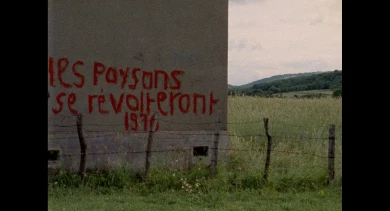
As a recap of the previous sessions, this screening considers a geography of past and present struggles: a refined formal approach, a portrait of popular life, the landscape testimony of working communities and the critique of accumulation and inequality. The monumental diptych Too Early, Too Late (1982) reflects Engels’s sharp analysis of the French Revolution, along with the enumeration of the distribution of taxes on different hamlets in the French countryside. In the second part, the account of Mahmoud Hussein — a pseudonym for Egyptian Marxist historians Bahgat El Nadi and Adel Rifaat — ranges across the memory of anti-imperialist citizen revolts in Egypt throughout the twentieth century. The film destabilises stereotypes and common places of political insurgency in the North African country. Recovering and circulating this latent memory helps to name that which still resists being named and, as Straub y Huillet indicate, “making the revolution is to put very old yet forgotten things back in their place”.
Framed inside The Collection Screened is the programme Present Time: Insurgent Images, curated by Luis López Carrasco, a key film-maker with a distinguished international career. The works in the programme, selected from the Museo’s film and video collection, interlink projects that are conceptual, refined, systematic — as an X-ray of their time in history — with firebrand domestic and activist films, comprehending different political emergencies from the second half of the twentieth century in Europe and Latin America. These works are viewed in light of a genealogy of revolt which buries its roots in the nineteenth century.
![Joan Colom, El carrer [La calle], 1960, película](https://recursos.museoreinasofia.es/styles/small_landscape/public/Actividades/coleccion-proyectada-5.jpg.webp)
Observation and Intervention
Friday, 24 April and 15 May 2026 — 7pm
If cinema does not set out to reach objectivity then each film takes a biased view of observed reality. The session begins with the seemingly neutral view of Cao Guimarães to observe a boy and girl playing in the rain in Da Janela do Meu Cuarto (From the Window of My Room, 2004). A work, deceptively relaxed, which prefigures one of the session’s constants: the place of childhood as a project of worlds to come. The boundless urban vitality of Barcelona Joan Colom portrays in El carrer (The Street, 1960) comes face to face with the extraordinary Niños (Children, 1974), by the Grupo de Cine Liberación sin Rodeos, a multi-voiced depiction of a group of friends in Cuzco whose citizen-focused schooling co-exists, just, with their daily work and reveals the limitations of the Revolutionary Government of the Armed Forces in Peru. Visión de la selva (View of the Jungle, 1973), by the same Peruvian collective, puts forward another model of representation and intervention on the public sphere with direct news activism, which denounces the plundering of the Amazon by multi-national companies.
Framed inside The Collection Screened is the programme Present Time: Insurgent Images, curated by Luis López Carrasco, a key film-maker with a distinguished international career. The works in the programme, selected from the Museo’s film and video collection, interlink projects that are conceptual, refined, systematic — as an X-ray of their time in history — with firebrand domestic and activist films, comprehending different political emergencies from the second half of the twentieth century in Europe and Latin America. These works are viewed in light of a genealogy of revolt which buries its roots in the nineteenth century.
![Video-Nou/Servei de Vídeo Comunitari, Ocaña. Exposició a la Galería Mec-Mec [Ocaña. Exposición en la Galería Mec-Mec], 1977, película](https://recursos.museoreinasofia.es/styles/small_landscape/public/Actividades/coleccion-proyectada-7.png.webp)
Daily Matter
Thursday, 23 April and 14 May 2026 — 7pm
Time, light, vision. What is an image? How does an image make us see the world? First, hypnosis, a reset: Paulino Viota’s Duración (Duration, 1970), the portrait of a clock face over sixty seconds. Next, a window into a slightly altered reality: Javier Aguirre’s Objetivo 40º (40 Degree Lens, 1968–1970). A minimum intervention that inspires a session considered as successive immersions in blocks of time, as well as a journey that starts from the intimacy of a candle, the movement of a car around abandoned peripheries and the traces of anti-Franco protestors, with night falling to the emotive, profound and sharp voice of Ocaña. Now in 1990, the journey ends at other street protests, those articulated by the Agustín Parejo School collective owing to the housing problem in Málaga. As Javier Aguirre states: “It is not about achieving the objective. It is about demystifying it”.
Framed inside The Collection Screened is the programme Present Time: Insurgent Images, curated by Luis López Carrasco, a key film-maker with a distinguished international career. The works in the programme, selected from the Museo’s film and video collection, interlink projects that are conceptual, refined, systematic — as an X-ray of their time in history — with firebrand domestic and activist films, comprehending different political emergencies from the second half of the twentieth century in Europe and Latin America. These works are viewed in light of a genealogy of revolt which buries its roots in the nineteenth century.
![Tracey Rose, The Black Sun Black Star and Moon [La luna estrella negro y negro sol], 2014.](https://recursos.museoreinasofia.es/styles/small_landscape/public/Obra/AD07091_2.jpg.webp)
On Black Study: Towards a Black Poethics of Contamination
27, 28, 29 ABR 2026
The seminar On Black Study: Towards a Black Poethics of Contamination proposes Black Study as a critical and methodological practice that has emerged in and against racial capitalism, colonial modernity and institutional capture. Framed through what the invited researcher and practitioner Ishy Pryce-Parchment terms a Black poethics of contamination, the seminar considers what it might mean to think Blackness (and therefore Black Study) as contagious, diffuse and spreadable matter. To do so, it enacts a constellation of diasporic methodologies and black aesthetic practices that harbor “contamination” -ideas that travel through texts, geographies, bodies and histories- as a method and as a condition.
If Blackness enters Western modernity from the position of the Middle Passage and its afterlives, it also names a condition from which alternative modes of being, knowing and relating are continually forged. From within this errant boundarylessness, Black creative-intellectual practice unfolds as what might be called a history of touches: transmissions, residues and socialities that unsettle the fantasy of pure or self-contained knowledge.
Situated within Black radical aesthetics, Black feminist theory and diasporic poetics, the seminar traces a genealogy of Black Study not as an object of analysis but as methodological propositions that continue to shape contemporary aesthetic and political life. Against mastery as the horizon of study, the group shifts attention from what we know to how we know. It foregrounds creative Black methodological practices—fahima ife’s anindex (via Fred Moten), Katherine McKittrick’s expansive use of the footnote, citation as relational and loving labour, the aesthetics of Black miscellanea, and Christina Sharpe’s practices of annotation—as procedures that disorganise dominant regimes of knowledge. In this sense, Black Study is approached not as a discrete academic field but as a feel for knowing and knowledge: a constellation of insurgent practices—reading, gathering, listening, annotating, refusing, world-making—that operate both within and beyond the university.
The study sessions propose to experiment with form in order to embrace how ‘black people have always used interdisciplinary methodologies to explain, explore, and story the world.’ Through engagements with thinkers and practitioners such as Katherine McKittrick, C.L.R. James, Sylvia Wynter, Christina Sharpe, Fred Moten, Tina Campt, Hilton Als, John Akomfrah, fahima ife and Dionne Brand, we ask: What might it mean to study together, incompletely and without recourse to individuation? How might aesthetic practice function as a poethical intervention in the ongoing work of what Sylvia Wynter calls the practice of doing humanness?
Situated Voices 38
Thursday, 23 April 2026 – 7pm
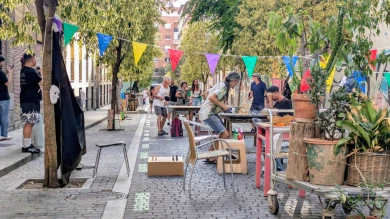
The Situated Voices programme offers de-hierarchised spaces of reflection and debate in which to generate, from situated experiences, collective knowledge in connection with present debates. With the title Climate Shelters for a Liveable City, this latest session looks to collectively address challenges around the accessibility of climate shelters in Madrid and to build a landscape of collaborative networks.
With the climate emergency, cities have become environments which are becoming harsher in the summer months due to high temperatures, exacerbated by concrete, and a lack of green spaces or cool, sheltered leisure areas not always bound up with consumerism. In recent years, community spaces and citizen and institutional collectives have started to organise “climate shelters”: accessible spaces providing shelter, shade, rest and relaxation to counter extreme climates, spaces which, faced with an increasingly chronic climate crisis, have proliferated in our cities as necessary, urgent places.
The previous experience of Climate Shelter. A Space for Rest, organised in the summer of 2025 by the Museo Reina Sofía, with the Museo Situado assembly, initiated a dialogue with other likeminded endeavours in the city. Therefore, this conversation seeks to gather their shared successes and challenges, particularly in that which refers to accessibility — and the consideration of exclusion and related solutions — with a view to thinking jointly about interventions for the summer of 2026. The encounter also touches on how to work in a network of collaboration: joining, supporting and connecting different climate shelters in Madrid, thinking collectively about how to respond to the climate crisis, the material realities approached in each project and meeting the specific needs of each context.
The networked organisation of climate shelters appears as a common horizon of resistance and organisation to tackle this eco-social crisis, a crisis that is no longer a future threat but a present condition which forces us to redefine ways of inhabiting the city.