![Benvenuto Chavajay, Suelo de zapato No. 39, 2022. Pirograbado en piel de animal sumergido en el agua del Lago Atitlán (Guatemala), que funciona como instrucciones de la performance Almas en Retorno [Popol Wuj]. Fotografía cortesía del artista](https://recursos.museoreinasofia.es/styles/small_landscape/public/Actividades/benvenuto_snippet.jpg.webp)
Benvenuto Chavajay, Shoe Sole No. 39, 2022. Pyrography on leather submerged in the water of Lake Atitlán (Guatemala), which works as instructions for the performance Returning Souls [Popol Wuj]. Photo courtesy of the artist
Date and time
Held on 21, 22, 23 Sep 2022
This seminar reflects on how performative artistic practices are inserted inside a collection and its institutional framework. In her essay Unmarked. The Politics of Performance, Peggy Phelan asserts that “performance's only life is in the present. Performance cannot be saved, recorded, documented, or otherwise participate in the circulation of representations […]. To the degree that performance attempts to enter the economy of reproduction it betrays and lessens the promise of its own ontology. Performance's being […] becomes itself through disappearance”. And so what are the implications of this collecting the present?
To spark this debate, an approach is set forth from different perspectives — theory, practice and ethics — convening voices from inside and outside the museum as an institution. A series of lectures and events with different artists, theorists, curators and researchers brings together different viewpoints and reflections around working conditions with performative works of art. The lines of analysis include: a discussion on the impossibility of preserving the living, the notion of archive as an artefact for the historical documentation and interpretation of performance and the conditions offered by museums as an instrument to reactivate the strengths of these types of practices.
Furthermore, inside the framework of the encounter is Performing Collections, a digital publication which assembles texts, interviews with artists and case studies on the experience of collecting performance in art institutions. It is devised by the collections work group from the L’Internationale confederation of European museums, inside the project Our Many Europes. Europe’s Critical ‘90s and the Constituent Museum.
[dropdown]
Lydia Antoniou is a curator, cultural producer and feminist film researcher. She sees her work in the sphere of public programmes as open forums for coming together, debating and exchanging and as catalysts for collectively organising and building solidarity. Moreover, she has been working as an assistant curator at documenta 15, where she has been part of the work group on the Lumbung Gallery project.
Roger Bernat creates performances where the audience shapes the work. His projects have been performed at documenta in Kassel and at the Venice Biennale and São Paulo Biennial. Some of his latest pieces include No se registran conversaciones de interés (MUCEM, 2016–2017), The place of the Thing (documenta 14, 2017), Flam (Festival Grec, 2019), ENA (Teatre Lliure, 2020), Desnonissea (CASM, 2021), PIM PAM (34th São Paulo Biennial, 2021) and Terra Baixa (Teatre Lliure, 2022).
Benvenuto Chavajay lives and works between San Pedro La Laguna and Guatemala City, creating work characterised by its strong social content and political critique. His most salient exhibitions include group shows at the Museum of Latin American Art (MOLAA), in Long Beach, California; Trans at the Centro Cultural de España en Guatemala, Guatemala City; and Los Desaparecidos at Espaciocé!, in Antigua Guatemala.
Clémentine Deliss works across the borders between contemporary art, curatorial practice and critical anthropology. She is currently a lecturer in Art History at Cambridge University and an associate curator at the KW Institut for Contemporary Art in Berlin. She was previously director of Weltkulturen Museum, Frankfurt, and a lecturer at Technischen Universität Wien and on the SVA’s MA Curatorial Practice in New York. Her most recent book is The Metabolic Museum (Hatje Cantz, 2020).
Jennifer Fitzgibbon is a researcher and administrator at The National Irish Visual Arts Library, a public centre which focuses on documenting twentieth- and twenty-first-century Irish visual art and design, conserving and expanding its collections via collaborations between artists, designers and cultural organisations.
Dora García is an artist who has developed works on the rhizomatic associations of anti-psychiatry with the series of books entitled Mad Marginal, since 2010, the film The Deviant Majority (2010) and the performance project The Inadequate, first presented in the Spanish Pavilion at the 54th Venice Biennale (2011). Moreover, García has used classic forms of television to investigate Germany’s most recent history (Die Klau Mich Show, documenta 13, 2012), attended Finnegans Wake reading groups (The Joycean Society, 2013), created meeting points for hearing voices (Hearing Voices Café, since 2014) and investigated the crossroads between performance and psychoanalysis (The Sinthome Score, 2013, and Segunda Vez, 2018). She is currently working on the film project Amor Rojo (Red Love), on the Marxist feminist Alexandra Kollontai and the impact of her legacy on third-world and intersectional feminism.
Lola Hinojosa is head of the Museo Reina Sofía’s Performing Arts and Intermedia Collection.
Bojana Kunst is a philosopher, playwright and performance art theorist who is a professor in the Institute of Applied Theatre Studies at the Justus Liebig University in Giessen, where she directs an international MA programme in Choreography and Performance. She previously worked as a researcher at Univerza v Ljubljani and Universiteit Antwerpen (until 2009), and also as a visiting professor at Universität Hamburg (2009–2012). She has published Artist at Work: Proximity of Art and Capitalism (John Hunt, 2015) and Življenje umetnosti: prečne črte skrbi (The Life of Art: Transversal Lines of Care, Maska, 2021).
Marcella Lista is an art historian who has been chief curator of the New Media Collection at the Centre Pompidou in Paris since 2016. Her most recent projects include Esma / Listen (Beirut Art Center, 2016), A Different Way to Move: Minimalismes, NEW YORK, 1960-1970 (Carré d'Art, 2017) and Anarcheology, Eric Baudelaire, After, and Harun Farocki: Images Against Themselves (all at Centre Pompidou, 2017).
Isabel de Naverán holds a PhD in Fine Arts from the University of the Basque Country and is an independent researcher. Part of the research group ARTEA, her studies explore the crossroads between art, contemporary choreography and performance in curatorship, publishing and written projects. In 2010, she founded, with Beatriz Cavia, Miren Jaio and Leire Vergara, the project Bulegoa z/b, the Office of Art and Knowledge, in which she was involved until 2018. She is the author of the books Envoltura, historia y síncope (Caniche, 2021) and Ritual de duelo (Consonni, 2022), and is currently a live arts consultant in the Museo Reina Sofía’s Public Activities Department and an associate researcher at the Azkuna Zentroa Centre of Contemporary Society and Culture in Bilbao.
Rosario Peiró is head of the Museo Reina Sofía’s Collections Area.
José Antonio Sánchez is a lecturer in Fine Arts at the University of Castilla-La Mancha (UCLM), in Cuenca, and a founder of the research group ARTEA and the MA in Arts Practice and Visual Culture, run jointly by UCLM and the Museo Reina Sofía. His most recent publications include Cuerpos ajenos (La uÑa RoTa, 2017) and Tenéis la palabra. Apuntes sobre teatralidad y justicia (2022). He has coordinated different events around creation and thought, for instance Situaciones (1999-2002), Jerusalem Show (2011) and No hay más poesía que la acción (2013), and co-directed, with Juan Ernesto Díaz and Ruth Estévez, the stage version of Palabras ajenas (The Words of Others, 2017–2018) by Argentinian artist León Ferrari. With Fernando Quesada, Isabel de Naverán and Victoria Pérez Royo he coordinates the Expanded Theatricalities Chair in the Museo Reina Sofía (2021 and 2022).
Leonor Serrano Rivas is an artist who lives between Málaga and Oxford. In recent years, she has exhibited her work at the Centro de Creación Contemporánea de Andalucía (C3A), in Córdoba (2019), and The Swiss Church (2017), Chisenhale Studios (2016) and Serpentine Galleries (2014), in London. She has received a number of awards, among them the 2019 Alhambra Award, the ARCO Community of Madrid Prize for Young Artists and the 2014 Generation Award from the Caja Madrid Special Foundation. She has an exhibition Natural Magic (21 September 2022 - 27 February 2023) in the Museo Reina Sofía, inside the framework of the Fissures programme.
Eva Wittocx works as a curator and art critic. Since 2009, she has directed the contemporary art department at the M – Museum Leuven, in Belgium. Between 1997 and 2006, she was a curator at the S.M.A.K. Museum of Contemporary Art in Ghent. From 2006 to 2009, she worked at the STUK Arts Centre in Leuven, creating, in 2007 alongside the STUK team, Playground, a new annual festival of live performance and arts, in collaboration between STUK and M – Museum (both as sites) since 2009.
Joanna Zielinska is an art historian and performance curator who focuses on theatre, performance literature and the visual arts. Currently, she works as a senior curator at M HKA in Antwerp. Between 2015 and 2020, she was director of the Performing Arts Department at the Ujazdowski Castle Centre for Contemporary Art in Warsaw. She has also been head curator at Cricoteka, the Centre for the Documentation of the Art of Tadeusz Kantor in Kraków, Poland, and artistic director of the Znaki Czasu Centre for Contemporary Art (CoCA) in Toruń, Poland.
[/dropdown]
Organised by
Museo Reina Sofía and L’Internationale
With the support of
Co-funded by the European Commission’s Creative Europe programme and with the patronage of Mario Cader-Frech, a member of the Museo Reina Sofía Foundation
Inside the framework of
Inside the framework of

Participants
Participants
-
Wednesday, 21 September 2022 Nouvel Building, Auditorium 200 and the rooms of the Collection (to be announced in the coming days)
Session 1
Tickets6pm Opening Lecture
By Manuel Borja-Villel, director of Museo Reina Sofía6:45pm Presentation of Communicating Vessels. Collection 1881–2021
By Rosario Peiró, head of the Museo Reina Sofía’s Collections Area7:30pm Tour of Communicating Vessels. Collection 1881–2021
-
Thursday, 22 September 2022 Nouvel Building, Auditorium 200
Session 2
Tickets11am The Metabolic Museum: Exercises in Counter-Conduct (in English, with simultaneous translation)
Lecture by Clémentine Deliss12pm Making Temporal Kinships. Can Collection Reach Beyond the Project? (in English, with simultaneous translation)
Lecture by Bojana Kunst1pm – 2pm What We Couldn't See. Notes for a Museography of Theater and Living Arts (in Spanish)
Lecture by José Antonio Sánchez4pm Collecting, Archiving and Programming Performance. Institutional Experiences (in English, with simultaneous translation)
Round-table discussion with Jennifer Fitzgibbon, Marcella Lista and Eva Wittocx
— Moderated by Rosario Peiró -
Thursday, 22 September 2022 Sabatini Building, Floor 1, Room 105
Session 3
Registration7pm - 9pm Returning Souls (Popol Wuj), performance by Benvenuto Chavajay
— In conjunction with Free Unions, a programme of events, tours and activations in the rooms of Communicating Vessels. Collection 1881–2021
-
Friday, 23 September 2022 Nouvel Building, Auditorium 200
Session 4
Tickets10am Lecture by Lydia Antoniou (Lumbung Gallery)
11am Performance Practices in Museums. Artists’ Perspectives
Round-table discussion with Roger Bernat, Benvenuto Chavajay, Dora García and Leonor Serrano Rivas
— Moderated by Isabel de Naverán1pm Presentation of Performing Collections, a L’Internationale digital publication
With editor Joanna Zielinska and Lola Hinojosa -
Friday, 23 September 2022 Nouvel Building, Protocol Room
Session 5
Registration12pm – 8pm The Castle of Crossed Destinies
Performance by Leonor Serrano Rivas
![Benvenuto Chavajay, Shoe Sole No. 39, 2022. Pyrography on leather submerged in the water of Lake Atitlán (Guatemala), which works as instructions for the performance Returning Souls [Popol Wuj]. Photo courtesy of the artist](https://recursos.museoreinasofia.es/styles/small_landscape/public/Actividades/benvenuto2.jpg.webp)
Más actividades
![Blake Edwards, The Party [El guateque], 1968, película](https://recursos.museoreinasofia.es/styles/small_landscape/public/Actividades/ciclocine-piscinas-14.jpg.webp)
Blake Edwards. The Party
Thursday, 20 August 2026
In The Party, actor Hrundi V. Bakshi (Peter Sellers) is mistakenly invited to a glamorous dinner party in Hollywood. His curiosity and two left feet lead to one funny mishap after the other. During the soiree he consoles Michèle, a young actress who has been fired by her producer, and the chaos gathers momentum when Bakshi accidentally opens a retractable floor, making the guests fall into a swimming pool. A small hippie-style elephant gatecrashes the party, brought by a group of young people, and Bakshi asks the guests to wash the elephant as it is a sacred animal in his country. The house fills with soap suds, culminating in a wackily chaotic party.
When Stanley Kubrick was once asked who Peter Sellers was, he replied: “There is no such person as Peter Sellers”. The Party is one of the most widely recognised comedies in the history of film, its director Blake Edwards and the English actor making an entertaining critique of a fading conservative society. The cultural revolutions of the 1960s fit into the container of a choppy swimming pool: people from high society, an elephant, a Russian ballet, waiters, beatnik youth… similar to Sellers’s own identity: an empty vessel that can be refilled. In the film, Edwards tapped into the ingenious actor’s innate improvisation and the swimming pool as a container for revolutionary intent.
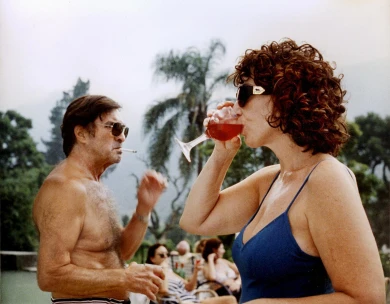
Lucrecia Martel. La ciénaga (The Swamp)
Viernes 21 de agosto, 2026
A couple of families spend the summer in a country cottage. The relationship between them exposes a crisis. The alcoholism of Mecha (Graciela Borges) and Gregorio (Martín Adjemián) becomes clear, leading to a drift in the education of their children and impacting relationships of respect and affect. Weariness expresses the lackadaisical environment.
In La ciénaga Lucrecia Martel approaches the decadence of a middle-class Argentinian family. The pool of dirty, stagnant water reflects the economic and social collapse of a whole country, yet reflects more than economic crisis as it becomes a murky well feeding off the pain of those living in the house. An erstwhile space of joy, the swimming pool becomes a reflection of adult depression, resulting in apathy. And the children, especially the girls, seem to be the only people awake in this drift. Barring a flicker of unawareness, the young people immerse themselves in rainwater or the water from the river, in water that flows, but are cautious of getting too close to the swimming pool.
![Yorgos Lanthimos, Kynodontas [Canino], 2009, película](https://recursos.museoreinasofia.es/styles/small_landscape/public/Actividades/ciclocine-piscinas-16_00.jpg.webp)
Yorgos Lanthimos. Dogtooth
Saturday, 22 August 2026
A couple with three adult children live in a modern country cottage. A large swimming pool takes centre stage in a sizeable garden. The property is skirted by a large fence that blocks a view of the outside. Here, the father has educated his children without outside contact, maintaining their belief in a false world: aeroplanes fall in the garden like toys and they must act like dogs to defend themselves from the ferocious cats that surround the house. The promise of going out into the world when they lose their dogtooth is proof of their maturity.
Lanthimos builds a world that is surreal, comical and terrible. The swimming pool is the house’s central element, a limited, controlled space assimilated like the sea, yet under the father’s supervision. A space of imagination, but with sinister intentions: the children are indoctrinated under the water as they believe in a better world. Far from reality. The swimming pool’s limits are the limits of their freedom, a false state of well-being expressed in the weightless bodies in the water. The liquid element is an analgesic magma with the power to educate offspring under the latent fear of a shark bite.
![Binka Zhelyazkova, Baseynat [La piscina], 1977, película](https://recursos.museoreinasofia.es/styles/small_landscape/public/Actividades/ciclocine-piscinas-17_00.png.webp)
Binka Zhelyazkova. The Swimming Pool
Viernes 28 de agosto, 2026
The young, bright Bella (Yanina Kasheva), after unforeseen heartbreak at her graduation party, meets Apostol (Kosta Tsonev), a reserved architect, and Boyan (Kliment Denchev), a comedy actor who is cynical about his country. The three characters climb up to a diving board in a municipal swimming pool, where they begin a strange relationship of friendship, love and despair which reflects a generational clash.
Binka Zhelyazkova, the great enfant terrible of Eastern European cinema, critic of the communist system and widely acclaimed film-maker beyond Bulgarian borders, made in The Swimming Pool a masterly metaphor for a country in decline. The public pool symbolises a closed, immovable enclosure where society is festering. From the height of a diving board she sees, in a panoptic view, the different generations living underneath a limited space. On one side, older people attempt to preserve the old revolutionary spirit with constant collective swimming exercises while, on the other, young people don’t hide the desire for freedom that remains unrealised. The result is an ideological clash in how to act and move in the enclosure, unearthing vast hypocrisy in the lost ideals of socialism, reflected in the total apathy of youth. The Swimming Pool for Zhelyazkova is a reflection of the disillusionment and existential void of a whole country and system.
![Jacques Deray, La piscine [La piscina], 1969, película](https://recursos.museoreinasofia.es/styles/small_landscape/public/Actividades/ciclocine-piscinas-18.jpg.webp)
Jacques Deray. The Swimming Pool
Saturday, 29 August 2026
The characters played by Alain Delon (Jean-Paul) and Romy Schneider (Marianne) experience their love in apparent splendour. A sun-drenched house, a blissful swimming pool, beautiful bodies, sexuality in abundance. The visit of Harry (Maurice Ronet), a successful musician, friend of Jean-Paul and ex-lover of Marianne, accompanied by his young and beautiful daughter Penélope (Jane Birkin), rocks their relationship, bringing to light the jealousy and insecurities of each one in a dark game of possession and male rivalry.
If there was a definition of the glistening blue pool in this sexual thriller, it would be the paradise of Adam and Eve, represented by the shots of happiness of Romy Schneider and Alain Delon in this swimming pool on France’s Côte d’Azur. The appearance of these two beautiful creatures kissing semi-naked by the water is one of film’s resonant images. The paradise cannot be fractured, not even by death. As in the crossing of the Tigris and Euphrates rivers, where humanity’s first lovers bathed naked in the water, innocent to their imminent end, the reflection of the crystalline water of The Swimming Pool shows this game, and the deep traumas which, under this mantle, are hidden in the amorous relationships and limits that only love is capable of breaking to solve.
In this session both endings to the film are screened: the original version, open and symbolic, and the Spanish version, marked by censorship during Francoism, and its sequence for a Spanish premiere — a stereotypical and reductive vision reflecting the sociological condition of the country.