Daily Matter
Session 1. Present Time: Insurgent Images. The Collection Screened #3
![Video-Nou/Servei de Vídeo Comunitari, Ocaña. Exposició a la Galería Mec-Mec [Ocaña. Exposición en la Galería Mec-Mec], 1977, película](https://recursos.museoreinasofia.es/styles/small_landscape/public/Actividades/coleccion-proyectada-7.png.webp)
Video-Nou/Servei de Vídeo Comunitari, Ocaña. Exposició a la Galería Mec-Mec (Ocaña. Exhibition at Galería Mec-Mec), 1977, film
Time, light, vision. What is an image? How does an image make us see the world? First, hypnosis, a reset: Paulino Viota’s Duración (Duration, 1970), the portrait of a clock face over sixty seconds. Next, a window into a slightly altered reality: Javier Aguirre’s Objetivo 40º (40 Degree Lens, 1968–1970). A minimum intervention that inspires a session considered as successive immersions in blocks of time, as well as a journey that starts from the intimacy of a candle, the movement of a car around abandoned peripheries and the traces of anti-Franco protestors, with night falling to the emotive, profound and sharp voice of Ocaña. Now in 1990, the journey ends at other street protests, those articulated by the Agustín Parejo School collective owing to the housing problem in Málaga. As Javier Aguirre states: “It is not about achieving the objective. It is about demystifying it”.
Framed inside The Collection Screened is the programme Present Time: Insurgent Images, curated by Luis López Carrasco, a key film-maker with a distinguished international career. The works in the programme, selected from the Museo’s film and video collection, interlink projects that are conceptual, refined, systematic — as an X-ray of their time in history — with firebrand domestic and activist films, comprehending different political emergencies from the second half of the twentieth century in Europe and Latin America. These works are viewed in light of a genealogy of revolt which buries its roots in the nineteenth century.
Curatorship
Luis López Carrasco
Organised by
Museo Reina Sofía
Accessible activity
This activity has two spaces reserved for people with reduced mobility
Agenda
jueves 23 abr 2026 a las 19:00
First Session
—With a presentation by Luis López Carrasco
jueves 14 may 2026 a las 19:00
Second Session
PROGRAMME
Paulino Viota. Duración (Duration)
Spain, 1970, DA, black and white, silent, 10’. Museo Reina Sofía Collection
Javier Aguirre, Objetivo 40º (40 Degree Lens)
Spain, 1968–1970, DA, black and white, sound, 11’. Museo Reina Sofía Collection
Francesc Abad, Experiències amb la llum (Experiences with Light) [Fragment from Film col·lectiu by Grup de Treball]
Spain, 1974, DA, black and white, silent, 8’38”. Museo Reina Sofía Collection
Dorothée Selz, Desplaçaments dels aparells d’imatges i so (Displacements of Audiovisual Equipment) [Fragment from Film col·lectiu by Grup de Treball]
Spain, 1974, DA, black and white, silent, 7’30”. Museo Reina Sofía Collection
Grup de Producció. Materiales (Materials) [Fragment from Film col·lectiu by Grup de Treball]
Spain, 1974, DA, black and white, silent, 3'. Museo Reina Sofía Collection
Video-Nou/Servei de Vídeo Comunitari. Ocaña. Exposició a la Galería Mec-Mec (Ocaña. Exhibition at Galería Mec-Mec)
Spain, 1977, DA, black and white, sound, original version in Spanish, 35'. Museo Reina Sofía Collection
Agustín Parejo School. Sin Vivienda (Without Housing)
Spain, 1990, DA, black and white, sound, original version in Spanish, 5’. Museo Reina Sofía Collection


Activity within the program...
Present Time: Insurgent Images
The Collection Screened #3
Framed inside The Collection Screened is the programme Present Time: Insurgent Images, curated by Luis López Carrasco, a key film-maker with a distinguished international career whose work deals with memory, activism and collectivity. The works in the programme, selected from the Museo’s film and video collection, interlink projects that are conceptual, refined, systematic — as an X-ray of their time in history — with firebrand domestic and activist films, comprehending different political emergencies from the second half of the twentieth century in Europe and Latin America. These works are viewed in light of a genealogy of revolt which buries its roots in the nineteenth century.
For theorist Siegfried Kracauer, one essential distinguishing feature of the film image is its capacity to depict daily life — film captures fragments of the lives of anonymous people with unprecedented closeness and intimacy. French critic Serge Daney also considered the moving image as an “art of the present”, a mode of representation which captures a specific segment of time, a time which unfolds before our eyes in each screening.
Present Time. Insurgent Images sets forth a micro-history of daily life under Franco’s dictatorship, from the popular and Cartesian depiction of the Puerta del Sol set out by Javier Aguirre in Objetivo 40º (1968–1970) to the revealing panoramic views of urban fringes by Dorothée Selz in Desplaçaments dels aparells d’imatges i so (1974), via street, child and proletarian expression rarely shown with the rawness with which Joan Colom portrays Barcelona in the 1960s in El carrer. This micro-history entwines the 1970s, rural ethnography and the anti-imperialist stance of the Grupo de Cine Liberación sin Rodeos from Peru, whose emancipatory message reverberates in the chronology of the anti-capitalist and anti-colonial movements of Danièle Huillet and Jean-Marie Straub, a session which concludes Luis López Carrasco’s essay based on the Museo’s audiovisual collection.
The series, moreover, shows private images that possess the will to be public. Images which project futures in which these insurgent energies can find audiences to proliferate through; images which seek, in conclusion, to recall that which must not be forgotten and to speak in an increasingly urgent way about our present.
Ver programaDaily Matter
Thursday, 23 April and 14 May 2026 — 7pm
Time, light, vision. What is an image? How does an image make us see the world? First, hypnosis, a reset: Paulino Viota’s Duración (Duration, 1970), the portrait of a clock face over sixty seconds. Next, a window into a slightly altered reality: Javier Aguirre’s Objetivo 40º (40 Degree Lens, 1968–1970). A minimum intervention that inspires a session considered as successive immersions in blocks of time, as well as a journey that starts from the intimacy of a candle, the movement of a car around abandoned peripheries and the traces of anti-Franco protestors, with night falling to the emotive, profound and sharp voice of Ocaña. Now in 1990, the journey ends at other street protests, those articulated by the Agustín Parejo School collective owing to the housing problem in Málaga. As Javier Aguirre states: “It is not about achieving the objective. It is about demystifying it”.
Framed inside The Collection Screened is the programme Present Time: Insurgent Images, curated by Luis López Carrasco, a key film-maker with a distinguished international career. The works in the programme, selected from the Museo’s film and video collection, interlink projects that are conceptual, refined, systematic — as an X-ray of their time in history — with firebrand domestic and activist films, comprehending different political emergencies from the second half of the twentieth century in Europe and Latin America. These works are viewed in light of a genealogy of revolt which buries its roots in the nineteenth century.
![Joan Colom, El carrer [La calle], 1960, película](https://recursos.museoreinasofia.es/styles/small_landscape/public/Actividades/coleccion-proyectada-5.jpg.webp)
Observation and Intervention
Friday, 24 April and 15 May 2026 — 7pm
If cinema does not set out to reach objectivity then each film takes a biased view of observed reality. The session begins with the seemingly neutral view of Cao Guimarães to observe a boy and girl playing in the rain in Da Janela do Meu Cuarto (From the Window of My Room, 2004). A work, deceptively relaxed, which prefigures one of the session’s constants: the place of childhood as a project of worlds to come. The boundless urban vitality of Barcelona Joan Colom portrays in El carrer (The Street, 1960) comes face to face with the extraordinary Niños (Children, 1974), by the Grupo de Cine Liberación sin Rodeos, a multi-voiced depiction of a group of friends in Cuzco whose citizen-focused schooling co-exists, just, with their daily work and reveals the limitations of the Revolutionary Government of the Armed Forces in Peru. Visión de la selva (View of the Jungle, 1973), by the same Peruvian collective, puts forward another model of representation and intervention on the public sphere with direct news activism, which denounces the plundering of the Amazon by multi-national companies.
Framed inside The Collection Screened is the programme Present Time: Insurgent Images, curated by Luis López Carrasco, a key film-maker with a distinguished international career. The works in the programme, selected from the Museo’s film and video collection, interlink projects that are conceptual, refined, systematic — as an X-ray of their time in history — with firebrand domestic and activist films, comprehending different political emergencies from the second half of the twentieth century in Europe and Latin America. These works are viewed in light of a genealogy of revolt which buries its roots in the nineteenth century.
All Time
Saturday, 25 April and 16 May 2026 — 7pm
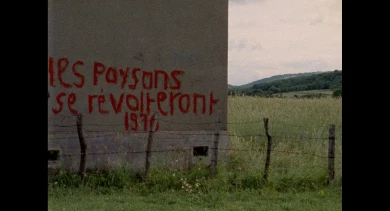
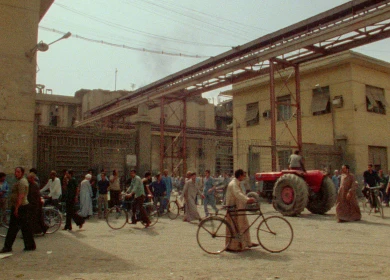
As a recap of the previous sessions, this screening considers a geography of past and present struggles: a refined formal approach, a portrait of popular life, the landscape testimony of working communities and the critique of accumulation and inequality. The monumental diptych Too Early, Too Late (1982) reflects Engels’s sharp analysis of the French Revolution, along with the enumeration of the distribution of taxes on different hamlets in the French countryside. In the second part, the account of Mahmoud Hussein — a pseudonym for Egyptian Marxist historians Bahgat El Nadi and Adel Rifaat — ranges across the memory of anti-imperialist citizen revolts in Egypt throughout the twentieth century. The film destabilises stereotypes and common places of political insurgency in the North African country. Recovering and circulating this latent memory helps to name that which still resists being named and, as Straub y Huillet indicate, “making the revolution is to put very old yet forgotten things back in their place”.
Framed inside The Collection Screened is the programme Present Time: Insurgent Images, curated by Luis López Carrasco, a key film-maker with a distinguished international career. The works in the programme, selected from the Museo’s film and video collection, interlink projects that are conceptual, refined, systematic — as an X-ray of their time in history — with firebrand domestic and activist films, comprehending different political emergencies from the second half of the twentieth century in Europe and Latin America. These works are viewed in light of a genealogy of revolt which buries its roots in the nineteenth century.
Más actividades
Economy of Hate
18 ABR, 9 MAY 2026
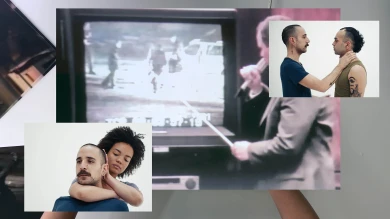
Economy of Hate features one sole work, Oído Odio (2021) by artist Diego del Pozo Barriuso. The piece combines television and media archive materials, recordings with performers with explicitly queer corporalities and 3D animations, combining in a strikingly fluid dialogue. The title alludes to a notion developed by the artist concerning the materiality with which hate circulates and the way it escalates. Setting out from the idea that hate is an affect which gains more value the more it circulates, the video shows the evolution from television to mobiles, expounding how the change of technological paradigm has made viral the fact of being in contact more than ever with explicitly violent images.
Inside the framework of The Collection Screened, a programme rooted in the institution’s film, video and moving image holdings, the Museo invites Laura Baigorri, one of the leading specialists in video art, to approach specific aspects related to identity, self-representation and the body within the Museo’s audiovisual collection since the 1990s.
![Dias & Riedweg, Casulo [Crisálida], 2019, película](https://recursos.museoreinasofia.es/styles/small_landscape/public/Actividades/desafios-cine-2.png.webp)
Other Voices in Us All
17 ABR, 8 MAY 2026
A session which starts from a subtle corporeal challenge that prompts a confrontation with reason from sensibility and emotion, both of which are linked to a difference in mental health or spiritualism. It opens with a beautiful and strange short film entitled A família do Capitao Gervásio (2013), by Tamar Guimarães and Kasper Akhøj, set in a small town in inland Brazil, where around half the inhabitants are psychic mediums whose work centres on community healing. The second piece, Dias & Riedweg’s Casulo, is the outcome of a participatory project with a group of patients from the Institute of Psychiatry at the Universidad Federal de Río de Janeiro. The video bears witness to the development of their routines after hospitalisation and captures their ideas and impressions about different aspects of life, revealing the division between territories of reason and madness in their daily existence.
Inside the framework of The Collection Screened, a programme rooted in the institution’s film, video and moving image holdings, the Museo invites Laura Baigorri, one of the leading specialists in video art, to approach specific aspects related to identity, self-representation and the body within the Museo’s audiovisual collection since the 1990s.
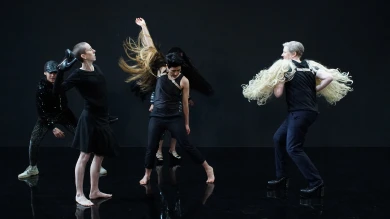
We Go On from Here… And Will Not Move
Thursday, 16 April and Thursday, 7 May 2026 — 19:00
This session advances a programme focused on the most elemental side of performance: a simple, direct act that starts from the self-exhibition of the body. At certain points, from the calculated serenity of Miguel Benlloch’s Tengo tiempo (I Have Time, 1994); at other times, from the challenging and visceral impulse of Bollos (Buns, 1996), by Cabello y Carceller, or the rage of Habla (Talk, 2008), by Cristina Lucas; and, finally, from video-graphic experimentation, disconcerting and sustained in the dance culture of Moving Backwards (2019), by Pauline Boudry and Renate Lorenz, whose mise en scène reminds us that it is not actually déjà vu but the present, unfortunately, that moves through a reactionary period.
Inside the framework of The Collection Screened, a programme rooted in the institution’s film, video and moving image holdings, the Museo invites Laura Baigorri, one of the leading specialists in video art, to approach specific aspects related to identity, self-representation and the body within the Museo’s audiovisual collection since the 1990s. The session recovers paradigmatic performances, from three successive decades, crossed by the indisputable expression of gender; that is, mediated by the confronted acts of feminisms and the queer paradigms of culture.
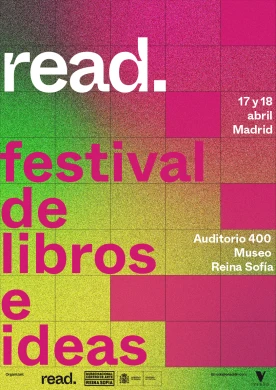
READ Madrid. Festival of Books and Ideas
Friday 17 and Saturday 18 April, 2026 – Check Programme
READ Madrid. Festival of Books and Ideas emerges as a meeting space for critical and experimental voices in the fields of literature, theory, and publishing. With particular attention to artistic production practices and independent publishing, and seeking to build a transatlantic cultural bridge with Latin America, the program aims to decenter hegemonic frameworks of knowledge production and open up new communities of interpretation and horizons for political imagination. To this end, it takes writing and reading—understood in broad and plural ways across their modes, forms, and registers—as constitutive of a public laboratory of what we call study: a space for thinking collectively, debating and coining ideas, making and unmaking arguments, as well as articulating new imaginaries and forms of enunciation.
In a context of ecological, political, and epistemological crisis, the festival proposes modes of gathering that make it possible to sustain shared time and space for collective reflection, thereby contributing to the reconfiguration of the terms of cultural debate. In this sense, the program is conceived as an intervention into the contemporary conditions of circulation and legitimation of thought and creation, expanding the traditional boundaries of the book and connecting literature, visual arts, performance, and critical thought. These formats are organized around three thematic axes led by key voices in contemporary writing, artistic practice, and critical thinking.
The thematic axes of READ Madrid. Festival of Books and Ideas are: a popular minoritarian, or how to activate an emancipatory practice of the popular; raging peace, or how to sustain justice, mourning, and repair without resorting to pacifying imaginaries devoid of conflict; and fiction against oblivion, which explores the role of science fiction, horror, and speculative narratives as forms of resistance against the liberalism of forgetting. Ultimately, the aim is to interrogate our present through the potential that ideas and books can mobilize within a shared space of study, debate, and enjoyment.
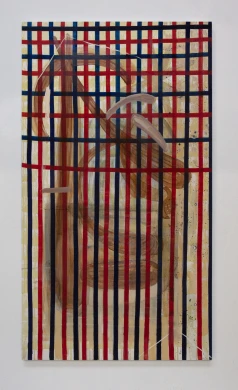
Juan Uslé and the New York Experience
15 ABR 2026
Framed inside the exhibition Juan Uslé. That Ship on the Mountain, this round-table discussion puts forward a journey towards a decisive time and place: New York in the 1980s and 1990s, the setting for an artistic vibrancy whose influence would run deep among an entire generation of artists from Spain who in the US city encountered fertile, chaotic anddemanding ground full of possibility. Such was the case with Juan Uslé, who in January 1987 crossed the Atlantic in the opposite direction to the Elorrio Ship — the sinking of which in 1960 off the coast of Langre (Cantabria) remained etched in the artist’s mind — to take up residence in New York.
The conversation, moderated by the show’s curator, Ángel Calvo Ulloa, brings together Juan Uslé, Vicky Civera, Txomin Badiola and Octavio Zaya, four voices who experienced this time from different yet complementary perspectives. Their dialogue reconstructs the experience of arriving in an alien context and explores the ways in which these artistic figures created ties and communities in an environment crossed by creative intensity and tensions of cultural change.
Furthermore, it approaches the relationship with the Museo Reina Sofía, which in those years was beginning to redefine its role within the international artistic ecosystem. The round-table prompts reflection on how the Spanish scene and Spain’s museum institutions were perceived from the distance of New York, recovering, through orality, a key episode in the history of Spanish art.