READ Madrid. Festival of Books and Ideas
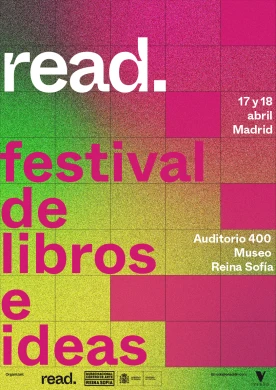
READ Madrid. Festival Of Books and Ideas. Graphic design: Münster Studio
Held on 17, 18 Apr 2026
READ Madrid. Festival of Books and Ideas emerges as a meeting space for critical and experimental voices in the fields of literature, theory, and publishing. With particular attention to artistic production practices and independent publishing, and seeking to build a transatlantic cultural bridge with Latin America, the program aims to decenter hegemonic frameworks of knowledge production and open up new communities of interpretation and horizons for political imagination. To this end, it takes writing and reading—understood in broad and plural ways across their modes, forms, and registers—as constitutive of a public laboratory of what we call study: a space for thinking collectively, debating and coining ideas, making and unmaking arguments, as well as articulating new imaginaries and forms of enunciation.
In a context of ecological, political, and epistemological crisis, the festival proposes modes of gathering that make it possible to sustain shared time and space for collective reflection, thereby contributing to the reconfiguration of the terms of cultural debate. In this sense, the program is conceived as an intervention into the contemporary conditions of circulation and legitimation of thought and creation, expanding the traditional boundaries of the book and connecting literature, visual arts, performance, and critical thought. These formats are organized around three thematic axes led by key voices in contemporary writing, artistic practice, and critical thinking.
The thematic axes of READ Madrid. Festival of Books and Ideas are: a popular minoritarian, or how to activate an emancipatory practice of the popular; raging peace, or how to sustain justice, mourning, and repair without resorting to pacifying imaginaries devoid of conflict; and fiction against oblivion, which explores the role of science fiction, horror, and speculative narratives as forms of resistance against the liberalism of forgetting. Ultimately, the aim is to interrogate our present through the potential that ideas and books can mobilize within a shared space of study, debate, and enjoyment.
Organised by
Museo Reina Sofía and READ
Agenda
viernes 17 abr 2026 a las 17:00
FOR A PLEBEIAN FOLKLORE
—With Luciana Cadahia and Pedro G. Romero. Moderated by Julia Morandeira Arrizabalaga
How can we relaunch an emancipatory practice of the popular today? What references and practices allow us to rethink the popular as a cultural technology of the commons in the face of its capture by reactionary and folklorizing populisms?
Location: Nouvel Building, Auditorium 400
Capacity: 400 people
viernes 17 abr 2026 a las 18:45
LIVING IN BASTARDY
—With Luz Pichel and Mario Obrero. Moderated by Munir Hachemi
A conversation exploring the tensions between language, class, memory, and experimentation, as well as the critical potential of non-standardized uses of speech.
Location: Nouvel Building, Auditorium 400
Capacity: 400 people
viernes 17 abr 2026 a las 20:30
DA PERDÓN LA CENSURA A LOS CUERVOS
—Performance by Álvaro Romero
A journey of reading aloud, not from reading itself, but from the body that is traversed by it. A set of texts ranging from the satire of Juvenal to more contemporary, dissident writings such as those of Miguel Benlloch and Pedro Lemebel; writings that do not follow a linear order, but rather contaminate one another.
Location: Nouvel Building, Auditorium 400
Capacity: 400 people
sábado 18 abr 2026 a las 10:30
La casa cuenta. Workshop for children and youth
—Activation of the Librería Viva project by El Palomar by Jana Pacheco
A dramaturgy workshop for children in which participants write stories, using theatrical prompts, that are set in a specific place: the home as a space for play, family, intimacy and the development of imagination. The workshop concludes with a public reading of the texts created.
Schedule: 10:30–14:00 h, including a break
Location: Nouvel Building, Protocolo Room
Capacity: 20 people
Aimed at: Children aged 5 to 13
Admission: Free entry until full capacity is reached, prior registration by email at elpalomardejanapacheco@gmail.com
sábado 18 abr 2026 a las 10:30
DESERTING A MILITARY NATION
—With Pastora Filigrana and Louisa Yousfi. Moderated by Olga Rodríguez
How can we cultivate a furious peace that allows us to withdraw from the violent frameworks that organize life as civilization? What structures, beyond pacified imaginaries and violent techniques, can we propose instead?
Location: Nouvel Building, Auditorium 400
Capacity: 400 people
sábado 18 abr 2026 a las 12:15
A cuatro manos. Workshop for children and youth
—With El Palomar by Jana Pacheco
A dramatic writing workshop that explores the desires and imagination of children through dramaturgy and theatre.
Duration: 1 h 45 min
Location: Nouvel Building, Protocol Room
Capacity: 30 people
sábado 18 abr 2026 a las 16:30
Screening of the film Nuestra Tierra (2025), by Lucrecia Martel
Nuestra tierra (2025) is the first documentary and most recent work by Argentine filmmaker Lucrecia Martel. The film focuses on the legal case surrounding the 2009 murder of Javier Chocobar, a member of the indigenous Chuschagasta community, who was killed while attempting to prevent the forced eviction of lands that this community, located in northern Argentina, has inhabited and worked for centuries.
sábado 18 abr 2026 a las 19:00
SCIENCE FICTION AGAINST LIBERAL OBLIVION
—With Fernanda Trías, Alberto Santamaría, and Layla Martínez. Moderated by Lara Alonso
A roundtable on speculative genres as a way of confronting contemporary forms of erasure, catastrophe, and dispossession, and on how literature can once again become a device for memory, unease, and radical imagination.
Location: Nouvel Building, Auditorium 400
Capacity: 400 people
Participants
Nuria Alabao
is a journalist and researcher. She holds a degree in Journalism from Pompeu Fabra University and a PhD in Anthropology from the University of Barcelona. She coordinates the Feminisms section at ctxt.es, is part of the editorial collective of Zona de Estrategia, and develops her research within critical thought spaces linked to social movements, such as the Fundación de los Comunes. Her most recent books are Incels, Gymbros, Cryptobros and Other Antifeminist Species (Escritos Contextarios, 2025) and Gender Wars: The Sexual Politics of the Radical Right (Katakrak, 2025).
Lara Alonso
is a writer and translator born in Gijón. They have spent most of their career in London, and their work has appeared in independent publishers such as Dostoyevsky Wannabe and Pilot Press. Since returning to Spain, they have collaborated with various publications, organized reading clubs, and taken part in performances and panel discussions. They have translated the experimental novel Playa Placer (Cielo Santo, 2025) by Helen Palmer. Their first book in Spanish, Cartografías tan incompletas, a science fiction reinterpretation of Invisible Cities, has been published by La Niña Azul.
Luciana Cadahia
holds a PhD in Philosophy from the Autonomous University of Madrid, teaches at the Catholic University of Chile, and has been a visiting professor at various universities in Latin America, Europe, and the United States. She directs the network Populism, Republicanism and Global Crisis and is a member of the International Consortium of Critical Theory Programs, led by Judith Butler. She is the author of several books, including Republic of Care (Herder, 2024), Seven Essays on Populism (Polity, 2021), and Mediations of the Sensible (FCE, 2017).
Dahlia de la Cerda
is a writer, workshop facilitator, and feminist activist. She is the author of Reservoir Bitches (2022), Desde los zulos (2023), and Medea me cantó un corrido (2024), all published by Editorial Sexto Piso. Her work has been translated into ten languages and has received international recognition: she was longlisted for the International Booker Prize, shortlisted for the 2023 Ribera del Duero Prize and the 2024 Les Inrockuptibles Prize, and the translation of Reservoir Bitches won the PEN Translation Prize. She is also the recipient of the National Young Short Story Prize Comala (2019) and the Letras de la Memoria Prize (2009). She is co-founder of Morras Help Morras, an anti-racist, trans-inclusive feminist collective.
Munir Hachemi
is a writer and translator whose work moves between narrative and poetry. He holds a degree in Hispanic Philology from the University of Granada and a Master’s in Latin American Studies from the Autonomous University of Madrid. He has published the novels Living Things (2018), The Tree to Come (2023), and What Is Missing (2025), as well as the poetry collection The Remains (2022), which won the El Ojo Crítico Poetry Prize. He was selected by Granta as one of the twenty-five best Spanish-language writers.
Layla Martínez
is a writer and columnist. She has published the essay Utopia Is Not an Island (2020) and the horror novel Carcoma (2021), which was nominated for the National Book Award (2024), has been translated into seventeen languages, and is currently being adapted for film and theatre. She has also received the Finestres and Montserrat Roig fellowships.
Luz Pichel
is a poet, philologist, and professor of Spanish Language and Literature. Her works include El pájaro mudo (La Palma, 1990; Ciudad de Santa Cruz de la Palma Prize), La marca de los potros (2004; Juan Ramón Jiménez Hispano-American Prize), Casa pechada (2006; Esquío Poetry Prize), Cativa en su lughar (Progresele, 2013), and CO CO CO U (La Uña Rota, 2017). In 2025, La Uña Rota reissued Casa pechada / Cativa en su lughar.
Pedro G. Romero
is an artist, curator, researcher, and editor. He has worked as an artist since 1985 and was a founding member of the collective Juan del Campo (1986–1993). Since the late 1990s, his work has been structured around two major projects: Archivo F.X., focused on images and iconoclasm, and Máquina P.H., on flamenco and popular culture. He was part of UNIA arteypensamiento and of the Platform for Reflection on Cultural Policies (PRPC) in Seville. He is the founder of pie.fmc (Independent Platform for Modern and Contemporary Flamenco Studies). His publications include The Split Eye: Flamenco, Mass Culture and the Avant-Garde (Athenaica, 2016) and Exaltation of Vision (Mudito & Co). In 2021, the Museo Reina Sofía presented his retrospective exhibition Máquinas de trovar.
Alberto Santamaría
is a poet, philosopher, and Professor of Art Theory at the University of Salamanca. In the field of cultural criticism, he has published At the Limits of the Possible (2018), Decaffeinated High Culture (2019), and A Place Without Limits (2022), all with Akal. More recently, he has written The Only Truly Alien Planet Is Earth: J. G. Ballard, A User’s Guide to Disaster (Akal, 2025), the novel Barrio Venecia (Lengua de Trapo, 2023), and the poetry collection Of Pale Things (La Bella Varsovia, 2025), selected among the ten best poetry books of the year by El Cultural.
Olga Rodríguez
is a journalist and writer. She holds a degree in Journalism from the Complutense University of Madrid and is a specialist in the Middle East from the National University of Distance Education (UNED). Throughout her career, she has covered conflicts such as the 2003 invasion of Iraq, the Arab uprisings from Egypt, the Palestinian territories, Afghanistan, Syria, and the refugee crisis. She is the author of books such as A Wet Man Is Not Afraid of the Rain: Voices from the Middle East (Debate, 2009) and I Die Today: The Uprisings in the Arab World (Debate, 2012). She is co-founder of eldiario.es.
Pastora Filigrana
is a labour lawyer, activist, and Roma mestiza. She holds a law degree from the University of Seville and a Master’s in Human Rights, Interculturality, and Development from Pablo de Olavide University. She practices law with the Seville Bar Association and is a member of the Andalusian Workers’ Union. Co-founder of the Association of Andalusian Roma Women Graduates (AMURADI), she gained public visibility through the struggles of Moroccan strawberry pickers in Huelva (2019). She is the author of The Roma People Against the World-System: Reflections from Feminist and Anti-Capitalist Activism (Akal, 2020).
Julia Morandeira Arrizabalaga
is the Director of Studies at the Museo Reina Sofía.
Mario Obrero
is a poet. He has published Peachtree City (Visor, 2021; XXXIII Loewe Prize for Young Creation), Cerezas sobre la muerte (La Bella Varsovia, 2022; National Youth Prize 2023), Tiempos mágicos (La Bella Varsovia, 2024), and Con e de curcuspín (Anagrama, 2025). He hosted the first two seasons of the TV program Un país para leerlo on RTVE’s La 2 and is a regular radio contributor.
El Palomar de Jana Pacheco
is a playwright and stage director. Since 2008, she has been working on mediation projects related to childhood, youth, accessibility, and diverse bodies. In 2021, she founded the online and itinerant school El Palomar de Jana Pacheco, a platform for the development of performative projects and mediation initiatives connected to specific territories. It is also a cultural project through which she supports creative processes and fosters the artistic careers of stage creators.
Álvaro Romero
is a flamenco singer, performer, and activist. His practice draws on traditional flamenco singing, intersecting it with dissident texts, queer memory, and gestures of poetic insurrection. He removes his first surname as a symbolic act: singing from the matriarchy. Together with Toni Martín, he forms RomeroMartín, a sound project that connects flamenco and electronic music through texts by Pedro Lemebel and Miguel Benlloch. In 2022, he premiered the musical project Yeli Yeli at the Seville Flamenco Biennial, later presented at Conde Duque, Sadler’s Wells, and Europalia. In 2023, he participated in Coronada y el toro by Francisco Nieva at Teatro Español.
Louisa Yousfi
is a journalist and essayist, the daughter of Algerian immigrants in France. She studied Literature in Lille, Philosophy in Nice, and Journalism in Bordeaux. Known as the host of the program Paroles d’Honneur and associated with the anti-racist and decolonial movement Indigènes de la République, her first book, Rester barbare (La Fabrique, 2022), established her as a key voice in French decolonial thought. In 2024, she was awarded a residency at the Académie de France in Rome – Villa Medici to write her first novel.
Más actividades
![Isabel Coixet, 100 Years and You Everywhere [100 años y tú en todos los sitios], 2026, película](https://recursos.museoreinasofia.es/styles/small_landscape/public/Actividades/2.diseminar-mundo.jpg.webp)
John Berger and Isabel Coixet. Continued Ways of Seeing
Thursday, 17 September 2026 at 7pm
Ways of Seeing (1972) is one of the most revolutionary television series on art history, the museum and contemporary critical culture. Across four episodes, an articulate, enthusiastic John Berger unpacks the relationships between classical art through the gaze and new technology, the nude and feminism, the oil painting and commodity fetichism, advertising and consumerism. In essence, a level of critical commitment only comparable to its capacity for dissemination. Unsurprisingly, the series, and the book that would distil it, continues to forge vocations. This session sees art historians Alberto López Cuenca and Modesta Di Paola carry out an analysis of Berger’s audiovisual work, placing the stress on episodes one and four of the series. In the first episode, Berger reflects on the connection between the act of seeing, looking and being in light of new technology, such as the film camera. At the same time, it analyses how the culture of reproduction is turning paintings into messages or fragments of communication while stressing the importance of silence when observing historical paintings. In the fourth and final episode, he introduces advertising as a new iconic-verbal language that shares certain principles with the message of oil painting as a luxury item.
The session opens with the premiere of a filmic letter from Isabel Coixet, one of Spain’s most internationally acclaimed directors, to John Berger, with whom she maintained a long friendship and deep admiration. The short film is testament to the ubiquitous and long-lasting presence of the author of Ways of Seeing, even after his death in 2017.
![Chantal Akerman, Woman Sitting after Killing [Mujer sentada después de matar], 2001, instalación. Museo Reina Sofía](https://recursos.museoreinasofia.es/styles/small_landscape/public/Actividades/chantal-akerman-mujer-sentada-despues-matar.jpg.webp)
On Your Screen: Art History and the Museum Facing the Audiovisual Challenge
18, 19 SEP 2026
The conference On Your Screen: Art History and the Museum Facing the Audiovisual Challenge sparks debate around the transformations of art history and museum space upon embracing the audiovisual format. Its starting point is John Berger’s emblematic television series Ways of Seeing (1972), a landmark in the democratisation of art-historical discourse. In the series, Berger illustrated how the transfer of a work such as Goya’s Los fusilamientos del 3 de mayo (The Third of May 1808 or the Executions) from museum gallery to home TV screen completely changed the viewer’s experience, allowing the image to travel to straight to the viewer.
In the twenty-first century, this screen-based ecosystem has expanded exponentially, with museums not only physically integrating screenings and devices into their galleries— following in the wake of many exhibitions on the moving image — but also deploying complex virtual strategies. Equally, numerous en vez de a multitudeof historians, students and creators use digital platforms to circulate their ideas and projects. This audiovisual shift opens access to ignored materials and democratises knowledge, as well as challenging traditional hierarchies and the interpretive authority of institutions. The conference, promoted by the research project ATLAS AV: The Audiovisualisation of Art History and the Museum, seeks to analyse this vast audiovisual material, its archives, and its capacity to transform the memory of art.
Godard and Miéville: Time and Ruin
Friday, 18 September 2026 - 7pm
Inside the framework of the conference On Your Screen: Art History and the Museum Facing the Audiovisual Challenge, this film series sets forth three critical visions of the museum via three sessions featuring the works of John Berger, Jean-Luc Godard and Anne-Marie Miéville, Ariella Azoulay, Alan Resnais and Chris Marker, Kwate Nee-Owoo, and the premiere of short films by Isabel Coixet and La Vulcanizadora (Maria Rojas Arias and Andrés Jurado). In classical theory, the museum gives the world meaning; it contains fragments of the past, granting them a history, a narrative that explains preterite time and the present. Today, there is an implicit assumption that this function hides and legitimises forms of power, yet what if the museum, instead of explaining the world, multiplied it through radical ideas, silenced periods and repressed subjects? Such is the approach of the film-makers and artists in this film season.
In 1972 the writer John Berger opened the landmark television series Ways of Seeing with an iconoclastic gesture: slicing Sandro Botticelli’s painting Venus and Mars (1485) in London’s National Gallery. A transgressive act that recalls contemporary attacks on the museum by dissident youth and with which Berger, after revealing it was a reproduction, sought to ignite debate around the idea of an original artwork and a copy. In this, the hundredth anniversary of his birth, the first session pays homage to one of the great art writers of the twentieth century. Starting with a review of Berger’s audiovisual work by art historians Alberto López Cuenca and Modesta Di Paola, the series begins with the premiere of 100 Years and You Everywhere (2026), an unreleased short film by Isabel Coixet composed as a beautifully crafted letter to Berger, and continues with an analysis of fragments of Ways of Seeing in relation to the museum and contemporary art.
The second session screens two medium-length films by Jean-Luc Godard and Anne-Marie Miéville on time, ruin and museum. In The Old Place. Small Notes Regarding the Arts at Fall of 20th Century (1999), both film-makers consider what remains of that “old place”, the museum, at the close of a century of wars and totalitarianism, and ask whether it should be more of a legend or desire than a place. This same driving principle leads Godard to build his own imaginary museum in Reportage amateur (maquette expo) (2006), a rickety toy museum which, paradoxically, contains the great film-maker’s full power of thought on history and images.
Finally, the third session explores one of the major challenges of recent years: the decolonisation of the museum, the recognition of its link to imperialist discourses of power and the need to situate a new silenced or repressed subject at the centre of the Western narration of history. Under the title Museums and Restitution, it includes the film Undocumented. Unlearning Imperial Plunder (2019), by theorist Ariella Azoulay, Statues Also Die, by Alan Resnais and Chris Marker (1953), Kwate Nee-Owoo’s You Hide Me (1970) and the first screening of the short film Quinto verso, parte de Tonada (Fifth Verse, Part of Tonada), by La Vulcanizadora (Maria Rojas Arias and Andrés Jurado), filmed at the Museo de América in Madrid.
![Ariella Azoulay, Un-documented. Unlearning Imperial Plunder [Indocumentados. Desaprendiendo el saqueo imperial], 2019, película](https://recursos.museoreinasofia.es/styles/small_landscape/public/Actividades/5.diseminar-mundo.jpg.webp)
Museums and Restitution
Saturday, 19 September 2026 - 7pm
Centuries of plundering, decades of amnesia, years of living with unmitigated extractivist power… Does a museum, as we know it, have a raison d'être in a postcolonial society?
This session expounds the operations of the museum as a colonial machine, while putting forward ideas, in narration, for a more just, equal and inclusive institution of the future via society’s marginalised and minority voices. The session begins with the international premiere of Quinto verso, parte de Tonada (Fifth Verse, Part of Tonada), which presents a vision of the Quimbaya Collection (fifth and sixth centuries CE) from the Museo de América in Madrid. It is constructed with the voices and chants of Wayúu mourners and guides, not only as a way of reinstating the role of these gold idols — anthropomorphic figures of men and women used as vessels in ritual practices — but also to imagine that what must be exhibited is not the gold itself. It is the ritual’s own chant. In the classic film You Hide Me (1970), Ghanaian film-maker Kwate Nee-Owoo accesses the British Museum’s collection of African art, located in the building’s basement, to question the meaning behind a museum plundering and nullifying. A fine exercise of first-person institutional critique screened for the first time in Spain. Almost seventy years since Resnais and Marker made Statues Also Die (1953), a reflection on the aura-bearing value of the museum opposite the identity-based and cultural belonging of African art, theorist Ariella Azoulay films the same statues again at the Musée du Trocadéro (today the Musée du Quai Branly), which survive and wait to be reunited with their people. Azoulay, whose wholly original undertaking is a lesson to the museum of the future, connects the forced migration of these sculptures with the mass transit of people crossing borders artificially imposed by the same system that has plundered their culture.
The School of Transformative Institutionalism and Local Organisation
From 21 to 24 September 2026
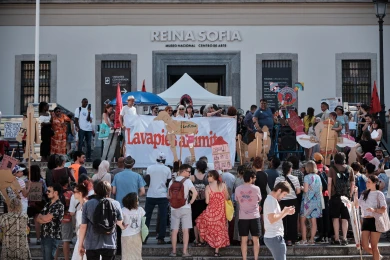
The School of Transformative Institutionalism and Local Organisation (S.T.I.L.O.) is a programme of joint learning and join strategy which sets in motion a process for the exchange of questions, methodologies and experiences between cultural organisations. The overall aim is to create, circulate and prototype tactics, tools and collective knowledge on institutional practices that open new channels for defending culture and advocating structural transformation in divergent geographical contexts.
The project is part of the Laboratorio de Institucionalidad Compartida (The Laboratory of Shared Institutionalism, LIC), a space for the Museo Reina Sofía’s research, work and advocacy centred on developing, experimenting with and systemising practices, protocols and tools which contribute to a fairer and more liveable cultural ecosystem.
For many years now, so-called infrastructural critique in museums questions material, legal and economic infrastructures, among others, as well as the forms of solidarity and practices required to sustain the cultural ecosystem. By approaching current debates, S.T.I.L.O. raises questions on the ways in which organisations define and interpret their practices, organise their relations and respond to the social contexts in which they operate.
The school gathers four cultural organisations that work via different institutional models – scale, contexts, conditions, different working models — with the goal of pooling common strategies and tools of organisation, advocacy and relationships with local communities.
The programme is conceived as a collaborative process with the participation of Arika, La Revuelta, BAK Basecamp and The Tentacular Museum (Museo Reina Sofía) and is structured around preparatory online sessions and an in-person seminar in Madrid.
S.T.I.L.O. is an activity framed inside the working strand of Situated Organisations from L'Internationale’s Museum of the Commons project, which reflects on the role of museums and art organisations as actors within complex social networks and ecosystems, with a view to exploring new ways to democratise institutions and make them more open, inclusive and useful.