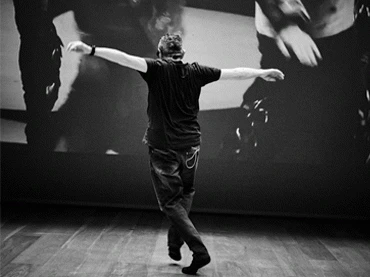
Toni Jodar. Photo: Tristán Pérez Martín
Held on 24 Apr 2019
While he explains the history of dance through his own history, in his body he shows the traces of other bodies, bringing forth accounts, schools and trends.
Bàrbara Raubert
As part of the performing arts program designed in collaboration with Teatros del Canal, the Museo Reina Sofía presents A Dance Lectureby Toni Jodar, anticipating the organisation of International Dance Day.
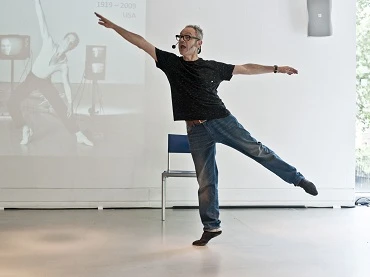
The piece – educational and an autobiographical account – approaches contemporary dance from a broad perspective, centring on its practical and historical side so as to bring it closer to audiences of every kind. Thus, the Catalan dancer and choreographer combines on stage a spoken and illustrated explanation with the danced movement.
On this occasion, Jodar retrieves his experiences as performer, dancer and artist to build a playful and didactic yet reflexive narrative which pivots on aspects that, over time, have defined and laid down what we know as contemporary dance. The nakedness of the body, hybridisation and eclecticism on stage, the crossover and dialogue with other artistic disciplines, an emphasis on the dimension of performance and the use of words, these are just some of the themes to have shaped dance over the past fifty years and are those which Jodar sets out to dissect, translate and, in the most direct sense of the word, explain.
With this intention, he recovers archive images, projecting them on stage and generating a documentary situation which is also current, seeing how his then-and-now body converses. Thus, the weight and imprint of time in dance and the dancer are emphasised, with this autobiographical vision articulated with and joined by allusions to the sphere of international choreography, such as dance-theatre ranging from Mary Wigman to Pina
Bausch, and to local accounts, making them more complex and pluralising them by calling together other voices, trajectories and textures.
A Dance Lecture maintains the research conducted in a previous work, Toni Jodar Explains Modern and Contemporary Dance, presented in the Museo in December 2016.
Support
Cultura Ajuntament de Mataró, L’Estruch Sabadell y Sismògraf Olot
Contributors
L’Animal a l’Esquena, El Graner, Centre de Creació del Cos i el Moviment, Centre National Danse Paris, Art-Club Shanghai, La Caldera, Centre creació de Dansa, Paso a dos y Fabra i Coats Fàbrica de Creació de Barcelona
Project funded by
Generalitat de Catalunya, Ajuntament de Barcelona e INAEM
Curatorship
Isabel de Naverán
In collaboration with
Organised by
Museo Reina Sofía
In collaboration with
Participants
Toni Jodar (Barcelona, 1954) is a performer, dancer and choreographer. He is the co-director and performer of BdDANSA / Explica Danza (2002), a programme for the creation and training of audiences offered in both Mercat de les Flors and Gran Teatre del Liceu, and other centres, in Barcelona. Responsible for the stage performance movement of Carles Santos (1998–2010), he also collaborated in the educational service of the Auditori de Barcelona and created the choreography and stage direction of Metàl·lics para Spanish Brass Luur Metalls and El poble de vent i de fusta.
Credits
Script: Toni Jodar and Helena Tornero
Dramaturgy: Helena Tornero
Mise en scène: Àlex Serrano and Helena Tornero
Images: Àlex Serrano and Jordi Soler
Lighting: Llorenç Parra
Research and content development: Toni Jodar and Bàrbara Raubert
Communication: Sara Peralta and La Taula
Management support and production: Marta Domènech
Artistic production and co-director: Beatriu Daniel
Co-producer: Mercat de les Flors

Más actividades
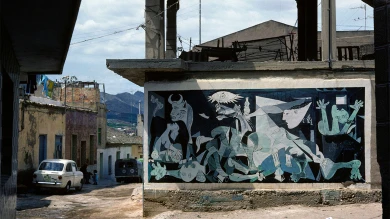
Rethinking Guernica
Monday and Sunday - Check times
This guided tour activates the microsite Rethinking Guernica, a research project developed by the Museo Reina Sofía’s Collections Area, Conservation and Restoration Department and the Digital Projects Area of the Editorial Activities Department, assembling around 2,000 documents, interviews and counter-archives related to Pablo Picasso’s painting Guernica (1937).
The visit sets out an in-situ dialogue between the works hung around the painting and a selection of key documents, selected by the Museo’s Education Team and essential to gaining an idea of the picture’s historical background. Therefore, the tour looks to contribute to activating critical thought around this iconic and perpetually represented work and seeks to foster an approach which refreshes our gaze before the painting, thereby establishing a link with the present. Essentially revisiting to rethink Guernica.
Dear Felix:
Saturdays at 6pm
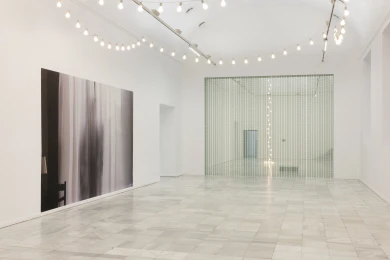
The immediately recognisable art of Felix Gonzalez-Torres, which is on display, from May to October 2026, in the show Sweet Revenge, moves beyond the transmission of messages laden with poetic evocation, vital or biographical reflection, or even a clear political or ethical positioning. Rather, it seeks an active response by visitors to the exhibition. His work invites engagement with these messages so that, whether delighting, moving or challenging, it still prompts viewers to participate in the dialogue and complete the artistic undertaking with their own actions.
Thus, the guided tour Dear Felix: offers a shared, dialogue-inflected tour through the show, with the aim of collectively thinking and feeling the gestures the artist’s work puts forward. Ostensibly simple actions such as crossing through a beaded curtain to take a sweet and eat it, taking a poster from a stack of paper or simply observing a billboard closely, all contain ways of understanding life, loss, love, injustice or the passing — never linear — of time. The tour’s ultimate aim is not to set meanings or create an overload of interpretations of the work, nor does it seek to crystallise an image of the artist and his life in a response to questions which are not there. It looks instead to provide a space to open shared meaning in these apparently simple objects and to attempt a possible correspondence of return from the here and now. A lumbering attempt at responding which starts with a simple Dear Felix:
1926–2026: One Hundred Years of the Lyceum Club Femenino
Thursday, 2 July 2026
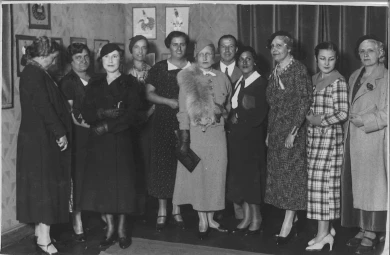
The Lyceum Club Femenino (Lyceum Women’s Club) was established in Madrid in 1926, constituting a space which opened new pathways for women to participate in Spain’s intellectual, artistic and political life in the first third of the twentieth century, and for figures such as designer Victorina Durán, pedagogue María de Maeztu, lawyer and politician Victoria Kent and artist Ángeles Santos, to name but a few. To mark the Madrid Club’s one hundredth anniversary, this research symposium examines its role as a key place for studying women’s and feminist culture in Spain’s Silver Age by analysing and vindicating the different agencies, trajectories and cultural projects that structured the space.
By way of three lectures and two round-table discussions, the symposium sets forth a journey through the Lyceum Club Femenino and the cultural context from which it emerged, from its standing as a pioneering institution to the study of cultural material from the period and the process of constructing the figure of the “modern woman”. These talks and discussions look to shed light on how new ways of thinking, creating and occupying public space were shaped, expanding the gaze on cultural, educational and social networks linked to the Lyceum — as much concerning its ties with other intellectual and artistic circles as the continuity and transformation of these networks during Republican exile. Finally, the symposium features three artistic interventions conceived to recover the artistic legacy of this space in Madrid.
The Museo Reina Sofia joins the Ministry of Culture’s cultural programme focused on the centenary of the Lyceum Club Femenino via these sessions, co-organised with the Spanish National Research Council (CSIC).
Robert Capa
Friday, 26 June 2026 – 6pm
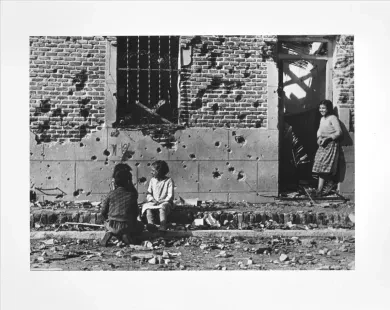
This international encounter centred on the figure of Robert Capa (Budapest, 1913 — Thai Binh, Vietnam, 1954), one of photojournalism’s pre-eminent figures, is held within the framework of the government initiative Spain and Freedom. Fifty Years and in conjunction with a cluster of three locations — the building on number 10 Calle Peironcely, the Plaza del Fotógrafo Robert Capa and the San Carlos Borromeo Parish in Vallecas — declared as a Place of Democratic Memory.
The emblematic photo Robert Capa took in 1936 of this area of Republican Madrid, featuring anonymous children talking in front of a bullet-riddled building attacked by Nazi-fascist air forces, has, in recent years, become a catalyst for impassioned collective action vindicating memory and denouncing the horrors and brutality of wars, past and present.
Within this context, representatives from cultural and academic spheres and civil society organisations from Germany, the USA and Spain discuss the legacy of Capa and photojournalism in European democratic memory, exploring in greater depth two citizen initiatives constructed by Europe from its shared memory: #SalvaPeironcely10 (#SavePeironcely10), in Entrevías (Puente de Vallecas), and the Capa Haus Initiative in the Lindenau neighbourhood of Leipzig, both united by the protection and conservation of historical heritage and by the defence of peace.
The round-table discussion features the participation of Cynthia Young, Juan Miguel Sánchez Vigil, Ulf-Dietrich Brumann and José María Uría Fernández and is moderated by Myriam Soto Lucas. Carmina Gustrán Loscos, the commissioner of Spain and Freedom. Fifty Years, will also join the discussion.
equipoMotor
Jueves alternos, 23 de octubre, 2025 - 11 de junio, 2026 - 17:30 h
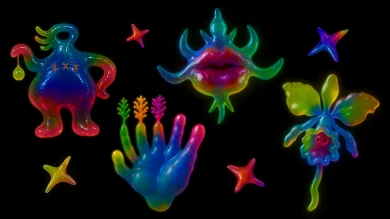
El programa equipoMotor regresa en su edición 25-26 con un aire espectral y mutante para lanzar la pregunta: ¿y si el Museo fuera «un poco más Frankenstein»? Inspirándose en dicho monstruo y en todas aquellas criaturas que desafían la norma desde los márgenes, el proyecto de mediación cultural Galaxxia diseña y acompaña una edición incisiva, intergeneracional y descentralizadora, donde saberes invisibilizados, cuerpos raros y deseos molestos se entrelazan para generar nuevas formas de imaginación crítica y radical. En los sótanos y corredores del Museo —un particular laboratorio— las dudas no se esconden: son materia prima.
Así, para este curso el equipoMotor convoca a personas de todas las edades que hayan participado en ediciones anteriores de los distintos equipos del Área de Educación a recorrer el Museo como quien manipula un cuerpo abierto: descoyuntando algunas de sus categorías teóricas y artísticas —la necropolítica, lo crip-cuir, la lucha de clases, las políticas del malestar, la decolonialidad, la temporalidad cuir, la descentralización institucional o el feísmo— para articular un relato díscolo, remendado y palpitante.
El programa se estructura en bloques temáticos sobre lo freak como metodología, el trabajo cultural, la intergeneracionalidad y la diversidad territorial. Cada bloque a su vez se despliega en sesiones que combinan disparadores teóricos y estéticos, visitas a exposiciones y espacios liminales del Museo, talleres artísticos con artistas, ejercicios de curaduría audiovisual colectiva y de relatoría radiofónica, así como instancias de activación pública, mediante proyecciones de cine experimental y coloquios compartidos con el público, en complicidad con el archivo Hamaca y el Área de Cine y Nuevos Medios del Museo.
De este modo, la presente edición incorpora una particularidad: el grupo de participantes irá transformándose en un «colectivo curatorial audiovisual temporalmente autónomo», con capacidad de incidir en la programación del Museo y de abrir la conversación de equipoMotor al público general, cuestionando y expandiendo así los límites entre las cabezas que deciden, las manos que producen y los cuerpos y presencias que habitan la institución. Las personas seleccionadas en la modalidad oyente serán invitadas a las proyecciones públicas, así como a otras activaciones y momentos de apertura del equipoMotor.
Frente al relato de un museo homogéneo, pulcro y lineal, apostamos por un Museo disidente, contradictorio y lleno de vida residual. Un Museo que no tema hacerse preguntas incómodas ni mostrar sus cicatrices. equipoMotor. Un poco más Frankenstein no busca repensar el cuerpo de la institución, sino habitarlo en sus desgarros, tal como es: híbrido, inacabado, infecto, fantasmagórico… y cargado de esporas y chispas por venir.