-
Together and Rising Up
ACTIVITIES
-
Thursday, 11 February 2021 – 12pm / online platform
Pink Triangle 3
Encounter between Miguel Missé and the Education Community
With the Pink Triangle encounters, the Museo looks to consolidate a space of convergence between different agents working in the sphere of affective-sexual diversity and gender in schools. The third edition of the programme features the participation of Miguel Missé, a sociologist, trans activist and independent educator in the sphere of public policies for diversity. Setting out from Missé’s experience, the encounter prompts joint thinking around the concepts of identity and diversity and shared experiences that help to understand how these realities are lived in schools.
Design and coordination: Cristina Gutiérrez Andérez and Fran MM Cabeza de Vaca
Force line: Action and Radical Imagination
Education programme developed with the sponsorship of the Banco Santander Foundation -
Sunday, 14 February 2021 – 12pm / Nouvel Building, Auditorium 400
Territorio Doméstico. Politicising Aprons, Pots and Streets
Screening and Round-table discussion
Territorio Doméstico. Politicising Aprons, Pots and Streets is a documentary audiovisual piece that records the history of the make-up and struggle of the feminist collective Territorio Doméstico (Domestic Territory), a group of domestic workers who live in the Community of Madrid but come from all over the world.
Participants: Vera Bartolomé, Justa Montero, Amaia Pérez Orozco, Mayo Pimentel, and members of Territorio Doméstico
Organised by: Museo Situado
Force line: Action and Radical Imagination
Collaboration: Rosa-Luxemburg-Stiftung (Madrid Office) -
Friday, 26 February 2021 – 6pm / Nouvel Building, Auditorium 200
Exile. Feminism. Essay Film: The Body as a Remnant
Lecture by Margarita Ledo
This edition of the Juan Antonio Ramírez Chair features a master lecture by film-maker, poet and writer Margarita Ledo, who sets forth a reflection on the body as a remnant, as a point of arrival after tracing an invisible thread that extends across film based on memory, anti-establishment practices, the marginalisation of women in public spaces, the estrangement of their own bodies and the power of essay films as an artistic practice.
Programme: Juan Antonio Ramírez Chair
Force line: Avant-gardes
Collaboration: MA in Contemporary Art History and Visual Culture conducted in the Museo Reina Sofía Study Centre, in collaboration with the Autonomous University of Madrid (UAM) and the Complutense University of Madrid (UCM)
Education programme developed with the sponsorship of the Banco Santander Foundation -
Nouvel Building, Auditorium 400
They Wanted Arms but People Arrived
A Radio Series on Migration and Domestic Work
They Wanted Arms but People Arrived is a radio series and theatre piece on migration and domestic work, written and performed by women from the Territorio Doméstico (Domestic Territory) association and featuring the participation of sound artist Susana Jiménez Carmona and the work cooperative Pandora Mirabilia. Its direction and mise en scène are overseen by actress, playwright and director Sandra Arpa. In the piece, the unwelcome experiences of three migrant women, Yuritsi, Quisqueya and Amalia, who live in Madrid, are narrated as they negotiate borders, deal with labour abuses and combine care with their own lives on both sides of the Atlantic.
Participants: Susana Jiménez Carmona, Pandora Mirabilia, and members of Territorio Doméstico
Organised by: Museo Situado
Coordinated by: Territorio Doméstico
Force line: Action and Radical Imagination -
Thursday, 4 March 2021 – 6pm / Auditorium 200, Nouvel Building
Documents 16. “It’s Just a Joke, Love!” Is it a Joke?
Misogyny and Symbolic Violence in Graphic Humour
The Documents programme explores the relationships between art and publishing. On this occasion, artist Raquel Manchado presents and carries out a critical reading of part of her graphic art collection, comprising postcards, comic strips, posters, calendars, newspapers, magazines and other widely distributed formats published since the early twentieth century and which, under the veneer of humour, degrade women over their physical appearance or behaviour.
Programme: Documents
Force line: Action and Radical Imagination -
Friday, 5 March 2021 – 6pm / Nouvel Building, Protocol Room and online platform
Situated Voices 18
Trans Law*. Lives and Rights
In recent years, the fight for trans* and non-binary depathologization and the attainment of their civil rights has questioned the debates of feminisms. The publication of the draft bill for Real and Effective Equality for Trans People, which broadens gender self-determination, sets forth a public debate that once again draws attention to key issues that were a decades-long part of feminist theory. This debate is set out as a conversation between people with first-person trans* experiences, their families and their environments in order to situate the specific demands of the collectives involved, and understand the key parts to this future law and underlying problems.
Participants: Aitzole Araneta, Rubén Castro, Coco Guzmán, Carolina León and Sabrina Sánchez
Organised by: Museo Situado
Coordinated by: Lucas Platero
Force line: Action and Radical Information -
Tuesday, 13 April 2021 – 7pm / Online platform
Situated Voices 19. Reproductive and Sexual Rights
Struggles for the Right to Decide
The mass victory of abortion rights in Argentina and its escalation across the feminist movement in Latin America contrasts sharply with feminist struggles in Poland, where the same rights attained in the past are now being curtailed. This encounter addresses strategies of organisation and contributions to feminist thought by activisms in different territories; proposals that are framed by the demands for women’s access to sex education and sexual health, contraception resources and the voluntary termination of pregnancy, in addition to the right to the free expression of sexuality and desire.
Participants: Sílvia Aldavert Garcia, Morena Herrera, Marta Lempart, Eleonora Mizzoni, Justa Montero and Martha Rosenberg
Coordinator: Justa Montero
Force line: Action and Radical Imagination -
Wednesday, 21 April 2021 – 6pm / Nouvel Building, Protocol Room
Revisiting Tenerife
Encounter with Carme Nogueira
The Forms of Making, the Making of Forms is a programme on methodologies, tools and techniques in artistic practice. This second edition sees artist Carme Nogueira share her art-making as she revisits, with a group of people from Madrid, her project Tenerife (2020), engaging in dialogue with the homonymous film by Yves Allégret and Eli Lotar. The photograph of a laundry room taken by Lotar in 1932 while she was visiting Madrid in 1932 during a trip with Yves Allégret, in which they would reach the Canary Islands instead of Las Hurdes, marks the trail from which to interrogate the past and present.
Curator: Tamara Díaz Bringas
Programme: The Forms of Making, the Making of Forms
Force line: Rethinking the Museum -
Wednesday, 26 May 2021 – 6pm / Nouvel Building, Protocol Room
Feminisms in Morocco
A Drift Through Territories
At a time of boiling-point and multiplicity in the feminist movement, Maggie Schmitt and Hanan Dalouh Amghar undertook a research process that started with a trip around Morocco in February 2020. This presentation explores the feminist collectives — and/or women’s and gender dissidence collectives — that are currently active in the Moroccan territory, and the practices, debates and challenges put forward among these groups and with Moroccan society, as well as the links that can be established with the situation in Mediterranean Europe.
Participants: Hanan Dalouh Amghar, Souad Eddouada, Zohra Koubia, Nadia Naïr and Maggie Schmitt
Organised by: Museo Reina Sofía and La Laboratoria. Feminist Research Spaces
Force line: Action and Radical Imagination
Programme: In the Meantime -
Thursday, 1 July 2021 – 6pm / Nouvel Building, Auditorium 200
Love Is Not a Crime
With Najat El Hachmi, Zainab Fasiki and Abdelá Taia
This encounter will discuss the arising tensions in Morocco through the ever more frequent protest actions around sexual rights in the private and public spheres. Signs of this is the recent publication L’amour fait loi (Éditions le sélénite, 2020) and the mobilisation that occurred when four hundred and ninety Moroccan women signed the Outside the Law manifesto in defence of their rights.
Organised by: Museo Reina Sofía, Casa Árabe and Medialab Prado
Curator: Susana Moliner (Grigri Projects)
Force line: Action and Radical Imagination
Programme: In the Meantime -
From 5 to 8 July 2021 – 6pm / Sabatini Building, Garden
Weaving a Blanket of Snow
Workshop with Eva Lootz
Creating string figures with Eva Lootz is the starting point of a series of summer afternoons which also include moments of viewing, listening, conversation and pauses; in which intertwined threads and knots relate body, memory and language. This workshop with Eva Lootz is the fourth edition of the programme The Forms of Making, the Making of Forms, which flows between methodologies and techniques of artistic practice.
Curator: Tamara Díaz Bringas
Programme: The Forms of Making, the Making of Forms
Force line: Rethinking the Museum -
Thursday 2, Friday, 3 and Saturday, 4 September 2021 - 11am / Sabatini Building, Workshops
Artivism and the Female Body
Fanzines workshop with Zainab Fasiki
This activity aims to collectively create a fanzine to explore the representation of bodies in the company of Zainab Fasiki, a feminist draughtswoman and illustrator whose first published comic Omor (Things) explores the difficulties facing women living in Morocco. In 2018, she put together Hshouma, a website and comic on taboos in Morocco with a significant social and media impact in her country.
Organised by: Museo Reina Sofía, Casa Árabe and Medialab Prado
Curator: Susana Moliner (Grigri Projects)
Force line: Action and Radical Imagination
Programme: In the Meantime -
Together and Rising Up
RESEARCH AND STUDY GROUPS
Throughout 2021, the Study Centre will welcome seven residency programmes and two study groups to approach the different research projects situated in relation to archive policies, identity, memory and communal life.
Education programme developed with the sponsorship of the Banco Santander Foundation
-
Alejandro Simón
Essays on Tackiness. Readings with Miguel Benlloch’s Creative Practice
Benlloch called himself a “performancero”, not a performer, and his creative practice from the body was also situated along a “diverted” and “tacky” line of performance. In his actions and forms of writing, Benlloch crossed words, objects, actions, places and relations, affording us a resistant reading of art history between the end of the twentieth century and beginning of the twenty-first century in Spain. How can Miguel Benlloch be read without having met him?
-
Magui Dávila
Sound Performance Practices in the Framework of Club Culture and the Electronic Music Scene in Madrid from 1985 to 2005, and its Development and Conveyance in Today’s Club Context
This investigation centres on the social context of 1990s Madrid and the political potential of local club culture from the period: knowledge situated in the culture of performative electronic music and collective space shaped by different figures and nightspots in the creative side of social action, in addition to influences and conveyance in other scenes, sounds and activisms. The invisible yet central place of many female DJs in this scene constitutes one of the pillars of the research.
-
Ana Sánchez
El Laboratorio 1997–2003. A Genealogy for Practices of the Commons
This archive project got under way in 2017 as a process to recompose and thematise the memory of the El Laboratorio Social Centre, presented at once as a tool to access history (at the crossroads of social, political and artistic movements in the late 1990s in Madrid through the Social Centre) and a tool of thought for the processes of transformation, creation and resistance in the city. Transfeminist stances were a key vector in configuring ways of making this activist experience.
-
Benny Nemerofsky Ramsay
Recollecting/Recueillir
Based on French writer and photographer Hervé Guibert’s collection of postcards, shared out among his friends after his death from AIDS-related complications, this project seeks to reinvent networks of kinship in the fourth decade of the epidemic. The accidental archives, epistolary activity and museum visits constitute gestures of resistance against oblivion, the growing distance of today’s queer realities and the complexity of their past.
In the framework of: the L’Internationale project Our Many Europes
-
Pablo Santa Olalla
Being from the South, Making Cable TV, Having AIDS, and Other Lived Experiences from the Margins
This research maps out the network Latin American artists such as Raul Marroquin, Ulises Carrión, Flavio Pons and Claudio Goulart created in Amsterdam in the 1970s. As Latin American migrants in Europe and sexual dissidents during the AIDS epidemic, these artists worked from their southernness, placing themselves on the edges of the art system and using alternative communication and media technology like mail art, artist’s publications, performance, video and cable TV.
-
Diego Marchante
"Genderhacker", Gendernaut. Queering the ‘90s
Gendernaut is the name that forms this multidisciplinary project started in 2018 and approaching questions around archive, gender, the body, performance and audiovisual creation, setting forth new forms of viewing transfeminist and queer narratives. By way of transmedia and performance projects, this non-binary archive has been conceived as a living interactive space, free from heteropatriarchical codes, inhabited by multiple bodies and subjectivities relating the past, present and future to come.
In the framework of: the L’Internationale project Our Many Europes
-
Elisa Fuenzalida and Javi Vargas Sotomayor
The Aroma of Flowers, the Pain of Others: Bodies, Mourning and Commonality
This research seeks to study the modes of interdependence and the organisation of care among bodies of desire and discomfort — also between living and dead bodies — deployed in the context of the social and economic flare-ups in 1990s Latin America, marked by the AIDS epidemic, economic crashes and sanitation, and in relation to fears, collapses, and probable alternatives to the abyss of the present and its new normalities.
In the framework of: the L’Internationale project Our Many Europes
-
25 February – 3 June 2021 - 4:30pm / Nouvel Building, Protocol Room
For a Care Statute
A Collective Writing Proposal for a Legal Fiction with Real Effects
This study group proposes a collaborative exercise of legal fiction, with the aim being to formulate, on the basis of Spain’s Workers’ Statute, a possible Care Statue, voluntarily applying the customary labour law language and the trade union struggle as an appropriation that sets in motion political imagination and foreshadows future scenarios.
Participants: Marta Busquets Gallego, Silvia Federici, Luisa Fuentes Guaza, Graciela Gallego Cardona, Marta Malo, Helen Torres and Cristina Vega
Coordinators: Luisa Fuentes Guaza and Marta Malo
Force line: Action and Radical Imagination; Contemporary Disturbances -
8 April – 8 July 2021 – 4pm / Online platform
Politics and Aesthetics of Memory. Fears, Violence, Affection
This study group looks at a conception of memory as an agent for deciphering and re-reading fragments and scenes, procedures and narratives, rhetoric and politics of the body and the image that continue to question the present with their performative force. At the crossroads between art, subjectivity, social discourse, culture and institutions, the group seeks to better understand the challenges of this tension between neoliberal operations fostering a forgotten past and the necessary political-critical retrieval of memory.
Coordinator: Nelly Richard
Force line: Politics and Aesthetics of Memory -
Together and Rising Up
COLLECTION
-
Room 427
Outside the Canon. Women Pop Artists in Spain
This room displays the work of women artists whose careers started in the 1960s and 1970s and who, forgotten in mainstream accounts, have come to the fore through recent research. Two places form the major focal points in bringing about feminist artistic discourses: Barcelona – where works were imbued with conceptual practices — and Valencia. Women artists added anti-Franco discourses and social critique to their attacks on the customary representation of women, in which they were strongly objectified as much in the mass media as in the Pop Art imagery of many of their male contemporaries.
-
Room 206.09
Front and Rearguard: Women in the Civil War
The role of women during the Spanish Civil War was at once active and diverse, most notably exemplified in Kati Horna (Budapest, 1912 – Mexico City, 2000) and Gerda Taro (Stuttgart, 1910 – El Escorial, 1937), two photographers who travelled to Spain to cover the armed conflict, disseminating their work in national and international publications such as Umbral, Regards and Die Volks-Illustrierte. In the sphere of visual arts, figures such as Francis Bartolozzi Sánchez “Pitti” (Madrid, 1908 – Pamplona, 2004) and Juana Francisca Rubio (Madrid, 1911–2008) created graphic art to the backdrop of war, while the role of female workers and militiawomen to serve the cause was broadly depicted in different media. In this room, two lines of ongoing research which are key to the Museo Reina Sofía Collection converge: the context of the 1930s and the Spanish Civil War, and the recovery of the work of women artists, often ignored or obscured by the output of their male counterparts.
-
Together and Rising Up
EXHIBITIONS
-
7 April – 16 August 2021 / Sabatini Building, Floor 3
Charlotte Johannesson
Take Me to Another World
The work of Charlotte Johannesson (Malmö, 1943), a textile artist and digital graphic art pioneer, is an early example of the conceptual synchrony between artistic languages and a technique involving computer programming and the loom. The binary nature of the image resulting from both technologies — produced both by zeros and ones and the weft and warp — facilitated the artist’s transition from weaving to computer-based art.
Organised by: Museo Reina Sofía
Curators: Lars Bang Larssen and Mats Stjernstedt -
2 June - 27 September 2021 / Sabatini Building, Floor 3
Ida Applebroog
Marginalias
The exhibition the Museo Reina Sofía devotes to Ida Applebroog (New York, 1929) is the largest and most exhaustive retrospective of her work to date. The selection of pieces, spanning more than five decades of continual work, places the stress on the interests and concerns that were constants across her life, such as violence, power, gender politics and female sexuality.
Organised by: Museo Reina Sofía
Curators: Manuel Borja-Villel and Soledad Liaño -
Together and Rising Up
GUIDED TOURS
-
From Monday to Sunday Meeting Point: Sabatini Building, Floor 1, Education Desk
Feminism. A Feminist Gaze on Avant-garde Movements
TicketsThis tour explores the spaces of the Collection devoted to historical avant-garde movements and questions women’s role and visibility in art history by means of an analysis of women as producers, recipients and subjects-objects of artistic production. It is part of a series of transversal tours that put forward new gazes of the Collection, questioning traditional interpretations and revealing the wealth of historical, social and political ramifications of artistic activity. It seeks to ignite a new gaze, to critically consider images of male domination and to prompt recognition of women’s work in overcoming roles and models.
-
From Monday to Sunday
Charlotte Johannesson. Take Me to Another World
7 April – 16 August 2021
A guided tour around the exhibition the Museo devotes to Charlotte Johannesson (Malmö, 1943), a textile artist and digital graphic art pioneer, and an early example of the conceptual synchrony between artistic languages and a technique involving computer programming and the loom.
Meeting point: Sabatini Building, Garden
Registration: only for one-hour visits. Tours organised at the meeting point in strict order of arrival, from 30 minutes before the start of the visit. -
Together and Rising Up
DIGITAL PROJECTS
-
Microsite Based on the Collection
Front and Rearguard: Women in the Civil War
The 1930s was a paradigmatic era in the progress and regression of the situation women faced in Spain across all spheres. Women’s public visibility in the years of the Second Republic was strengthened through their active role in the Civil War, both on the front and in the rearguard, but curtailed by the victory of the Nationalist faction. This microsite, therefore, explores in greater depth the lines of research and acquired works that have given rise to the room Front and Rearguard: Women in the Civil War, and also features collaboration with different specialists who analyse the context of women artists and the most significant works from this period in the Collection.
-
Research and playlist
Sicaliptic Women, Unknowingly Avant-garde Artists
With the Worst Dual Purpose, 1907–1940
The Spanish neologism sicalipsis is customarily associated with morally transgressive and mischievous eroticism, yet sicalipsis was also related to the price of bread, the workers’ struggle, feminism, changing gender roles and avant-garde movements. Sicaliptic women inhabited a territory bordering legality and illegality, hence their strategy of resistance in the recurrent use of dual purpose. This playlist also has a dual purpose: the tornado woman built with the neurasthenic woman, the wage earning woman built with the revolutionary activist woman, the highly politicised woman built with the apolitical woman, the traditional, autochthonous woman constructed with the cosmopolitan woman.
Curators: Gloria G. Durán and Miguel Molina-Alarcón
-
Together and Rising Up
RRS RADIO
-
Conversations with Mattin, Marisa Pérez Colina and Brigitte Vasallo
The New Reaction. Antidotes and Synergies
In this podcast, Agnès Pe assembles some of the cornerstones of the encounter held in the Museo Reina Sofía in November 2020 around the specific means that mobilise forces from the New Right. Furthermore, it centres around how to preserve the continued existence of emancipatory conquests, now under threat after centuries of struggle, generating spaces of thought from new feminisms, struggles for recognition and equality, and social and migration movements, among others.
Together and Rising Up
Transfeminist Struggles
Held on 01 Feb 2021
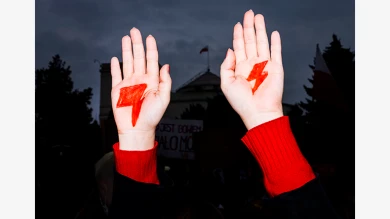
A red lightning bolt stirs Poland, and thence the world. A red lightning bolt, a tide of green handkerchiefs, thousands of bodies painted purple, the flap of multi-coloured flags, extending far and wide and flashing with danger in that instant. Uprisings that render an account of a time of promise in which feminist power becomes at once mass and radical, converging with other historical or intersectional fights, struggles of class, race and coloniality. At the same time, it is an historical moment that co-exists with a time of menace, where a new reaction attempts to advance on already conquered rights and diminish them, refuse them passage, break them up. A time in which mourning and celebration join, in which different generations mix and share the wisdom and experience of numerous women, share the irreverent and irrepressible passion of others. A time of rebellion in bedrooms, houses, on streets, and also in institutions. A time in which the museum, intersected and affected by these struggles, must take up its position.
The programme Together and Rising Up assembles a series of activities, exhibitions, rooms from the Collection, study groups, guided tours and digital projects inside the Museo, to be presented over the course of 2021, and thus reflecting the plural nature of transfeminist struggles and the complexity of new challenges for feminism.
![Zainab Fasiki, Hshouma [Tabú], 2019](https://recursos.museoreinasofia.es/styles/small_landscape/public/Actividades/zainab.png.webp)


Más actividades
![Isabel Coixet, 100 Years and You Everywhere [100 años y tú en todos los sitios], 2026, película](https://recursos.museoreinasofia.es/styles/small_landscape/public/Actividades/2.diseminar-mundo.jpg.webp)
John Berger and Isabel Coixet. Continued Ways of Seeing
Thursday, 17 September 2026 at 7pm
Ways of Seeing (1972) is one of the most revolutionary television series on art history, the museum and contemporary critical culture. Across four episodes, an articulate, enthusiastic John Berger unpacks the relationships between classical art through the gaze and new technology, the nude and feminism, the oil painting and commodity fetichism, advertising and consumerism. In essence, a level of critical commitment only comparable to its capacity for dissemination. Unsurprisingly, the series, and the book that would distil it, continues to forge vocations. This session sees art historians Alberto López Cuenca and Modesta Di Paola carry out an analysis of Berger’s audiovisual work, placing the stress on episodes one and four of the series. In the first episode, Berger reflects on the connection between the act of seeing, looking and being in light of new technology, such as the film camera. At the same time, it analyses how the culture of reproduction is turning paintings into messages or fragments of communication while stressing the importance of silence when observing historical paintings. In the fourth and final episode, he introduces advertising as a new iconic-verbal language that shares certain principles with the message of oil painting as a luxury item.
The session opens with the premiere of a filmic letter from Isabel Coixet, one of Spain’s most internationally acclaimed directors, to John Berger, with whom she maintained a long friendship and deep admiration. The short film is testament to the ubiquitous and long-lasting presence of the author of Ways of Seeing, even after his death in 2017.
![Chantal Akerman, Woman Sitting after Killing [Mujer sentada después de matar], 2001, instalación. Museo Reina Sofía](https://recursos.museoreinasofia.es/styles/small_landscape/public/Actividades/chantal-akerman-mujer-sentada-despues-matar.jpg.webp)
On Your Screen: Art History and the Museum Facing the Audiovisual Challenge
18, 19 SEP 2026
The conference On Your Screen: Art History and the Museum Facing the Audiovisual Challenge sparks debate around the transformations of art history and museum space upon embracing the audiovisual format. Its starting point is John Berger’s emblematic television series Ways of Seeing (1972), a landmark in the democratisation of art-historical discourse. In the series, Berger illustrated how the transfer of a work such as Goya’s Los fusilamientos del 3 de mayo (The Third of May 1808 or the Executions) from museum gallery to home TV screen completely changed the viewer’s experience, allowing the image to travel to straight to the viewer.
In the twenty-first century, this screen-based ecosystem has expanded exponentially, with museums not only physically integrating screenings and devices into their galleries— following in the wake of many exhibitions on the moving image — but also deploying complex virtual strategies. Equally, numerous en vez de a multitudeof historians, students and creators use digital platforms to circulate their ideas and projects. This audiovisual shift opens access to ignored materials and democratises knowledge, as well as challenging traditional hierarchies and the interpretive authority of institutions. The conference, promoted by the research project ATLAS AV: The Audiovisualisation of Art History and the Museum, seeks to analyse this vast audiovisual material, its archives, and its capacity to transform the memory of art.
Godard and Miéville: Time and Ruin
Friday, 18 September 2026 - 7pm
Inside the framework of the conference On Your Screen: Art History and the Museum Facing the Audiovisual Challenge, this film series sets forth three critical visions of the museum via three sessions featuring the works of John Berger, Jean-Luc Godard and Anne-Marie Miéville, Ariella Azoulay, Alan Resnais and Chris Marker, Kwate Nee-Owoo, and the premiere of short films by Isabel Coixet and La Vulcanizadora (Maria Rojas Arias and Andrés Jurado). In classical theory, the museum gives the world meaning; it contains fragments of the past, granting them a history, a narrative that explains preterite time and the present. Today, there is an implicit assumption that this function hides and legitimises forms of power, yet what if the museum, instead of explaining the world, multiplied it through radical ideas, silenced periods and repressed subjects? Such is the approach of the film-makers and artists in this film season.
In 1972 the writer John Berger opened the landmark television series Ways of Seeing with an iconoclastic gesture: slicing Sandro Botticelli’s painting Venus and Mars (1485) in London’s National Gallery. A transgressive act that recalls contemporary attacks on the museum by dissident youth and with which Berger, after revealing it was a reproduction, sought to ignite debate around the idea of an original artwork and a copy. In this, the hundredth anniversary of his birth, the first session pays homage to one of the great art writers of the twentieth century. Starting with a review of Berger’s audiovisual work by art historians Alberto López Cuenca and Modesta Di Paola, the series begins with the premiere of 100 Years and You Everywhere (2026), an unreleased short film by Isabel Coixet composed as a beautifully crafted letter to Berger, and continues with an analysis of fragments of Ways of Seeing in relation to the museum and contemporary art.
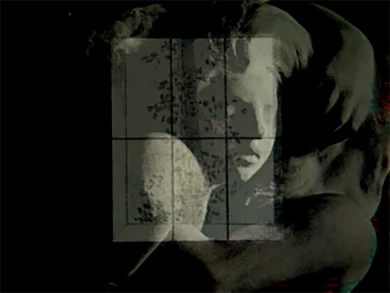
The second session screens two medium-length films by Jean-Luc Godard and Anne-Marie Miéville on time, ruin and museum. In The Old Place. Small Notes Regarding the Arts at Fall of 20th Century (1999), both film-makers consider what remains of that “old place”, the museum, at the close of a century of wars and totalitarianism, and ask whether it should be more of a legend or desire than a place. This same driving principle leads Godard to build his own imaginary museum in Reportage amateur (maquette expo) (2006), a rickety toy museum which, paradoxically, contains the great film-maker’s full power of thought on history and images.
Finally, the third session explores one of the major challenges of recent years: the decolonisation of the museum, the recognition of its link to imperialist discourses of power and the need to situate a new silenced or repressed subject at the centre of the Western narration of history. Under the title Museums and Restitution, it includes the film Undocumented. Unlearning Imperial Plunder (2019), by theorist Ariella Azoulay, Statues Also Die, by Alan Resnais and Chris Marker (1953), Kwate Nee-Owoo’s You Hide Me (1970) and the first screening of the short film Quinto verso, parte de Tonada (Fifth Verse, Part of Tonada), by La Vulcanizadora (Maria Rojas Arias and Andrés Jurado), filmed at the Museo de América in Madrid.
![Ariella Azoulay, Un-documented. Unlearning Imperial Plunder [Indocumentados. Desaprendiendo el saqueo imperial], 2019, película](https://recursos.museoreinasofia.es/styles/small_landscape/public/Actividades/5.diseminar-mundo.jpg.webp)
Museums and Restitution
Saturday, 19 September 2026 - 7pm
Centuries of plundering, decades of amnesia, years of living with unmitigated extractivist power… Does a museum, as we know it, have a raison d'être in a postcolonial society?
This session expounds the operations of the museum as a colonial machine, while putting forward ideas, in narration, for a more just, equal and inclusive institution of the future via society’s marginalised and minority voices. The session begins with the international premiere of Quinto verso, parte de Tonada (Fifth Verse, Part of Tonada), which presents a vision of the Quimbaya Collection (fifth and sixth centuries CE) from the Museo de América in Madrid. It is constructed with the voices and chants of Wayúu mourners and guides, not only as a way of reinstating the role of these gold idols — anthropomorphic figures of men and women used as vessels in ritual practices — but also to imagine that what must be exhibited is not the gold itself. It is the ritual’s own chant. In the classic film You Hide Me (1970), Ghanaian film-maker Kwate Nee-Owoo accesses the British Museum’s collection of African art, located in the building’s basement, to question the meaning behind a museum plundering and nullifying. A fine exercise of first-person institutional critique screened for the first time in Spain. Almost seventy years since Resnais and Marker made Statues Also Die (1953), a reflection on the aura-bearing value of the museum opposite the identity-based and cultural belonging of African art, theorist Ariella Azoulay films the same statues again at the Musée du Trocadéro (today the Musée du Quai Branly), which survive and wait to be reunited with their people. Azoulay, whose wholly original undertaking is a lesson to the museum of the future, connects the forced migration of these sculptures with the mass transit of people crossing borders artificially imposed by the same system that has plundered their culture.
The School of Transformative Institutionalism and Local Organisation
From 21 to 24 September 2026
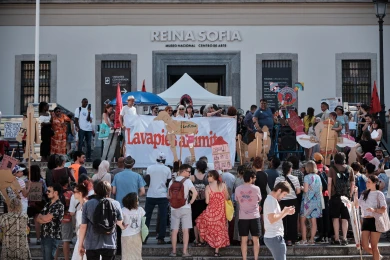
The School of Transformative Institutionalism and Local Organisation (S.T.I.L.O.) is a programme of joint learning and join strategy which sets in motion a process for the exchange of questions, methodologies and experiences between cultural organisations. The overall aim is to create, circulate and prototype tactics, tools and collective knowledge on institutional practices that open new channels for defending culture and advocating structural transformation in divergent geographical contexts.
The project is part of the Laboratorio de Institucionalidad Compartida (The Laboratory of Shared Institutionalism, LIC), a space for the Museo Reina Sofía’s research, work and advocacy centred on developing, experimenting with and systemising practices, protocols and tools which contribute to a fairer and more liveable cultural ecosystem.
For many years now, so-called infrastructural critique in museums questions material, legal and economic infrastructures, among others, as well as the forms of solidarity and practices required to sustain the cultural ecosystem. By approaching current debates, S.T.I.L.O. raises questions on the ways in which organisations define and interpret their practices, organise their relations and respond to the social contexts in which they operate.
The school gathers four cultural organisations that work via different institutional models – scale, contexts, conditions, different working models — with the goal of pooling common strategies and tools of organisation, advocacy and relationships with local communities.
The programme is conceived as a collaborative process with the participation of Arika, La Revuelta, BAK Basecamp and The Tentacular Museum (Museo Reina Sofía) and is structured around preparatory online sessions and an in-person seminar in Madrid.
S.T.I.L.O. is an activity framed inside the working strand of Situated Organisations from L'Internationale’s Museum of the Commons project, which reflects on the role of museums and art organisations as actors within complex social networks and ecosystems, with a view to exploring new ways to democratise institutions and make them more open, inclusive and useful.