-
September 17, 2015 Nouvel Building, Protocol Room
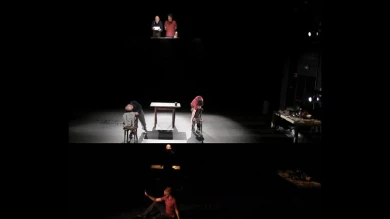
66 Exercises in Style, by Colectivo Armadillo
Two actors/homo ludens brimming with dramatic literature and theatrical art history, invaded by voices from every epoch, and locked inside the loop of a trivial stage without resolution.
Setting out from Raymond Queneau’s book Exercises in Style (1947), the piece considers a game of trivial appearances developed in absolute seriousness, a rhetorical pastime, both mannerist and extravagant and not devoid of comedy but also possessing a didactic component that displays its blueprints and intentions. Something that doesn’t materialise into a performance piece but a draft, sketch and project, theatre performed in front of the spectator.
Armadillo is a collective made up of Jesús Barranco, Pilar Campos, Oscar G. Villegas, Raúl Marcos, Luciana Pereyra and Carlos Rod. The collective has developed theatre experiments on the works of Georges Perec (The Raise), Thomas Bernhard (On Earth and in Hell) and Bertolt Brecht (Unfinished Work).66 Exercises in Style is created and performed by: Raúl Marcos/Jesús Barranco. Sound design and lighting: Óscar G. Villegas
-
October 1, 2015 Nouvel Building, Auditorium 200
Discussion
In collaboration with: Institut Français
A round-table discussion centred on the OuLiPo group’s. With participation by leading especialists and some of the protagonists of this historic literary experiment.
Paul Fournel, member of the OuLiPo group since 1972, provisional secretary until 2003 and the current chairman. He is the author of an expansive body of literary work that includes Clefs pour la littérature potentielle (Gallimard, 1972), Guignol (Editions du Seuil, 1995) and Les Athlètes dans leur tête (Aldus, ed. Spanish translation, 2009, winner of the Prix Goncourt de la Nouvelle in 1989).
Pablo Martín Sánchez, writer, author of El anarquista que se llamaba como yo (The Anarchist Whose Name Was Mine, Acantilado, 2012), selected as the best debut novel, and the only Spanish member of OuLiPo.
Pablo Moíño Sánchez, Spanish translator of Georges Perec – The Art of Asking Your Boss for a Raise (Spanish translation, La uÑa RoTa, 2009) and Raymond Queneau – The Last Days (Gallo Nero, 2013). He is also author of un verso en una casa enana (A Verse in a Tiny House, La Discreta, 2011).
Carlos Rodríguez, one of the editors of La uÑa RoTa, a publishing house which released Es un oficio de hombres (Autorretrato de hombres y mujeres en reposo) (It’s a Man’s Profession [A Self-portrait of Idle Men and Women]) and has works by Georges Perec and Samuel Beckett, among others, in its catalogue.
Daniel Montero Galán, illustrator, author of the graphic novel Zooilógico. Bestiario de seres mitoilógicos (Zoo. Bestiary of Mythological Beings, Ediciones Jaguar, 2011) and, together with Juan Mayorga, the illustrated play El elefante ha ocupado la catedral (The Elephant Has Taken Over the Cathedral, Veintisiete letritas, 2012). He also illustrated the cover to the book OuLiPo Es un oficio de hombres (Autorretrato de hombres y mujeres en reposo) (It’s a Man’s Profession [A Self-portrait of Idle Men and Women]), (La uÑa RoTa, 2015).
OuLiPo. 55th Anniversary
Held on 17 Sep, 01 Oct 2015
The Museo marks the 55th anniversary of the OuLiPo group with two activities: The presentation of the work 66 Exercises in Style by Colectivo Armadillo, which is inspired by Queneau’s book Exercises in Style (1947), and a discussion which revolves around the group.
Founded by François Le Lionnais and Raymond Queneau, OuLiPo (Ouvroir de Littérature Potentielle, Primer of Potential Literature), emerged in 1960 from a group of mathematicians and writers interested in maximising the possibilities of language through the creation of contraintes. This term is normally translated as constraints or obstacles and alludes to the rules imposed by a literary structure; in the contrainte oulipons find the capacity for language in order to establish unusual connections between words, which allows for unsuspected relationships. From the beginning, OuLiPo would distance itself from literary movements, scientific seminars or literary workshops to build a key chapter that reconsiders the relationships between art and writing, or between language and meaning. Despite taking up previous experience from Dada and Surrealism, it would also displace random exploration and the subconscious with multiplied meaning, projecting and transforming both avant-garde movements from the 1960s onwards. Writers such as Georges Perec, Italo Calvino, Julio Cortázar and Samuel Beckett and artists like Oyvind Fahlström, Guy de Cointet and Allen Ruppersberg would express how greatly indebted they were to this group with regard to approaches to the creative potential of writing. The Museo Reina Sofía joins in with this acknowledgment via the first theatrical approach to OuLiPo’s inexhaustible present.
Más actividades
![Joseph Kosuth. One and Three Chairs [Una y tres sillas]](https://recursos.museoreinasofia.es/styles/small_landscape/public/Actividades/joseph_kosuth.jpg.webp)
The (legal) person and the legal form. Chapter III
Monday 11, Wednesday 13 and Thursday 14 May 2026
As part of the Studies Constellation, the Study Directoship’s annual fellowship, art historian and theorist Sven Lütticken leads the seminar The (Legal) Person and the Legal Form: Theoretical, Artistic, and Activist Commitments to foster dialogue and deepen the hypotheses and questions driving his research project.
The seminar consists of eight sessions, divided into three chapters throughout the academic year. While conceived as non-public spaces for discussion and collective work, these sessions complement, nourish, and amplify the public program of the Studies Constellation.
First session of the third chapter focuses on the transformation of the artwork in the context and wake of Conceptual art. The very notion of the artwork, together with its ownership and authenticity, is reconsidered from a broad perspective open to new and alternative models of management, which could ultimately transform the relationship between artist, artwork and owner. Can some of the practices in question serve as critical models? To what extent is it possible to think and act with them, and extrapolate from them, beyond a beautiful niche?
The second session turns to the question of representation. While many (but not all) human natural persons can, in principle, represent themselves in legal matters, other needs representatives. This goes for minors as well for adults who have been placed under legal guardianship; it applies to fictitious persons such as corporations and states, who need human representatives to sign contracts or defend them in court. We will look into the question of legal representation in conjunction with other forms of representation, in the cultural as well as political register—taking cues from Spivak’s distinction between portrait (Darstellung) and proxy (Vertretung), which is an unstable and historically mutable one.
The seminar concludes with a closing session dedicated to collectively revisiting and reflecting on the themes and discussions that have emerged throughout the first Studies Constellation Residency Program.
Patricia Falguières
Tuesday May 12th 2026 – 19:00 h
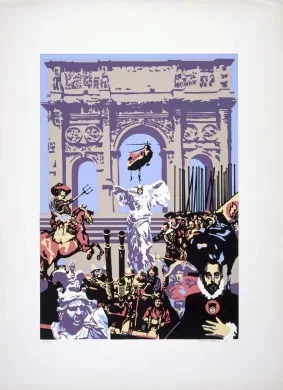
Art historian Patricia Falguières inaugurates the María Luisa Caturla Chairwith the lecture Art History in Dark Times. This Chair, dedicated to the reflection on art in times «sick with uncertainty», is aimed at dismounting, digressing and imagining multiple temporalities and materialities in art history and cultural studies from an eccentric gaze, in the sense of being displaced, off-centre or with a centre that is different.
The lecture’s title references Hannah Arendt’s collection of essays Men in Dark Times, which in turn paraphrases a Bertol Brecht poem. In it, Arendt asserts «dark times are not only not new, they are no rarity in history».
Patricia Falguières also claims history knows many periods when the public realm has been obscured, when the world becomes so uncertain that people cease to ask anything of politics except to relieve them of the burden of their vital interests and their private freedom. The art historian —whose expertise is in the field of Renaissance art and philosophy but paying close attention to contemporaneity— invites us to a «chaotic and adventurous journey», from the Italian Renaissance to Fukushima, through which to delve into the questions: What can the practice of art history mean today, in a world ablaze with ominous glimmers and even more ominous threats, if not as mere entertainment or social ornament? Of what vital interests, of what freedom can it bear witness and serve as an instrument?
![Tracey Rose, The Black Sun Black Star and Moon [La luna estrella negro y negro sol], 2014.](https://recursos.museoreinasofia.es/styles/small_landscape/public/Obra/AD07091_2.jpg.webp)
On Black Study: Towards a Black Poethics of Contamination
27, 28, 29 ABR 2026
The seminar On Black Study: Towards a Black Poethics of Contamination proposes Black Study as a critical and methodological practice that has emerged in and against racial capitalism, colonial modernity and institutional capture. Framed through what the invited researcher and practitioner Ishy Pryce-Parchment terms a Black poethics of contamination, the seminar considers what it might mean to think Blackness (and therefore Black Study) as contagious, diffuse and spreadable matter. To do so, it enacts a constellation of diasporic methodologies and black aesthetic practices that harbor “contamination” -ideas that travel through texts, geographies, bodies and histories- as a method and as a condition.
If Blackness enters Western modernity from the position of the Middle Passage and its afterlives, it also names a condition from which alternative modes of being, knowing and relating are continually forged. From within this errant boundarylessness, Black creative-intellectual practice unfolds as what might be called a history of touches: transmissions, residues and socialities that unsettle the fantasy of pure or self-contained knowledge.
Situated within Black radical aesthetics, Black feminist theory and diasporic poetics, the seminar traces a genealogy of Black Study not as an object of analysis but as methodological propositions that continue to shape contemporary aesthetic and political life. Against mastery as the horizon of study, the group shifts attention from what we know to how we know. It foregrounds creative Black methodological practices—fahima ife’s anindex (via Fred Moten), Katherine McKittrick’s expansive use of the footnote, citation as relational and loving labour, the aesthetics of Black miscellanea, and Christina Sharpe’s practices of annotation—as procedures that disorganise dominant regimes of knowledge. In this sense, Black Study is approached not as a discrete academic field but as a feel for knowing and knowledge: a constellation of insurgent practices—reading, gathering, listening, annotating, refusing, world-making—that operate both within and beyond the university.
The study sessions propose to experiment with form in order to embrace how ‘black people have always used interdisciplinary methodologies to explain, explore, and story the world.’ Through engagements with thinkers and practitioners such as Katherine McKittrick, C.L.R. James, Sylvia Wynter, Christina Sharpe, Fred Moten, Tina Campt, Hilton Als, John Akomfrah, fahima ife and Dionne Brand, we ask: What might it mean to study together, incompletely and without recourse to individuation? How might aesthetic practice function as a poethical intervention in the ongoing work of what Sylvia Wynter calls the practice of doing humanness?
Mediations of the Archive: Art, Community, and Political Action
Tuesday 7, and Thursday 23, April, 2026 – 17:00 h
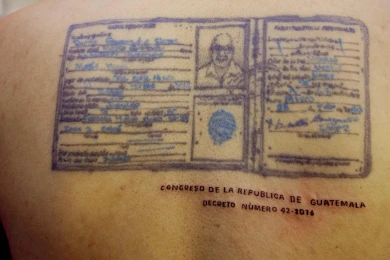
The online seminar Archival Mediations: Art, Community, and Political Action, curated by Sofía Villena Araya, examines the role of archival practices in caring for, dignifying, and activating memory in Central America. As part of the Cáder Institute for Central American Art’s first line of research, driven by the question “What Art Histories does Central America produce?”, this seminar proposes an approach to the archive as a mediator that articulates relationships between art, community, and political action, while engaging with the historiographical questions raised by their intersections.
Although the proposal is not limited to discussions of the Central American isthmus, it is framed by the particular conditions under which memory has been constructed in the region. Central America is a territory vulnerable to natural and geological disasters, marked by political violence exercised by authoritarian states and fragile institutions, a persistent colonial and imperial legacy, and the social fragmentation resulting from these factors. It is also a context in which the archive does not necessarily refer to a specific place —such as a building or documentary collection— nor does it primarily follow the protocols of a discipline such as archival science. Rather, the seminar explores how the archive operates, through art, as a dispositif that forges connections, generates forms of belonging, and opens spaces for political action.
The encounter unfolds across two sessions: the first focuses on archival practices addressing questions of memory, violence, and war; the second examines community-based practices surrounding queer and sex-dissident archives. In the face of the systematic destruction of memory, the archival practices discussed in these sessions demonstrate how the archive emerges in other spaces and according to different logics. Within this framework, the proposed space for exchange and research explores the role of art as a productive medium for constructing archives through images, affects, intimacy, performativity, the body, orality, and fiction, as well as through other materialities that challenge the centrality of the document and of writing.
Intergenerationality
Thursday, 9 April 2026 – 5:30pm
This series is organised by equipoMotor, a group of teenagers, young people and older people who have participated in the Museo Reina Sofía’s previous community education projects, and is structured around four themed blocks that pivot on the monstrous.
The third session gazes at film as a place from which to dismantle the idea of one sole history and one sole time. From a decolonial and queer perspective, it explores films which break the straight line of past-present-future, which mix memories, slow progress and leave space for rhythms which customarily make no room for official accounts. Here the images open cracks through which bodies, voices and affects appear, disrupting archive and questioning who narrates, and from where and for whom. The proposal is at once simple and ambitious: use film to imagine other modes of remembering, belonging and projecting futures we have not yet been able to live.