-
Friday, 9 July 2021 – 10pm Sabatini Building, Garden
Session 1
Second session: Friday, 6 August 2021
TicketsAkosua Adoma Owusu. Me Broni Ba (My White Baby)
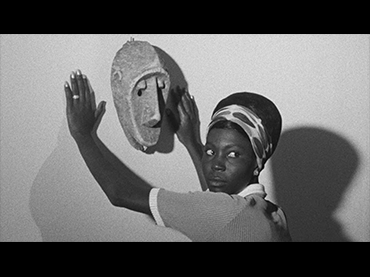
Ghana and USA, 2009, colour, original version in English and Akan with Spanish subtitles, 22’Ousmane Sembène. La Noire de…
Senegal and France, 1966, b/w, original version in French and Wolof, with Spanish subtitles, 60’ version, restored by the Film Foundation’s World Cinema Project, in collaboration with Cineteca di Bologna— Recital with a musical accompaniment in the first session by poet, actress and activist Syla Aboubabacar and Artemisa Semedo, whose work fuses poetry, dance and music through an Afro-Descendant gaze.
The first feature by Senegalese director Ousmane Sembène is considered a seminal film in cinema from African countries south of the Sahara and a landmark of world cinema. Yet the history of a nameless woman, a black servant working for a rich white family in Dakar who moves with them to Europe, a story of alienation and isolation, loses none of its relevance and topicality over time and today is as pertinent as it ever was. The short film Me Broni Ba by Ghanaian-American film-maker Akosua Adoma Owusu offers keys to the present-day relevance of Sembène’s work. The confused legacy of European colonialism in Africa is evoked through women who braid the hair of discarded Western dolls — a lyrical portrait of the hair salons of Kumasi, in Ghana, which presents the body as a place of political meanings linked to notions of race and gender.
-
Saturday, 10 July 2021 – 10pm Sabatini Building, Garden
Session 2
Second session: Saturday, 7 August 2021
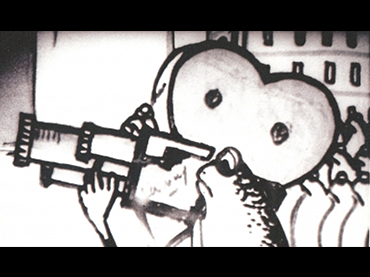
TicketsMoustapha Alassane. Bon Voyage, Sim
Niger, 1966, colour, sound, 5’
Courtesy of Institut français, SpainOusmane Sembène. Mandabi (The Money Order)
Senegal, 1968, colour, original version in Wolof and French with Spanish subtitles, 90’. Restored versionSembène’s second feature is the tragicomic odyssey of a man trying to cash a money order sent by his nephew from France and coming up against local bureaucracy, widespread greed and his own ignorance. This film was the first feature shot in an African language, Wolof, cementing its place in film history, yet it is also simultaneously an arresting portrait of newly independent Senegal and Sembène’s statement of intent which, torn between literature and cinema (Mandabi, like La Noire de…, is based on his own previous stories), chooses cinema. In contrast to literature, which limits the work’s reception because it requires reading and writing skills, more often than not in one of the colonising languages, Sembène conceives of film as a universal language that prolongs oral African conveyance, and as a key medium to disseminate history and the present without the boundaries of literacy. Another universal medium able to dispense with dialogue is the satirical animated fables of Moustapha Alassane, a tireless pioneer and inventor of critical film impelled by a desire to reach the masses.
-
Friday, 16 July 2021 – 10pm Sabatini Building, Garden
Session 3
Second session: Friday, 13 August 2021
TicketsJean-Pierre Bekolo. La Grammaire de grand-mère (Grandma’s Grammar)
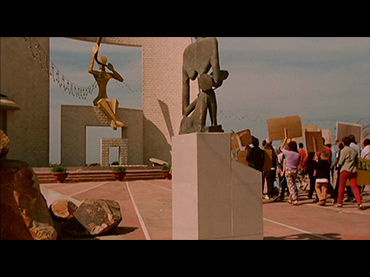
Cameroon, 1996, colour, original version in French with Spanish subtitles, 7’Djibril Diop Mambéty. Touki bouki
Senegal, 1973, colour, original version in Wolof with Spanish subtitles, 89’In Dakar, a shepherd meets a student and both dream of going to Paris using any means necessary to raise money for the trip. Between the daily life of poor neighbourhoods in Dakar and the representation of Paris, more symbolic than real, between tradition and modernity, dream and reality, a classic of African cinema is born. Touki bouki is preceded by an interview with Djibril Diop Mambéty, filmed almost reverently by Jean-Pierre Bekolo. Mambéty tells us: “Film was born in Africa because the image was born in Africa. Perhaps the instruments are European, but the creative need and reasoning comes from our oral tradition. To make a film you just have to close your eyes and see images. You open your eyes and the film is there. I want children to understand that Africa is a land of images […] simply and paradoxically because of oral tradition. And oral tradition is a tradition of images. What is said is more powerful than what is written; the word directly speaks to the imagination, not the ear. The imagination creates the image and the image creates cinema, so directly we are the forefathers of cinema”.

-
Saturday, 17 July 2021 – 10pm Sabatini Building, Garden
Session 4
Second session: Saturday, 14 August 2021
TicketsSafi Faye. Fad’jal
Senegal and France, 1979, colour, original version in Serer with Spanish subtitles, 112’— First session presented by Elena García, an anthropologist and member of the CNAAE (Black, African and African-Descendant Community in Spain) association.
In 1975, film-maker and ethnologist Safi Faye premiered Kaddu Beykat, the first feature-length film directed by an African woman. Four years later, she directed Fad’jal, a documentary on her ancestral village, based on her PhD thesis, in which she seeks to put history and daily life, hitherto preserved through the word, into images, while also condemning existing exploitation in the agricultural world. As Safi Faye puts it: “In contrast to France’s history, written and studied at school, how is African history, which only exists in oral tradition, conveyed? Who will pass this on to children? The elder preserves the memory of history. Every evening, the children scramble up into the beautiful kapok trees after getting out of school to gather around the village elder. He would then pass on their history, that which hasn’t been written down. Fad'Jal speaks of this, of the foundation of the village and all the events that have since unfolded there. The grandfather speaks of traditional rites of passage and agrarian rites, as well as the origin of this village founded by a woman (Mbang Fadial) around the 16th century”.

-
Friday, 23 July 2021 – 10pm Sabatini Building, Garden
Session 5
Second session: Friday, 20 August 2021
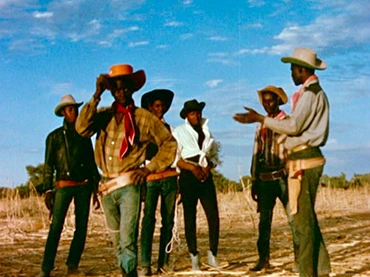
TicketsMoustapha Alassane. Le Retour d’un aventurier (The Return of an Adventurer)
Niger, 1966, colour, original version in Hausa and French with Spanish subtitles, 34’
Courtesy of Institut français, Spain.Jean-Marie Teno. Lieux saints (Sacred Places)
Cameroon, 2009, colour, original version in French with Spanish subtitles, 70’— Second session by film-maker Javier Fernández Vázquez, who has directed two feature-length films on Equatorial Guinea and Spain’s colonial past, Anunciaron Tormenta (Storm Forecast, 2020) and Árboles (Trees, 2013), produced by the film collective Los Hijos.
Jean-Marie Teno returns to Ouagadougou, the capital of Burkina Faso, to attend FESPACO, the Pan-African Film and Television Festival and a major event in African cinema since 1969. This time around, however, following an invitation from a friend, he lives in and films the city and the St. Léon neighbourhood, where there is a video club screening pirate copies of films for local residents. Subtly the film’s scenes unfold, raising questions — some new, some old — and revealing unheard-of threads entwining film, religion, tradition, craftsmanship and masculinity. As a prologue to this documentary, which combines intelligence, humour and modesty, we retrieve Le Retour d’un aventurier, the first African western and an homage to the genre in an adaptation of the context and an ironical reflection on its different codes. Talking about his film, Jean-Marie Teno remarks: “Fifty years ago African films weren’t shown because there weren’t any. Even now when there are, European and American films dominate the market. We run the risk of a whole generation growing up without having seen African films. Idrissa Ouédraogo said to me: ‘If I had the resources, I would be worse than the pirates. I would flood the market so that the youth would get used to watching these films’”.

-
Saturday, 24 July 2021 – 10pm Sabatini Building, Garden
Session 6
Second session: Saturday, 21 August 2021
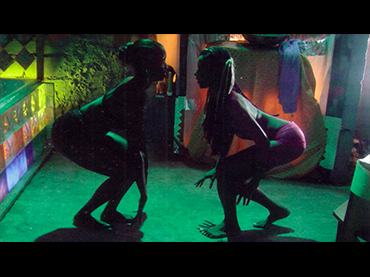
TicketsJean-Pierre Bekolo. Les Saignantes (The Bloodettes
Cameroon, 2005, colour, original version in French with Spanish subtitles, 97’— Second session presented by photographer and film-maker Rubén H. Bermúdez, founder of the Afroconciencia collective and creator of the feature A todos nos gusta el plátano (We All Like Bananas, 2021) and the photobook Y tú, ¿por qué eres negro? (And You, Why Are You Black?, 2018).
A bold mix of political satire, horror film and science fiction narrative set in a not-so-distant 2025. Two young women turn to mutual support and the powers of the ancient Cameroon rituals of mevungu to defend themselves in a society driven by death, bureaucracy and corruption. As Bekolo asserts: “I would say, above all, the films of the genre are part of our culture as Africans. No doubt about that. The issue is not to use them but question them in relation to the choices we have to make in the context of African cultures. It’s about knowing how we appropriate the cinema out there and that we see like everyone else. Not copying, like sheep, what people are doing and instead reaffirming our own identities. […] We have to ask ourselves the question: Why am I using a horror film style. Why resort to science fiction? I don’t think there is any formula, except that you have to reflect on it and ask yourself, why make a sci-fi film? For me, the most important thing is that every time Africa is spoken about there is never any mention of the future”.
-
Friday, 30 July 2021 – 10pm Sabatini Building, Garden
Session 7
Second session: Friday, 27 August 2021
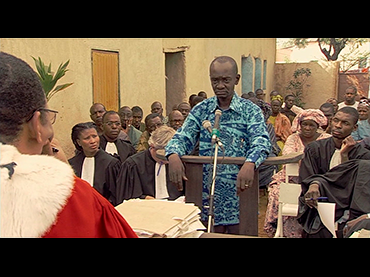
TicketsAbderrahmane Sissako. Bamako
France, 2006, colour, original version in French, Bambara, Senufo languages, Wolof and English with Spanish subtitles, 115’— Second session presented by Susana Moliner (a cultural manager with far-reaching experience working with the African and Afro-Descendant community in Spain, founder of Grigri Projects and a member of the Museo Situado network) and Mamadou Traore, a collaborator with the Programme Afrique Day Centre from SERCADE (an association of social action, cooperation and transformative education)
At the end of the 1980s, the World Bank and International Monetary Fund wanted Africa to be part of global capitalism. Their policy demanded that African countries open their markets to international capital, reduce governmental spending and privatise goods and services. In the yard of a house a singer and her unemployed husband share with other families, lawyers, judges and witnesses gather to put globalisation on trial. Scenes unfold with flecks of humour and a western-inspired sequence which sees Danny Glover arrive in the city to spare a final confrontation. “Westerns are many things to me. Spaghetti westerns were the first films that made me dream, but then so did Moustapha Alassane’s Le retour d’un aventurier (1966); when I was a kid and still didn’t know I would make films it made me see that we could also do it. […] The World Bank’s and International Monetary Fund’s mission is like a western. Structural adjustment was considered ‘good work’, and that’s where people’s suffering and poverty is gambled with,” writes the film-maker.
-
Saturday, 31 July 2021 – 10pm Sabatini Building, Garden
Session 8
Second session: Saturday, 28 August 2021
TicketsSylvestre Amoussou. Africa Paradis
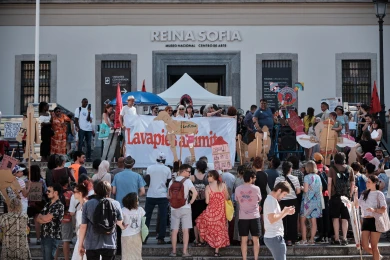
Benin and France, colour, 2006, original version in French with Spanish subtitles, 87’— First session presented by Red Interlavapiés, a mutual support network made up of migrant and autochthonous people fighting against racist and excluding policies in diversity.
— Recital with a musical accompaniment by poet, actress and activist Artemisa Semedo in the second session.
In an imaginary future, Africa has entered an age of prosperity while Europe has succumbed to misery and underdevelopment. Olivier, an unemployed computer scientist, lives with Pauline, a teacher who is also out of work. Given the depressing employment prospects in France, they secretly emigrate to Africa, yet upon their arrival the border police detain and imprison them as they await deportation back to France. Olivier manages to escape and embarks on a life underground; Pauline accepts a position as a maid for a bourgeois African family. Sylvestre Amoussou writes: “It is complicated because those who fund African cinema tend to block projects they don’t finance and make ‘pitying’ films, which speak of ablation, disease or Africans suffering and struggling day to day. We are the ones who have to create the chains, from start to finish, that enable our cinema to gain currency. The films that I make are, above all, aimed at African countries and diaspora”.
Held on 09 Jul 2021
The Museo Reina Sofía’s annual summer cinema returns once again, focusing this year on rediscovering a central part of African cinema which, by way of the strength of its fiction, challenges the images with which the West tries to invade it.
As is now customary, the Museo’s film programme leaves behind the film theatre and moves into the open air and the pleasant surroundings of the Sabatini Building Garden. The series is organised in collaboration with the Museo Situado network, a project which connects the institution to the Lavapiés neighbourhood. Moreover, it is the perfect occasion to discover or become reacquainted with beautiful, classic or contemporary works, akin to those novels we finally pick up in the summer after they have spent months gathering dust on the bookshelf. Tying in with previous focal points, which have sought to translate some of the imaginaries that occupy the streets adjacent to the Museo, this year’s gaze settles on films from African countries south of the Sahara, the places of origin of different migrant communities in Lavapiés.
Film production in these countries stretches back to the 1950s, coinciding with the beginnings of independence for some countries making up the region. Naturally, African landscapes, customs and light had been filmed previously ad nauseum, exhausted through a one-toned expression which, as yet another colonial weapon, was detrimental to film-making. Nevertheless, in response, and with an awareness that cinema is possibly one of the most powerful combat tools, films in the region were assembled early on as a cognizant reaction to racism, to the cultural appropriation of exotic beauty and to the backdrop of the adventures of Tarzan and Jane. Contrary to that which governs the heavily quoted phrase by Afro-feminist Audre Lorde (USA, 1934–1992), “the master’s tools will never dismantle the master’s house”, the aim here is in fact to dismantle the master’s house with the master’s tools. The history behind this particular film-making is also the history of the tempestuous, creative and unexpected relationship between cinema and the anti-colonial struggle, for its strategies have been and are as different as they are varied, have been and are related to circumstances in each country, in each era.
The series gets under way with the popular Pan-African ideal in the emancipatory work of Ousmane Sembène (Senegal, 1923–2007), before moving on to the production of imaginaries by Djibril Diop Mambéty (Senegal, 1945-France, 1998) and Safi Faye (Senegal, 1943), and Moustapha Alassane (Niger, 1942–2015), Jean-Marie Teno (Cameroon, 1954), Jean-Pierre Bekolo (Cameroon, 1966), Abderrahmane Sissako (Mali, 1961), Sylvestre Amoussou (Benin, 1964) and Akosua Adoma Owusu (Ghana-USA, 1984), offering a glimpse into the complicated relationship these films have with canonical film genres and with the imperialism of the West’s audiovisual industry.
With the Master’s Tools. Narratives of African Cinema does not attempt to be an exhaustive film series, and could not be so even if it wished. It does not look to map different forms of national film-making or establish an auteur-centred canon. Any film notable for its absence could easily have found a place here, because if anything this series sets out to fill in gaps, enquire about them, and open many others, until the master’s house is dismantled.
Curators
Ana Useros and Chema González
Collaboration
Sponsor
Acknowledgements
Institut français, Spain
Organised by
Museo Reina Sofía
Organised by

Sponsor

Más actividades
![Isabel Coixet, 100 Years and You Everywhere [100 años y tú en todos los sitios], 2026, película](https://recursos.museoreinasofia.es/styles/small_landscape/public/Actividades/2.diseminar-mundo.jpg.webp)
John Berger and Isabel Coixet. Continued Ways of Seeing
Thursday, 17 September 2026 at 7pm
Ways of Seeing (1972) is one of the most revolutionary television series on art history, the museum and contemporary critical culture. Across four episodes, an articulate, enthusiastic John Berger unpacks the relationships between classical art through the gaze and new technology, the nude and feminism, the oil painting and commodity fetichism, advertising and consumerism. In essence, a level of critical commitment only comparable to its capacity for dissemination. Unsurprisingly, the series, and the book that would distil it, continues to forge vocations. This session sees art historians Alberto López Cuenca and Modesta Di Paola carry out an analysis of Berger’s audiovisual work, placing the stress on episodes one and four of the series. In the first episode, Berger reflects on the connection between the act of seeing, looking and being in light of new technology, such as the film camera. At the same time, it analyses how the culture of reproduction is turning paintings into messages or fragments of communication while stressing the importance of silence when observing historical paintings. In the fourth and final episode, he introduces advertising as a new iconic-verbal language that shares certain principles with the message of oil painting as a luxury item.
The session opens with the premiere of a filmic letter from Isabel Coixet, one of Spain’s most internationally acclaimed directors, to John Berger, with whom she maintained a long friendship and deep admiration. The short film is testament to the ubiquitous and long-lasting presence of the author of Ways of Seeing, even after his death in 2017.
![Chantal Akerman, Woman Sitting after Killing [Mujer sentada después de matar], 2001, instalación. Museo Reina Sofía](https://recursos.museoreinasofia.es/styles/small_landscape/public/Actividades/chantal-akerman-mujer-sentada-despues-matar.jpg.webp)
On Your Screen: Art History and the Museum Facing the Audiovisual Challenge
18, 19 SEP 2026
The conference On Your Screen: Art History and the Museum Facing the Audiovisual Challenge sparks debate around the transformations of art history and museum space upon embracing the audiovisual format. Its starting point is John Berger’s emblematic television series Ways of Seeing (1972), a landmark in the democratisation of art-historical discourse. In the series, Berger illustrated how the transfer of a work such as Goya’s Los fusilamientos del 3 de mayo (The Third of May 1808 or the Executions) from museum gallery to home TV screen completely changed the viewer’s experience, allowing the image to travel to straight to the viewer.
In the twenty-first century, this screen-based ecosystem has expanded exponentially, with museums not only physically integrating screenings and devices into their galleries— following in the wake of many exhibitions on the moving image — but also deploying complex virtual strategies. Equally, numerous en vez de a multitudeof historians, students and creators use digital platforms to circulate their ideas and projects. This audiovisual shift opens access to ignored materials and democratises knowledge, as well as challenging traditional hierarchies and the interpretive authority of institutions. The conference, promoted by the research project ATLAS AV: The Audiovisualisation of Art History and the Museum, seeks to analyse this vast audiovisual material, its archives, and its capacity to transform the memory of art.
Godard and Miéville: Time and Ruin
Friday, 18 September 2026 - 7pm
Inside the framework of the conference On Your Screen: Art History and the Museum Facing the Audiovisual Challenge, this film series sets forth three critical visions of the museum via three sessions featuring the works of John Berger, Jean-Luc Godard and Anne-Marie Miéville, Ariella Azoulay, Alan Resnais and Chris Marker, Kwate Nee-Owoo, and the premiere of short films by Isabel Coixet and La Vulcanizadora (Maria Rojas Arias and Andrés Jurado). In classical theory, the museum gives the world meaning; it contains fragments of the past, granting them a history, a narrative that explains preterite time and the present. Today, there is an implicit assumption that this function hides and legitimises forms of power, yet what if the museum, instead of explaining the world, multiplied it through radical ideas, silenced periods and repressed subjects? Such is the approach of the film-makers and artists in this film season.
In 1972 the writer John Berger opened the landmark television series Ways of Seeing with an iconoclastic gesture: slicing Sandro Botticelli’s painting Venus and Mars (1485) in London’s National Gallery. A transgressive act that recalls contemporary attacks on the museum by dissident youth and with which Berger, after revealing it was a reproduction, sought to ignite debate around the idea of an original artwork and a copy. In this, the hundredth anniversary of his birth, the first session pays homage to one of the great art writers of the twentieth century. Starting with a review of Berger’s audiovisual work by art historians Alberto López Cuenca and Modesta Di Paola, the series begins with the premiere of 100 Years and You Everywhere (2026), an unreleased short film by Isabel Coixet composed as a beautifully crafted letter to Berger, and continues with an analysis of fragments of Ways of Seeing in relation to the museum and contemporary art.
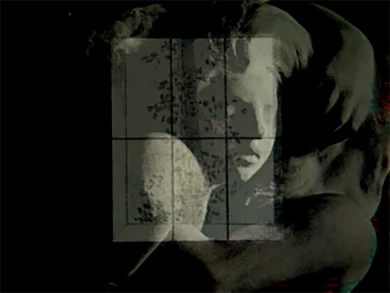
The second session screens two medium-length films by Jean-Luc Godard and Anne-Marie Miéville on time, ruin and museum. In The Old Place. Small Notes Regarding the Arts at Fall of 20th Century (1999), both film-makers consider what remains of that “old place”, the museum, at the close of a century of wars and totalitarianism, and ask whether it should be more of a legend or desire than a place. This same driving principle leads Godard to build his own imaginary museum in Reportage amateur (maquette expo) (2006), a rickety toy museum which, paradoxically, contains the great film-maker’s full power of thought on history and images.
Finally, the third session explores one of the major challenges of recent years: the decolonisation of the museum, the recognition of its link to imperialist discourses of power and the need to situate a new silenced or repressed subject at the centre of the Western narration of history. Under the title Museums and Restitution, it includes the film Undocumented. Unlearning Imperial Plunder (2019), by theorist Ariella Azoulay, Statues Also Die, by Alan Resnais and Chris Marker (1953), Kwate Nee-Owoo’s You Hide Me (1970) and the first screening of the short film Quinto verso, parte de Tonada (Fifth Verse, Part of Tonada), by La Vulcanizadora (Maria Rojas Arias and Andrés Jurado), filmed at the Museo de América in Madrid.
![Ariella Azoulay, Un-documented. Unlearning Imperial Plunder [Indocumentados. Desaprendiendo el saqueo imperial], 2019, película](https://recursos.museoreinasofia.es/styles/small_landscape/public/Actividades/5.diseminar-mundo.jpg.webp)
Museums and Restitution
Saturday, 19 September 2026 - 7pm
Centuries of plundering, decades of amnesia, years of living with unmitigated extractivist power… Does a museum, as we know it, have a raison d'être in a postcolonial society?
This session expounds the operations of the museum as a colonial machine, while putting forward ideas, in narration, for a more just, equal and inclusive institution of the future via society’s marginalised and minority voices. The session begins with the international premiere of Quinto verso, parte de Tonada (Fifth Verse, Part of Tonada), which presents a vision of the Quimbaya Collection (fifth and sixth centuries CE) from the Museo de América in Madrid. It is constructed with the voices and chants of Wayúu mourners and guides, not only as a way of reinstating the role of these gold idols — anthropomorphic figures of men and women used as vessels in ritual practices — but also to imagine that what must be exhibited is not the gold itself. It is the ritual’s own chant. In the classic film You Hide Me (1970), Ghanaian film-maker Kwate Nee-Owoo accesses the British Museum’s collection of African art, located in the building’s basement, to question the meaning behind a museum plundering and nullifying. A fine exercise of first-person institutional critique screened for the first time in Spain. Almost seventy years since Resnais and Marker made Statues Also Die (1953), a reflection on the aura-bearing value of the museum opposite the identity-based and cultural belonging of African art, theorist Ariella Azoulay films the same statues again at the Musée du Trocadéro (today the Musée du Quai Branly), which survive and wait to be reunited with their people. Azoulay, whose wholly original undertaking is a lesson to the museum of the future, connects the forced migration of these sculptures with the mass transit of people crossing borders artificially imposed by the same system that has plundered their culture.
The School of Transformative Institutionalism and Local Organisation
From 21 to 24 September 2026
The School of Transformative Institutionalism and Local Organisation (S.T.I.L.O.) is a programme of joint learning and join strategy which sets in motion a process for the exchange of questions, methodologies and experiences between cultural organisations. The overall aim is to create, circulate and prototype tactics, tools and collective knowledge on institutional practices that open new channels for defending culture and advocating structural transformation in divergent geographical contexts.
The project is part of the Laboratorio de Institucionalidad Compartida (The Laboratory of Shared Institutionalism, LIC), a space for the Museo Reina Sofía’s research, work and advocacy centred on developing, experimenting with and systemising practices, protocols and tools which contribute to a fairer and more liveable cultural ecosystem.
For many years now, so-called infrastructural critique in museums questions material, legal and economic infrastructures, among others, as well as the forms of solidarity and practices required to sustain the cultural ecosystem. By approaching current debates, S.T.I.L.O. raises questions on the ways in which organisations define and interpret their practices, organise their relations and respond to the social contexts in which they operate.
The school gathers four cultural organisations that work via different institutional models – scale, contexts, conditions, different working models — with the goal of pooling common strategies and tools of organisation, advocacy and relationships with local communities.
The programme is conceived as a collaborative process with the participation of Arika, La Revuelta, BAK Basecamp and The Tentacular Museum (Museo Reina Sofía) and is structured around preparatory online sessions and an in-person seminar in Madrid.
S.T.I.L.O. is an activity framed inside the working strand of Situated Organisations from L'Internationale’s Museum of the Commons project, which reflects on the role of museums and art organisations as actors within complex social networks and ecosystems, with a view to exploring new ways to democratise institutions and make them more open, inclusive and useful.