-
Programme 1
Museum
-
Wednesday, 22 January 2020 – 7pm
Session 1
Second session: Sunday, 26 January – 6pm
Jean-Luc Godard and Anne-Marie Miéville
The Old Place. Small Notes Regarding the Arts at Fall of 20th Century
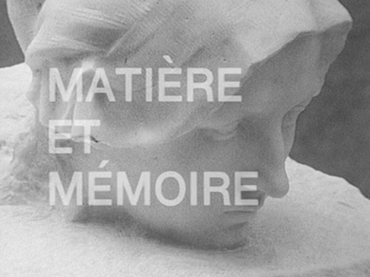
France and USA, 1999, colour, original version in French with Spanish subtitles, DA, 49´This film was made for MoMA and serves as a moving compendium of Godard’s and Miéville’s aesthetic thought. Posing the question of whether art is “legend” or “reality”, i.e. myth or history, images of artworks from diverse eras and disciplines materialise. All of them are contained in this “old place”, the museum, a space of memory and reflection in times of amnesia and absolute market demand. Art, Godard tells us, is one more object from this past time but, between distance and proximity (“legend” or “reality”), it still entertains hope of changing the present: it is the invention of a fragment of another possible world. Authors also write 23 theories of unique beauty and mystery that claim, at the end of the 20th century, the right to exist from art.
-
Friday, 24 January 2020 – 7pm
Session 2
Second session: Monday, 27 January – 7pm
Anne-Marie Miéville
Souvenir d´utopie
France and Switzerland, 2006, colour, original version in French with Spanish subtitles, DA, 6’Jean-Luc Godard and Anne-Marie Miéville
Reportage amateur (maquette expo)
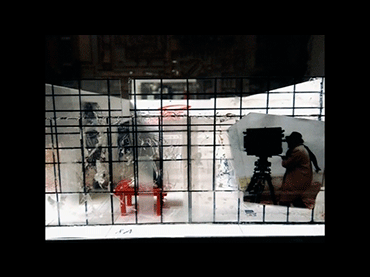
France and Switzerland, 2006, colour, original version in French with Spanish subtitles, DA, 47´At the turn of the 21st century, the Centre Pompidou undertook a project to mount an exhibition curated by one of the previous century’s great film-makers, with the initial title Collage(s) de France, archéologie du cinéma d’après JLG. Godard would not only pull out of the project, he also declared that the final exhibition, entitled Voyage(s) en utopie, Jean-Luc Godard, 1946-2006. À la recherche d’un théorème perdu (Centre Pompidou, 2006), did not represent his thinking. He also remarked that the only trace of the original show was the maquettes, which Godard made by hand and which he used to mount its curatorial discourse. The two films in this session film these maquettes, a personal imaginary museum in which Godard puts forward the most radical installation of the exhibition space. Souvenir d´utopie is a silent walk around the exhibition, with Miéville’s camera simulating the visitor’s gaze. Reportage amateur (maquette expo) sees Godard narrate the theoretical diagram of Collage(s) of France, according to the arrangement of rooms initially conceived in his project: Myth, Humanity, Camera, Film(s), The Subconscious, The Bastards, Reality, Death, The Grave. An inimitable challenge to the conditions in the museum.
-
Programme 2
Language and Catastrophe
-
Saturday, 25 January 2020 – 7pm
Session 1
Second session: Saturday, 8 February – 7pm
Jean-Luc Godard
Adieu au langage (Goodbye to Language)
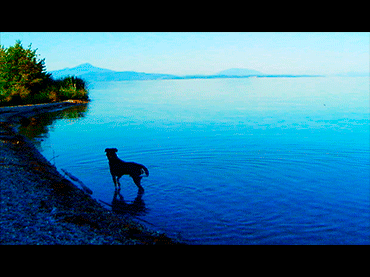
France, 2014, colour, original version in French, English and German with Spanish subtitles, B-R, 67´Godard’s second film in a new digital medium and 3D technology. We imagine the film-maker drawing a line under analogue film, after Histoire(s) de cinema, and trying out a new way of writing with the digital image. Goodbye to Language assumes an elegiac tone of abandonment on numerous levels: in the film medium, in the stories of lovelessness between the film’s two couples, two nostalgic and youthful remakes by Godard, and in the role of the word (language) to define the world. It is also the pure and innocent birth of a new experience, when words are left behind. How does the world speak to us when the simple and conventional code that reduces it disappears? The prominence of the dog Roxy (“the only being that will love you more than you love yourself”, a Charles Darwin quote Godard utters) and the exuberance of nature speaks of a fledgling sensibility when words become surplus.
-
Wednesday, 29 January 2020 – 7pm
Session 2
Second session: Sunday, 9 February – 6pm
Jean-Luc Godard
Film socialisme
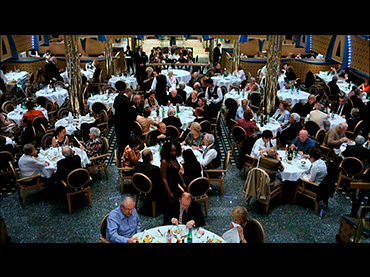
Switzerland, 2010, colour, original version in French with Spanish subtitles, DA, 97´Godard’s first feature film that is shot completely in video and fully utilises the juxtapositions, contrasts and saturation of the digital image, symptomatic of a time which is unhinged and rushed. The film-maker offers a film in three movements, in the form of a sonata: the first is quick, realised on a Mediterranean cruise with different stops; the second is slow and involves a family, a house and a petrol station in Southern France; the third, faster and shorter than the first, is a journey around some of the renowned enclaves on the shores of the Mediterranean and the Black Sea.
In the first movement, Such Things, Godard, Alain Badiou and Patti Smith share space with a motley crew of tourists who record images without looking at them — a cruise as an eroded version of the Grand Tour of the Enlightenment. In the second, Our Europe, a family is visited by two cameras while children debate liberty, equality and fraternity in a time of perpetual surveillance. The third, Our Humanities, focuses on the phrase: “the nation is not a country; it is a territory in conflict”. The approach of Film Socialisme is clear: to maintain a model of civilization alive in its fragments or delighting in the scene of its disintegration.
-
Thursday, 30 January 2020 – 7pm
Session 3
Second session: Monday, 10 February – 7pm
Paul Grivas
Film catastrophe
France, 2018, colour, original version in French with Spanish subtitles, DA, 55’First session presented by Paul Grivas.
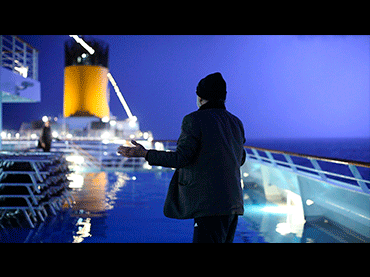
Paul Grivas is one of four cinematographers, with François Aragno, Jean-Paul Battagia and Godard, in Film Socialisme, forming part of the group of young collaborators working closely with the director in recent years. The role of prophet has followed Jean-Luc Godard throughout his career: widely known are his prophecies from May ‘68, the fall of the Berlin Wall and the Palestinian Intifada. This is also the case with Film Socialisme, a film which astonishingly foresees the spectre of the European crisis, with the first part filmed on an ocean liner on the Mediterranean, denoting the moral debacle of old continental culture. Few could envisage this metaphor becoming international news: this liner is the Costa Concordia, the boat which capsized and sank in 2012 on the Italian coast, causing 32 deaths. In Film Catastrophe Paul Grivas captures the setting around the shooting of Film Socialisme: living alongside tourists, concerts, buffets, outdoor activities, and so on. Rituals which are inseparable from another on-board feast: tourists devouring images with their mobile phones.
-
Saturday, 1 February 2020 – 7pm
Session 4
Second session: Saturday, 15 February – 7pm
Jean-Luc Godard
Le Livre d´image (The Image Book)
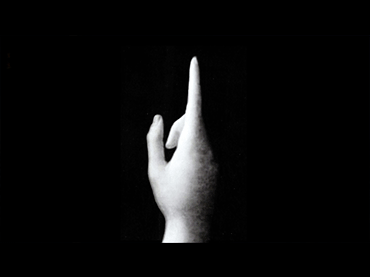
Switzerland, 2018, b/w and colour, original version in French, English, Arabic, Italian and German with Spanish subtitles, DA, 84´“The Image Book is cinema, and cinema is the lay culture that helps us against all books of the law, the Koran, the Bible, the Torah… It is the modernity of light against the darkness conveyed by those books of monotheistic religions. The image is what protects us against laws, dictatorships, rules. The image is the territory of freedom, fraternity… The principles of the republic of images. Each image is important, from those in my mobile phone to those from a sublime Hitchcock film in Hollywood. Each image is a citizenry in the republic of images, and a political model. Films are political models of co-existence, mutual solidarity, dialogue, against all rules that come from books, text, logos. All bibles are prescriptions (…). Images free us from those beliefs and prohibitions, and the way in which Jean-Luc (Godard) edits them, organises them, saves them, adds them and also disconnects them is an organisational model on how to be free,” writes Nicole Brenez, a lecturer in Film Studies at the University of Sorbonne Nouvelle-Paris 3, and a film programmer, theorist and writer.
-
Programme 3
History
-
Monday, 3 February 2020 – 7pm
Session 1
Second session: Wednesday, 12 February – 7pm
Jean-Luc Godard and Anne-Marie Miéville
De l’origine du XXIe siècle
France, 2000, b/w and colour, original version in French with Spanish subtitles, DA, 16’Moments choisis des histoire[s] du cinéma
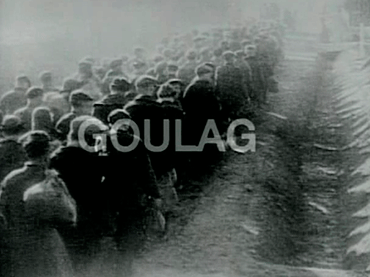
France, 2004, b/w and colour, original version in French with Spanish subtitles, 35mm, 84’This film shows the film-maker performing the role of a historian contemplating brutality and attempting to unravel its causes and motives through images, new words he writes with to produce history. De l’origine du XXIe siècle is a stream of violence, ecstasy and emotion before the legacy of the 20th century, a tumultuous and savage period. Documentary images live beside fictitious, pornographic and sacrificial ones — all, ultimately, images of history. “In search of a lost century”, recites one of the subtitles, the main characteristic of which Godard sets in the thought of Georges Bataille: the struggle between State control and the freedom of love. Moments choisis des histoire(s) du cinema, meanwhile, is a coda to the great Histoire(s) de cinéma (1988-1998). An epilogue contained in the phrase of film-maker and theorist Hollis Frampton: “No activity can become an art before its epoch has ended”. What remains of cinema after the 20th century?
-
Wednesday, 5 February 2020 – 7pm
Session 2
Second session: Friday, 14 February – 7pm
Jean-Luc Godard
Vrai faux passeport. Fiction documentaire sur des occasions de porter un jugement à propos de la façon de faire des films
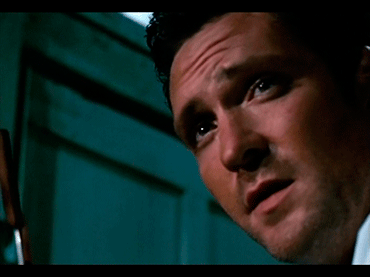
France, 2006, b/w and colour, original version in French with Spanish subtitles, DA, 56’A summary trial in which Godard expounds and dismantles film-making methods of other directors and references the possible link to a true discourse or, conversely, one which is manipulated, or profoundly false. A quote from Saint Augustine opens the film like a declaration of intent: “The truth is so cherished that even the liars wish that what they say is true”. The Latin terms bonus and malus are used by the judge/film-maker as moral categories (passports) assigned without consideration. In the dock sit Quentin Tarantino, Federico Fellini, Roberto Rossellini, Jean Vigo, Chantal Akerman, Martin Scorsese and Vincent Gallo, and many others. In contrast to the analytical and totalizing reflection of Histoire(s) de cinema, Vrai faux passeport is a critique in the strictest tradition of Charles Baudelaire: passionate, subjective, uncontrollable.
-
Programme 4
Apparitions
-
Friday, 7 February 2020 – 7pm
Sesion 1
Second session: Sunday, 16 February – 6pm
Jean-Luc Godard
JLG/JLG – autoportrait de décembre (JLG/JLG – Self-Portrait in December)
France, 1995, colour, original version in French with Spanish subtitles, AD, 60´Une catastrophe
Switzerland, 2008, colour, original version in French with Spanish subtitles, DA, 1’Khan Khanne, seléction naturelle
France, 2014, b/w and colour, original version in French with Spanish subtitles, DA, 9’Remerciements de Jean-Luc Godard à son Prix d´honneur du cinéma suisse
Switzerland, 2015, colour, original version in French with Spanish subtitles, DA, 5’Bande-annonce de la 22ème édition du festival international du film documentaire de Jihlava
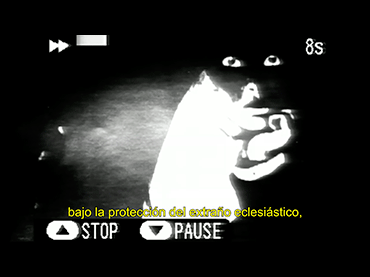
Switzerland and the Czech Republic, 2018, colour, original version in French with Spanish subtitles, DA, 1’Sought by the whole film system, considered to be one of the great artists in our life and times, and rejuvenated in the exploration of digital language, Godard has become a ubiquitous presence in the programmes and homages of renowned festivals. Yet the film-maker responds by acts of disappearance and noticeable absence to become a spectre, a ghost, one more image. This session is a two-part self-portrait: in JLG/JLG – Self-Portrait in December we see his spartan lifestyle in the Swiss town of Rolle, his refuge and centre of operations. In the other short pieces, the film-maker examines his own disappearance and theorises about his marginalised and classless role. A poet who speaks about the world from outside the world: “So I’m going home/with The Ashes of Gramsci/a poem by Pasolini/it speaks of humble corruption,” Jean-Luc Godard remarks in Remerciements de Jean-Luc Godard à son Prix d´honneur du cinéma suisse.

Held on 22, 24, 25, 26, 27, 29, 30 Jan, 01, 03, 05, 07, 08, 09, 10, 12, 14, 15, 16 Feb 2020
The Museo Reina Sofía presents a retrospective on one of the vital artists and thinkers of our time: film-maker Jean-Luc Godard (1930). The series spotlights his twenty-first-century productions and his ventures into the potential of the digital image, where film is rewritten as a present-day art.
At 89, Jean-Luc Godard sits among the most avant-garde film-makers and, rather than lingering on past roles — writer, activist, poet — he has reinvented himself as a thinker through images. In his later years, Godard has made Goya’s famous maxim his own: I’m still learning; new knowledge related to the limitless exploration of the digital image, understood not from the fetishism of a new technique, but as the possibility of engendering a new discourse, a new useful language for another experience. This period also stresses the importance of a group of his collaborators: cinematographers Fabrice Aragno and Jean-Paul Battaglia, film historian Nicole Brenez, and photographer and film-maker Anne-Marie Miéville, Godard’s companion in his exile in Rolle, Switzerland.
The series begins after Histoire(s) de cinema (1988-1998), a gargantuan project that would take him a decade and in which he would officiate the history of the 20th century through successive multiplications of film histories, stretching to his recent participation in international festivals with brief pieces, the letters by an artist celebrating his concurrent disappearance and omnipresence.
In the series, four programmes form thematic strands. Firstly, Museum: two sessions focusing on how the film-maker questions the institution, “the old place”. On one side, filming, in essay form, for MoMA, ranging over memory, time and the role of art (The Old Place, with Anne-Marie Miéville, 1999), and, on the other, exploring the installation of an exhibition at the Pompidou, in itself a history of civilization (Souvenir d´utopie, Anne-Marie Miéville, 2006, and Reportage amateur (maquette expo), with Anne-Marie Miéville, 2006).
The second programme, entitled Language and Catastrophe, encompasses the trilogy Goodbye to Language, Film Socialisme and The Image Book, three feature-length films in which a new digital vocabulary sets the scene to speak of contemporary catastrophe and hope for the future. Interspersed with this trilogy is the screening of Film Catastrophe. The third programme, History, includes the epilogue to Histoire(s) de cinema, Godard’s version of the 20th century as a legacy of brutality and, finally, a devastating critique of other film-makers through the ethics of images. To conclude, the programme Apparitions presents the director’s film portraits — in JLG/JLG – Self-Portrait in December we get a look into his austerity and isolation in Rolle; in the rest, brief letters Godard sent to festivals where he questions himself, invoking absurdity and existential solitude (Buster Keaton and Samuel Beckett) while examining the rituals of cinema.
Acknowledgements
Fabrice Aragno, CNAP (Centre national des arts plastiques, Paris) and MoMA (Museum of Modern Art, New York)
Force line
Rethinking the Museum and Avant-gardes
Curatorship
Chema González
Organised by
Museo Reina Sofía
Más actividades
All Time
Saturday, 25 April and 16 May 2026 — 7pm
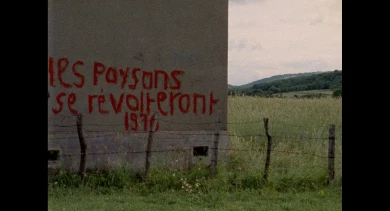
As a recap of the previous sessions, this screening considers a geography of past and present struggles: a refined formal approach, a portrait of popular life, the landscape testimony of working communities and the critique of accumulation and inequality. The monumental diptych Too Early, Too Late (1982) reflects Engels’s sharp analysis of the French Revolution, along with the enumeration of the distribution of taxes on different hamlets in the French countryside. In the second part, the account of Mahmoud Hussein — a pseudonym for Egyptian Marxist historians Bahgat El Nadi and Adel Rifaat — ranges across the memory of anti-imperialist citizen revolts in Egypt throughout the twentieth century. The film destabilises stereotypes and common places of political insurgency in the North African country. Recovering and circulating this latent memory helps to name that which still resists being named and, as Straub y Huillet indicate, “making the revolution is to put very old yet forgotten things back in their place”.
Framed inside The Collection Screened is the programme Present Time: Insurgent Images, curated by Luis López Carrasco, a key film-maker with a distinguished international career. The works in the programme, selected from the Museo’s film and video collection, interlink projects that are conceptual, refined, systematic — as an X-ray of their time in history — with firebrand domestic and activist films, comprehending different political emergencies from the second half of the twentieth century in Europe and Latin America. These works are viewed in light of a genealogy of revolt which buries its roots in the nineteenth century.
![Joan Colom, El carrer [La calle], 1960, película](https://recursos.museoreinasofia.es/styles/small_landscape/public/Actividades/coleccion-proyectada-5.jpg.webp)
Observation and Intervention
Friday, 24 April and 15 May 2026 — 7pm
If cinema does not set out to reach objectivity then each film takes a biased view of observed reality. The session begins with the seemingly neutral view of Cao Guimarães to observe a boy and girl playing in the rain in Da Janela do Meu Cuarto (From the Window of My Room, 2004). A work, deceptively relaxed, which prefigures one of the session’s constants: the place of childhood as a project of worlds to come. The boundless urban vitality of Barcelona Joan Colom portrays in El carrer (The Street, 1960) comes face to face with the extraordinary Niños (Children, 1974), by the Grupo de Cine Liberación sin Rodeos, a multi-voiced depiction of a group of friends in Cuzco whose citizen-focused schooling co-exists, just, with their daily work and reveals the limitations of the Revolutionary Government of the Armed Forces in Peru. Visión de la selva (View of the Jungle, 1973), by the same Peruvian collective, puts forward another model of representation and intervention on the public sphere with direct news activism, which denounces the plundering of the Amazon by multi-national companies.
Framed inside The Collection Screened is the programme Present Time: Insurgent Images, curated by Luis López Carrasco, a key film-maker with a distinguished international career. The works in the programme, selected from the Museo’s film and video collection, interlink projects that are conceptual, refined, systematic — as an X-ray of their time in history — with firebrand domestic and activist films, comprehending different political emergencies from the second half of the twentieth century in Europe and Latin America. These works are viewed in light of a genealogy of revolt which buries its roots in the nineteenth century.
![Video-Nou/Servei de Vídeo Comunitari, Ocaña. Exposició a la Galería Mec-Mec [Ocaña. Exposición en la Galería Mec-Mec], 1977, película](https://recursos.museoreinasofia.es/styles/small_landscape/public/Actividades/coleccion-proyectada-7.png.webp)
Daily Matter
Thursday, 23 April and 14 May 2026 — 7pm
Time, light, vision. What is an image? How does an image make us see the world? First, hypnosis, a reset: Paulino Viota’s Duración (Duration, 1970), the portrait of a clock face over sixty seconds. Next, a window into a slightly altered reality: Javier Aguirre’s Objetivo 40º (40 Degree Lens, 1968–1970). A minimum intervention that inspires a session considered as successive immersions in blocks of time, as well as a journey that starts from the intimacy of a candle, the movement of a car around abandoned peripheries and the traces of anti-Franco protestors, with night falling to the emotive, profound and sharp voice of Ocaña. Now in 1990, the journey ends at other street protests, those articulated by the Agustín Parejo School collective owing to the housing problem in Málaga. As Javier Aguirre states: “It is not about achieving the objective. It is about demystifying it”.
Framed inside The Collection Screened is the programme Present Time: Insurgent Images, curated by Luis López Carrasco, a key film-maker with a distinguished international career. The works in the programme, selected from the Museo’s film and video collection, interlink projects that are conceptual, refined, systematic — as an X-ray of their time in history — with firebrand domestic and activist films, comprehending different political emergencies from the second half of the twentieth century in Europe and Latin America. These works are viewed in light of a genealogy of revolt which buries its roots in the nineteenth century.
![Tracey Rose, The Black Sun Black Star and Moon [La luna estrella negro y negro sol], 2014.](https://recursos.museoreinasofia.es/styles/small_landscape/public/Obra/AD07091_2.jpg.webp)
On Black Study: Towards a Black Poethics of Contamination
27, 28, 29 ABR 2026
The seminar On Black Study: Towards a Black Poethics of Contamination proposes Black Study as a critical and methodological practice that has emerged in and against racial capitalism, colonial modernity and institutional capture. Framed through what the invited researcher and practitioner Ishy Pryce-Parchment terms a Black poethics of contamination, the seminar considers what it might mean to think Blackness (and therefore Black Study) as contagious, diffuse and spreadable matter. To do so, it enacts a constellation of diasporic methodologies and black aesthetic practices that harbor “contamination” -ideas that travel through texts, geographies, bodies and histories- as a method and as a condition.
If Blackness enters Western modernity from the position of the Middle Passage and its afterlives, it also names a condition from which alternative modes of being, knowing and relating are continually forged. From within this errant boundarylessness, Black creative-intellectual practice unfolds as what might be called a history of touches: transmissions, residues and socialities that unsettle the fantasy of pure or self-contained knowledge.
Situated within Black radical aesthetics, Black feminist theory and diasporic poetics, the seminar traces a genealogy of Black Study not as an object of analysis but as methodological propositions that continue to shape contemporary aesthetic and political life. Against mastery as the horizon of study, the group shifts attention from what we know to how we know. It foregrounds creative Black methodological practices—fahima ife’s anindex (via Fred Moten), Katherine McKittrick’s expansive use of the footnote, citation as relational and loving labour, the aesthetics of Black miscellanea, and Christina Sharpe’s practices of annotation—as procedures that disorganise dominant regimes of knowledge. In this sense, Black Study is approached not as a discrete academic field but as a feel for knowing and knowledge: a constellation of insurgent practices—reading, gathering, listening, annotating, refusing, world-making—that operate both within and beyond the university.
The study sessions propose to experiment with form in order to embrace how ‘black people have always used interdisciplinary methodologies to explain, explore, and story the world.’ Through engagements with thinkers and practitioners such as Katherine McKittrick, C.L.R. James, Sylvia Wynter, Christina Sharpe, Fred Moten, Tina Campt, Hilton Als, John Akomfrah, fahima ife and Dionne Brand, we ask: What might it mean to study together, incompletely and without recourse to individuation? How might aesthetic practice function as a poethical intervention in the ongoing work of what Sylvia Wynter calls the practice of doing humanness?
Situated Voices 38
Thursday, 23 April 2026 – 7pm
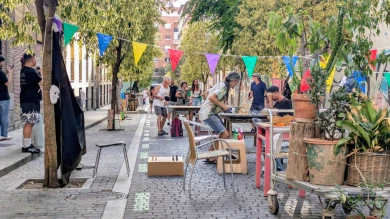
The Situated Voices programme offers de-hierarchised spaces of reflection and debate in which to generate, from situated experiences, collective knowledge in connection with present debates. With the title Climate Shelters for a Liveable City, this latest session looks to collectively address challenges around the accessibility of climate shelters in Madrid and to build a landscape of collaborative networks.
With the climate emergency, cities have become environments which are becoming harsher in the summer months due to high temperatures, exacerbated by concrete, and a lack of green spaces or cool, sheltered leisure areas not always bound up with consumerism. In recent years, community spaces and citizen and institutional collectives have started to organise “climate shelters”: accessible spaces providing shelter, shade, rest and relaxation to counter extreme climates, spaces which, faced with an increasingly chronic climate crisis, have proliferated in our cities as necessary, urgent places.
The previous experience of Climate Shelter. A Space for Rest, organised in the summer of 2025 by the Museo Reina Sofía, with the Museo Situado assembly, initiated a dialogue with other likeminded endeavours in the city. Therefore, this conversation seeks to gather their shared successes and challenges, particularly in that which refers to accessibility — and the consideration of exclusion and related solutions — with a view to thinking jointly about interventions for the summer of 2026. The encounter also touches on how to work in a network of collaboration: joining, supporting and connecting different climate shelters in Madrid, thinking collectively about how to respond to the climate crisis, the material realities approached in each project and meeting the specific needs of each context.
The networked organisation of climate shelters appears as a common horizon of resistance and organisation to tackle this eco-social crisis, a crisis that is no longer a future threat but a present condition which forces us to redefine ways of inhabiting the city.