José María García de Paredes, 1924-1990

Held on 25 Mar 2020
The Museo Reina Sofía and Fundación Arquia present a monographic exhibition on architect José María García de Paredes (Seville, 1924 – Madrid, 1990), in a contribution which aims to disseminate and promulgate Spanish contemporary architecture.
The Museo and the Fundación, whose work focuses on promoting and disseminating cultural projects in the field of architecture, construction, design and urbanism, signed a collaboration agreement in 2019 to undertake joint activities in this area.
The book assembles different architectural works by García de Paredes through the gaze of different authors and, as a multiple-voiced monograph, constitutes a unified document on his work.
Furthermore, the book’s twelve authors also have different ties to the works analysed, and review the ideology of the architecture from a position that straddles tradition and modernity, imagination and reality, and displays the multiple relations of these constructions with their urban environments — across three decades — and even with other technical and artistic disciplines. The patina of time settles on all of these constructions, as evidenced by his churches in Vitoria, Málaga and Madrid, the Manuel de Falla Auditorium in Granada, or the National Music Auditorium in Madrid.
The presentation will be preceded by a cello concert by Aldo Mata.
Organised by
Fundación Arquia and Museo Reina Sofía
Participants
Aldo Mata: Madrid, 1973. An international concert performer and a regular guest at different festivals in countries like Brazil, Japan, France and the USA. He earned a PhD from Indiana University Bloomington, and is a lecturer at the Seville Advanced Music Conservatoire and the Katarina Gurska Advanced Centre of Teaching, in Madrid. He also lectures in countries such as Holland, Germany, Portugal, Colombia and Ecuador, and has worked as the co-conductor of the Orquesta Sinfónica de Castilla y León (OSCyL) and as a chamber music professor in the Musiken Advanced Music Centre in the Basque Country. His training prominently features figures such as Rados, Macedo, Monighetti, Scholes, Tsutsumi and Janos Starker. As a researcher, he has written about Boccherini and the art of portamentos in music – the transition of one sound to another with a higher or deeper pitch. His article “Tras la nota misteriosa del Preludio de la Quinta Suite de Bach” (After the Mysterious Note of the Prelude to Bach’s Cello Suite No.5), in Recos, Year 2, Vol. 4, is referenced in the latest edition of Bärenreiter’s Suites. He has also recorded for Naxos Records, performing pieces by composers that include Leonardo Balada and Bruno Dozza, to mention a few. In his performance on this occasion, he will play a 1889 Gand & Bernardel cello.
Ángela García de Paredes: Madrid, 1958. After qualifying as an architect at Madrid’s Higher Technical School of Architecture (ETSAM) in 1982, she obtained a PhD in the same field with the thesis La Arquitectura de José María García de Paredes, Ideario de una obra (The Architecture of José María García de Paredes, Ideology of a Work), which received the Extraordinary Prize from the Polytechnic University of Madrid (2015). Since 1990, she has carried out her work at the Paredes Pedrosa Architects Studio, with Ignacio García Pedrosa, receiving together the ar+D Award (1999), the European II and IV, Spain’s National Architecture Award (2007), the Gold Medal International Prize for Sustainable Architecture (2012), the Gold Medal of Merit in the Fine Arts (2014), the Eduardo Torroja Award for Engineering and Architecture (2014) and the European Prize for Architectural Heritage Intervention AADIPA (2015). Moreover, she is a professor of Architectural Projects at ETSAM and guest professor at Università IUAV in Venice, as well as a critic and lecturer.
Rafael Moneo Vallés: Tudela (Navarra), 1937. After qualifying as an architect at Madrid’s Higher Technical School of Architecture (ETSAM) in 1961, he carried out his early work as a student with Oíza and Utzon in Rome between 1963 and 1965. He is also a professor at the Higher Technical Schools of Architecture in Madrid and Barcelona, chairman of the Harvard Graduate School of Design and Sert Professor of Architecture at the same school. Furthermore, he designed the building that houses the Museo Nacional de Arte Romano de Mérida, the extension built around the Claustro de los Jerónimos of the Museo del Prado and Kursaal in San Sebastián. In addition to his work as an architect, he is a lecturer and critic. In 2004, he published Theoretical Anxiety and Design Strategies in the Work of Eight Contemporary Architects, which was translated into seven languages, and in 2010 Remarks on 21 Works. His broad-ranging distinctions include the Gold Medal of Merit in the Fine Arts (1992), the Pritzker Architecture Prize (1996), the Gold Medal of RIBA (2203), the Prince of Asturias Arts Prize (2012) and Spain’s National Architecture Prize (2015).
Juan Navarro Baldeweg: Santander, 1939. After qualifying as an architect at Madrid’s Higher Technical School of Architecture (ETSAM) in 1965, he obtained a PhD in the same field in 1969. He was guest artist at the Center for Advanced Visual Studies (CAVS) at the Massachusetts Institute of Technology from 1971 to 1975), and a professor of Architectural Projects at ETSAM in 1977. In the 1990s, he was guest professor at the University of Pennsylvania, Eero Saarinen Professor at Yale, Jean Labatut Professor at Princeton and Kenzo Tange Professor at the Harvard Graduate School of Design. Furthermore, his work has received a number of distinctions, including Spain’s National Prize for Plastic Arts (1990), the Heinrich Tessenow Gold Medal (1998), the Gold Medal for Merit in the Fine Arts (2007), the Gold Medal of Spain’s Advanced Council of Architects (2008), the Spanish Biennial Award for Architecture (2009 and 2013), the 8th Ibero-American Award for Architecture (2012), the National Award for Architecture (2014) and the Medal of Honour from the Polytechnic University of Madrid (2014). Since 2003, he has served as an academic at the San Fernando Royal Academy of Fine Arts.
Elisa Valero: Ciudad Real, 1971. As an architect, she qualified from the University of Valladolid in 1996 and gained a PhD from the University of Granada. She is a professor of Architectural Projects at the Higher Technical School of Architecture in Granada and director of the research group RNM909 Vivienda eficiente y reciclaje urbano (Efficient Housing and Urban Recycling), and a head researcher of national and regional projects. She is the author of some 200 science articles, and has given talks at conferences and written chapters and articles in science journals, in addition to publishing numerous books, for instance Light in Architecture. The Intangible Material (2004), Dangerous Leisure. An Introduction to the Architecture Project (2006), The Working University of Almería (2008), Dictionary of Light (2008), Elisa Valero. Architecture 1998-2008 and Glossary of Urban Recycling (2014). Moreover, she has received numerous awards and mentions, including the First “Abitare il Mediterraneo” Prize (3rd edition), a special mention in the arcVision Prize (2016) and the Swiss Architectural Award (2017).

Más actividades
![Joseph Kosuth. One and Three Chairs [Una y tres sillas]](https://recursos.museoreinasofia.es/styles/small_landscape/public/Actividades/joseph_kosuth.jpg.webp)
The (legal) person and the legal form. Chapter III
Monday 11, Wednesday 13 and Thursday 14 May 2026
As part of the Studies Constellation, the Study Directoship’s annual fellowship, art historian and theorist Sven Lütticken leads the seminar The (Legal) Person and the Legal Form: Theoretical, Artistic, and Activist Commitments to foster dialogue and deepen the hypotheses and questions driving his research project.
The seminar consists of eight sessions, divided into three chapters throughout the academic year. While conceived as non-public spaces for discussion and collective work, these sessions complement, nourish, and amplify the public program of the Studies Constellation.
First session of the third chapter focuses on the transformation of the artwork in the context and wake of Conceptual art. The very notion of the artwork, together with its ownership and authenticity, is reconsidered from a broad perspective open to new and alternative models of management, which could ultimately transform the relationship between artist, artwork and owner. Can some of the practices in question serve as critical models? To what extent is it possible to think and act with them, and extrapolate from them, beyond a beautiful niche?
The second session turns to the question of representation. While many (but not all) human natural persons can, in principle, represent themselves in legal matters, other needs representatives. This goes for minors as well for adults who have been placed under legal guardianship; it applies to fictitious persons such as corporations and states, who need human representatives to sign contracts or defend them in court. We will look into the question of legal representation in conjunction with other forms of representation, in the cultural as well as political register—taking cues from Spivak’s distinction between portrait (Darstellung) and proxy (Vertretung), which is an unstable and historically mutable one.
The seminar concludes with a closing session dedicated to collectively revisiting and reflecting on the themes and discussions that have emerged throughout the first Studies Constellation Residency Program.
Patricia Falguières
Tuesday May 12th 2026 – 19:00 h
Art historian Patricia Falguières inaugurates the María Luisa Caturla Chairwith the lecture Art History in Dark Times. This Chair, dedicated to the reflection on art in times «sick with uncertainty», is aimed at dismounting, digressing and imagining multiple temporalities and materialities in art history and cultural studies from an eccentric gaze, in the sense of being displaced, off-centre or with a centre that is different.
The lecture’s title references Hannah Arendt’s collection of essays Men in Dark Times, which in turn paraphrases a Bertol Brecht poem. In it, Arendt asserts «dark times are not only not new, they are no rarity in history».
Patricia Falguières also claims history knows many periods when the public realm has been obscured, when the world becomes so uncertain that people cease to ask anything of politics except to relieve them of the burden of their vital interests and their private freedom. The art historian —whose expertise is in the field of Renaissance art and philosophy but paying close attention to contemporaneity— invites us to a «chaotic and adventurous journey», from the Italian Renaissance to Fukushima, through which to delve into the questions: What can the practice of art history mean today, in a world ablaze with ominous glimmers and even more ominous threats, if not as mere entertainment or social ornament? Of what vital interests, of what freedom can it bear witness and serve as an instrument?
![Tracey Rose, The Black Sun Black Star and Moon [La luna estrella negro y negro sol], 2014.](https://recursos.museoreinasofia.es/styles/small_landscape/public/Obra/AD07091_2.jpg.webp)
On Black Study: Towards a Black Poethics of Contamination
27, 28, 29 ABR 2026
The seminar On Black Study: Towards a Black Poethics of Contamination proposes Black Study as a critical and methodological practice that has emerged in and against racial capitalism, colonial modernity and institutional capture. Framed through what the invited researcher and practitioner Ishy Pryce-Parchment terms a Black poethics of contamination, the seminar considers what it might mean to think Blackness (and therefore Black Study) as contagious, diffuse and spreadable matter. To do so, it enacts a constellation of diasporic methodologies and black aesthetic practices that harbor “contamination” -ideas that travel through texts, geographies, bodies and histories- as a method and as a condition.
If Blackness enters Western modernity from the position of the Middle Passage and its afterlives, it also names a condition from which alternative modes of being, knowing and relating are continually forged. From within this errant boundarylessness, Black creative-intellectual practice unfolds as what might be called a history of touches: transmissions, residues and socialities that unsettle the fantasy of pure or self-contained knowledge.
Situated within Black radical aesthetics, Black feminist theory and diasporic poetics, the seminar traces a genealogy of Black Study not as an object of analysis but as methodological propositions that continue to shape contemporary aesthetic and political life. Against mastery as the horizon of study, the group shifts attention from what we know to how we know. It foregrounds creative Black methodological practices—fahima ife’s anindex (via Fred Moten), Katherine McKittrick’s expansive use of the footnote, citation as relational and loving labour, the aesthetics of Black miscellanea, and Christina Sharpe’s practices of annotation—as procedures that disorganise dominant regimes of knowledge. In this sense, Black Study is approached not as a discrete academic field but as a feel for knowing and knowledge: a constellation of insurgent practices—reading, gathering, listening, annotating, refusing, world-making—that operate both within and beyond the university.
The study sessions propose to experiment with form in order to embrace how ‘black people have always used interdisciplinary methodologies to explain, explore, and story the world.’ Through engagements with thinkers and practitioners such as Katherine McKittrick, C.L.R. James, Sylvia Wynter, Christina Sharpe, Fred Moten, Tina Campt, Hilton Als, John Akomfrah, fahima ife and Dionne Brand, we ask: What might it mean to study together, incompletely and without recourse to individuation? How might aesthetic practice function as a poethical intervention in the ongoing work of what Sylvia Wynter calls the practice of doing humanness?
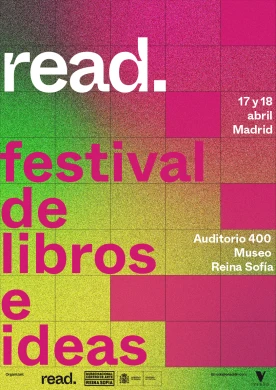
READ Madrid. Festival of Books and Ideas
Friday 17 and Saturday 18 April, 2026 – Check Programme
READ Madrid. Festival of Books and Ideas emerges as a meeting space for critical and experimental voices in the fields of literature, theory, and publishing. With particular attention to artistic production practices and independent publishing, and seeking to build a transatlantic cultural bridge with Latin America, the program aims to decenter hegemonic frameworks of knowledge production and open up new communities of interpretation and horizons for political imagination. To this end, it takes writing and reading—understood in broad and plural ways across their modes, forms, and registers—as constitutive of a public laboratory of what we call study: a space for thinking collectively, debating and coining ideas, making and unmaking arguments, as well as articulating new imaginaries and forms of enunciation.
In a context of ecological, political, and epistemological crisis, the festival proposes modes of gathering that make it possible to sustain shared time and space for collective reflection, thereby contributing to the reconfiguration of the terms of cultural debate. In this sense, the program is conceived as an intervention into the contemporary conditions of circulation and legitimation of thought and creation, expanding the traditional boundaries of the book and connecting literature, visual arts, performance, and critical thought. These formats are organized around three thematic axes led by key voices in contemporary writing, artistic practice, and critical thinking.
The thematic axes of READ Madrid. Festival of Books and Ideas are: a popular minoritarian, or how to activate an emancipatory practice of the popular; raging peace, or how to sustain justice, mourning, and repair without resorting to pacifying imaginaries devoid of conflict; and fiction against oblivion, which explores the role of science fiction, horror, and speculative narratives as forms of resistance against the liberalism of forgetting. Ultimately, the aim is to interrogate our present through the potential that ideas and books can mobilize within a shared space of study, debate, and enjoyment.
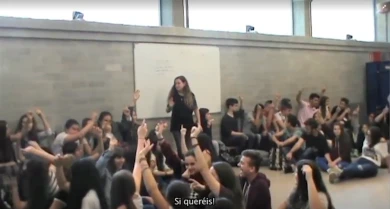
Intergenerationality
Thursday, 9 April 2026 – 5:30pm
This series is organised by equipoMotor, a group of teenagers, young people and older people who have participated in the Museo Reina Sofía’s previous community education projects, and is structured around four themed blocks that pivot on the monstrous.
The third session gazes at film as a place from which to dismantle the idea of one sole history and one sole time. From a decolonial and queer perspective, it explores films which break the straight line of past-present-future, which mix memories, slow progress and leave space for rhythms which customarily make no room for official accounts. Here the images open cracks through which bodies, voices and affects appear, disrupting archive and questioning who narrates, and from where and for whom. The proposal is at once simple and ambitious: use film to imagine other modes of remembering, belonging and projecting futures we have not yet been able to live.