Held on 30 Oct 2019
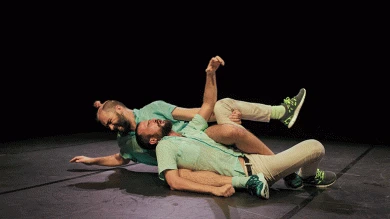
As part of the series of performing arts staged in collaboration with the Community of Madrid’s Teatros del Canal, the Museo Reina Sofía presents #LOSMICRÓFONOS (#THEMICROPHONES) by Jorge Dutor and Guillem Mont de Palol. Upon its conclusion, the performance will be followed by an encounter with the artists, presented and moderated by Isabel de Naverán. Furthermore, on 31 October the artists will conduct a workshop in the Museo to share their practices, particularly those related to this project.
#LOSMICRÓFONOS (#THEMICROPHONES), first staged in 2013, is performed on this occasion in relation to the presentation of Lo mínimo, a new work by Dutor and Mont de Palol, on 25, 26 and 27 October 2019 and on 27 May 2020 in Teatros del Canal’s Sala Negra. The piece has been conceived in collaboration with artist and performer Cris Blanco and explores the capacity to generate small, and ostensibly implausible, quasi-magical actions with elements of everyday use. The possibility of a previous piece conversing with this latest production occasions a survey of a work which, through the prism of time, reveals numerous constants with different paths of development.
In #LOSMICRÓFONOS we sit in on a conversation in which those speaking only do so through the names of famous stars, well-known lines from mainstream films or melodies learnt from themed radio and the background music of stores and transportation. These references are all tied to particular pop stars or, more specifically, to the names of particular stars or, more specifically, to the sound made from pronouncing such names.
Celine Dion, Michael Jackson, Alejandro Sanz. For a certain generation, these names cannot be prised apart from an aesthetic, dance movement or style. Although they are not stars from the sky, they still act within a constellation; they are part of the so-called star system, a system of stars which light up a type of sky, using their influence, drawing a network of connections between figures, life movements, affection and images. Which universe can be conceived under the celestial vault created by these “other” stars? This was one of the questions asked by the artists when they undertook the project seven years ago.
Its title, written as one word and preceded by a hashtag, situates this work in the age of tags, in the world of complicity and tracking that characterises virtual social networks. It also references the instrument used to amplify voices and sounds when they alone cannot be heard in spaces like those we imagine to be occupied by stars from this unique cosmos.
In this piece, Dutor and Mont de Palol act as microphones of these names, but from another possibly less tangible universe arising out of their gestures and movements during the performance — for #LOSMICRÓFONOS is a very different nomination exercise from TV game shows. Here, the act of naming is a gesture of assignment and evocation that soon makes way for something else, for another state, a game which invites us to be participants in unforeseen situations.
In exploring every possibility of pronouncing a name, an archive is shown trapped inside a body from which it wishes to escape, recalling the number of melodies — and moments associated with them — we hang on to, ones that can be reactivated with a minor gesture of the body. Just as a smell can take us back to a situation we have experienced, a name is like a door opening into a room, and just one room; one particular song is what takes us back to one precise situation and not another.
Yet in #LOSMICRÓFONOS Dutor and Mont de Palol appear to physically cross the layers of meaning attached to specific names, testing out, through play and humour, and also musically, everything associated with them; thus, it almost seems ridiculous without being so as it shows the volume of such storage.
In collaboration with
Curatorship
Isabel de Naverán
Organised by
Museo Reina Sofía
In collaboration with

Participants
Jorge Dutor (Madrid, 1979) is a performer and set designer. Trained at Madrid’s Royal School for Performing Arts (RESAD), he has worked in Amsterdam, Barcelona, Bilbao and Madrid. His practice is multi-faceted and encompasses light and wardrobe design for plays, films and fashion, organising parties and music events, and DJing, in addition to his work as an actor in different film and art projects.
Guillem Mont de Palol (Girona, 1978) is a performer and choreographer who graduated from the SNDO School for New Dance Development in Amsterdam, where he is currently a visiting lecturer. As a performer he has worked for Xavier le Roy, Mette Ingvartsen, Vicent Dunoyer and Frederique Gies, to mention but a few.
Jorge Dutor and Guillem Mont de Palol have been creating pieces together over the past ten years, for instance: UUUHHH! Yo fui un hombre lobo adolescente inventando horrores (2009), Y POR QUÉ JOHN CAGE? (2011), #LOSMICRÓFONOS (2013), HACER COSAS QUE NOS PERMITAN O NOS ABOQUEN A HACER OTRAS COSAS (2015-2016), Grand Applause (2018), lo pequeño (2018) and Lo mínimo(2019), the last two collaborations with Cris Blanco.
Credits
Concept, choreography and performance: Jorge Dutor and Guillem Mont de Palol
Dramaturgy assistance: Juan Domínguez
Production: Jorge Dutor, Guillem Mont de Palol and TNT Terrasa Festival
Collaborators: WSB workspacebrussels (Brussels), kunstencentrum BUDA (Kortrijk), Azala espacio de creación (Lasierra, Álava), SpazioK Kinkaleri (Prato), Danshane (Istanbul), Graner and El Local (Barcelona)

Más actividades
![Joseph Kosuth. One and Three Chairs [Una y tres sillas]](https://recursos.museoreinasofia.es/styles/small_landscape/public/Actividades/joseph_kosuth.jpg.webp)
The (legal) person and the legal form. Chapter III
Monday 11, Wednesday 13 and Thursday 14 May 2026
As part of the Studies Constellation, the Study Directoship’s annual fellowship, art historian and theorist Sven Lütticken leads the seminar The (Legal) Person and the Legal Form: Theoretical, Artistic, and Activist Commitments to foster dialogue and deepen the hypotheses and questions driving his research project.
The seminar consists of eight sessions, divided into three chapters throughout the academic year. While conceived as non-public spaces for discussion and collective work, these sessions complement, nourish, and amplify the public program of the Studies Constellation.
First session of the third chapter focuses on the transformation of the artwork in the context and wake of Conceptual art. The very notion of the artwork, together with its ownership and authenticity, is reconsidered from a broad perspective open to new and alternative models of management, which could ultimately transform the relationship between artist, artwork and owner. Can some of the practices in question serve as critical models? To what extent is it possible to think and act with them, and extrapolate from them, beyond a beautiful niche?
The second session turns to the question of representation. While many (but not all) human natural persons can, in principle, represent themselves in legal matters, other needs representatives. This goes for minors as well for adults who have been placed under legal guardianship; it applies to fictitious persons such as corporations and states, who need human representatives to sign contracts or defend them in court. We will look into the question of legal representation in conjunction with other forms of representation, in the cultural as well as political register—taking cues from Spivak’s distinction between portrait (Darstellung) and proxy (Vertretung), which is an unstable and historically mutable one.
The seminar concludes with a closing session dedicated to collectively revisiting and reflecting on the themes and discussions that have emerged throughout the first Studies Constellation Residency Program.
Patricia Falguières
Tuesday May 12th 2026 – 19:00 h
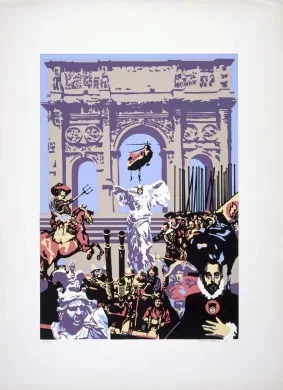
Art historian Patricia Falguières inaugurates the María Luisa Caturla Chairwith the lecture Art History in Dark Times. This Chair, dedicated to the reflection on art in times «sick with uncertainty», is aimed at dismounting, digressing and imagining multiple temporalities and materialities in art history and cultural studies from an eccentric gaze, in the sense of being displaced, off-centre or with a centre that is different.
The lecture’s title references Hannah Arendt’s collection of essays Men in Dark Times, which in turn paraphrases a Bertol Brecht poem. In it, Arendt asserts «dark times are not only not new, they are no rarity in history».
Patricia Falguières also claims history knows many periods when the public realm has been obscured, when the world becomes so uncertain that people cease to ask anything of politics except to relieve them of the burden of their vital interests and their private freedom. The art historian —whose expertise is in the field of Renaissance art and philosophy but paying close attention to contemporaneity— invites us to a «chaotic and adventurous journey», from the Italian Renaissance to Fukushima, through which to delve into the questions: What can the practice of art history mean today, in a world ablaze with ominous glimmers and even more ominous threats, if not as mere entertainment or social ornament? Of what vital interests, of what freedom can it bear witness and serve as an instrument?
![Tracey Rose, The Black Sun Black Star and Moon [La luna estrella negro y negro sol], 2014.](https://recursos.museoreinasofia.es/styles/small_landscape/public/Obra/AD07091_2.jpg.webp)
On Black Study: Towards a Black Poethics of Contamination
27, 28, 29 ABR 2026
The seminar On Black Study: Towards a Black Poethics of Contamination proposes Black Study as a critical and methodological practice that has emerged in and against racial capitalism, colonial modernity and institutional capture. Framed through what the invited researcher and practitioner Ishy Pryce-Parchment terms a Black poethics of contamination, the seminar considers what it might mean to think Blackness (and therefore Black Study) as contagious, diffuse and spreadable matter. To do so, it enacts a constellation of diasporic methodologies and black aesthetic practices that harbor “contamination” -ideas that travel through texts, geographies, bodies and histories- as a method and as a condition.
If Blackness enters Western modernity from the position of the Middle Passage and its afterlives, it also names a condition from which alternative modes of being, knowing and relating are continually forged. From within this errant boundarylessness, Black creative-intellectual practice unfolds as what might be called a history of touches: transmissions, residues and socialities that unsettle the fantasy of pure or self-contained knowledge.
Situated within Black radical aesthetics, Black feminist theory and diasporic poetics, the seminar traces a genealogy of Black Study not as an object of analysis but as methodological propositions that continue to shape contemporary aesthetic and political life. Against mastery as the horizon of study, the group shifts attention from what we know to how we know. It foregrounds creative Black methodological practices—fahima ife’s anindex (via Fred Moten), Katherine McKittrick’s expansive use of the footnote, citation as relational and loving labour, the aesthetics of Black miscellanea, and Christina Sharpe’s practices of annotation—as procedures that disorganise dominant regimes of knowledge. In this sense, Black Study is approached not as a discrete academic field but as a feel for knowing and knowledge: a constellation of insurgent practices—reading, gathering, listening, annotating, refusing, world-making—that operate both within and beyond the university.
The study sessions propose to experiment with form in order to embrace how ‘black people have always used interdisciplinary methodologies to explain, explore, and story the world.’ Through engagements with thinkers and practitioners such as Katherine McKittrick, C.L.R. James, Sylvia Wynter, Christina Sharpe, Fred Moten, Tina Campt, Hilton Als, John Akomfrah, fahima ife and Dionne Brand, we ask: What might it mean to study together, incompletely and without recourse to individuation? How might aesthetic practice function as a poethical intervention in the ongoing work of what Sylvia Wynter calls the practice of doing humanness?
Mediations of the Archive: Art, Community, and Political Action
Tuesday 7, and Thursday 23, April, 2026 – 17:00 h
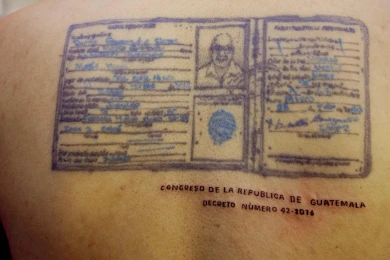
The online seminar Archival Mediations: Art, Community, and Political Action, curated by Sofía Villena Araya, examines the role of archival practices in caring for, dignifying, and activating memory in Central America. As part of the Cáder Institute for Central American Art’s first line of research, driven by the question “What Art Histories does Central America produce?”, this seminar proposes an approach to the archive as a mediator that articulates relationships between art, community, and political action, while engaging with the historiographical questions raised by their intersections.
Although the proposal is not limited to discussions of the Central American isthmus, it is framed by the particular conditions under which memory has been constructed in the region. Central America is a territory vulnerable to natural and geological disasters, marked by political violence exercised by authoritarian states and fragile institutions, a persistent colonial and imperial legacy, and the social fragmentation resulting from these factors. It is also a context in which the archive does not necessarily refer to a specific place —such as a building or documentary collection— nor does it primarily follow the protocols of a discipline such as archival science. Rather, the seminar explores how the archive operates, through art, as a dispositif that forges connections, generates forms of belonging, and opens spaces for political action.
The encounter unfolds across two sessions: the first focuses on archival practices addressing questions of memory, violence, and war; the second examines community-based practices surrounding queer and sex-dissident archives. In the face of the systematic destruction of memory, the archival practices discussed in these sessions demonstrate how the archive emerges in other spaces and according to different logics. Within this framework, the proposed space for exchange and research explores the role of art as a productive medium for constructing archives through images, affects, intimacy, performativity, the body, orality, and fiction, as well as through other materialities that challenge the centrality of the document and of writing.
Intergenerationality
Thursday, 9 April 2026 – 5:30pm
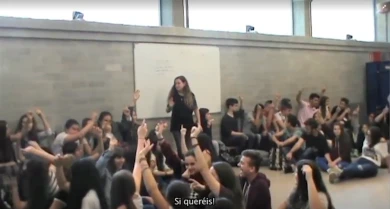
This series is organised by equipoMotor, a group of teenagers, young people and older people who have participated in the Museo Reina Sofía’s previous community education projects, and is structured around four themed blocks that pivot on the monstrous.
The third session gazes at film as a place from which to dismantle the idea of one sole history and one sole time. From a decolonial and queer perspective, it explores films which break the straight line of past-present-future, which mix memories, slow progress and leave space for rhythms which customarily make no room for official accounts. Here the images open cracks through which bodies, voices and affects appear, disrupting archive and questioning who narrates, and from where and for whom. The proposal is at once simple and ambitious: use film to imagine other modes of remembering, belonging and projecting futures we have not yet been able to live.