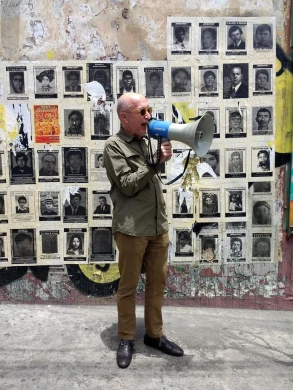
Curator Gerardo Mosquera during a guided tour at the Twenty-First Arte Paiz Biennial (2018) in Guatemala City, where he was curator. (CC) pvt
Held on 19 May 2026
This encounter pays homage to Gerardo Mosquera (Havana, 1945), a pre-eminent curator, an essayist who has been part of key debates on decolonisation and the drifts of globalisation, a communicator and, primarily, an art critic who has managed to radically situate discourses and practices, while still taking on risks and perpetually upholding committed ethical positions.
Mosquera is one of the foremost curators internationally and was involved with the Havana Biennial from its foundation in 1984 to 1989, as well as curating pivotal shows in museums and art centres around the globe. Notable among his curatorial work is as adjunct curator at the New Museum in New York (1995–2009), the Liverpool Biennial (2006) and the exhibition It’s Not Just What You See. Perverting Minimalism (Museo Reina Sofía, 2000).
This round-table discussion, which features the participation of Gerardo Mosquerahimself and an ensemble of art critics, thinkers and artists, for instance Fernando Castro Flórez, Diana Cuéllar, Lillebit Fadraga and René Francisco Rodríguez, will approach the multifaceted and extremely fertile work of Mosquera as a renowned master curator.
Organised by
Museo Reina Sofía
Participants
Fernando Castro Flórez
(Plasencia, 1964) is head lecturer of Aesthetics and Art Theory at the Autonomous University of Madrid, an art critic at ABC Cultural and a regular contributor to specialist magazines. His work combines criticism, research,teaching and curatorial practice, and he has been a member of the Museo Reina Sofía’s Board of Trustees and Advisory Committee, as well as teaching on different postgraduate programmes centred on contemporary culture. He directs the Infralevescollection of CENDEAC and has curated exhibitions by artists such as Andy Warhol, Anselm Kiefer and Imi Knoebel, in addition to participating at different international biennials.
Diana Cuéllar Ledesma
(Mexico, 1986) is a curator and university lecturer. She holds a PhD in Art, Literary and Cultural Studies from the Autonomous University of Madrid, and her essays have been published in specialist catalogues, journals and magazines such as Casa del tiempo (a magazine from the Universidad Autónoma Metropolitana de México), Campo de relámpagos (Spain), Exit Express (Spain), Fórum Permanente(Brazil), ArtNexus (Bogotá) and Third Text (London). In 2022 she was a consultant at the publisher Phaidon for the book Prime. Art’s Next Generation, and in 2023 acted as a consultant for the same publishing house for the volume Artistas latinoamericanos: desde 1785 hasta hoy, to which she also contributed as a writer.
Lillebit Fadraga Tudela
(Havana, 1977) is a curator, cultural manager, critic and art historian who holds a degree in Art History from the Universidad de La Habana and an MA in Contemporary Art History and Visual Culture from the Autonomous University of Madrid, the Complutense University of Madrid and the Museo Reina Sofía. Since 2000 she has worked as director of the Estudio Carlos Garaicoa and, since 2015, as executive director of the residency programme Artista X Artista. She has established her career in curatorship, museography and cultural management, with projects carried out in institutions in Cuba, Europe and North America. Moreover, she has participated in international seminars, biennials and academic programmes, while her editorial, audiovisual and critical work has been disseminated in specialist publications and art catalogues published nationally and internationally.
René Francisco Rodríguez
(Holguín, Cuba, 1960) graduated from the Instituto Superior de Arte (ISA) in Havana in 1987. Throughout his career he has received awards such as the Cuba National Plastic Arts Award (2010), the Honorary Doctorate from the San Francisco Art Institute (2001) and the UNESCO Prize for the Arts(Galería DUPP, 2000), while his recent work has been shown at institutions such as Kunst Merano Arte, MFAH (Houston), Casa Daros Latinamerica (Rio de Janeiro), Kunsthalle Düsseldorf, Goch Museum, Harn Museum of Art (Florida), the Xin Dong Cheng Gallery (Beijing), the Frist Art Museum (Nashville) and the Walker Art Center(Minneapolis), among others. His notable pedagogical and social work can be seen in projects such as DUPP (1989–2013), Art Works on Commission, Free (Utrecht, 2017)and Entre Trópicos - 46º 05'' (Rio de Janeiro, 2012), and he was guest lecturer at Burg Giebichenstein Kunsthochschule in Halle. Furthermore, he has curated major exhibitions such as Tramas (MNBA/CIFO, 2015) and Adiós Utopía. Dreams and Deceptions in Cuban Art Since 1950 (MFAH, 2017) and his work is part of the collections of MNBA (Havana), Daros Latinamerica, Ludwig Forum (Aechen), PAMM Miami, 21C Museum (Louisville), CIFO (Miami) and others in Europe, the USA and Asia.
Gerardo Mosquera
(Havana, 1945) is a curator, critic, art historian and independent writer based between Havana and Madrid. He was the co-founder of the Havana Biennial, a curator at the New Museum of Contemporary Art (New York) and artistic director of PHotoESPAÑA (Madrid). He has curated myriad biennials and international exhibitions around the world, most recently: Desbocadas. Yeguas del Apocalipsis. Retrospectiva (2026) at the Museo de Bellas Artes (Santiago de Chile), Hot Spot. Caring for a Burning World (2022) at Galleria Nazionale d’Arte Moderna e Contemporanea (Rome) and the Guangzhou Image Triennial (2021). Further, he received the award for Best Curating at the Cuenca Biennial in 2025 and was awarded the Guggenheim Fellowship in New York in 1995, among other distinctions. He is also an advisor to different institutions and international journals, and has published books and essays in numerous countries and languages, the last of these being Beyond the Fantastic. Crítica de arte contemporánea desde América Latina (University ofGranada, 2022), Caminar con el diablo. Textos sobre arte, internacionalismo y culturas(Exit, 2010) and Arte desde América Latina (y otros pulsos globales) (Cátedra, 2020).
Gerardo Mosquera: Island Thinker, Global Curator
Round-table Discussion
Más actividades
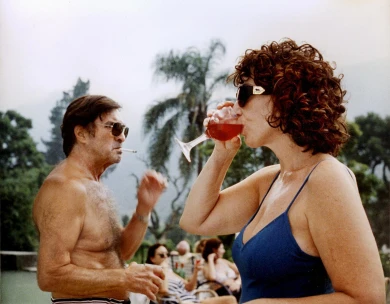
Lucrecia Martel. La ciénaga (The Swamp)
Viernes 21 de agosto, 2026
A couple of families spend the summer in a country cottage. The relationship between them exposes a crisis. The alcoholism of Mecha (Graciela Borges) and Gregorio (Martín Adjemián) becomes clear, leading to a drift in the education of their children and impacting relationships of respect and affect. Weariness expresses the lackadaisical environment.
In La ciénaga Lucrecia Martel approaches the decadence of a middle-class Argentinian family. The pool of dirty, stagnant water reflects the economic and social collapse of a whole country, yet reflects more than economic crisis as it becomes a murky well feeding off the pain of those living in the house. An erstwhile space of joy, the swimming pool becomes a reflection of adult depression, resulting in apathy. And the children, especially the girls, seem to be the only people awake in this drift. Barring a flicker of unawareness, the young people immerse themselves in rainwater or the water from the river, in water that flows, but are cautious of getting too close to the swimming pool.
![Yorgos Lanthimos, Kynodontas [Canino], 2009, película](https://recursos.museoreinasofia.es/styles/small_landscape/public/Actividades/ciclocine-piscinas-16_00.jpg.webp)
Yorgos Lanthimos. Dogtooth
Saturday, 22 August 2026
A couple with three adult children live in a modern country cottage. A large swimming pool takes centre stage in a sizeable garden. The property is skirted by a large fence that blocks a view of the outside. Here, the father has educated his children without outside contact, maintaining their belief in a false world: aeroplanes fall in the garden like toys and they must act like dogs to defend themselves from the ferocious cats that surround the house. The promise of going out into the world when they lose their dogtooth is proof of their maturity.
Lanthimos builds a world that is surreal, comical and terrible. The swimming pool is the house’s central element, a limited, controlled space assimilated like the sea, yet under the father’s supervision. A space of imagination, but with sinister intentions: the children are indoctrinated under the water as they believe in a better world. Far from reality. The swimming pool’s limits are the limits of their freedom, a false state of well-being expressed in the weightless bodies in the water. The liquid element is an analgesic magma with the power to educate offspring under the latent fear of a shark bite.
![Binka Zhelyazkova, Baseynat [La piscina], 1977, película](https://recursos.museoreinasofia.es/styles/small_landscape/public/Actividades/ciclocine-piscinas-17_00.png.webp)
Binka Zhelyazkova. The Swimming Pool
Viernes 28 de agosto, 2026
The young, bright Bella (Yanina Kasheva), after unforeseen heartbreak at her graduation party, meets Apostol (Kosta Tsonev), a reserved architect, and Boyan (Kliment Denchev), a comedy actor who is cynical about his country. The three characters climb up to a diving board in a municipal swimming pool, where they begin a strange relationship of friendship, love and despair which reflects a generational clash.
Binka Zhelyazkova, the great enfant terrible of Eastern European cinema, critic of the communist system and widely acclaimed film-maker beyond Bulgarian borders, made in The Swimming Pool a masterly metaphor for a country in decline. The public pool symbolises a closed, immovable enclosure where society is festering. From the height of a diving board she sees, in a panoptic view, the different generations living underneath a limited space. On one side, older people attempt to preserve the old revolutionary spirit with constant collective swimming exercises while, on the other, young people don’t hide the desire for freedom that remains unrealised. The result is an ideological clash in how to act and move in the enclosure, unearthing vast hypocrisy in the lost ideals of socialism, reflected in the total apathy of youth. The Swimming Pool for Zhelyazkova is a reflection of the disillusionment and existential void of a whole country and system.
![Jacques Deray, La piscine [La piscina], 1969, película](https://recursos.museoreinasofia.es/styles/small_landscape/public/Actividades/ciclocine-piscinas-18.jpg.webp)
Jacques Deray. The Swimming Pool
Saturday, 29 August 2026
The characters played by Alain Delon (Jean-Paul) and Romy Schneider (Marianne) experience their love in apparent splendour. A sun-drenched house, a blissful swimming pool, beautiful bodies, sexuality in abundance. The visit of Harry (Maurice Ronet), a successful musician, friend of Jean-Paul and ex-lover of Marianne, accompanied by his young and beautiful daughter Penélope (Jane Birkin), rocks their relationship, bringing to light the jealousy and insecurities of each one in a dark game of possession and male rivalry.
If there was a definition of the glistening blue pool in this sexual thriller, it would be the paradise of Adam and Eve, represented by the shots of happiness of Romy Schneider and Alain Delon in this swimming pool on France’s Côte d’Azur. The appearance of these two beautiful creatures kissing semi-naked by the water is one of film’s resonant images. The paradise cannot be fractured, not even by death. As in the crossing of the Tigris and Euphrates rivers, where humanity’s first lovers bathed naked in the water, innocent to their imminent end, the reflection of the crystalline water of The Swimming Pool shows this game, and the deep traumas which, under this mantle, are hidden in the amorous relationships and limits that only love is capable of breaking to solve.
In this session both endings to the film are screened: the original version, open and symbolic, and the Spanish version, marked by censorship during Francoism, and its sequence for a Spanish premiere — a stereotypical and reductive vision reflecting the sociological condition of the country.

University Micro-Credential in Intercultural and Multilingual Mediation within Artistic Contexts
Miércoles, del 12 de septiembre al 16 de diciembre, 2026
Micro-credentials are short-term learning experiences (up to 150 hours/15 ECTS) which are certified at a European level. They aim to certify key competences of lifelong learning through eminently practical proposals, and with an active methodological approach.
The University Micro-Credential in Intercultural and Multilingual Mediation within Artistic Contexts, organised by the Autonomous University of Madrid (UAM), in a collaboration with the Museo Reina Sofía, seeks to develop knowledge around intercultural mediation to be practised in museum and art contexts, and from a perspective which integrates linguistic diversity to impart a more just, diverse and plural experience of contemporary art and culture. The micro-credential goes towards a university qualification issued by UAM.
This initiative is the outcome of a shared research undertaking of linguistic justice between the Museo Reina Sofía’s Studies Directorship and UAM’s Centre for Research in Multilingualism, Discourse and Communication (MIRCo). Following over twenty years of experience as a research group, MIRCo established itself in 2021 as an open science and citizen-engagement space that drives research on multilingual practices, speech and speakers in diaspora, interrelations between discourse and power, intercultural communication and the transformation of space via communicative linguistic spaces.
This common interest materialises through ReDes_Ling, an interdisciplinary research and action project that studies language as a vehicle which reproduces social inequality, seeking to design actions that reduce its effects in society. The creation of this micro-credential constitutes one of these actions.
Furthermore, the programme is rooted in the experience of the Aissatou Ndiaye School of Situated Mediation, propelled since 2022 by Museo Situado, in collaboration with teams from the Museo Reina Sofía’s Tentacular Museum and Education Department. By way of contact with works conserved in the Museo and with different professionals from the cultural sphere and social activists, mediators from this school will develop their own routes in different languages, including Spanish, Wolof, Bengali, Darija, Arabic, Tagalog and French, enriching the narratives in the Museo Reina Sofía Collections. Therefore, the school is encompassed within a reflection on and continuing work with cultural mediation to dissolve any barriers that stand in the way of practices, discourses and contemporary artworks and people of any age or social status.
The convergence of these experiences makes the micro-credential a space of training which blends academic reflection, professional practice and a commitment to linguistic justice and cultural rights.