Encounter with Daniel G. Andújar
In conversation with Manuel Borja-Villel and Iris Dressler
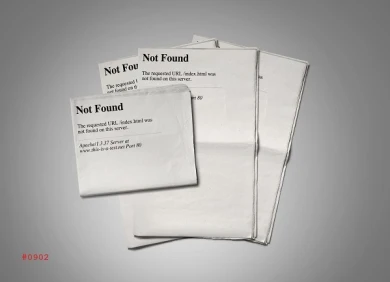
Held on 21 Jan 2015
The work of Daniel G. Andújar enters into dialogue with institutional critique, an analysis of the mass media and intervention in public spaces. Since the 1990s his work has moved between two poles: on one side, a consideration based on the progression of the virtual, with the changing paradigm that gives rise to new forms of access and the use of technology, and on the other, raised awareness of the contradictions stemming from real intervention in the public sphere. Consequently, in 1996, under the slogan Technologies To The People (TTTP) , he started up a project conceived as a space for thought and a working archive, a space from which to articulate and bind together different artistic interventions that question, with pronounced irony, themes such as corporate language and market strategies, the processes of urban change in large metropolises and democratic promises initiated in new media. The name of the project, inherited from appropriationist critique, provides a kind of fictional company, a reverse of corporate culture, alluding, as a parody, to the utopia of freedom and independence that the Internet extols.
The forthcoming exhibition, Daniel G. Andújar. Operating System, presents a selection of the artist’s work from the 1990s, giving prominence to the most recent pieces. This ensemble of heterogeneous and complex work spans photography and installation, in addition to actions in public spaces, appropriations of language and advertising spaces and the creation of Internet communities. The encounter sees Daniel G. Andújar engage in conversation with the curator of the exhibition, Manuel Borja-Villel, and a critic with extensive knowledge of his output, Iris Dressler, to discuss some of the key aspects of the artist’s work.
In collaboration with
Participants
Manuel Borja-Villel. Director of the Museo Reina Sofía and curator of the exhibition Daniel G. Andújar. Operating System (21 January – 4 May, 2015).
Iris Dressler. Researcher and curator. In 1996, together with Hans D. Christ, she founded the independent contemporary art platform Hartware Medien Kunst Verein in Dortmund, subsequently an exhibition space. Since 2005 they have co-directed the Württembergischer Kunstverein centre, in Stuttgart. In both centres she has curated a wide range of exhibitions, including individual shows by Daniel G. Andújar in 1997 and 2008.
Daniel G. Andújar. Visual artist and theorist. A long-time member of irational.org, an international reference point of net.art. He has exhibited internationally and overseen Internet projects such as art.net.dortmund, e-barcelona.org and e-valencia.org, as well as running workshops with artists and social collectives and actively participating in the debate on the artist’s status in the immaterial economy.
Más actividades
![Binka Zhelyazkova, Baseynat [La piscina], 1977, película](https://recursos.museoreinasofia.es/styles/small_landscape/public/Actividades/ciclocine-piscinas-17_00.png.webp)
Binka Zhelyazkova. The Swimming Pool
Viernes 28 de agosto, 2026
The young, bright Bella (Yanina Kasheva), after unforeseen heartbreak at her graduation party, meets Apostol (Kosta Tsonev), a reserved architect, and Boyan (Kliment Denchev), a comedy actor who is cynical about his country. The three characters climb up to a diving board in a municipal swimming pool, where they begin a strange relationship of friendship, love and despair which reflects a generational clash.
Binka Zhelyazkova, the great enfant terrible of Eastern European cinema, critic of the communist system and widely acclaimed film-maker beyond Bulgarian borders, made in The Swimming Pool a masterly metaphor for a country in decline. The public pool symbolises a closed, immovable enclosure where society is festering. From the height of a diving board she sees, in a panoptic view, the different generations living underneath a limited space. On one side, older people attempt to preserve the old revolutionary spirit with constant collective swimming exercises while, on the other, young people don’t hide the desire for freedom that remains unrealised. The result is an ideological clash in how to act and move in the enclosure, unearthing vast hypocrisy in the lost ideals of socialism, reflected in the total apathy of youth. The Swimming Pool for Zhelyazkova is a reflection of the disillusionment and existential void of a whole country and system.
![Jacques Deray, La piscine [La piscina], 1969, película](https://recursos.museoreinasofia.es/styles/small_landscape/public/Actividades/ciclocine-piscinas-18.jpg.webp)
Jacques Deray. The Swimming Pool
Saturday, 29 August 2026
The characters played by Alain Delon (Jean-Paul) and Romy Schneider (Marianne) experience their love in apparent splendour. A sun-drenched house, a blissful swimming pool, beautiful bodies, sexuality in abundance. The visit of Harry (Maurice Ronet), a successful musician, friend of Jean-Paul and ex-lover of Marianne, accompanied by his young and beautiful daughter Penélope (Jane Birkin), rocks their relationship, bringing to light the jealousy and insecurities of each one in a dark game of possession and male rivalry.
If there was a definition of the glistening blue pool in this sexual thriller, it would be the paradise of Adam and Eve, represented by the shots of happiness of Romy Schneider and Alain Delon in this swimming pool on France’s Côte d’Azur. The appearance of these two beautiful creatures kissing semi-naked by the water is one of film’s resonant images. The paradise cannot be fractured, not even by death. As in the crossing of the Tigris and Euphrates rivers, where humanity’s first lovers bathed naked in the water, innocent to their imminent end, the reflection of the crystalline water of The Swimming Pool shows this game, and the deep traumas which, under this mantle, are hidden in the amorous relationships and limits that only love is capable of breaking to solve.
In this session both endings to the film are screened: the original version, open and symbolic, and the Spanish version, marked by censorship during Francoism, and its sequence for a Spanish premiere — a stereotypical and reductive vision reflecting the sociological condition of the country.
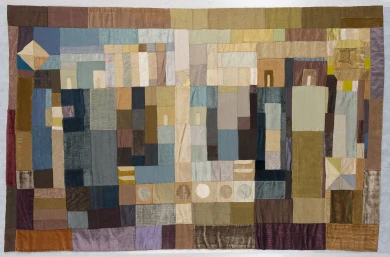
Transnational Perspectives on Aurèlia Muñoz and Fibre Art
Wednesday, 2 September 2026
Coinciding with the end of the Aurèlia Muñoz. Beings exhibition, this study day gathers international experts to explore the connections and affinities between the different movements that renovated languages of contemporary Textile Art from the late 1960s. Movements such as Nouvelle Tapisserie and Fibre Art found, from that decade onwards, epicentres in places as diverse as Lausanne, Warsaw, New York, São Paulo and Barcelona, their key figures, including Aurèlia Muñoz, embodying a community of artists engaged in constant dialogue and formal evolution.
The study day Transnational Perspectives on Aurèlia Muñoz and Fibre Art offers, by way of experts and the show’s curatorial team, keys to situating the artist’s work within a framework crossed by major debates — both eco-political and aesthetic — that resonate strongly in today’s artistic dynamics.

University Micro-Credential in Intercultural and Multilingual Mediation within Artistic Contexts
Miércoles, del 12 de septiembre al 16 de diciembre, 2026
Micro-credentials are short-term learning experiences (up to 150 hours/15 ECTS) which are certified at a European level. They aim to certify key competences of lifelong learning through eminently practical proposals, and with an active methodological approach.
The University Micro-Credential in Intercultural and Multilingual Mediation within Artistic Contexts, organised by the Autonomous University of Madrid (UAM), in a collaboration with the Museo Reina Sofía, seeks to develop knowledge around intercultural mediation to be practised in museum and art contexts, and from a perspective which integrates linguistic diversity to impart a more just, diverse and plural experience of contemporary art and culture. The micro-credential goes towards a university qualification issued by UAM.
This initiative is the outcome of a shared research undertaking of linguistic justice between the Museo Reina Sofía’s Studies Directorship and UAM’s Centre for Research in Multilingualism, Discourse and Communication (MIRCo). Following over twenty years of experience as a research group, MIRCo established itself in 2021 as an open science and citizen-engagement space that drives research on multilingual practices, speech and speakers in diaspora, interrelations between discourse and power, intercultural communication and the transformation of space via communicative linguistic spaces.
This common interest materialises through ReDes_Ling, an interdisciplinary research and action project that studies language as a vehicle which reproduces social inequality, seeking to design actions that reduce its effects in society. The creation of this micro-credential constitutes one of these actions.
Furthermore, the programme is rooted in the experience of the Aissatou Ndiaye School of Situated Mediation, propelled since 2022 by Museo Situado, in collaboration with teams from the Museo Reina Sofía’s Tentacular Museum and Education Department. By way of contact with works conserved in the Museo and with different professionals from the cultural sphere and social activists, mediators from this school will develop their own routes in different languages, including Spanish, Wolof, Bengali, Darija, Arabic, Tagalog and French, enriching the narratives in the Museo Reina Sofía Collections. Therefore, the school is encompassed within a reflection on and continuing work with cultural mediation to dissolve any barriers that stand in the way of practices, discourses and contemporary artworks and people of any age or social status.
The convergence of these experiences makes the micro-credential a space of training which blends academic reflection, professional practice and a commitment to linguistic justice and cultural rights.
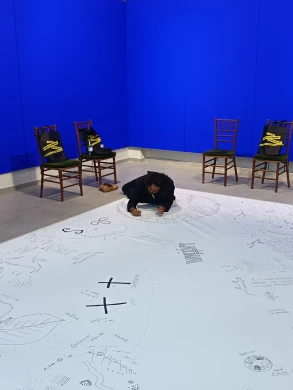
Blueprints. Paper Constellations of Lavapiés’ Memory
Friday 25 September, 2026 – 6:00 pm
As part of his research residency at the Museum, Olivier Marboeuf explores how communities can be gathered through the telling and retelling of stories, in a process in which narratives are continually reshaped, giving rise to a collective tale that is always open, unfinished and imprecise.
This workshop, conceived for the communities of Lavapiés, brings together storytelling, writing, drawing and embodied movement to create a collective map of life in the neighbourhood. Individual stories and gestures become part of a shared composition, opening up spaces for encounter, friction and exchange.
The aim of Blueprints. Paper Constellations of Lavapiés’ Memory is to create a graphic score for a conversation in many voices, connecting words with the traces of movements, encounters, accidents and coincidences registered on paper as prints of each participant. These individual movements come together in a choreography inscribed in a mural of interwoven stories, shaped not only by consensus and attentive listening, but also by cacophony, disagreement and contradiction. In doing so, the workshop explores the idea of transition in two interconnected senses: as physical movement or migration from one place to another, and as a process of change and transformation—such as the transformation a story undergoes as it is told, translated and passed from one person to another.