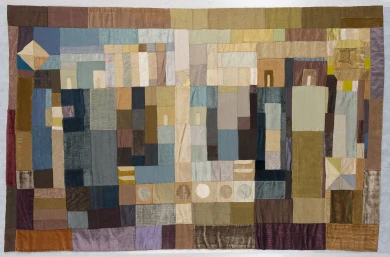
Aurèlia Muñoz, Personajes místicos y cruz (Mystical Figures and a Cross), 1964, fabric patchwork (120 x 185 cm)
Museu Nacional d’Art de Catalunya, Barcelona. Donation by the heirs of Aurèlia Muñoz, 2019
Held on 02 Sep 2026
Coinciding with the end of the Aurèlia Muñoz. Beings exhibition, this study day gathers international experts to explore the connections and affinities between the different movements that renovated languages of contemporary Textile Art from the late 1960s. Movements such as Nouvelle Tapisserie and Fibre Art found, from that decade onwards, epicentres in places as diverse as Lausanne, Warsaw, New York, São Paulo and Barcelona, their key figures, including Aurèlia Muñoz, embodying a community of artists engaged in constant dialogue and formal evolution.
The study day Transnational Perspectives on Aurèlia Muñoz and Fibre Art offers, by way of experts and the show’s curatorial team, keys to situating the artist’s work within a framework crossed by major debates — both eco-political and aesthetic — that resonate strongly in today’s artistic dynamics.
Organised by
Museo Reina Sofía
Agenda
miércoles 02 sep 2026 a las 17:30
Aurèlia Muñoz and Her Hybrid “Beings”: In Search of Ties to the International Art World
— Master lecture by Juliet Kinchin. Introduced by Manuel Cirauqui, the show’s director of research
A historian and textile conservator in European and North American institutions, Juliet Kinchin is an expert in Aurèlia Muñoz’s practice and is responsible for incorporating her works into the MoMA Collection in New York. In this master lecture, Kinchin reviews some of the milestones punctuating Muñoz’s career, from her first exhibition in Scotland to becoming consolidated as a touchstone figure in the international context of so-called Fibre Art. Muñoz would continually challenge this consolidation, however, eschewing technical categorisation and constantly redefining the possibilities of her practice.
miércoles 02 sep 2026 a las 18:30
From Nouvelle Tapisserie to an Interest in Today’s Ancestral and Committed Practices
— Round-table. Participants: Giselle Eberhard Cotton and Grant Watson. Moderated by: Rosa Lleó
Aurèlia Muñoz participated in six editions of the Lausanne International Tapestry Biennial and was part of a major international network of textile artists from the late 1970s and 1980s. With a view to framing her work in this context and understanding its impact, as well as relating it to the renewed interest in textiles today, this session invites two specialists on the subject to exchange perspectives: Giselle Eberhard Cotton, the first director of Fondation Toms Pauli in Lausanne and co-author of the key reference work From Tapestry to Fiber Art: The Lausanne Biennials 1962–1995, and curator, writer and researcher Grant Watson.
miércoles 02 sep 2026 a las 19:30
Aurèlia Muñoz. Approaches to Technique and Textile Materiality
— Conversation between Sílvia Ventosa and Sara Martinetti
If one thing defined Aurèlia Muñoz’s textile practice it was her ability to reinterpret artisan techniques to conceive of contemporary artworks, in addition to her endeavours to bring down borders between fabric, sculpture and flexible architecture. Historian and researcher Sara Martinetti, whose works seeks to connect disciplines such as the anthropology of writing, textiles and crafts, engages in dialogue with Sílvia Ventosa, casting light on the articulation of materials and techniques to reveal the connections running through Muñoz’s practice.
Participants
Manuel Cirauqui
(Zaragoza, 1978) is a curator, writer and the director of einaidea, a research and organisational platform from Fundació Eina (Barcelona) that creates artistic projects, programmes intensive studies and serves as a curatorial office. In dialogue with the Aurèlia Muñoz Archive, einaidea has organised the exhibition Aurèlia Muñoz. Beings (2026) for the Museo Reina Sofía and Museu d’Art Contemporani de Barcelona (MACBA), a show for which Cirauqui is responsible for its scientific management, and Aurèlia Muñoz. Taller aeri (Aurèlia Muñoz. Aerial Atelier, 2023), unveiled at the Centro Grau-Garriga de Arte Textil Contemporáneo de Sant Cugat del Vallès (Barcelona). Cirauqui’s career also notably includes his role as a curator at the Museo Guggenheim Bilbao, where he organised the exhibitions Artes de la Tierra (Arts of the Earth, 2025); June Crespo. Vascular (2024); Secciones/Intersecciones: La vida material (Sections/Intersections: Material Life, 2022); El arte y el espacio (Art and Space, 2017); and Anni Albers. Tocar la vista (Anni Albers. Touching Vision, 2017), among numerous others. Notable among his other curatorial projects are his collaborations with the Museo Tamayo (México), Dia Art Foundation (New York) and Jeu de Paume (Paris).
Giselle Eberhard Cotton
is an art historian and museologist who studied at the University of East Anglia (UK) and the École du Louvre in Paris. Her early professional career centred on organising exhibitions and the art market, before, in 2002, she was appointed as the first director of the Fondation Toms Pauli in Lausanne, coinciding with its creation. For over twenty years she has contributed to consolidating the prestige of the institution and its collection of old and modern tapestries. In 2010 she published The Toms Collection: Tapestries of the Sixteenth to Nineteenth Centuries (Fondation Toms Pauli, 2010) and in 2017 was co-author, with Magali Junet, of From Tapestry to Fiber Art: The Lausanne Biennials 1962–1995 (Skira, 2017). She has also lectured in the history of Fibre Art, and is currently the honorary director of Fondation Toms Pauli.
Juliet Kinchin
is a cultural historian and independent author who lives in Scotland. Between 2008 and 2022, she served as a curator in the Department of Architecture and Design at MoMA in New York, where she organised exhibitions such as Taking a Thread For a Walk (2019–2021). During this period, she propelled the incorporation of the work of Aurèlia Muñoz and many other women artists into the museum’s permanent collection. Her work as a curator and her publications span different spheres of twentieth-century design and culture, and today she develops research, in collaboration with specialists from Hungary and Romania, on the intersections between textiles, environmental art and architecture. In the academic sphere, she has held different positions at the University of Glasgow (Scotland), where she was the founding director of the postgraduate course in Decorative Arts. She has also taught at The Glasgow School of Art and the Bard Graduate Center for Studies in Design, Decorative Arts and Material Culture in New York.
Rosa Lleó
(Barcelona, 1980) is a curator and founder of the non-profit organisation The Green Parrot (Barcelona) — which she directed from 2014 to 2023 — a benchmark space devoted to producing exhibitions and publications and organising residencies and workshops with visual artists. She was also a curator and research fellow with the einaidea platform from 2023 to 2025, working on numerous projects, including the exhibition Beings (2026) centred on artist Aurèlia Muñoz in the Museo Reina Sofía and Museu d’Art Contemporani de Barcelona (MACBA). She has also independently curated exhibitions such as Reencantamientos. Artistas en las colecciones etnológicas (2024); at the Museu Etnològic i de Cultures del Món (Barcelona); La plaga, el provecho (2024), by Eulàlia Rovira and Adrian Schindler at the Centro Cultural de España (Mexico City); and Pedro Neves Marques. YWY, Visions (2020–2021) at CA2M (Móstoles, Madrid), 1646 (The Hague) and CaixaForum (Barcelona). She is currently putting together a solo show on artist Regina de Miguel for the Institut Valencià d'Art Modern (IVAM).
Sara Martinetti
is a researcher in art history, anthropology and contemporary art theory, with a focus on writing and textiles. Her doctoral thesis, directed by Béatrice Fraenkel and defended in 2020 at the École des hautes études en sciences sociales (EHESS), focused on the practices of writing and theoretical aspects in the work of Seth Siegelaub, in relation to conceptual art, activism and research. She has curated different exhibitions and publications linked to this area of study, including The Stuff That Matters: Textiles Collected by Seth Siegelaub for the CSROT (Raven Row, 2012); Seth Siegelaub: Beyond Conceptual Art (Stedelijk Museum Amsterdam, 2015–2016; catalogue, Walther König, 2015); and Seth Siegelaub: "Better Read Than Dead". Writings and Interviews, 1964–2013 (catalogue, Walther König, 2020). Furthermore, she has worked with art critic Michel Claura, Polish gallerist Anka Ptaszkowska — in conjunction with the show Anka, au cas par cas (CAPC Musée d’art contemporain de Bordeaux, 2022) — and with Jean-Noël Herlin for the exhibition Jean-Noël Herlin, a junk mail junkie (Centre d’art et de recherches Bétonsalon, Paris, 2024).
Sílvia Ventosa Muñoz
(Barcelona, 1957) is a museologist with a degree in Philosophy from the University of Barcelona and a PhD in Urban Anthropology from the Universitat Rovira i Virgili in Tarragona. Her professional career has evolved in different Barcelona museums: as a conservator of fabrics and fashion at DHub-Museu del Disseny (2008–2023), a conservator and coordinator of the scientific management of collections at the Museu de les Arts Decoratives (2000–2008), a conservator at the Museu Etnològic (1985–1990 and 1994–2000) and at the Museu d’Arts, Indústries i Tradicions Populars (1982–1985). Her research centres on the relationship between bodies, identities, clothing and fashion, and on their representation in museums. Further, Ventosa Muñoz has curated exhibitions on history, photography and the anthropology of fashion, including projects devoted to Aurèlia Muñoz, whose archive she manages. She has also participated in recovering textile techniques through the ARPA collective of textile artists and has written over seventy articles and books on textile art, traditional dress and fashion.
Grant Watson
is a curator, writer and researcher with a long-standing interest in the intersections between textile politics, queer sensibility, Left histories and the transcultural. His work has contributed to granting visibility to underrepresented ideas, mediums and forms of practice via projects developed inside, outside and between institutions, as well as in digital platforms and community contexts. These projects include archive work, collaborations with artists and researchers and long-form interview processes, the results of which are presented in exhibition formats, and through sound, video and text. Watson has worked with institutions such as If I Can't Dance, I Don't Want To Be Part Of Your Revolution (Amsterdam), the Haus der Kulturen der Welt (Berlin), the Bauhaus Kooperation (Berlin, Dessau and Weimar), SESC Pompeia (São Paulo), the Kiran Nadar Museum of Art (New Delhi), Tate Liverpool and documenta 12.
![Aurèlia Muñoz, Ocell estel S2 [Pájaro-cometa S2], 1982. Archivo Aurèlia Muñoz](https://recursos.museoreinasofia.es/styles/small_landscape/public/Actividades/aurelia-munoz-charlainaugura.jpg.webp)
Más actividades
![Isabel Coixet, 100 Years and You Everywhere [100 años y tú en todos los sitios], 2026, película](https://recursos.museoreinasofia.es/styles/small_landscape/public/Actividades/2.diseminar-mundo.jpg.webp)
John Berger and Isabel Coixet. Continued Ways of Seeing
Thursday, 17 September 2026 at 7pm
Ways of Seeing (1972) is one of the most revolutionary television series on art history, the museum and contemporary critical culture. Across four episodes, an articulate, enthusiastic John Berger unpacks the relationships between classical art through the gaze and new technology, the nude and feminism, the oil painting and commodity fetichism, advertising and consumerism. In essence, a level of critical commitment only comparable to its capacity for dissemination. Unsurprisingly, the series, and the book that would distil it, continues to forge vocations. This session sees art historians Alberto López Cuenca and Modesta Di Paola carry out an analysis of Berger’s audiovisual work, placing the stress on episodes one and four of the series. In the first episode, Berger reflects on the connection between the act of seeing, looking and being in light of new technology, such as the film camera. At the same time, it analyses how the culture of reproduction is turning paintings into messages or fragments of communication while stressing the importance of silence when observing historical paintings. In the fourth and final episode, he introduces advertising as a new iconic-verbal language that shares certain principles with the message of oil painting as a luxury item.
The session opens with the premiere of a filmic letter from Isabel Coixet, one of Spain’s most internationally acclaimed directors, to John Berger, with whom she maintained a long friendship and deep admiration. The short film is testament to the ubiquitous and long-lasting presence of the author of Ways of Seeing, even after his death in 2017.
![Chantal Akerman, Woman Sitting after Killing [Mujer sentada después de matar], 2001, instalación. Museo Reina Sofía](https://recursos.museoreinasofia.es/styles/small_landscape/public/Actividades/chantal-akerman-mujer-sentada-despues-matar.jpg.webp)
On Your Screen: Art History and the Museum Facing the Audiovisual Challenge
18, 19 SEP 2026
The conference On Your Screen: Art History and the Museum Facing the Audiovisual Challenge sparks debate around the transformations of art history and museum space upon embracing the audiovisual format. Its starting point is John Berger’s emblematic television series Ways of Seeing (1972), a landmark in the democratisation of art-historical discourse. In the series, Berger illustrated how the transfer of a work such as Goya’s Los fusilamientos del 3 de mayo (The Third of May 1808 or the Executions) from museum gallery to home TV screen completely changed the viewer’s experience, allowing the image to travel to straight to the viewer.
In the twenty-first century, this screen-based ecosystem has expanded exponentially, with museums not only physically integrating screenings and devices into their galleries— following in the wake of many exhibitions on the moving image — but also deploying complex virtual strategies. Equally, numerous en vez de a multitudeof historians, students and creators use digital platforms to circulate their ideas and projects. This audiovisual shift opens access to ignored materials and democratises knowledge, as well as challenging traditional hierarchies and the interpretive authority of institutions. The conference, promoted by the research project ATLAS AV: The Audiovisualisation of Art History and the Museum, seeks to analyse this vast audiovisual material, its archives, and its capacity to transform the memory of art.
Godard and Miéville: Time and Ruin
Friday, 18 September 2026 - 7pm
Inside the framework of the conference On Your Screen: Art History and the Museum Facing the Audiovisual Challenge, this film series sets forth three critical visions of the museum via three sessions featuring the works of John Berger, Jean-Luc Godard and Anne-Marie Miéville, Ariella Azoulay, Alan Resnais and Chris Marker, Kwate Nee-Owoo, and the premiere of short films by Isabel Coixet and La Vulcanizadora (Maria Rojas Arias and Andrés Jurado). In classical theory, the museum gives the world meaning; it contains fragments of the past, granting them a history, a narrative that explains preterite time and the present. Today, there is an implicit assumption that this function hides and legitimises forms of power, yet what if the museum, instead of explaining the world, multiplied it through radical ideas, silenced periods and repressed subjects? Such is the approach of the film-makers and artists in this film season.
In 1972 the writer John Berger opened the landmark television series Ways of Seeing with an iconoclastic gesture: slicing Sandro Botticelli’s painting Venus and Mars (1485) in London’s National Gallery. A transgressive act that recalls contemporary attacks on the museum by dissident youth and with which Berger, after revealing it was a reproduction, sought to ignite debate around the idea of an original artwork and a copy. In this, the hundredth anniversary of his birth, the first session pays homage to one of the great art writers of the twentieth century. Starting with a review of Berger’s audiovisual work by art historians Alberto López Cuenca and Modesta Di Paola, the series begins with the premiere of 100 Years and You Everywhere (2026), an unreleased short film by Isabel Coixet composed as a beautifully crafted letter to Berger, and continues with an analysis of fragments of Ways of Seeing in relation to the museum and contemporary art.
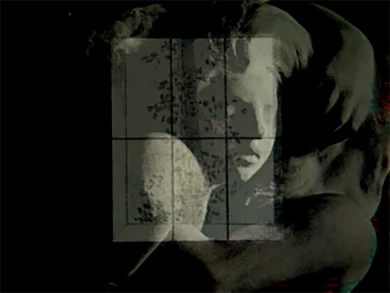
The second session screens two medium-length films by Jean-Luc Godard and Anne-Marie Miéville on time, ruin and museum. In The Old Place. Small Notes Regarding the Arts at Fall of 20th Century (1999), both film-makers consider what remains of that “old place”, the museum, at the close of a century of wars and totalitarianism, and ask whether it should be more of a legend or desire than a place. This same driving principle leads Godard to build his own imaginary museum in Reportage amateur (maquette expo) (2006), a rickety toy museum which, paradoxically, contains the great film-maker’s full power of thought on history and images.
Finally, the third session explores one of the major challenges of recent years: the decolonisation of the museum, the recognition of its link to imperialist discourses of power and the need to situate a new silenced or repressed subject at the centre of the Western narration of history. Under the title Museums and Restitution, it includes the film Undocumented. Unlearning Imperial Plunder (2019), by theorist Ariella Azoulay, Statues Also Die, by Alan Resnais and Chris Marker (1953), Kwate Nee-Owoo’s You Hide Me (1970) and the first screening of the short film Quinto verso, parte de Tonada (Fifth Verse, Part of Tonada), by La Vulcanizadora (Maria Rojas Arias and Andrés Jurado), filmed at the Museo de América in Madrid.
![Ariella Azoulay, Un-documented. Unlearning Imperial Plunder [Indocumentados. Desaprendiendo el saqueo imperial], 2019, película](https://recursos.museoreinasofia.es/styles/small_landscape/public/Actividades/5.diseminar-mundo.jpg.webp)
Museums and Restitution
Saturday, 19 September 2026 - 7pm
Centuries of plundering, decades of amnesia, years of living with unmitigated extractivist power… Does a museum, as we know it, have a raison d'être in a postcolonial society?
This session expounds the operations of the museum as a colonial machine, while putting forward ideas, in narration, for a more just, equal and inclusive institution of the future via society’s marginalised and minority voices. The session begins with the international premiere of Quinto verso, parte de Tonada (Fifth Verse, Part of Tonada), which presents a vision of the Quimbaya Collection (fifth and sixth centuries CE) from the Museo de América in Madrid. It is constructed with the voices and chants of Wayúu mourners and guides, not only as a way of reinstating the role of these gold idols — anthropomorphic figures of men and women used as vessels in ritual practices — but also to imagine that what must be exhibited is not the gold itself. It is the ritual’s own chant. In the classic film You Hide Me (1970), Ghanaian film-maker Kwate Nee-Owoo accesses the British Museum’s collection of African art, located in the building’s basement, to question the meaning behind a museum plundering and nullifying. A fine exercise of first-person institutional critique screened for the first time in Spain. Almost seventy years since Resnais and Marker made Statues Also Die (1953), a reflection on the aura-bearing value of the museum opposite the identity-based and cultural belonging of African art, theorist Ariella Azoulay films the same statues again at the Musée du Trocadéro (today the Musée du Quai Branly), which survive and wait to be reunited with their people. Azoulay, whose wholly original undertaking is a lesson to the museum of the future, connects the forced migration of these sculptures with the mass transit of people crossing borders artificially imposed by the same system that has plundered their culture.
The School of Transformative Institutionalism and Local Organisation
From 21 to 24 September 2026
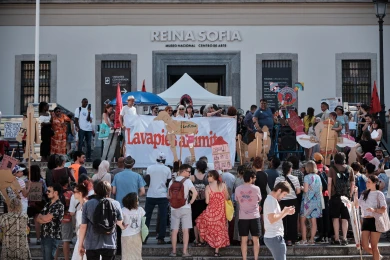
The School of Transformative Institutionalism and Local Organisation (S.T.I.L.O.) is a programme of joint learning and join strategy which sets in motion a process for the exchange of questions, methodologies and experiences between cultural organisations. The overall aim is to create, circulate and prototype tactics, tools and collective knowledge on institutional practices that open new channels for defending culture and advocating structural transformation in divergent geographical contexts.
The project is part of the Laboratorio de Institucionalidad Compartida (The Laboratory of Shared Institutionalism, LIC), a space for the Museo Reina Sofía’s research, work and advocacy centred on developing, experimenting with and systemising practices, protocols and tools which contribute to a fairer and more liveable cultural ecosystem.
For many years now, so-called infrastructural critique in museums questions material, legal and economic infrastructures, among others, as well as the forms of solidarity and practices required to sustain the cultural ecosystem. By approaching current debates, S.T.I.L.O. raises questions on the ways in which organisations define and interpret their practices, organise their relations and respond to the social contexts in which they operate.
The school gathers four cultural organisations that work via different institutional models – scale, contexts, conditions, different working models — with the goal of pooling common strategies and tools of organisation, advocacy and relationships with local communities.
The programme is conceived as a collaborative process with the participation of Arika, La Revuelta, BAK Basecamp and The Tentacular Museum (Museo Reina Sofía) and is structured around preparatory online sessions and an in-person seminar in Madrid.
S.T.I.L.O. is an activity framed inside the working strand of Situated Organisations from L'Internationale’s Museum of the Commons project, which reflects on the role of museums and art organisations as actors within complex social networks and ecosystems, with a view to exploring new ways to democratise institutions and make them more open, inclusive and useful.