-
Tuesday, 13, Wednesday, 14, and Thursday, 15 December 2022 Nouvel Building, Children’s Workshops, Floor -1
Workshop
RegistrationThis workshop explores the reverberations of underground visual culture today, shining a light on the trajectory of draughtswomen and the existence, or not, of genealogies with present-day artists via both theory and practice.
The first session traces a timeline from pioneering women comics artists in Spain to contemporary female fanzine artists and committed graphic art. The second session, conducted by Ángela Fernández del Campo, comprises practical exercises focused on boosting creative and critical meaning by way of different artistic techniques. The third and final session approaches self-management, the root of the DIY concept that makes alternative cultural production possible. It features Yeyei Gómez, the coordinator of two self-publishing events, Lo hacemos nosotras and Autozine, and Marika Vila, who will share her experience in this sphere.
-
Thursday, 15 December 2022 Nouvel Building, Protocol Room
Round-table Discussion
Tickets—Moderated by: Elisa McCausland
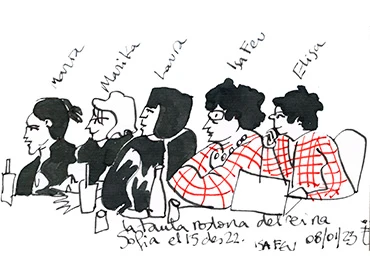
This round table features the participation of some of the most salient figures in Spain’s comix underground, for instance Isa Feu, Marta Guerrero, Laura Pérez Vernetti and Marika Vila, alongside researcher and spokesperson Elisa McCausland. As a coda to the programme, the discussion includes the first-person testimonies of these artists and widens the questions addressed in the previous workshop.
Documents 23. Women Artists from Spain’s Comix Underground
Workshop and Round-table
Held on 13, 14, 15 Dec 2022
The Documents programme explores the relationships between art and publishing, exploring themes that include the effects of archive on narratives of art history, the artist’s book and publishing as an artistic practice. This latest edition, comprising a workshop and a round-table discussion, recovers and grants visibility to women artists from Spain’s comix underground.
In the early 1970s in Spain, a vindication of ugliness, seediness and excess arose from a youth disillusioned and stymied by Francoist censorship, framed inside a context marked by the final repressive throes of the dictatorship. Numerous artists developed their work in magazines like El Rrollo enmascarado, El Víbora, Star and countless transgressive fanzines, yet women’s presence remained out of sight. The lack of women cartoonists was coupled with many women’s invisibility, either owing to careers being shelved in the world of comics or for working alongside other artists that ultimately emerged. Thus, this new edition of Documents recovers the work of female cartoonists such as Montse Clavé, Ana Miralles, Núria Pompeia and Mariel Soria, and serves as a prelude to a document-based show on the same theme, to be held in the Museo’s Library and Documentation Centre in 2023.
A workshop coordinated by illustrator Yeyei Gómez and a round-table discission, featuring the participation of artists such as Isa Feu, Marta Guerrero, Laura Pérez Vernetti and Marika Vila, highlight the role these women played in developing Spanish counterculture and in creating new narratives and references from the feminism of the time.
[dropdown]
Isa Feu (1956) is a draughtswoman and comic book artist who regularly contributed to magazines such as Los tebeos del Rrollo, El Víbora and Cavall Fort. She also published illustrations in Diario de Barcelona, La Vanguardia, El Periódico and other periodic publications, and her works have been displayed in the rooms of Metrònom (Barcelona), Amadís (Madrid) and Vinçon (Barcelona). Since 1991, she has worked in film as an assistant set designer.
Ángela Fernández del Campo (1991) is an illustrator and silk-screen printer. She is the founder of the silk-screen printing and illustration workshop La Caverna (Madrid), and is a participant in the Autozine Festival, in Madrid, and a member of publishing collectives such as Turbina Magia and Ediciones Cavernícolas. Moreover, she has participated in self-publishing events like Gutter Fest (Barcelona), Vendetta (Marseille), Hungry Eyes (Berlin) and Tenderete (Valencia). In 2016, she was awarded the CreaCIC (Cuenca) First Prize for Illustration.
Yeyei Gómez (1993) is a draughtswoman and cartoonist who works in the field of editorial illustrations, graphic-art humour and poster art, publishing her work in newspapers such as The New York Times and El Salto and with publishers like Penguin Random House. Her self-published works include Cuaderno de clase (2019), Guy (2017) and Naufragio Universal (2017). In 2021, she was awarded a grant from the Academy of Spain in Rome.
Marta Guerrero (1965) is a draughtswoman, designer and animation director. She was a regular contributor to the magazines ¡¡Al ataque!! and El Víbora, publishing the series Los sonidos del morbo, Sarita and Dolores sus labore. She also made …De ellas (Edicions de Ponent, 2006) and has participated in collective exhibitions that include Brazil Inspiração and El cómic en la democracia española, 1975-2005/6 (Brussels, 2005). In 2017 she premiered the aminated short film El Mag.
Elisa McCausland (1983) is a journalist, critic and researcher specialised in comics. She is a regular contributor to Dirigido por, El Salto and Sofilm, and her most notable publications include Wonder Woman. El feminismo como superpoder (Errata Naturae, 2017) and, with Diego Salgado, Supernovas. Una historia de la ciencia ficción audiovisual (Errata Naturae, 2019) and Sueños y Fábulas. Historia de Vertigo (Ecc Ediciones, 2022). Furthermore, she has curated the exhibition Presentes: Autoras de tebeo de ayer y hoy (Rome, 2016), and promoted Colectivo de Autoras de Cómic (The Collective of Women Comics Artists) and is a member of the Association of Spain’s Comix Critics and Spokespeople.
Laura Pérez Vernetti (1958) is a comics artist, illustrator and photographer. She is a regular contributor to the magazine El Víbora, and has published the albums El toro blanco (La Cúpula, 1989), Las habitaciones desmanteladas (Edicions de Ponent, 1999), El brillo del gato negro (Edicions de Ponent, 2008) and Sarà Servito (Edicions de Ponent, 2010). She has exhibited her work in the Museo de Arte Contemporáneo de Madrid, Es Baluard Museu (Palma de Mallorca) and the Centre de Cultura Contemporània de Barcelona, among others.
Marika Vila (1949) is a comics artist, illustrator, curator and teacher. Her works have been disseminated in Butifarra!, El Periódico de Catalunya, Totem and El Papus, and most notably include the comic strips Si en el día una mujer… ( Troya/Totem), Dossier Amparo Torrego ( Totem) and Mata Hari (Isla de Nabumbu, 2019). She has also received the Homage Prize for her career at the XVIII Salón del Cómic de Getxo (2019), the Honorary Prize from the Colectivo de Autoras de Cómic (The Collective of Women Comics Artists, 2020) and the Girocòmic Prize (2022), among others.
[/dropdown]
Curated by
Raquel Jimeno y Alberto Medina
Organised by
Museo Reina Sofía
Collaboration
Illycaffè and Colectivo de Autoras de Cómic
Programme
Participants
Participants


Más actividades
Institutional Decentralisation
Thursday, 21 May 2026 – 5:30pm
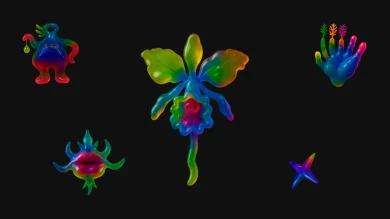
This series is organised by equipoMotor, a group of teenagers, young people and older people who have participated in the Museo Reina Sofía’s previous community education projects, and is structured around four themed blocks that pivot on the monstrous.
This fourth and final session centres on films that take the museum away from its axis and make it gaze from the edges. Pieces that work with that which is normally left out: peripheral territories, unpolished aesthetics, clumsy gestures full of intent. Instead of possessing an institutional lustre, here they are rough, precarious and strange in appearance, legitimate forms of making and showing culture. The idea is to think about what happens when central authority is displaced, when the ugly and the uncomfortable are not hidden, when they are recognised as part of the commons. Film that does not seek to be to one’s liking, but to open space and allow other ways of seeing and inhabiting the museum to enter stage.
![Tracey Rose, The Black Sun Black Star and Moon [La luna estrella negro y negro sol], 2014.](https://recursos.museoreinasofia.es/styles/small_landscape/public/Obra/AD07091_2.jpg.webp)
On Black Study: Towards a Black Poethics of Contamination
Monday 27, Tuesday 28 and Wednesday 29 of April, 2026 – 16:00 h
The seminar On Black Study: Towards a Black Poethics of Contamination proposes Black Study as a critical and methodological practice that has emerged in and against racial capitalism, colonial modernity and institutional capture. Framed through what the invited researcher and practitioner Ishy Pryce-Parchment terms a Black poethics of contamination, the seminar considers what it might mean to think Blackness (and therefore Black Study) as contagious, diffuse and spreadable matter. To do so, it enacts a constellation of diasporic methodologies and black aesthetic practices that harbor “contamination” -ideas that travel through texts, geographies, bodies and histories- as a method and as a condition.
If Blackness enters Western modernity from the position of the Middle Passage and its afterlives, it also names a condition from which alternative modes of being, knowing and relating are continually forged. From within this errant boundarylessness, Black creative-intellectual practice unfolds as what might be called a history of touches: transmissions, residues and socialities that unsettle the fantasy of pure or self-contained knowledge.
Situated within Black radical aesthetics, Black feminist theory and diasporic poetics, the seminar traces a genealogy of Black Study not as an object of analysis but as methodological propositions that continue to shape contemporary aesthetic and political life. Against mastery as the horizon of study, the group shifts attention from what we know to how we know. It foregrounds creative Black methodological practices—fahima ife’s anindex (via Fred Moten), Katherine McKittrick’s expansive use of the footnote, citation as relational and loving labour, the aesthetics of Black miscellanea, and Christina Sharpe’s practices of annotation—as procedures that disorganise dominant regimes of knowledge. In this sense, Black Study is approached not as a discrete academic field but as a feel for knowing and knowledge: a constellation of insurgent practices—reading, gathering, listening, annotating, refusing, world-making—that operate both within and beyond the university.
The study sessions propose to experiment with form in order to embrace how ‘black people have always used interdisciplinary methodologies to explain, explore, and story the world.’ Through engagements with thinkers and practitioners such as Katherine McKittrick, C.L.R. James, Sylvia Wynter, Christina Sharpe, Fred Moten, Tina Campt, Hilton Als, John Akomfrah, fahima ife and Dionne Brand, we ask: What might it mean to study together, incompletely and without recourse to individuation? How might aesthetic practice function as a poethical intervention in the ongoing work of what Sylvia Wynter calls the practice of doing humanness?
Intergenerationality
Thursday, 9 April 2026 – 5:30pm
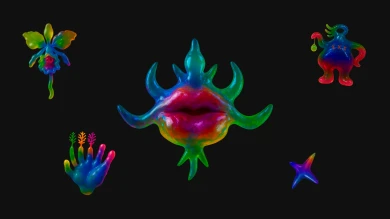
This series is organised by equipoMotor, a group of teenagers, young people and older people who have participated in the Museo Reina Sofía’s previous community education projects, and is structured around four themed blocks that pivot on the monstrous.
The third session gazes at film as a place from which to dismantle the idea of one sole history and one sole time. From a decolonial and queer perspective, it explores films which break the straight line of past-present-future, which mix memories, slow progress and leave space for rhythms which customarily make no room for official accounts. Here the images open cracks through which bodies, voices and affects appear, disrupting archive and questioning who narrates, and from where and for whom. The proposal is at once simple and ambitious: use film to imagine other modes of remembering, belonging and projecting futures we have not yet been able to live.
Remedios Zafra
Thursday March 19, 2026 - 19:00 h
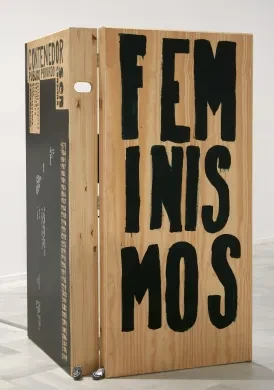
The José Luis Brea Chair, dedicated to reflecting on the image and the epistemology of visuality in contemporary culture, opens its program with an inaugural lecture by essayist and thinker Remedios Zafra.
“That the contemporary antifeminist upsurge is constructed as an anti-intellectual drive is no coincidence; the two feed into one another. To advance a reactionary discourse that defends inequality, it is necessary to challenge gender studies and gender-equality policies, but also to devalue the very foundations of knowledge in which these have been most intensely developed over recent decades—while also undermining their institutional support: universities, art and research centers, and academic culture.
Feminism has been deeply linked to the affirmation of the most committed humanist thought. Periods of enlightenment and moments of transition toward more just social forms—sustained by education—have been when feminist demands have emerged most strongly. Awareness and achievements in equality increase when education plays a leading social role; thus, devaluing intellectual work also contributes to harming feminism, and vice versa, insofar as the bond between knowledge and feminism is not only conceptual and historical, but also intimate and political.
Today, antifeminism is used globally as the symbolic adhesive of far-right movements, in parallel with the devaluation of forms of knowledge emerging from the university and from science—mistreated by hoaxes and disinformation on social networks and through the spectacularization of life mediated by screens. These are consequences bound up with the primacy of a scopic value that for some time has been denigrating thought and positioning what is most seen as what is most valuable within the normalized mediation of technology. This inertia coexists with techno-libertarian proclamations that reactivate a patriarchy that uses the resentment of many men as a seductive and cohesive force to preserve and inflame privileges in the new world as techno-scenario.
This lecture will address this epochal context, delving into the synchronicity of these upsurges through an additional parallel between forms of patriarchal domination and techno-labor domination. A parallel in which feminism and intellectual work are both being harmed, while also sending signals that in both lie emancipatory responses to today’s reactionary turns and the neutralization of critique. This consonance would also speak to how the perverse patriarchal basis that turns women into sustainers of their own subordination finds its equivalent in the encouraged self-exploitation of cultural workers; in the legitimation of affective capital and symbolic capital as sufficient forms of payment; in the blurring of boundaries between life and work and in domestic isolation; or in the pressure to please and comply as an extended patriarchal form—today linked to the feigned enthusiasm of precarious workers, but also to technological adulation. In response to possible resistance and intellectual action, patriarchy has associated feminists with a future foretold as unhappy for them, equating “thought and consciousness” with unhappiness—where these have in fact been (and continue to be) levers of autonomy and emancipation.”
— Remedios Zafra
27th Contemporary Art Conservation Conference
Wednesday, 4, and Thursday, 5 March 2026
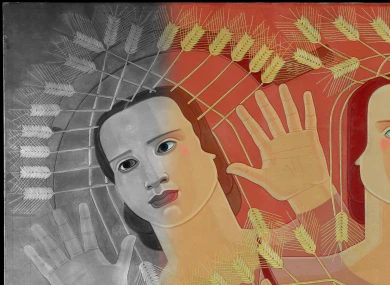
The 27th Contemporary Art Conservation Conference, organised by the Museo Reina Sofía’s Department of Conservation and Restoration, with the sponsorship of the Mapfre Foundation, is held on 4 and 5 March 2026. This international encounter sets out to share and debate experience and research, open new channels of study and reflect on conservation and the professional practice of restorers.
This edition will be held with in-person and online attendance formats, occurring simultaneously, via twenty-minute interventions followed by a five-minute Q&A.