-
Friday, 3 December 2021 - 6pm Nouvel Building, Auditorium 200
The Possible Reinas
Lecture by Moisés Puente
TicketsThis lecture analyses the prototypes from the architect’s offices that participated in the International Architecture Tender to Expand the Museo Reina Sofía, organised in 1999. Such a tender brought together over one hundred international studios and in the final stretch saw twelve finalists compete: Tadao Ando, Santiago Calatrava, Antonio Cruz and Antonio Ortiz, David Chipperfield, Manuel de las Casas, Zaha M. Hadid, Enric Miralles and Benedetta Tagliabue, Luis Moreno Mansilla and Emilio Tuñón, Juan Navarro Baldeweg, Jean Nouvel (the final winner of the tender), Dominique Perrault and Guillermo Vázquez Consuegra. The prototypes and documents from the Central Archive, shown for the first time in this lecture, have been recovered following extensive research allowing participants’ reflections on the institution to be reviewed, as well as elucidating the development of some of the ideas on the Museo that never came to fruition, for instance a public garden and large communal spaces.
-
Tuesday, 14 December 2021 – 6pm Tour from the Central Archive
Tour from the Central Archive
InscripciónIn the second session of the activity, Isabel Bordes, Alberto Medina and Daniel Pecharromán, members of the Library and Central Archive team, will introduce the archive and conduct a tour around different rooms and places in the Museo with the aim of evaluating, in situ, the spatial and functional evolution of some of the buildings that make up the institution, as well as casting light on the impact of these architectural and urbanistic decisions on the civic environment. The visit contributes to offering new perspectives on the usual areas of the Museo, and includes stops at less-frequent or little-known places for visitors, and to highlight different projects in which the Museo is currently immersed. The visit concludes at one of the repositories of the Central Archive, where the team will show some of the roles, aims and services of this documentary centre and a selection of materials related to the institution’s architecture: objects, plans, photographs and other documents able to reconstruct one part, partial and incomplete but also engrossing and unknown, of the history of the institution.
Documents 20. The Idea of a Museum
Architecture from the Museo Reina Sofía’s Central Archive

Held on 03 Dec 2021
The Documents programme explores the relationships between art and publishing, and other subjects that include the effects of archive on narratives of art history, the artist’s book and publishing as an artistic practice. This new edition analyses the presence of architecture in the Museo Reina Sofía’s Central Archive, a repository of memory containing, in fragments, the history of the institution: its origins as a hospital of neoclassicism, its role during the Spanish Civil War as a field hospital, its transformation into an art centre and its expansion as an international museum. Various landmarks that enable a micro history of civil and public architecture to be traced from the 18th century to the present day, but without losing sight of the process of configuration and the idea of what a museum must be.
Documents 20 unfolds across two sessions. In the first, editor, critic and architectural historian, Moisés Puente, gives a lecture in which he analyses the prototypes of the different architect’s offices that participated in the International Architecture Tender to Expand the Museo Reina Sofía, organised in 1999. In the second, the Library and Central Archive team will conduct a visit around the Museo, focusing on documents created by this tender and preserved in the institution.
Moisés Puente is an architect, editor and translator of architectural subjects. He is the editor of the magazine 2G and founder of the independent publisher Puente Editores. Furthermore, he has edited books with texts by Alejandro de la Sota, Josep Llinàs, Jørn Utzon and Mies van der Rohe, among others, and is the author of monographs on the domestic work of Mies van der Rohe and the work of Alejandro de la Sota. In 2010, he won an FAD Award for Thought and Critique for his professional career as an editor. He has recently published Cháchara y otras historias de la arquitectura (Caniche editorial, 2021)
Organised by
Museo Reina Sofía
Collaboration
illycaffèParticipants
Participants


Más actividades
![Jean Vigo, Taris, ou la natation [Taris, rey del agua], 1931, película](https://recursos.museoreinasofia.es/styles/small_landscape/public/Actividades/ciclocine-piscinas-7.jpg.webp)
Leni Riefenstahl. Olympia, Part 2. Festival of Beauty and Jean Vigo. Taris, Swimming Champion
Friday, 24 July 2026
The body in water as an object of ideology. This is one of the major themes of the 1930s and this session, where Nazism and Anarchism dissolve into two different swimming pools. Two great films of counterposed ideologies which have gone down in history as examples of film’s power to represent a vision of the world. In Olympia, Part 2. Festival of Beauty, Leni Riefenstahl films the Olympic Games of Berlin in 1936, organised during the Third Reich. The camera leaves the athletics stadium to show the repertoire of modern sports — fencing, polo, cycling, pentathlon — before culminating in the Olympic pool with Adolf Hitler as the host, where the beautiful, disciplined, classical bodies of the swimmers bring to mind, as Susan Sontag wrote, the visual fascination that characterised fascism. Meanwhile, Jean Vigo, the son of an exiled Spanish anarchist, films French Olympic champion Jean Taris in a funny, playful exercise, where the swimming pool becomes a field of play without rules and where avant-garde film-making elements of the 1930s materialise, such as slow motion, superimposed images and dynamic editing. Two avant-garde films, two films on opposite poles that show, for a time, swimming not as an object of pleasure or desire, but as a space of contest from which to demonstrate the power of the twentieth century’s great ideologies.
![François Ozon, Swimming Pool [La piscina], 2003, película](https://recursos.museoreinasofia.es/styles/small_landscape/public/Actividades/ciclocine-piscinas-6.jpg.webp)
François Ozon. Swimming Pool
Saturday, 18 July 2026
Sarah Morton (Charlotte Rampling), a frustrated English writer paralysed by writer’s block, is invited by her editor to spend a few days in her summer house in the south of France. While there she meets Julie (Ludivine Sagnier), the editor’s uninhibited daughter. The young girl’s hypersexuality clashes with Morton’s cold nature, an initial hostility which turns into a fascination with the private life of the young girl, serving the writer as inspiration for her new novel and tugging the story to an ambiguous game between truth and imagination.
Being in crisis is wanting to be another person. Sarah wants to absorb the vitality of her young host, a process of metamorphosis triggered by the swimming pool. The pool is the film’s central character, the place where Julie shows her naked body and amorous acts, sending Sarah into a state of agitation. Through the pool and its water, the writer drinks in Julie’s wild passion. The aquatic enclosure thus acts as catharsis: the place where the subconscious of the writer flourishes, enabling her to unleash her creativity and free her fantasies. At the same time, water distorts the image, blurring fiction and reality; ultimately, the necessary medium to keep art afloat.
Jonathan Glazer. Sexy Beast
Friday, 17 July 2026
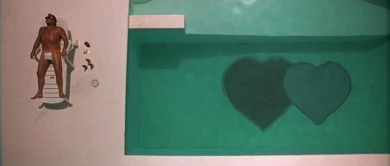
Gal Dove (Ray Winstone), a criminal for the British mafia, lives happily retired with his wife in an idyllic villa in southern Spain and a dazzling swimming pool. Their peace is shattered with the arrival of Don Logan (Ben Kingsley), a former gangster and criminal associate who wants to convince him to do one last job.
If a swimming pool can be at the heart of suspense, then Sexy Beast is the quintessence. The reflection of blue water in Gal’s idyllic seclusion symbolises the artificial paradise that can be broken at any time. This first feature-length film by British director Jonathan Glazer (also the director of The Zone of Interest, 2023) starts with one of the most striking swimming pool scenes, a symbol for the impending danger about to reach this whitewashed haven of peace. The perfect vision of recreated beauty — luxury pools on the Andalusian coast — which, in the depths of pristine water, conceals an unsettling fear of returning to the past.
Sofia Coppola. Somewhere
Saturday, 11 July 2026
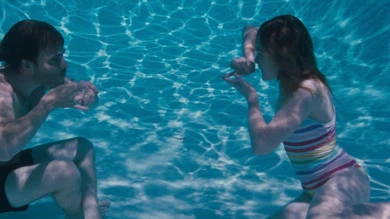
Johnny Marco (Stephen Dorff), a famous Hollywood actor, lives a life of pleasure in Hotel Chateau Marmont in Los Angeles, drifting aimlessly between vacuous relationships, punctuated by film shoots and commercial duties. Cleo (Elle Fanning), his eleven-year-old daughter, stays with him for a few weeks due to her mother’s absence, forcing him to rethink his life.
Sofia Coppola’s employment of swimming pools is carefully considered in the film — blue water in Somewhere is the only place where Marco can recover the meaning of his existence as the pool acts as a womb in which he finds balance. While living with his daughter Cleo and the reflection of these aquatic moments — diving under water, floating, playing or simply sunbathing with no real purpose — everything happens. Thus, Coppola explores in depth themes such as fame, loneliness and the complexity of human ties, putting forward an intimate and profound portrait full of the subtleties of life.
![Céline Sciamma, Naissance des pieuvres [Lirios de agua], 2007, película](https://recursos.museoreinasofia.es/styles/small_landscape/public/Actividades/ciclocine-piscinas-3.jpg.webp)
Céline Sciamma. Water Lilies
Friday, 10 July 2026
Céline Sciamma’s directorial debut, Naissance des pieuvres,depicts the emotional and sexual awakening of three teenagers around an indoor swimming pool in a Parisian suburb. Marie, a fifteen-year-old introvert, becomes fascinated by Floriane, the charismatic captain of a local synchronised swimming team. Driven by this attraction, Marie tries to get closer to her while observing the complex dynamics of desire, friendship and power that develops between the young girls. At the same time, Anne, one of Marie’s friends, has her own experience of insecurity and affective search, shaped by the pressure to fit in and belong. As the relationship between the three intensifies, contradictions surface between the image they outwardly project and their real feelings.
Standing away from the common places on adolescence, Céline Sciamma explores first love, burgeoning queer identity and the uncertainty of desire with an intimate, observational gaze, resulting in a sensitive and honest portrait of a time of transformation, in which each gesture leads to the passage from childhood to adulthood.