Films of the Dead and the Living
Session 3. Tactical Spectres. Visions of Anti-colonial and Decolonial Cinema
![Filipa César y Marinho de Pina, Resonance Spiral [Espiral en resonancia], 2024, película](https://recursos.museoreinasofia.es/styles/small_landscape/public/Actividades/6_0-espectros-tacticos.jpg.webp)
Filipa César and Marinho Pina, Resonance Spiral, 2024, film
Held on 12 Sep 2026
Filmed collectively by Sana na N’Hada, Flora Gomes, José Bolama Cubumba, Djalma Martins Fettermann and Josefina Lopes Crato two years after the declared independence in Guinea-Bissau in 1974, O Regresso de Amílcar Cabral (1976) documents a ritual of mourning: the transfer of the mortal remains of Amílcar Cabral, assassinated in 1973, from Conakry to Bissau. The film shows the importance of cinema, teaching and the construction of emancipatory infrastructures in the anti-colonial leader’s political-cultural project. Its spectral dimension, explored by Filipa César and strengthened by re-employing modes of archives, situates it beyond the naturalism of representation to reflect the contiguity between the visible and the invisible of vernacular cosmologies — “We, the Africans, firmly believe that the dead carry on living by our side; we are a society of the dead and the living”, Cabral said. O Regresso de Amílcar Cabral is a key film for thinking what cinema is, and what it can be, in times of fascism and genocide and reflects on the delicate balance between information and invention.
Resonance Spiral (2024), co-directed by Portuguese film-maker Filipa César and Bissau- Guinean architect and film director Marinho Pina, converses with history, memory and audiovisual forms of the liberation struggle in Guinea-Bissau, expanding the performativity of film; namely, its capacity to change the real. Continuing work to compile and digitise the anti-colonial archives of this African country, started by César in 2011, Resonance Spiral accompanies, and fosters, the process of constructing the Mediateca Onshore, in Malafo. Located in the geographical centre of Guinea-Bissau, this horizontal emancipatory infrastructure of teaching and community was founded by the film-maker Marinho Pina and his partners and houses a media library and sound archives on the anti-colonial struggle. Not only does the film return anti-colonial archives into circulation, thereby creating a living archive beyond the category of “archive”, but it also makes the principle of circulation its formal driving force. The modes of horizontal and vertical montage, with the mutual permeation of visual and sound elements, give presence to the liberation struggle and affirm a cyclical conception of time and revolution, of which spirals and spiralling archives are forms of expression.
Organised by
Museo Reina Sofía
Inside the framework of
Sonic and Cinema Commons. L'Internationale
Acknowledgements
The Film Foundation / World Cinema Project / Fondazione Cineteca di Bologna




Accessible activity
This activity has two spaces reserved for people with reduced mobility.
Agenda
sábado 12 sep 2026 a las 19:00
Programme
— With a presentation by the programme’s curator, Raquel Schefer, and a talk by film-maker and researcher Filipa César
Sana na N'Hada, Flora Gomes, José Bolama Cubumba, Djalma Martins Fettermann and Josefina Lopes Crato. O Regresso de Amílcar Cabral (The Return of Amílcar Cabral)
Guinea-Bissau, 1976, DCP, colour, sound, original version in Portuguese, Guinea-Bissau Creole, Mandinka and French, with Spanish subtitles, 32'–33'
Restored in 4K by the World Cinema Project from the Film Foundation and the Cineteca di Bologna (the L'Immagine Ritrovata laboratory), in collaboration with the Cooperativa de Produção Cinematográfica e Audiovisual Geba Filmes. Funded by the Hobson/Lucas Family Foundation. This restoration is part of the African Film Heritage Project, an initiative created by the Film Foundation’s World Cinema Project, Fédération Panafricaine des Cinéastes and UNESCO, in collaboration with Cineteca di Bologna, to locate, restore and disseminate African cinema.
Filipa César and Marinho Pina. Resonance Spiral
Portugal, Guinea-Bissau and Germany, 2024, DCP, colour, sound, original version in Guinea-Bissau Creole, Cape Verde Creole, French and Portuguese, with Spanish subtitles, 92'
![Sana na N'Hada, Flora Gomes, José Bolama Cubumba, Djalma Martins Fettermann, Josefina Lopes Crato, O Regresso de Amílcar Cabral [El regreso de Amílcar Cabral], 1976, película.](https://recursos.museoreinasofia.es/styles/small_landscape/public/Actividades/5_2-espectros-tacticos.jpg.webp)
![Filipa César y Marinho Pina, Resonance Spiral [Espiral en resonancia], 2024, película](https://recursos.museoreinasofia.es/styles/small_landscape/public/Actividades/6_2-espectros-tacticos.jpg.webp)
![Filipa César y Marinho de Pina, Resonance Spiral [Espiral en resonancia], 2024, película](https://recursos.museoreinasofia.es/styles/small_landscape/public/Actividades/6_4-espectros-tacticos.jpg.webp)
![Filipa César y Marinho de Pina, Resonance Spiral [Espiral en resonancia], 2024, película](https://recursos.museoreinasofia.es/styles/small_landscape/public/Actividades/6_1-espectros-tacticos.jpg.webp)
![Filipa César y Marinho Pina, Resonance Spiral [Espiral en resonancia], 2024, película](https://recursos.museoreinasofia.es/styles/small_landscape/public/Actividades/6_3-espectros-tacticos.jpg.webp)
![Sana na N'Hada, Flora Gomes, José Bolama Cubumba, Djalma Martins Fettermann, Josefina Lopes Crato, O Regresso de Amílcar Cabral [El regreso de Amílcar Cabral], 1976, película](https://recursos.museoreinasofia.es/styles/small_landscape/public/Actividades/5_1_1.jpg.webp)
Activity within the program...
Tactical Spectres. Visions of Anti-colonial and Decolonial Cinema
Cinema Commons: Reclaiming Land
Cinema Commons, organised in two annual editions, is a European project of research, programming and publishing which explores how film articulates interpretive communities, fosters collective debate and devises proposals for common spaces. This instalment centres on the poetics of land, conceived as a horizontal space of distributed property, and as a form of learning to construct a filmic imaginary rooted in a reclamation of territory. The edition pivots around two moments in time: a programme of screenings and debate in September, curated by historian and curator Raquel Schefer and featuring film-maker Filipa César, and a spotlight in December shone on artist Ben Russell, whose practice concentrates on processes of direct action in dialogue with different collectives and social agents struggling for the representation of work and the common use of land.
Tactical Spectres surveys anti-colonial and decolonial cinema through the prism of spectrality. Setting films from different historical times and geographical zones in contact and tension with one another, the programme explores film’s capacity to reveal the material and spectral scope of logistical infrastructures from the capitalist-colonial system, as well as processes for implementing emancipatory infrastructures. The formal experimentation of certain films operates from a principle of mimetic variation — of separation and transfiguration, beyond a simple reproduction of the real — which, breaking from naturalism and “archive images” of colonial modernity, contributes to desecrating and restoring the common use of these infrastructures. Other works give formal expression to vernacular or local ontologies, external to the paradigm of colonial modernity, upon documenting processes of creating collective and community infrastructures. The spectral in anti-colonial and decolonial cinema, understood as an operative, tactical principle, works as an engine of visualities, realisms, epistemologies and materialities of other, as well as an expression and tool of common film-making and being.
Skip Norman’s On Africa (1970) examines the inner workings of colonialism, in tension with a cartography of anti-colonial liberation movements. Shot in West Berlin, the film sketches a spectral counter-ethnography of the city and its logistical infrastructures, also a central gesture in the presence-absence dialectics of Basma al-Sharif’s Morgenkreis (2025). Mahmoud Alhaj’s Control Anatomy (2024) desecrates military images of the colonial army and Israeli genocide by opening up a sensitive counter-shot. The experimental forms of editing in Scenes of the Occupation from Gaza (1973), by Mustafa Abu Ali and the Palestine Film Unit, create powerful images of thought and resistance, while the collective film O Regresso de Amílcar Cabral (The Return of Amílcar Cabral, 1976) documents the return of the mortal remains of the leader and anti-colonial thinker to Bissau via a spectral ontology, in line with the fluid transitions between the realm of the living and the dead in vernacular cultural conceptions. Resonance Spiral (2024), by Filipa César and Marinho Pina, also adopts an inter-visual and inter-epistemological matrix to grant visibility to and document the construction of the Mediateca Onshore, a community infrastructure in Guinea-Bissau, in dialogue with the local population and their temporal and cosmological conceptions.
This corpus of films occasions a rethinking of the relationship between politics and aesthetics. Upon mobilising formal experimental processes opposite the spectral, the “tactical spectres” — an expression of British poet Sean Bonney — these films break from the anti-colonial and decolonial film canon to highlight the political nature of aesthetics, placing at odds the conventional separation between experimental film and militant film. Equally, the process of varying from the real, produced in these representations committed to the world’s collective transformation, offers other readings of the performative nature of cinema, enabling, in parallel, certain notions to be questioned, such as “objectivity”, which have historically defined anti-colonial, decolonial and, more loosely, militant film and documentary. Underlying these manifestations and desecrations of the spectral is a thinking around the ontologies of cinema as a possibility of decolonialising the sphere of representation.
Ver programaFilms of the Dead and the Living
Past activity
Filmed collectively by Sana na N’Hada, Flora Gomes, José Bolama Cubumba, Djalma Martins Fettermann and Josefina Lopes Crato two years after the declared independence in Guinea-Bissau in 1974, O Regresso de Amílcar Cabral (1976) documents a ritual of mourning: the transfer of the mortal remains of Amílcar Cabral, assassinated in 1973, from Conakry to Bissau. The film shows the importance of cinema, teaching and the construction of emancipatory infrastructures in the anti-colonial leader’s political-cultural project. Its spectral dimension, explored by Filipa César and strengthened by re-employing modes of archives, situates it beyond the naturalism of representation to reflect the contiguity between the visible and the invisible of vernacular cosmologies — “We, the Africans, firmly believe that the dead carry on living by our side; we are a society of the dead and the living”, Cabral said. O Regresso de Amílcar Cabral is a key film for thinking what cinema is, and what it can be, in times of fascism and genocide and reflects on the delicate balance between information and invention.
Resonance Spiral (2024), co-directed by Portuguese film-maker Filipa César and Bissau- Guinean architect and film director Marinho Pina, converses with history, memory and audiovisual forms of the liberation struggle in Guinea-Bissau, expanding the performativity of film; namely, its capacity to change the real. Continuing work to compile and digitise the anti-colonial archives of this African country, started by César in 2011, Resonance Spiral accompanies, and fosters, the process of constructing the Mediateca Onshore, in Malafo. Located in the geographical centre of Guinea-Bissau, this horizontal emancipatory infrastructure of teaching and community was founded by the film-maker Marinho Pina and his partners and houses a media library and sound archives on the anti-colonial struggle. Not only does the film return anti-colonial archives into circulation, thereby creating a living archive beyond the category of “archive”, but it also makes the principle of circulation its formal driving force. The modes of horizontal and vertical montage, with the mutual permeation of visual and sound elements, give presence to the liberation struggle and affirm a cyclical conception of time and revolution, of which spirals and spiralling archives are forms of expression.
![Mahmoud Alhaj, Control Anatomy [Anatomía del control], 2024, película](https://recursos.museoreinasofia.es/styles/small_landscape/public/Actividades/3_0-espectros-tacticos.jpg.webp)
Desecrations and Images of Thought
Past activity
Morgenkreis (Morning Circle, 2025), by Basma al-Sharif, a film-maker of Palestinian origin, transposes the counter-ethnographic spectral gaze of On Africa to the enunciative present as it travels through the logistical infrastructures of Berlin, and its lines of transit and post-modern architectures. As well as revealing the layers of history, these infrastructures embody post-Ford capitalism, while their figurations evoke Germany’s hand in various genocides, including genocide in Armenia, to whose diaspora the characters belong. This film, shot in 16mm, questions the biopolitical devices of German society through the stark gaze and voiceover of the police interrogator, as well as the desecration of the kindergarten morning circle, an important disciplinary mechanism in modern nation-states introduced in nineteenth-century Germany. If the circle here is motif and form, then the film is also traversed by the dialectic of presence-absence, central to Palestinian poetry and film, by forms of absence that become forms of presence in the media-circulated images of genocide in Palestine.
In dialogue with a genealogy of the film analysis practices of “war inscriptions”, Control Anatomy (2024), by Palestine film-maker Mahmoud Alhaj, also unfurls mechanisms of desecration, here in the reconstruction of Israeli colonialism in Gaza by way of images that document the evolving military technology of occupation and genocide. Their redeployment coincides with the opening of a sensitive counter-shot through the sound plane, inverting the non-reciprocity between the gaze of the observer and the gaze of the observed — the dominator is symbolically subjected to the gaze of the dominated.
Directed by Mustafa Abu Ali with the Palestine Film Unit, a militant film collective founded in 1968, Scenes of the Occupation from Gaza (1973) documents the Israeli occupation in Gaza after the Six-Day War. The film maps the biopolitics of colonialism, framing them against anti-colonial resistance as an emancipatory infrastructure. It also breaks from the militant film canon as it generates, through montage, images of thought encompassing actions of resistance in the film syntagm. Here too, formal experimentation is a tool of decolonisation in the sphere of representation.
![Skip Norman, On Africa [Sobre África], 1970, película](https://recursos.museoreinasofia.es/styles/small_landscape/public/Actividades/1_1_0-espectros-tacticos.jpeg.webp)
Ghosts Looming Over Europe
Past activity
Digitised in 2021 by the Arsenal Filminstitut, in collaboration with the Harun Farocki Institut, following a long period of obscurity, On Africa was made by American film-maker, visual anthropologist and teacher Skip Norman in 1970 following his graduation from the German Film and Television Academy in Berlin, as part of its first graduating class, along with other figures such as Harun Farocki, Hartmut Bitomsky and Holger Meins.
On many levels, On Africa is a film of substitution. Norman sought to document the liberation struggle against Portuguese colonialism in Angola, yet, as the colonial authorities blocked his arrival in Luanda — for lacking a permit to film, by all accounts — the crew recorded and edited the film in West Berlin. The intricate material history of its shooting goes some way to explaining the complex formal fabric of On Africa and its high level of reflexiveness. The film is dialectically structured by two vectors, aligned and breaking with, respectively, the anti-colonial film canon from that period in history. On one side, a didactic vector, developed through the re-deployment and montage of colonial and anti-colonial archive photographs, accompanied by an ensemble of voiceovers which start by elucidating the workings of colonialism, before presenting, and listing, African anti-colonial liberation movements. And on the other, an experimental vector, developed in two narrative segments noteworthy for their high degree of experimentation and counter-ethnographic scope. Thus, the travellings on Kurfürstendamm, one of the major arteries of old West Berlin — shot in 16mm and black and white and formalising a movement of rotating the gaze — are rendered as negatives to grant visibility to the spectral dimension of the infrastructures of the old metropolis. Furthermore, the sequence of archive photographs from the Berlin Conference (1884–1885) not only reconstructs the history of the modern colonial system, but also confronts German society with a mirror — no longer opaque — of its own colonialism. On Africa sustains the spectral dimension of certain urban symphonies which, upon manifesting a “disdain of the mimetic”, a phrase by American theorist Annette Michelson in reference to Dziga Vertov, divert the dominant perceptive and cognitive model. More than a manifesto on the politics of colonialism and anti-colonialism, On Africa is an affirmation of an expression and a tool of decolonialisation from the sphere of representation.
Más actividades
![Isabel Coixet, 100 Years and You Everywhere [100 años y tú en todos los sitios], 2026, película](https://recursos.museoreinasofia.es/styles/small_landscape/public/Actividades/2.diseminar-mundo.jpg.webp)
John Berger and Isabel Coixet. Continued Ways of Seeing
Thursday, 17 September 2026 at 7pm
Ways of Seeing (1972) is one of the most revolutionary television series on art history, the museum and contemporary critical culture. Across four episodes, an articulate, enthusiastic John Berger unpacks the relationships between classical art through the gaze and new technology, the nude and feminism, the oil painting and commodity fetichism, advertising and consumerism. In essence, a level of critical commitment only comparable to its capacity for dissemination. Unsurprisingly, the series, and the book that would distil it, continues to forge vocations. This session sees art historians Alberto López Cuenca and Modesta Di Paola carry out an analysis of Berger’s audiovisual work, placing the stress on episodes one and four of the series. In the first episode, Berger reflects on the connection between the act of seeing, looking and being in light of new technology, such as the film camera. At the same time, it analyses how the culture of reproduction is turning paintings into messages or fragments of communication while stressing the importance of silence when observing historical paintings. In the fourth and final episode, he introduces advertising as a new iconic-verbal language that shares certain principles with the message of oil painting as a luxury item.
The session opens with the premiere of a filmic letter from Isabel Coixet, one of Spain’s most internationally acclaimed directors, to John Berger, with whom she maintained a long friendship and deep admiration. The short film is testament to the ubiquitous and long-lasting presence of the author of Ways of Seeing, even after his death in 2017.
![Chantal Akerman, Woman Sitting after Killing [Mujer sentada después de matar], 2001, instalación. Museo Reina Sofía](https://recursos.museoreinasofia.es/styles/small_landscape/public/Actividades/chantal-akerman-mujer-sentada-despues-matar.jpg.webp)
On Your Screen: Art History and the Museum Facing the Audiovisual Challenge
18, 19 SEP 2026
The conference On Your Screen: Art History and the Museum Facing the Audiovisual Challenge sparks debate around the transformations of art history and museum space upon embracing the audiovisual format. Its starting point is John Berger’s emblematic television series Ways of Seeing (1972), a landmark in the democratisation of art-historical discourse. In the series, Berger illustrated how the transfer of a work such as Goya’s Los fusilamientos del 3 de mayo (The Third of May 1808 or the Executions) from museum gallery to home TV screen completely changed the viewer’s experience, allowing the image to travel to straight to the viewer.
In the twenty-first century, this screen-based ecosystem has expanded exponentially, with museums not only physically integrating screenings and devices into their galleries— following in the wake of many exhibitions on the moving image — but also deploying complex virtual strategies. Equally, numerous en vez de a multitudeof historians, students and creators use digital platforms to circulate their ideas and projects. This audiovisual shift opens access to ignored materials and democratises knowledge, as well as challenging traditional hierarchies and the interpretive authority of institutions. The conference, promoted by the research project ATLAS AV: The Audiovisualisation of Art History and the Museum, seeks to analyse this vast audiovisual material, its archives, and its capacity to transform the memory of art.
Godard and Miéville: Time and Ruin
Friday, 18 September 2026 - 7pm
Inside the framework of the conference On Your Screen: Art History and the Museum Facing the Audiovisual Challenge, this film series sets forth three critical visions of the museum via three sessions featuring the works of John Berger, Jean-Luc Godard and Anne-Marie Miéville, Ariella Azoulay, Alan Resnais and Chris Marker, Kwate Nee-Owoo, and the premiere of short films by Isabel Coixet and La Vulcanizadora (Maria Rojas Arias and Andrés Jurado). In classical theory, the museum gives the world meaning; it contains fragments of the past, granting them a history, a narrative that explains preterite time and the present. Today, there is an implicit assumption that this function hides and legitimises forms of power, yet what if the museum, instead of explaining the world, multiplied it through radical ideas, silenced periods and repressed subjects? Such is the approach of the film-makers and artists in this film season.
In 1972 the writer John Berger opened the landmark television series Ways of Seeing with an iconoclastic gesture: slicing Sandro Botticelli’s painting Venus and Mars (1485) in London’s National Gallery. A transgressive act that recalls contemporary attacks on the museum by dissident youth and with which Berger, after revealing it was a reproduction, sought to ignite debate around the idea of an original artwork and a copy. In this, the hundredth anniversary of his birth, the first session pays homage to one of the great art writers of the twentieth century. Starting with a review of Berger’s audiovisual work by art historians Alberto López Cuenca and Modesta Di Paola, the series begins with the premiere of 100 Years and You Everywhere (2026), an unreleased short film by Isabel Coixet composed as a beautifully crafted letter to Berger, and continues with an analysis of fragments of Ways of Seeing in relation to the museum and contemporary art.
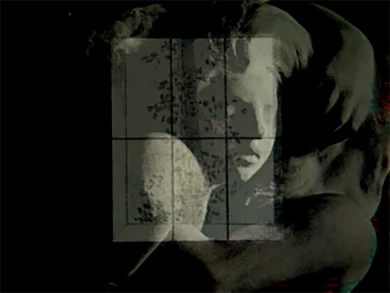
The second session screens two medium-length films by Jean-Luc Godard and Anne-Marie Miéville on time, ruin and museum. In The Old Place. Small Notes Regarding the Arts at Fall of 20th Century (1999), both film-makers consider what remains of that “old place”, the museum, at the close of a century of wars and totalitarianism, and ask whether it should be more of a legend or desire than a place. This same driving principle leads Godard to build his own imaginary museum in Reportage amateur (maquette expo) (2006), a rickety toy museum which, paradoxically, contains the great film-maker’s full power of thought on history and images.
Finally, the third session explores one of the major challenges of recent years: the decolonisation of the museum, the recognition of its link to imperialist discourses of power and the need to situate a new silenced or repressed subject at the centre of the Western narration of history. Under the title Museums and Restitution, it includes the film Undocumented. Unlearning Imperial Plunder (2019), by theorist Ariella Azoulay, Statues Also Die, by Alan Resnais and Chris Marker (1953), Kwate Nee-Owoo’s You Hide Me (1970) and the first screening of the short film Quinto verso, parte de Tonada (Fifth Verse, Part of Tonada), by La Vulcanizadora (Maria Rojas Arias and Andrés Jurado), filmed at the Museo de América in Madrid.
![Ariella Azoulay, Un-documented. Unlearning Imperial Plunder [Indocumentados. Desaprendiendo el saqueo imperial], 2019, película](https://recursos.museoreinasofia.es/styles/small_landscape/public/Actividades/5.diseminar-mundo.jpg.webp)
Museums and Restitution
Saturday, 19 September 2026 - 7pm
Centuries of plundering, decades of amnesia, years of living with unmitigated extractivist power… Does a museum, as we know it, have a raison d'être in a postcolonial society?
This session expounds the operations of the museum as a colonial machine, while putting forward ideas, in narration, for a more just, equal and inclusive institution of the future via society’s marginalised and minority voices. The session begins with the international premiere of Quinto verso, parte de Tonada (Fifth Verse, Part of Tonada), which presents a vision of the Quimbaya Collection (fifth and sixth centuries CE) from the Museo de América in Madrid. It is constructed with the voices and chants of Wayúu mourners and guides, not only as a way of reinstating the role of these gold idols — anthropomorphic figures of men and women used as vessels in ritual practices — but also to imagine that what must be exhibited is not the gold itself. It is the ritual’s own chant. In the classic film You Hide Me (1970), Ghanaian film-maker Kwate Nee-Owoo accesses the British Museum’s collection of African art, located in the building’s basement, to question the meaning behind a museum plundering and nullifying. A fine exercise of first-person institutional critique screened for the first time in Spain. Almost seventy years since Resnais and Marker made Statues Also Die (1953), a reflection on the aura-bearing value of the museum opposite the identity-based and cultural belonging of African art, theorist Ariella Azoulay films the same statues again at the Musée du Trocadéro (today the Musée du Quai Branly), which survive and wait to be reunited with their people. Azoulay, whose wholly original undertaking is a lesson to the museum of the future, connects the forced migration of these sculptures with the mass transit of people crossing borders artificially imposed by the same system that has plundered their culture.
The School of Transformative Institutionalism and Local Organisation
From 21 to 24 September 2026
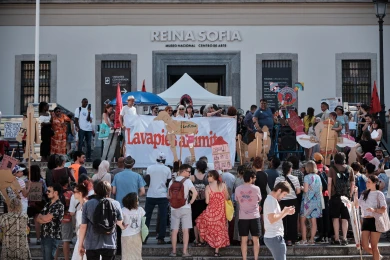
The School of Transformative Institutionalism and Local Organisation (S.T.I.L.O.) is a programme of joint learning and join strategy which sets in motion a process for the exchange of questions, methodologies and experiences between cultural organisations. The overall aim is to create, circulate and prototype tactics, tools and collective knowledge on institutional practices that open new channels for defending culture and advocating structural transformation in divergent geographical contexts.
The project is part of the Laboratorio de Institucionalidad Compartida (The Laboratory of Shared Institutionalism, LIC), a space for the Museo Reina Sofía’s research, work and advocacy centred on developing, experimenting with and systemising practices, protocols and tools which contribute to a fairer and more liveable cultural ecosystem.
For many years now, so-called infrastructural critique in museums questions material, legal and economic infrastructures, among others, as well as the forms of solidarity and practices required to sustain the cultural ecosystem. By approaching current debates, S.T.I.L.O. raises questions on the ways in which organisations define and interpret their practices, organise their relations and respond to the social contexts in which they operate.
The school gathers four cultural organisations that work via different institutional models – scale, contexts, conditions, different working models — with the goal of pooling common strategies and tools of organisation, advocacy and relationships with local communities.
The programme is conceived as a collaborative process with the participation of Arika, La Revuelta, BAK Basecamp and The Tentacular Museum (Museo Reina Sofía) and is structured around preparatory online sessions and an in-person seminar in Madrid.
S.T.I.L.O. is an activity framed inside the working strand of Situated Organisations from L'Internationale’s Museum of the Commons project, which reflects on the role of museums and art organisations as actors within complex social networks and ecosystems, with a view to exploring new ways to democratise institutions and make them more open, inclusive and useful.