-
Monday, March 14, 2011
Screening of Aurora de esperanza
Antonio Sau. 1937
Aurora de esperanza, 1937, 60’
-
Monday, March 14, 2011
Colloquium with Anselmo Lorenzo Foundation
Colloquium with Anselmo Lorenzo Foundation
-
Monday, March 14, 2011
Presentation of the series by Javier Rioyo, Enrique del Olmo and Manuel Bonmati Portillo
Presentation of the series by Javier Rioyo, Enrique del Olmo and Manuel Bonmati Portillo
-
Monday, March 14, 2011
Screening of Raza
José Luis Sáenz de Heredia. 1941
Raza, 1941, 105’
-
Wednesday, March 16, 2011
Screening of Las cajas españolas
Alberto Porlán. 2004
Las cajas españolas, 2004, 90’
-
Wednesday, March 16, 2011
Colloquium with Alberto Porlán
Colloquium with Alberto Porlán
-
Wednesday, March 16, 2011
Screening of Guernica
Alain Resnais and Robert Hessens. 1950
Guernica, 1950, 13’
-
Wednesday, March 16, 2011
Screening of Extranjeros de si mismos
Javier Rioyo and José Luis López-Linares. 2001
Extranjeros de si mismos, 2001, 86’
-
Wednesday, March 16, 2011
Screening of Arrhash (Veneno)
Javier Rada and Tarik el Idrissi. 2008
Arrhash (Veneno), 2008, 44’
-
Thursday, March 17, 2011
Screening of Los niños de Rusia
Jaime Camino. 2001
Los niños de Rusia, 2001, 93’
-
Thursday, March 17, 2011
Screening of Paseo
Arturo Ruiz Serrano. 2007
Paseo, 2007, 13’
-
Thursday, March 17, 2011
Colloquium with Arturo Ruiz Serrano
Colloquium with Arturo Ruiz Serrano
-
Thursday, March 17, 2011
Screening of La madre que los parió
Inma Jiménez Neira. 2008
La madre que los parió, 2008, 29’
-
Thursday, March 17, 2011
Screening of Las cajas españolas
Alberto Porlán. 2004
Las cajas españolas, 2004, 90’
-
Thursday, March 17, 2011
Screening of En el balcón vacío
Jomi García Ascott. 1961
En el balcón vacío, 1961, 64’
-
Thursday, March 17, 2011
Colloquium with Román Gubern
Colloquium with Román Gubern
1936. Memories of silence
Tribute to the victims of the Spanish Civil War and Franco's repression
Held on 16 Mar 2011
In the first stage, the 1936-1939 period, the country was torn into two antagonistic factions, each of which produced militant and propaganda-ridden films – especially documentaries – that obviously had opposing purposes. The triumphalism of Phalangist cinema after the war was followed by a period of uncertainty caused by the events of World War II, which led to the Civil War not being represented in fiction until 1948.
Between 1948 and 1975 a new official slogan appeared in films made by filmmakers working for the Franco regime: the Regime's enemies, those who had supported the Spanish Republic, had to be recovered, upon the condition that they expressed regret for their “political errors” and began to submit to the dictatorship. Following the death of Franco, a new eye was turned to the Civil War and its victims. The political puppetry so evident before disappeared and both fiction and documentary genres criticized the military coup that had given rise to the Civil War, by discrediting those who had perpetrated it or by using melancholy, showing solidarity with the vanquished and its victims. Since 1936, the Civil War has been the chosen topic of more than a hundred feature films made by Spanish filmmakers, and this series has selected a few of them.
Más actividades

Cinema, for the First Time
7 and 14 June 2026 – 12:00 pm
The final session in this Moon Projector season contemplates the feeling around the first experience of cinema — cinema as revelation, magic, fantasy and mystery from the first gaze, from the first contact with the medium, and imagery etched on the retina of childhood. The programme shows Émile Cohl’s landmark Fantasmagorie (1908), the first ever hand-drawn animation, and Ignacio Agüero’s Cien niños esperando un tren (One Hundred Children Waiting for a Train, 1988), a feature-length film on play and the origins of cinema.
Fantasmagorie (1908)by Émile Cohl (Paris, 1857– Villejuif, 1938) is the first expression in the history of animated drawing. Émile Cohl was an illustrator who belonged to the Parisian art group Arts incohérents (1882–1895), who was bestowed with an absurdist and pre-Surrealist talent. Whereas the Lumière brothers were able get audiences out of their seats as they witnessed a train moving towards them in 1895, Fantasmagorie is a supernatural experience, akin to an apparition yet also innocuous and entertaining — the inanimate comes to life out of nothing and figures seemingly move with little sense. From the outset, animation was related to caricature, fabulation and the comical, a sweet spot for the dreams of the youngest audience.
From the discovery of new imagery arising from the animated line to knowledge of the world through a screen, Cien niños esperando un tren (1988), by Chilean director Ignacio Agüero (Santiago, 1952), narrates a group of young people’s discovery of cinema in a workshop on the origins of the medium in a poverty-stricken town on the outskirts of Santiago de Chile. Play, fun and learning combine with a fascination with images, as viewing Émile Cohl’s Fantasmagorie (1908) in the workshop becomes an act of freedom.
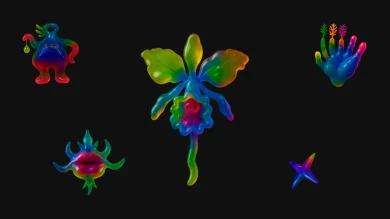
Institutional Decentralisation
Thursday, 21 May 2026 – 5:30pm
This series is organised by equipoMotor, a group of teenagers, young people and older people who have participated in the Museo Reina Sofía’s previous community education projects, and is structured around four themed blocks that pivot on the monstrous.
This fourth and final session centres on films that take the museum away from its axis and make it gaze from the edges. Pieces that work with that which is normally left out: peripheral territories, unpolished aesthetics, clumsy gestures full of intent. Instead of possessing an institutional lustre, here they are rough, precarious and strange in appearance, legitimate forms of making and showing culture. The idea is to think about what happens when central authority is displaced, when the ugly and the uncomfortable are not hidden, when they are recognised as part of the commons. Film that does not seek to be to one’s liking, but to open space and allow other ways of seeing and inhabiting the museum to enter stage.
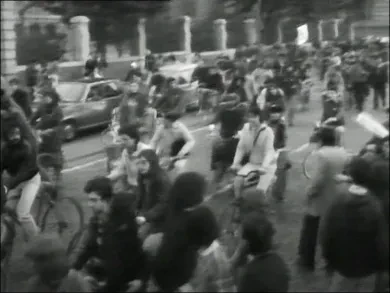
Ordinary, Common and Public. Common Fixes for Ordinary Communities
Tuesday, 26, and Wednesday, 27 May 2026 – Check programme
Ordinary, Common and Public. Common Fixes for Ordinary Communities is the title of the fourteenth encounter run by Sociología Ordinaria, a transdisciplinary research group that explores daily knowledge deemed ordinary, superficial or frivolous from a traditional academic and intellectual viewpoint.
This latest edition seeks to approach and map connections between concepts of the commons and the public realm — remembering that the ordinary is also the commons — and to ensure affects and moods of discontent are mobilised towards hope.
By way of its multiple declinations — community, community-based practices, the commons, the communal — the encounter seeks to reflect on different ways of creating, (re)configuring, maintaining, fixing, arranging, caring for and defending the public realm and the commons. Furthermore, it explores forms of invocation and experimentation as tools opposite the helplessness of an uncertain present, in addition to resistance against attempts of expropriation, distortion, privatisation and touristification.
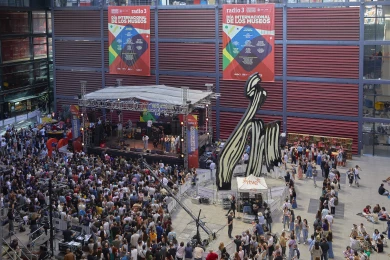
International Museum Day 2026 with Radio 3
22 MAY 2026
On Friday, 22 May 2026 the Museo Reina Sofía celebrates International Museum Day by way of a vibrant music programme conducted by Radio 3.
From 9am to 11pm, the Museo’s Nouvel Courtyard will host the live broadcast of Radio 3’s day-long programme —also available on a video streaming on the Radio3 website and app, on RTVEPlay and on the Museo’s social media accounts. The programme comprises more than twenty live acts, including artists such as Carlangas, Shego, Soleá Morente, Kokoshca, La Tania, La Pegatina, Pipiolas, Ángel Stanich, Triángulo de Amor Bizarro and Zahara, and many others.
With this programme the Museo Reina Sofía concludes its celebration of International Museum Day, which takes place on Monday, 18 May. Both on 18 May, from 10am to 9pm, and 22 May admission to the Museo will be free of charge.
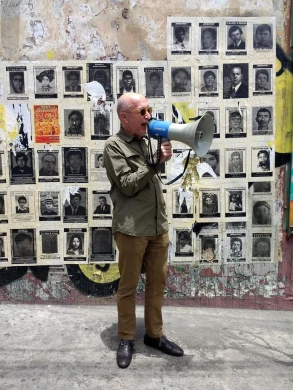
Gerardo Mosquera: Island Thinker, Global Curator
19 MAY 2026
This encounter pays homage to Gerardo Mosquera (Havana, 1945), a pre-eminent curator, an essayist who has been part of key debates on decolonisation and the drifts of globalisation, a communicator and, primarily, an art critic who has managed to radically situate discourses and practices, while still taking on risks and perpetually upholding committed ethical positions.
Mosquera is one of the foremost curators internationally and was involved with the Havana Biennial from its foundation in 1984 to 1989, as well as curating pivotal shows in museums and art centres around the globe. Notable among his curatorial work is as adjunct curator at the New Museum in New York (1995–2009), the Liverpool Biennial (2006) and the exhibition It’s Not Just What You See. Perverting Minimalism (Museo Reina Sofía, 2000).
This round-table discussion, which features the participation of Gerardo Mosquerahimself and an ensemble of art critics, thinkers and artists, for instance Fernando Castro Flórez, Diana Cuéllar, Lillebit Fadraga and René Francisco Rodríguez, will approach the multifaceted and extremely fertile work of Mosquera as a renowned master curator.