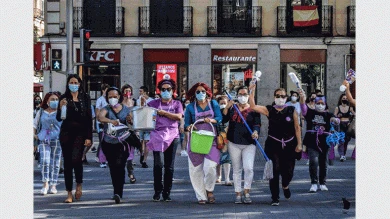
Held on 02 Dec 2020
Intersectional feminisms contend that violence, extractivism and exploitation are not read separately, for they are conflicts tied up in complex modes. New struggles, with the clear prominence of women, are emerging and shaping other ways of addressing these conflicts, new imaginaries of resistance and different strategies of self-protection.
These new forms of syndicalism pick up tools from the twentieth century’s major working-class struggles (strikes, picket lines, resistance funds, councils, assemblies), but do so in a way that moves beyond purely labour-based ground, given that exploitation is not limited to wage ratio and labour violence combines with other types of violence — financial, sexual, extractive, legal.
These are struggles imbued with feminism, not only because gender-dissident women and people are at the forefront, but because their languages and strategies disrupt patriarchal schisms between the public and private, productive and reproductive, personal and political, centring essential questions around good living and good dying in an increasingly damaged planet.
This encounter, therefore, sets out to convene, converse with and create fruitful exchanges between some of the leading figures in these struggles, setting out from the conviction that, from their view of the world, their networks of self-protection and their ways of “shouldering” rebellion, they are developing the syndicalist feminism to come.
Programme
Wednesday, 2 December 2020 / Online Platform
7pm. Opening lecture. Feminist Revolt and Organisational Connections Entwined in Life.
Participants: Raquel Gutiérrez Aguilar (Institute of Social Sciences and Humanities at the Benemérita Universidad Autónoma de Puebla, Mexico) and Haizea Miguela Álvarez (Feministas en acción).
Thursday, 3 December 2020 / Nouvel Building, Protocol Room and online Platform
5:30pm – 7pm. Round-table discussion. Dismantling the House of the Master. Dispossession, Exploitation and Extractivism Through a Feminist Lens.
Participants: Costanza Cisneros (Territorio Doméstico), Myrian Espinoza and Lotta Meri Pirita Tenhunen (Plataforma de Afectados por la Hipoteca de Vallekas), Pastora Filigrana (Abogadas Sociedad Cooperativa Andaluza) and Zohra Koubia (Asociación Marroquí de Derechos Humanos).
Presented by: Beatriz García and Marta Malo (La Laboratoria).
A new lexis is emerging in the mutual pollination between more street-level feminisms and social struggles, with some of the key concepts with which to understand the extraction of value in the world system including: financialisation, debt, old and new labour regulations, care, land, borders and coloniality. All of the above take on fresh nuances through the feminist lens, and this round-table looks to unravel some of the implications for a radical political imagination.
7pm. Break.
7:30pm – 9pm. Round-table discussion. When Work Doesn’t Seem Like Work. Feminist Conflicts in Old and New Deregulation.
Participants: María José Barrera (Colectivo de Prostitutas de Sevilla), Graciela Gallego (Sindicato de Trabajadoras del Hogar y de los Cuidados) and Nuria Soto (Riders x Derechos).
Presented by: Amalia Caballero and Rafaela Pimentel (Territorio Doméstico).
Friday, 4 December 2020 / Nouvel Building, Protocol Room and online Platform
5:30pm – 7pm. Round-table discussion. We Are Owed a Life. Feminist Conflicts in Social Syndicalism.
Participants: Rebeca Tolosa (Sindicato de inquilinas e inquilinos de Madrid) and Asun Paños Arroyo (feminist self-defense facilitator) representatives of the Sindicato del barrio de Vallekas.
Presented by: Myrian Espinoza and Lotta Meri Pirita Tenhuenen (Plataforma de Afectados por la Hipoteca Vallekas).
7pm. Break.
7:30pm – and 9pm. Round-table discussion. Bread and Roses. Feminist Conflicts in the Syndicalist Struggle.
Participants: María Fuentes (MATS Cleaning at Gregorio Marañón Hospital), Rosa María García (a worker in care homes), Verónica Domínguez, Ana Pinto y Fatiha Suleman (Asociación Jornaleras de Huelva en lucha), María del Mar Jiménez (a chambermaid) and Nadia Naïr (Moroccan Feminist Action Union).
Presented by: Pastora Filigrana (Abogadas Sociedad Cooperativa Andaluza).
Saturday, 5 December 2020 / Nouvel Building, Protocol Room and online Platform
11am – 1:30pm. Plenary session. The Situation for Women Cannot Be Changed Without Changing the World. The Feminist Movement and Feminist Syndicalism.
Participants: all participants in the encounter, the 8M Commission and union representatives, among others.
1:30pm – 2pm. Catwalk by Territorio Doméstico.
A performance action built from the lived experiences of domestic work and care and forms of feminised precariousness, whereby estrangement and parody work to trigger the critical gaze. They are also strategies to “shoulder” revolts and add force to daily struggles during times of extreme instability.
النقابية النسوية القادمة
[dropdown]
كلنا عاملات
الأربعاء 2 ، الخميس 3 ، الجمعة 4 والسبت 5 ديسمبر / استشر البرنامج
الدخول: مجاني عند سحب بطاقة الدخول مسبقاً وذلك اعتبارًا من يوم الاثنين 30/11. تفتح الأبواب على الساعة 00: 17.
وسيتمّ بثّ الفعالية:
عبر تطبيق زوم على رقم الدخول: 996 0137 0708 وكلمة السرّ: 656207
اللغّة :
الإسبانية والعربية
ي نظم:
متحف الملكة صوفيا المركزي الوطني للفنون، “لابوراتوريا“ ( La Laboratoria ). مساحة الأبحاث النسوية.
المتعاونون:
مبادرة المجتمع المفتوح لأوروبا، ومؤسسة المبادرات الفنية ومؤسسة روزا لوكسمبورغ.
خطوط القوة:
التخيل والعمل الراديكالي
تدعي الحركات النسّوية بجوانبها المتعددّة أن العنف والخروج عن القانون والاستغلال لا يمكن قراءتهم بشكل منفصل، بل بالأحرى لا بد من ربطهم بطرق معقدة وبأنواع جديدة من النضالات.. تظهر في هذه العقد شخصيات أنثوية تمزج كل شيء وتبتكر طرقًا جديدة لطرح الصراع، كما تطرح تصورات للمقاومة فريدة من نوعها واستراتيجيات جديدة للحماية الذاتية.
ولذلك تستعمل نفس أدوات النضالات العمالية العظيمة في القرن العشرين (إضراب، اعتصام، صندوق مقاومة، مجلس، تجمع) ولكن بلمسة مختلفة حيث أنها تفعل ذلك ضمن مجال العمل الصارم، لأن الاستغلال لا يقتصر على علاقة الأجر وحسب.. الحقيقة أن على العنف العمالي يجب إضافة العنف المالي والجنسي والقانوني والقضائي أيضا.
هنّ نساء مشبعات بالنسوية، ليس فقط لأنهنّ نساء والمعارضات بين الجنسين في المقدمة، ولكن أيضًا لأنهنّ في لغاتهن واستراتيجياتهن يفجرن الانقسامات الأبوية بين العام والخاص، وبين الإنتاجية والإنجابية، وبين الشخصي والسياسي، لوضع الأسئلة الأساسية حول الحياة الحسنة والموت الحسن في كوكب لا يتوقف عن النزيف.
يهدف هذا الاجتماع إلى اللقّاء، والدخول في حوار، وتوليد تبادلات مثمرة بين أنصار هذه النضالات، انطلاقاً من الاقتناع بأنه بناءً على رؤيتهن للعالم ومخططاتهن الخاصة بالحماية الذاتية وطرقهن في احتضان التمرد، فإنهنّ يتأهبنّ لإنشاء النسوية النقابية القادمة .
تشارك كل من:
Raquel Gutiérrez Aguilar
راكيل غوتيريث أغيلا
رياضية و فيلسوفة وباحثة في علم الإجتماع مكسيكية. أستاذة- باحثة في الدراسات العليا في علم الإجتماع بمعهد العلوم الإجتماعية والإنسانية بجامعة أوطونما بويبلا. باحثة في العلاقة بين الحركات النسوية الشعبية المتجددة وممارسات إنتاج ما هو مشترك في رييو دي بلاطا، بوليفيا و أمريكا الوسطى.
Haizea Miguela Álvarez
أيثيا ميغلا البارس
عضوة في ”نسويات في الحراك“ Feministas en Acción
Costanza Cisneros, Rafaela Pimentel y Amalia Caballero
كونستانثا ثيسنيروس- رافايلا بمينتال - اميليا كاباييرو
عضوتين في " أرض المَنزَل" Territorio Doméstico : مساحة للقاء والعناية والنضال لنساء -معظمهن عاملات البيوت- ناضلات من أجل كرامة العمل المنزلي وأعمال الرعاية
Myrian Espinoza y Lotta Tenhunen
ميريان إسبينوزا - لوطا تنهونن
عضوتين في PAH-Vallekas " منصة المتأثرين بالرهن العقاري بحي فايكاس في مدريد "
Pastora Filigrana
باستورا فيلغرانا
تعمل كمحامية في coopAbogadas@ وهي ناشطة نشيطة في مجال حقوق الإنسان. أندلسية من sat_nacional @ و من حي تريانا بالضبط. ميستيثو- غجرية طوال الوقت.
Zohra Koubia
زهرة قوبيع
عضوة في الجمعية المغربية لحقوق الإنسان AMDH، مؤسسة ورئيسة منتدى نساء الريف AFFA .
Nadia Naïr
نادية الناير
أستاذة بجامعة عبد المالك السعدي طنجة - تطوان وعضوة اتحاد العمل النسوي - المغرب
Graciela Gallego
غراسيلا غاييغو
عضوة ومؤسسة النقابة للعاملات المنزلية وخدمات الرعاية
Nuria Soto
نورية صوتو
المتحدثة باسم نقابة ”عمال التوصيل للمنازل من أجل الحقوق”
María José Barrera
ماريا خوسي باريرا
عاملة سابقة في مجال الخدمات الجنسية وناشطة في مجال حقوق العاملات في نفس المجال في التجمع الإشبيلي للعاملات في مجال الخدمات الجنسية
Ana Pinto, Verónica Domínguez y Fatiha Suleman
آنا بينتو - فيرونيكا دومينغيز- فتيحة سليمان
أعضاء في الجمعية الحراكية لعاملات المياومة في ويلفا إسبانيا
María del Mar Jiménez
ماريا ديل مار خيمينز
ناشطة في مجال حقوق نادلات الشقق )مدريد(
María Fuentes
ماريا فوينتس
عاملة نظافة في مستشفى غريغوريو مارانيون بمدريد وعضوة في نقابة MATS
Rosa María García
روسا ماريا غرثيا
عاملة ونقابية في دور رعاية المسنين
Almudena Fernández
المدينة فيرنانديز
طبيبة مقيمة داخلية في طب الأسرة والمجتمع وعضوة في تجمع الأطباء المقيمين الداخليين الحراكيين بفايكاس. مدريد
Rebeca Tolosa
ريبيكا تولوزا
المتحدثة باسم نقابة المستأجرين والمستأجرات
مجموعات أخرى قيد تأكيد حضورها البرنامج
جدول البرنامج:
الجلسة الافتتاحية
الأربعاء 2 ديسمبر 2020 عل ى الساعة 19:00 أون لاين
محاضرة افتتاحية.
راكيل غوتيريث أغيلار، المحاضرة الإفتتاحية .تشابكت الثورة النسوية والنسيج التنظيمي مع الحياة.
تقدم: أيثيا ميغلا البارس. Feministas en Acción” نسويات في الحراك“
الخميس 3 ديسمبر 2020 - على الساعة 17:30 مبنى Nouvel، صالة البروتوكول
19:00-17:30
حلقة نقاش تفكيك منزل السيد: نزع الملكية والاستغلال والخروج عن القانون من منظور نسوي
يظهر معجم جديد في إطار التلقيح المتبادل بين الحركات النسوية في الشوارع والنضالات الاجتماعية. تكتسب المفاهيم الأساسية لفهم استخراج القيمة في نظام العالم )الأمْوَلَة، الديون، أنظمة العمل القديمة والجديدة ، أعمال الرعاية، الأرض، الحدود، والاستعمار( فروقًا دقيقة جديدة إذا نظرنا إليها من منظور نسوي. تهدف هذه الحلقة إلى كشف بعض تداعيات تلك المفاهيم في التخيل السياسي الجذري
تشترك: لوتا ميري بيتا وميريان إسبينوزا وباستورا فيليغرانا وكوستانزا سيسنيروس وزهرة قوبيع .
تقدم: بياتريس غارسيا ومارتا مالو) لابوراتوريا( .
19:00 استراحة
21:00-19:30
حلقة نقاش
عندما لا يبدو العمل عملا ً
صراعات نسوية في التحرر القديم والجديد
تشترك: غراسيلا غاييغو(SANTRAHOCU) و نورية صوتو ( (Riders por Derechos و ماريا خوسي باريرا )التجمع الإشبيلي للعاملات في مجال الخدمات الجنسية ( .
تقدم: رافاييلا بيمنتال وآماليا كاباييرو "أرض المَنزَل ".
الجمعة 4 ديسمبر 2020 - على الساعة 17:30 مبنى Nouvel، صالة البروتوكول
17:30– 19:00
حلقة نقاش
إنهم مدينون لنا بالحياة. الصراعات النسوية في النقابات الاشتراكية
تشترك: ريبيكا تولوسا )نقابة المستأجرين والمستأجرات (، ألمدينة فرنانديز ) تجمع الأطباء المقيمين الداخليين الحراكيين بفايكاس واتحاد حي فايكاس(
تقدم: ميريان إسبينوزا )منصة المتأثرين بالرهن العقاري بحي فايكاس في مدريد(
19:00 استراحة
19:30 – 21:00
حلقة نقاش
الخبز والورد .الصراعات النسوية في النضال النقابي
تشترك: نادية الناير)جامعة عبد المالك السعدي طنجة -تطوان( وآنا بينتو وفيرونيكا دومينغيز وفتيحة سليمان )الجمعية
الحراكية لعاملات المياومة في ويلفا إسبانيا(، ماريا ديل مار خيمينيز )ناشطة في مجال حقوق نادلات الشقق -مدريد( ، ماريا فوينتيس )نقابةMATS لعاملات تنظيف مستشفى جريجوريو مارانيون (، روزا ماريا غارسيا) دور رعاية المسنين ( تقدم: باستورا فيليغرانا
السبت 5 ديسمبر 2020 - على الساعة 10:00مبنى Nouvel، صالة البروتوكول
10.00-12.00 عرض أزياء تحت مسئولية Territorio Doméstico” أرض المَنزَل “.
عمل أدائي مبني على تجارب العمل المنزلي والرعاية وأشكال العمل النسائي الغير المستقر. يعتبر الإستغراب والمحاكاة الساخرة بمثابة حافز للنظرة النقدية.. كما يشكل أيضًا استراتيجيات لاحتضان وتقوية النضالات اليومية في لحظات البؤس الشديد.
12.00-12.30 استراحة
12.30-14.00 نقاش عام” لا يمكنك تغيير وضع المرأة دون تغيير العالم “
الحركة النسوية والنقابية النسوية .
تشترك: جميع المحاضرات والمشاركات في الاجتماع، لجنة M8، ممثلات النقابات، إلخ.
[/dropdown]
Organised by:
With the collaboration of:
Force line
Action and Radical Imagination
With the collaboration of
Organised by
Museo Reina Sofía and La Laboratoria. Espacios de Investigación Feminista
Organised by

In collaboration with
In collaboration with
In collaboration with
Admission:
In-person: Free, until full capacity is reached, with prior ticket collection on the Museo Reina Sofía website from 10am on 30 November. A maximum of 1 per person. Doors open thirty minutes before the activity.
Online Platform: free access.
Capacity:
70 people in-person; 500 online
Language:
Spanish and Arabic with simultaneous interpretation
Participants
Haizea Miguela Álvarez with a training in sociology, works linked to the world of education. A feminist activist, she participated in the Madrid 8M Commission and is a member of Feministas en Acción.
María José Barrera is a former prostitute and currently an activist for sex workers’ rights in the Colectivo de Prostitutas de Sevilla (Seville Prostitutes’ Collective).
Amalia Caballero, Costanza Cisneros and Rafaela Pimentel are members of Territorio Doméstico (Domestic Territory), a collective and space of encounters, care and organisation for women, the majority domestic workers who fight for dignity in domestic work and to defend the visibility and social re-organisation of care.
Myrian Espinoza and Lotta Meri Pirita Tenhunen are members of the women’s group Plataforma de Afectados por la Hipoteca de Vallekas (Platform for People Affected by Mortgages, Vallekas), which fights for the right to housing, an end to evictions, dation in payment (writing off debt) and social rented housing.
Pastora Filigrana holds a Law Degree from the University of Seville. She works in Abogadas Sociedad Cooperativa Andaluza (the Andalusian Female Lawyers’ Cooperative) and is a human rights activist. An Andalusian native from the Seville neighbourhood of Triana and with mixed-race gypsy heritage, she collaborates with the Andalusian Union of Workers (SAT). She is also the author of El pueblo gitano contra el sistema-mundo (Akal, 2020).
María Fuentes is a cleaner at Gregorio Marañón Hospital and a union member of Movimiento Asambleario de Trabajadores-as de Sanidad (Assembly Movement of Workers in Healthcare, MATS).
Graciela Gallego is a member and founder of Trabajadoras del Hogar and Cuidados (Female Home and Care Workers, SINTRAHOCU), the first trade union of its kind on a state level.
Raquel Gutiérrez Aguilar is a Mexican mathematician, philosopher and sociologist who lectures on the Sociology post-graduate course at the Benemérita Universidad Autónoma de Puebla (Mexico) and is the author of different publications on the indigenous movement in Latin America. Her work explores the relationship between renewed popular feminisms and production practices of the commons.
Beatriz García and Marta Malo are members of La Laboratoria. Espacios de Investigación Feminista (The Lab. Feminist Research Spaces), a transnational device that supports feminist activist research.
Rosa María García works in care homes and is a unionist.
María del Mar Jiménez is a chambermaid and a unionist.
Zohra Koubia part of the Asociación Marroquí de Derechos Humanos (Moroccan Human Rights Association, AMDH) and founder and chairwoman of Association Forum des Femmes Au Rif (AFFA RIF).
Nadia Naïr is a lecturer at the Abdelmalek Essaâdi University, an activist, and a member of the Moroccan Feminist Action Union. She specialises in issues related to gender and human rights and has written a broad range of articles defending women in Morocco and on Muslim emigration in Europe.
Asun Paños Arroyo is a feminist self-defense facilitator for women and girls, a social educator and an intercultural mediator.
Nuria Soto is a spokesperson for the Riders x Derechos (Riders for Rights) union, a collective that fights for human rights and decent living conditions for home delivery workers.
Rebeca Tolosa is a member of the Sindicato de inquilinas e inquilinos de Madrid that fights for a fair and affordable rent.
Verónica Domínguez, Ana Pinto and Fatiha Suleman are members of the Asociación Jornaleras de Huelva en lucha (Association Fighting for Female Day Workers in Huelva), a collective against the abuses suffered by female day workers in fields and warehouses.
Más actividades
![Isabel Coixet, 100 Years and You Everywhere [100 años y tú en todos los sitios], 2026, película](https://recursos.museoreinasofia.es/styles/small_landscape/public/Actividades/2.diseminar-mundo.jpg.webp)
John Berger and Isabel Coixet. Continued Ways of Seeing
Thursday, 17 September 2026 at 7pm
Ways of Seeing (1972) is one of the most revolutionary television series on art history, the museum and contemporary critical culture. Across four episodes, an articulate, enthusiastic John Berger unpacks the relationships between classical art through the gaze and new technology, the nude and feminism, the oil painting and commodity fetichism, advertising and consumerism. In essence, a level of critical commitment only comparable to its capacity for dissemination. Unsurprisingly, the series, and the book that would distil it, continues to forge vocations. This session sees art historians Alberto López Cuenca and Modesta Di Paola carry out an analysis of Berger’s audiovisual work, placing the stress on episodes one and four of the series. In the first episode, Berger reflects on the connection between the act of seeing, looking and being in light of new technology, such as the film camera. At the same time, it analyses how the culture of reproduction is turning paintings into messages or fragments of communication while stressing the importance of silence when observing historical paintings. In the fourth and final episode, he introduces advertising as a new iconic-verbal language that shares certain principles with the message of oil painting as a luxury item.
The session opens with the premiere of a filmic letter from Isabel Coixet, one of Spain’s most internationally acclaimed directors, to John Berger, with whom she maintained a long friendship and deep admiration. The short film is testament to the ubiquitous and long-lasting presence of the author of Ways of Seeing, even after his death in 2017.
![Chantal Akerman, Woman Sitting after Killing [Mujer sentada después de matar], 2001, instalación. Museo Reina Sofía](https://recursos.museoreinasofia.es/styles/small_landscape/public/Actividades/chantal-akerman-mujer-sentada-despues-matar.jpg.webp)
On Your Screen: Art History and the Museum Facing the Audiovisual Challenge
18, 19 SEP 2026
The conference On Your Screen: Art History and the Museum Facing the Audiovisual Challenge sparks debate around the transformations of art history and museum space upon embracing the audiovisual format. Its starting point is John Berger’s emblematic television series Ways of Seeing (1972), a landmark in the democratisation of art-historical discourse. In the series, Berger illustrated how the transfer of a work such as Goya’s Los fusilamientos del 3 de mayo (The Third of May 1808 or the Executions) from museum gallery to home TV screen completely changed the viewer’s experience, allowing the image to travel to straight to the viewer.
In the twenty-first century, this screen-based ecosystem has expanded exponentially, with museums not only physically integrating screenings and devices into their galleries— following in the wake of many exhibitions on the moving image — but also deploying complex virtual strategies. Equally, numerous en vez de a multitudeof historians, students and creators use digital platforms to circulate their ideas and projects. This audiovisual shift opens access to ignored materials and democratises knowledge, as well as challenging traditional hierarchies and the interpretive authority of institutions. The conference, promoted by the research project ATLAS AV: The Audiovisualisation of Art History and the Museum, seeks to analyse this vast audiovisual material, its archives, and its capacity to transform the memory of art.
Godard and Miéville: Time and Ruin
Friday, 18 September 2026 - 7pm
Inside the framework of the conference On Your Screen: Art History and the Museum Facing the Audiovisual Challenge, this film series sets forth three critical visions of the museum via three sessions featuring the works of John Berger, Jean-Luc Godard and Anne-Marie Miéville, Ariella Azoulay, Alan Resnais and Chris Marker, Kwate Nee-Owoo, and the premiere of short films by Isabel Coixet and La Vulcanizadora (Maria Rojas Arias and Andrés Jurado). In classical theory, the museum gives the world meaning; it contains fragments of the past, granting them a history, a narrative that explains preterite time and the present. Today, there is an implicit assumption that this function hides and legitimises forms of power, yet what if the museum, instead of explaining the world, multiplied it through radical ideas, silenced periods and repressed subjects? Such is the approach of the film-makers and artists in this film season.
In 1972 the writer John Berger opened the landmark television series Ways of Seeing with an iconoclastic gesture: slicing Sandro Botticelli’s painting Venus and Mars (1485) in London’s National Gallery. A transgressive act that recalls contemporary attacks on the museum by dissident youth and with which Berger, after revealing it was a reproduction, sought to ignite debate around the idea of an original artwork and a copy. In this, the hundredth anniversary of his birth, the first session pays homage to one of the great art writers of the twentieth century. Starting with a review of Berger’s audiovisual work by art historians Alberto López Cuenca and Modesta Di Paola, the series begins with the premiere of 100 Years and You Everywhere (2026), an unreleased short film by Isabel Coixet composed as a beautifully crafted letter to Berger, and continues with an analysis of fragments of Ways of Seeing in relation to the museum and contemporary art.
The second session screens two medium-length films by Jean-Luc Godard and Anne-Marie Miéville on time, ruin and museum. In The Old Place. Small Notes Regarding the Arts at Fall of 20th Century (1999), both film-makers consider what remains of that “old place”, the museum, at the close of a century of wars and totalitarianism, and ask whether it should be more of a legend or desire than a place. This same driving principle leads Godard to build his own imaginary museum in Reportage amateur (maquette expo) (2006), a rickety toy museum which, paradoxically, contains the great film-maker’s full power of thought on history and images.
Finally, the third session explores one of the major challenges of recent years: the decolonisation of the museum, the recognition of its link to imperialist discourses of power and the need to situate a new silenced or repressed subject at the centre of the Western narration of history. Under the title Museums and Restitution, it includes the film Undocumented. Unlearning Imperial Plunder (2019), by theorist Ariella Azoulay, Statues Also Die, by Alan Resnais and Chris Marker (1953), Kwate Nee-Owoo’s You Hide Me (1970) and the first screening of the short film Quinto verso, parte de Tonada (Fifth Verse, Part of Tonada), by La Vulcanizadora (Maria Rojas Arias and Andrés Jurado), filmed at the Museo de América in Madrid.
![Ariella Azoulay, Un-documented. Unlearning Imperial Plunder [Indocumentados. Desaprendiendo el saqueo imperial], 2019, película](https://recursos.museoreinasofia.es/styles/small_landscape/public/Actividades/5.diseminar-mundo.jpg.webp)
Museums and Restitution
Saturday, 19 September 2026 - 7pm
Centuries of plundering, decades of amnesia, years of living with unmitigated extractivist power… Does a museum, as we know it, have a raison d'être in a postcolonial society?
This session expounds the operations of the museum as a colonial machine, while putting forward ideas, in narration, for a more just, equal and inclusive institution of the future via society’s marginalised and minority voices. The session begins with the international premiere of Quinto verso, parte de Tonada (Fifth Verse, Part of Tonada), which presents a vision of the Quimbaya Collection (fifth and sixth centuries CE) from the Museo de América in Madrid. It is constructed with the voices and chants of Wayúu mourners and guides, not only as a way of reinstating the role of these gold idols — anthropomorphic figures of men and women used as vessels in ritual practices — but also to imagine that what must be exhibited is not the gold itself. It is the ritual’s own chant. In the classic film You Hide Me (1970), Ghanaian film-maker Kwate Nee-Owoo accesses the British Museum’s collection of African art, located in the building’s basement, to question the meaning behind a museum plundering and nullifying. A fine exercise of first-person institutional critique screened for the first time in Spain. Almost seventy years since Resnais and Marker made Statues Also Die (1953), a reflection on the aura-bearing value of the museum opposite the identity-based and cultural belonging of African art, theorist Ariella Azoulay films the same statues again at the Musée du Trocadéro (today the Musée du Quai Branly), which survive and wait to be reunited with their people. Azoulay, whose wholly original undertaking is a lesson to the museum of the future, connects the forced migration of these sculptures with the mass transit of people crossing borders artificially imposed by the same system that has plundered their culture.
The School of Transformative Institutionalism and Local Organisation
From 21 to 24 September 2026
The School of Transformative Institutionalism and Local Organisation (S.T.I.L.O.) is a programme of joint learning and join strategy which sets in motion a process for the exchange of questions, methodologies and experiences between cultural organisations. The overall aim is to create, circulate and prototype tactics, tools and collective knowledge on institutional practices that open new channels for defending culture and advocating structural transformation in divergent geographical contexts.
The project is part of the Laboratorio de Institucionalidad Compartida (The Laboratory of Shared Institutionalism, LIC), a space for the Museo Reina Sofía’s research, work and advocacy centred on developing, experimenting with and systemising practices, protocols and tools which contribute to a fairer and more liveable cultural ecosystem.
For many years now, so-called infrastructural critique in museums questions material, legal and economic infrastructures, among others, as well as the forms of solidarity and practices required to sustain the cultural ecosystem. By approaching current debates, S.T.I.L.O. raises questions on the ways in which organisations define and interpret their practices, organise their relations and respond to the social contexts in which they operate.
The school gathers four cultural organisations that work via different institutional models – scale, contexts, conditions, different working models — with the goal of pooling common strategies and tools of organisation, advocacy and relationships with local communities.
The programme is conceived as a collaborative process with the participation of Arika, La Revuelta, BAK Basecamp and The Tentacular Museum (Museo Reina Sofía) and is structured around preparatory online sessions and an in-person seminar in Madrid.
S.T.I.L.O. is an activity framed inside the working strand of Situated Organisations from L'Internationale’s Museum of the Commons project, which reflects on the role of museums and art organisations as actors within complex social networks and ecosystems, with a view to exploring new ways to democratise institutions and make them more open, inclusive and useful.