-
From 18 to 20 May
Workshop conducted by Mattin
Free registration, open until 13 May
Please send your CV and a cover letter to artesenvivo2@museoreinasofia.es
List of accepted aplicants
Intended for people interested in contemporary art, performance and sound practices, the workshop sets out from the historical resonance of the Sala de Bóvedas, located in the basement of the Museo, which underscores the qualities of voice in relation to insanity.
Mattin’s sound, performance and theoretical production focuses on different political aspects of noise and improvisation, his work encompasses noise records and concepts and deals of identity on the voice, as well as collaborations with other improvisation artists and groups like Sakada, La Grieta and Billy Bao. In many of his projects the idea of musical performance is destroyed or social and hierarchical organisation becomes apparent. -
20 May, 2015 Sabatini Building, Sala de Bóvedas. Floor -1
Mattin, in collaboration with Maite Barreras, Susana Carmona, Rubén Coll, Fátima Cue, Julie Mathieu, Julián Mayorga, Jorge Ocasio Colón and Marta Sainz. Collective Performance for Voices and Vaults
This collective intervention looks to appropriate the subjectivities and temporalities that comprise the historical resonance of the Sabatini Building. Devised in the workshop calling for proposals and performed by the same participants, it will take place in the Sala de Bóvedas, one of the oldest spaces in the building which, until the closure of the General Hospital in 1963, housed hydrotherapy facilities and rooms for patients with dementia.
-
27 May, 2015 Sabatini Building, east and west stairs
Jean-Luc Guionnet y Artur Vidal. Two Simultaneous Concerts for Two Staircases. Babbling and Glossolalias
The concert featuring these two saxophonists is held simultaneously in two symmetrical staircases, separated by some two hundred metres – despite the fact that nowadays they are cut off, in the past they were an essential part of the building in its years as a hospital. The intervention stems from the interaction of the wind instrument with the granite, enormous staircase and the setting it occurs in.
This is the first time both world-renowned saxophonists have worked together, although they will be performing in different places and hearing them at the same time will be impossible. The simultaneity of the intervention looks to break away from the duo structure in which the performers communicate by seeing and listening to one another, and looks to rethink the arrangement of a standard programme, where one musician follows the other in time.
Both musicians have worked with the potential of the instrument and the circumstances that arise in live performance. Artur Vidal’s work interacts with the specific site and the space it circulates around, while the music of Jean-Luc Guionnet relates external elements and the instrument used to a question or theoretical principle, for instance what is rumour.
-
3 June, 2015 Sabatini Building. Garden and Protocol Room
Alex Mendizabal. Concert for a Patio, a Room, ½ a Litre of Liquid Soap, Water, 248 Balloons, Taps and Etceteras
This concert uses 248 balloons as a wind instrument, which, together with soap and water, explore two very different acoustic spaces: on one side, the space in the bay of the vaults and the different woods in the Protocol Room, originally conceived as a kitchen before becoming a space for linens in the 19th century, the Protocol Room in 1986 and a gallery for temporary exhibitions in the present day, where the sound is warmer and more contemplative. And on the other, the garden’s open space, the only one remaining of the five designed by the hospital in the 18th century, where the balloons weave a fusion of changing tones to circulate around.
Over the last 30 years, Alex Mendizabal has intervened in different musical and sound environments, setting out from more traditional compositional arrangements such as sheet music and magnetic tape to include playful and heterodox forms. He has participated in the Ertz festival (Bera).
-
10 June, 2015 Sabatini Building, Room 210
Rhodri Davies. Eliane Radigue: Occam I
Occam I was formulated by composer Eliane Radigue for Rhodri Davies in 2011. The piece is based on the electromagnetic and audible spectrum, the relationship of the body to waves and, of course, the William of Ockham principle, according to which the simplest idea will probably be the correct one. Room 102 was designed as a nursing space and currently houses Richard Serra’s piece Equal-Parallel: Guernica-Bengasi (1986), a sculpture with a strong historical content which formally enters into dialogue with the space and the body of the viewer.
.
Eliane Radigue, a renowned French composer, has worked with the modular synthesiser since the 1960s, developing diverse electronic pieces. More recently she has composed works for acoustic instruments.
Rhodri Davies, a free improvisation artist, is characterised by his use of rare sounds and timbres, in addition to barely changing, low and near silent volumes. He frequently works with the saxophonist John Butcher and the composer Philip Corner, among others.
-
17 June, 2015 Sabatini Building, Room 210
Itziar Okariz. Performance for Palms and Rooms
Itziar Okariz normally uses amplification and delay as expressive mediums to join the voice and body. On this occasion she works with space and audience through the use of applause, a sign of acceptance often shown in performing arts. This gesture and sound is tightly codified and controlled; rarely is it spontaneous and its timings and intensities have a specific meaning in auditoriums and theatres. Yet applause can also be over signified, for instance when it starts to conclude a performance that no longer holds any interest, or when it is given slowly as a sign of derision. In the context of this intervention it is over exposed and conditioned by response and place.
The work of Itziar Okariz is characterised by actions produced that question norms surrounding language and the production of signs that define us as subjects. In her work, repetition and the decontextualisation of gestures and actions take on particular importance.
-
24 June, 2015 Sabatini Building, Garden
Alberto Bernal (with Neopercusión). Mobile. Work for a Percussion and a Performer
Mobile has been specifically composed for this space and programme and aims to explore the main garden in the Sabatini Building through four moving percussionists. For this purpose, the group of performers will traverse the corridors, turning the garden into another instrument. The piece analyses the sonorous possibilities of percussion and its relationship with the architecture, sculptures, vegetation, earth and water concentrated in the same garden. This spatial score makes use of four outer and four inner corners that form the corner points of Alexander Calder’s monumental sculpture Carmen, which has stood in the garden since 1992.
Alberto Bernal is a composer and sound artist with a classical background and eclectic influences who puts together pieces in the crossroads between music and visual arts. His work involves the search for limits: between aesthetics and socio-politics and between traditional spheres of perception – sound, images, words and daily perceptions.
Resonance. Concerts for Another Listening
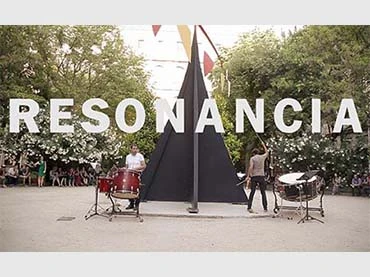
Alberto Bernal (with Neopercusión). Mobile. Work for a Percussion and a Performer
Held on 20, 27 May, 03, 10, 17, 24 Jun 2015
Resonance is a series of sound interventions for a specific site, activating the acoustic and historical space in the Museo Reina Sofía’s Sabatini Building. The programme refrains from using the auditorium and electronic amplification, which means guest artists, musicians and composers will present a series of pieces that set in motion alternative contexts for sound and contemporary music.
This series lays out a set of interventions that work with unwanted echoes and resonances, developing the properties sound possesses, depending on where it is produced – a quality that the careful design of auditoriums, speakers and earphones have tried to make us forget.
Modern music in Europe changes with the buildings that houses it. There is a type of opera for a type of opera house, while the waltz in large-scale rooms does not possess the same musical form as swing music in dance halls. Buildings designed for listening such as auditoriums – which are becoming increasingly more specialised – direct attention frontally or define space shared by the musician and listener. The introduction and popularisation of the record player, electronic amplifiers and radio have established new ways of listening based on reproduction, where the musician and listener become more and more distanced and where there is no control over who accesses the symbolic space of the music.
This series puts forward other paradigms of listening, introducing six sound interventions as possible alternatives to the traditional history of modern resonance. Where are we when we listen? When we listen are we in another world or inside the music? writes Veit Earlman. Listening is to live in the sound, and the pieces for these other modes of listening in the Sabatini Building include, among others: a collective performance for voices and vaults by Mattin, a wind concert without blowing for garden and rooms by Alex Mendizabal and a duo for two saxophones and two staircases by Jean Luc Guionnet and Artur Vidal.
Curatorship
José Luis Espejo


Más actividades
![Video-Nou/Servei de Vídeo Comunitari, Ocaña. Exposició a la Galería Mec-Mec [Ocaña. Exposición en la Galería Mec-Mec], 1977, película](https://recursos.museoreinasofia.es/styles/small_landscape/public/Actividades/coleccion-proyectada-7.png.webp)
Daily Matter
Thursday, 23 April and 14 May 2026 — 7pm
Time, light, vision. What is an image? How does an image make us see the world? First, hypnosis, a reset: Paulino Viota’s Duración (Duration, 1970), the portrait of a clock face over sixty seconds. Next, a window into a slightly altered reality: Javier Aguirre’s Objetivo 40º (40 Degree Lens, 1968–1970). A minimum intervention that inspires a session considered as successive immersions in blocks of time, as well as a journey that starts from the intimacy of a candle, the movement of a car around abandoned peripheries and the traces of anti-Franco protestors, with night falling to the emotive, profound and sharp voice of Ocaña. Now in 1990, the journey ends at other street protests, those articulated by the Agustín Parejo School collective owing to the housing problem in Málaga. As Javier Aguirre states: “It is not about achieving the objective. It is about demystifying it”.
Framed inside The Collection Screened is the programme Present Time: Insurgent Images, curated by Luis López Carrasco, a key film-maker with a distinguished international career. The works in the programme, selected from the Museo’s film and video collection, interlink projects that are conceptual, refined, systematic — as an X-ray of their time in history — with firebrand domestic and activist films, comprehending different political emergencies from the second half of the twentieth century in Europe and Latin America. These works are viewed in light of a genealogy of revolt which buries its roots in the nineteenth century.
Economy of Hate
18 ABR, 9 MAY 2026
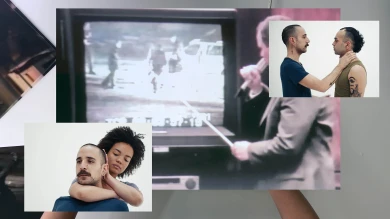
Economy of Hate features one sole work, Oído Odio (2021) by artist Diego del Pozo Barriuso. The piece combines television and media archive materials, recordings with performers with explicitly queer corporalities and 3D animations, combining in a strikingly fluid dialogue. The title alludes to a notion developed by the artist concerning the materiality with which hate circulates and the way it escalates. Setting out from the idea that hate is an affect which gains more value the more it circulates, the video shows the evolution from television to mobiles, expounding how the change of technological paradigm has made viral the fact of being in contact more than ever with explicitly violent images.
Inside the framework of The Collection Screened, a programme rooted in the institution’s film, video and moving image holdings, the Museo invites Laura Baigorri, one of the leading specialists in video art, to approach specific aspects related to identity, self-representation and the body within the Museo’s audiovisual collection since the 1990s.
![Dias & Riedweg, Casulo [Crisálida], 2019, película](https://recursos.museoreinasofia.es/styles/small_landscape/public/Actividades/desafios-cine-2.png.webp)
Other Voices in Us All
17 ABR, 8 MAY 2026
A session which starts from a subtle corporeal challenge that prompts a confrontation with reason from sensibility and emotion, both of which are linked to a difference in mental health or spiritualism. It opens with a beautiful and strange short film entitled A família do Capitao Gervásio (2013), by Tamar Guimarães and Kasper Akhøj, set in a small town in inland Brazil, where around half the inhabitants are psychic mediums whose work centres on community healing. The second piece, Dias & Riedweg’s Casulo, is the outcome of a participatory project with a group of patients from the Institute of Psychiatry at the Universidad Federal de Río de Janeiro. The video bears witness to the development of their routines after hospitalisation and captures their ideas and impressions about different aspects of life, revealing the division between territories of reason and madness in their daily existence.
Inside the framework of The Collection Screened, a programme rooted in the institution’s film, video and moving image holdings, the Museo invites Laura Baigorri, one of the leading specialists in video art, to approach specific aspects related to identity, self-representation and the body within the Museo’s audiovisual collection since the 1990s.
Mediations of the Archive: Art, Community, and Political Action
Tuesday 7, and Thursday 23, April, 2026 – 17:00 h
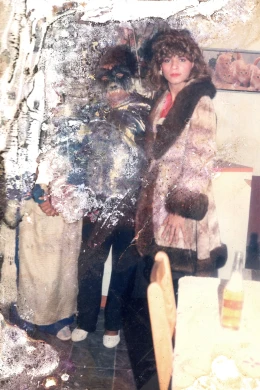
The online seminar Mediations of the Archive: Art, Community, and Political Action, curated by Sofía Villena Araya, examines the role of archival practices in caring for, dignifying, and activating memory in Central America. As part of the Cáder Institute for Central American Art’s first line of research, driven by the question “What Art Histories does Central America produce?”, this seminar proposes an approach to the archive as a mediator that articulates relationships between art, community, and political action, while engaging with the historiographical questions raised by their intersections.
Although the proposal is not limited to discussions of the Central American isthmus, it is framed by the particular conditions under which memory has been constructed in the region. Central America is a territory vulnerable to natural and geological disasters, marked by political violence exercised by authoritarian states and fragile institutions, a persistent colonial and imperial legacy, and the social fragmentation resulting from these factors. It is also a context in which the archive does not necessarily refer to a specific place —such as a building or documentary collection— nor does it primarily follow the protocols of a discipline such as archival science. Rather, the seminar explores how the archive operates, through art, as a dispositif that forges connections, generates forms of belonging, and opens spaces for political action.
The encounter unfolds across two sessions: the first focuses on archival practices addressing questions of memory, violence, and war; the second examines community-based practices surrounding queer and sex-dissident archives. In the face of the systematic destruction of memory, the archival practices discussed in these sessions demonstrate how the archive emerges in other spaces and according to different logics. Within this framework, the proposed space for exchange and research explores the role of art as a productive medium for constructing archives through images, affects, intimacy, performativity, the body, orality, and fiction, as well as through other materialities that challenge the centrality of the document and of writing.
Lucrecia Martel. Our Land
Saturday, 18 April 2026 – 4:30pm
Nuestra tierra (Our Land, 2025) is Argentinian film-maker Lucrecia Martel’s first documentary and her most recent work. The film focuses on the legal case surrounding the murder, in 2009, of Javier Chocobar, a member of the Los Chuschagasta Indigenous community, who was killed while resisting the forced displacement of ancestral land located in northern Argentina, territory hiscommunity has inhabited and farmed for centuries.
Drawning on fragments of the above-mentioned trial, which took place in 2019, as well as a meticulous reconstruction of the history of Los Chuschagasta since the seventeenth century, Martel decries how colonial violence, far from being a relic of the past, underlies current political and social structures and ends in the mistreatment and systematic invisibility of Indigenous peoples.
Lucrecia Martel is a director and screenwriter widely regarded asone of the most relevant film-makers in the twenty-first-centuryLatin American cinema. To date, she has directed four feature-length films: La ciénaga (The Swamp, 2001), Zama (2001), La niña santa (The Holy Girl, 2004) and La mujer rubia (The Blonde Woman, 2008), all of which have been awarded at film festivals, including recognitions in the Official Selection at Cannes. Accross her work Martel explores the complexities of an Argentina shaped by the political and social crisis of the 1990s and by the burden of a colonial past, which she translates into her own visual language of documentary, paradoxically offsetting it against fiction. As Martel asserts: “What I do is all lies, all artifice. I don’t believe in the truth and, if there is any effect of truth in my films, then it’s a miracle”.
These notions, the germinating material of her films, enable a reflection on how the tactics of fiction and imagination, materialized thought creativity, can function as powerful means of resisting the erasure of memory and as a tactic of reparative justice. This line of thought also underpins READ Madrid. The Festival of Books and Ideas, which frames the screening of this film.
READ Madrid is a space of encounter for critical and experimental voices in the sphere of literature and theory. The festival gathers a transatlantic framework of voices related to writing, art and publishing, whose practices challenge hegemonic frameworks of knowledge production and make room for performative and cinematic forms as expanded forms of research.