-
Museo Reina Sofía, Sabatini Building, Auditorium
Programme 1. Lettrism
-
Friday, 21 February 2020 – 7pm
Session 1
Second session: Saturday, 22 February – 7pm
Isidore Isou
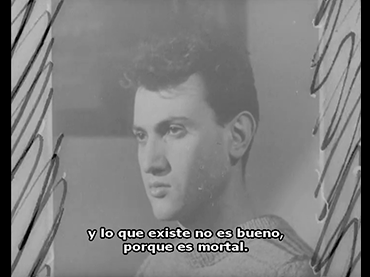
Traité de bave et d’éternité (Treaty on Venom and Eternity)
France, 1951, b/w, original version in French with Spanish subtitles, DA, 123’. Museo Reina Sofía Collection.– Presented by Kaira M. Cabañas, art historian specialised in Lettrism, and author of the book Off-Screen Cinema: Isidore Isou and the Lettrist Avant-Garde (University of Chicago Press, 2015) [audio intervention]
Isou, a young Romanian poet and intellectual who had moved to Paris, was only 27 when he presented this film at Cannes. His aspirations included: resuming Russian Dadaist and formalist investigations into language, akin to his compatriot Tristan Tzara, and surmising the end of the then exhausted Surrealist movement. His goal: the birth of a new artistic avant-garde movement based on the liberating potential of the letter between sign and sound; that is, outside the logical order of word and language. This cult film constitutes his birth certificate and, produced on discarded footage from the French army, is an essay on artistic unrest through the life of a young artist. It also innovates in a hugely significant way: the ‘discrepant’ edit, in which the image becomes dissociated from the sound and is thus no longer the grounds for what we see on the screen, and ‘chiselled’ cinema, with scratches, crossings-out and other physical attacks on the actual film.
-
Friday, 28 February 2020 – 7pm
Session 2
Second session: Saturday, 29 February – 7pm
Gil J Wolman
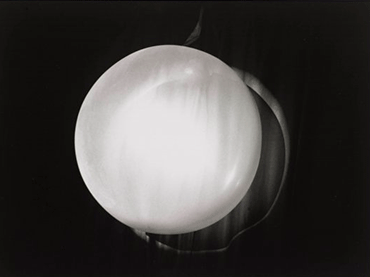
L’Anticoncept (Anti-concept)
France, 1951 b/w, original version in French with simultaneous interpretation into Spanish, DA, 60’. Museo Reina Sofía Collection.“I am immortal and I am alive” are the words which conclude the audio of this unprecedented film work and which appear to allude to the fascination that still stirs in artists and theorists today. A huge hot-air balloon ushers us into the film theatre, acting as a volumetric screen folded upon itself, in which an abstract 35mm film with circles and opaque black blocks is projected. The sound comes from the voice of Gil J Wolman, who leaves behind discursive logic utterances, returning the voice to the phoneme, the breath, the body, in memory of Artaud. The film was censored in France from 1952 onwards due its strobe lights; “when the powers of the cop are added to professional blindness, we have idiots banning anything they don’t understand”, Guy Debord would write. Anti-Concept would be key in Debord’s first film and also to the film experiments of Brion Gysin and William Burroughs. For this series, the film is reactivated adhering to Gil J Wolman’s maxim: “recounting a work lacks a relationship with the work; revive it”.
-
Saturday, 12 September 2020 – 7pm / Museo Reina Sofía, Sabatini Building, Auditorium
Session 3
Second session: Sunday, 13 September 2020 – 7pm / Museo Reina Sofía, Sabatini Building, Auditorium
François Dufrêne
Tambours du jugement premier (Drums of the First Judgement)
France, 1952 (1973 register), 72’. Reinterpreted by Gran Circo IndómitoA film with no screen and no sound. The Lettrists would become pioneers in disarming the film device; namely, in thinking of the cinema experience in another way. Therefore, they would not only presage film installations and expanded cinema, they would also reconnect with their own origins, despite them not being encoded in a dominant form. This film of “imaged cinema”, in the words of Dufrêne, takes us to the variety show, fair, and cinema in an unpredictable and uncontrolled situation. The recital, the voice and aphorisms articulate a series of events that occur in the room and which, on this occasion, an ensemble of Gran Circo Indómito poets and artists adapt to the present.
-
Museo Reina Sofía, Sabatini Building, Auditorium
Programme 2. René Viénet
-
Monday, 2 March 2020 – 7pm
Session 1
Second session: Thursday, 10 September 2020 – 7pm. Cancelled
René Viénet
La dialectique peut-elle casser des briques? (Can Dialectics Break Bricks?)
France, 1972, colour, original version in Cantonese with audio modified in French and with Spanish subtitles, DA, 90’René Viénet develops the ludic and subversive possibilities of Situationist détournement (diversion), a technique for appropriating, resignifying and making images and mass-culture materials circle again with a new and critical meaning with respect to the original. In so doing, the Situationists managed to reveal the ideological workings of the entertainment industry. In this film, Viénet appropriates Crush (1972), a martial arts film from Honk Kong made by Kuang-Chi Tu, in which some Japanese thugs terrorise Korean peasants, culminating in a fight. Viénet turns it into a confrontation between bureaucrats and proletariats inside State capitalism, between the use of dialogue and the use of violence, resulting in an aesthetically and politically avant-garde Situationist comedy demonstrating that play and humour are at once two effective and essential weapons in social critique.

-
Wednesday, 4 March 2020 – 7pm
Session 2
Second session: Saturday, 7 March – 7pm
René Viénet
Chinois, encore un effort pour être révolutionnaires (One More Effort, Chinamen, If You Want to Be Revolutionary)
France, 1977, colour, original version in Mandarin with audio modified in French and with Spanish subtitles, 35mm, 120’– First session presented by René Viénet and Carlos Prieto Acevedo, editor, film programmer and translator of Viénet’s films.
In May 1965, Guy Debord and Gil J Wolman published the article “Mode d’emploi du détournement” (A User’s Guide to Détournement), where they assert: “clearly it is in the sphere of film where diversion is at its most effective and, undoubtedly, for those concerned about it, most beautiful (…). We can say that Griffith’s Birth of a Nation is one of the most important films in the history of cinema due to the mass of new contributions it represents. On the other hand, it is a racist film: in no way does it merit being screened in its current form. It is much better to divert its whole (…). A diversion like this, a very moderate one, would be nothing, in short, but the moral equivalent of the restorations of ancient paintings in museums”. René Viénet continues with the masterful use of detournement in this anti-Maoist film — a “spectacular” concentrated regime, according to Debord — together with newsreels and fiction films.

-
Círculo de Bellas Artes and Museo Reina Sofía
Programme 3. Guy Debord
-
Thursday, 5 March 2020 – 7:30pm / Círculo de Bellas Artes, Cine Estudio
Session 1
Guy Debord
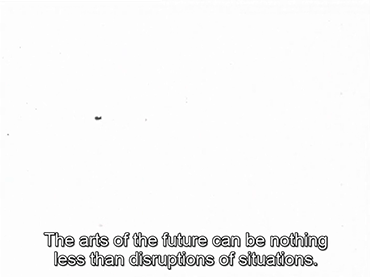
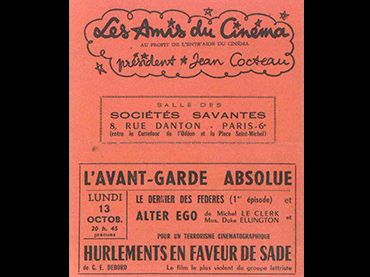
Hurlements en faveur de Sade (Howlings for Sade)
France, 1952, b/w, original version in French with Spanish subtitles, DCP, 79’Guy Debord’s first film and an example of his temporary allegiance to Lettrism. The film conveys a denial of the image, with alternate black-and-white screens and an independent soundtrack, in which dialogues are held on politics and love, news, extracts from the Civil Code, and readings of novels with the voices of Gil J Wolman, Isidore Isou, Barbara Rosenthal and Debord. Among these phrases, there is a resounding overview: “I decided to destroy cinema because it was easier than killing passers-by”. This anti-film inherits from Isou (discrepant cinema or the separation of image-audio) and is hugely influenced by Wolman’s Anti-Concept, not only in the extreme denial of the visible, but also in a specific idea: ending cinema is associated with the broadening of its critical possibilities.
-
Sunday, 8 March 2020 – 7:30pm / Círculo de Bellas Artes, Cine Estudio
Session 2
Guy Debord
Sur le passage de quelques personnes à travers une assez courte unité de temps (On Some People Passing Through a Rather Short Time Unit)
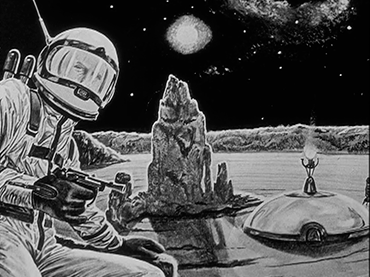
France, 1959, b/w, original version in French with Spanish subtitles, DCP, 19’Critique de la séparation (The Critique of Separation)
France, 1961, b/w, original version in French with Spanish subtitles, DCP, 18’This session features two films made by Debord while Situationist International (1957–1972) existed. Both adhere to this movement of cultural and political agitation that promotes the rescue of life, with the latter having been turned into commodity, according to the logic of the spectacle. Therefore, they set out from the “creation of situations”, interactions between people and places that give rise to emancipatory social relations from the production-consumption axis. The conquest of a daily time and an existential space outside of this axis dominates both beautiful manifestos. In terms of audiovisual language, Debord appropriates the documentary genre of art devised by Alain Resnais (voice-over, still shots, subtitles, the fiction-documentary rupture) with an implicit objective and critique: transcending art in the recovery of life.
-
Tuesday, 10 March 2020 – 7:30pm / Círculo de Bellas Artes, Cine Estudio
Session 3
Guy Debord. Writing Cinema
A round-table discussion, with the participation of Amador Fernández-Savater, Hugo Savino and Manuel AsínThe cinematic writings of Guy Debord form an essential corpus for approaching the thought of the theorist and his relationship to images. Translated into Spanish for the first time by the publishing house Caja Negra, they include scripts and letters, most notably unrealised projects, for example the one in which he dedicates his last film to Spain. Participants in the round-table comprise Amador Fernández-Savater, theorist and editor of Panegírico (Acuarela Libros, 1999), the Guy Debord autobiography, Hugo Savino, essayist and translator, and Manuel Asín, editor of the book and co-curator of the series.
-
Thursday, 3 September 2020 – 7:30pm / Círculo de Bellas Artes, Cine Estudio
Session 4
Guy Debord
La société du spectacle (Society of the Spectacle)
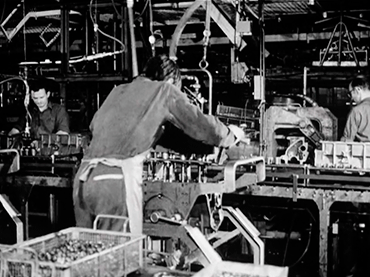
France, 1973, b/w, original version in French with Spanish subtitles, DCP, 90’A film adaptation of one of the most profound, ludic and revealing literary essays of our times, Society of the Spectacle (1967), also by Guy Debord. The theoretical analysis in the film-maker’s own voice-over and the flow of appropriated and resignified images from Westerns and Hollywood war films, Soviet propaganda, advertising and pornography, seek to show the workings of this political regime, whereby, according to Debord, all forms of social relations are obstructed by images and the spectacle; in short: “[…] capital in such a degree of accumulation that it has become an image”. Debord uses this image overload to formulate a radical critique of the system based on two principles: not filming in order to not generate any new image prone to being turned into a commodity and examining the potential of cinema, in its recoding, as a weapon of ideological critique.
-
Friday, 4 September 2020 – 7:30pm / Círculo de Bellas Artes, Cine Estudio
Session 5
Guy Debord
Réfutation de tous les jugements, tant élogieux qu'hostiles, qui ont été jusqu'ici portés sur le film La Société du spectacle (Refutation of all Judgement, Eulogist and Hostile, Made Until this Point on the Film Society of the Spectacle)
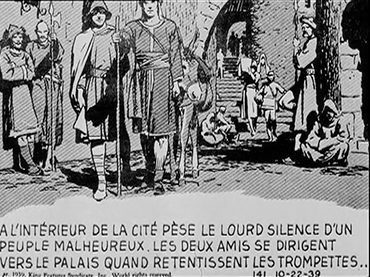
France, 1975, b/w, original version in French with Spanish subtitles, DCP, 22’In girum imus nocte et consumimur igni
France, 1981, b/w, original version in French with Spanish subtitles, DCP, 100’Two films with a semi-wakeful, melancholy tone that reflect the belligerence of the political and social establishment towards Debord and the end of the untamed youth uprising represented by International Situationism. In Réfutation (…), the author takes charge of answering different critiques and rejections involved in the film version of Society of the Spectacle: “The most tenacious among those defeated liars still pretend to ask themselves whether the society of spectacle actually exists or whether, by chance, I am its inventor,” he said. In girum imus nocte et consumimur igni is a palindrome in Latin, and is known as a verse of the devil meaning “we move in the night and we are consumed by fire”. Scenes from Westerns, war and social films narrate the heroic times of Situationism as the party’s end. Debord, transformed into Errol Flynn or General Custer from They Died With Their Boots On, admits its rejection in the face of a drugged and self-complacent society.
-
Saturday 14 November, 2020 - 5:30pm / Museo Reina Sofía, Sabatini Building, Auditorium
Session 6
Brigitte Cornand y Guy Debord
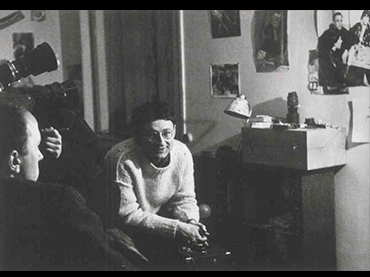
Guy Debord, son temps et son art (Guy Debord, His Time and His Art)
France, 1994, colour, original version in French with Spanish subtitles, DA, 60’A documentary on Guy Debord with a screenplay by the theorist, who says of himself: “Guy Debord made very little art, but he did make it extreme”. Screened and subtitled for the first time in Spain, the film is a deliberate testament. It was shown on Canal+, its producer, on the agreed date of 9 January 1995, together with La société du spectacle and Réfutation. Only a month or so earlier, on 30 November 1994, Debord committed suicide in Bellevue-la-Montagne.
-
Saturday 14 November, 2020 – 7pm / Museo Reina Sofía, Sabatini Building, Garden
Session 7
Guy Debord
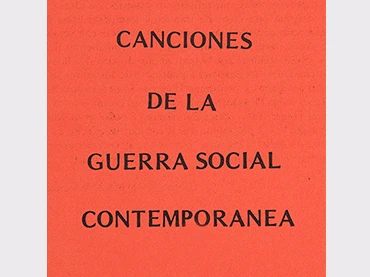
Songs of the Contemporary Social War
Concert and screening
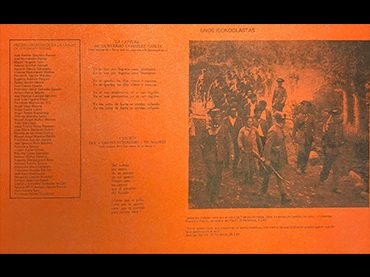
Length: 1 hourJorge Manrique, Baltasar Gracián, conceptist baroque, Spanish anarchism, miners’ protests during Francoism… Guy Debord became passionate about Spanish culture, leading him to spend some time in Seville and even want to make a film as the culmination of his work, a project that would slip by the wayside: “thus, I will have dedicated an empty statue to Spain, a profound statue of nothing. Is there a more beautiful statue?”, Debord wrote to Jorge Semprún in 1986. The film is replaced by a songbook that narrates post-Francoist Spain: social movements, proletariat autonomy, neighbourhood organisations and the whole world of transformative energy and possibility moulded in the Transition to democracy. The coplas, summaries of the origins of contemporary Spain, are reinterpreted by choirs, artists and present-day musicians following invaluable research by artist Pedro G. Romero.
Guy Debord and René Viénet, from Lettrism to Situationism
Film Is Dead: If You Want, Let’s Proceed to the Debate
Held on 03, 04, 05, 10, 11, 12, 13, 18, 19, 25, 26 Sep, 02, 03, 09, 10, 11, 16, 17, 23, 24, 30, 31 Oct, 06, 07, 13, 14 Nov 2020
Lettrism and Situationism were two intellectual and artistic movements that foreshadowed the transcendence of the idea of the avant-garde. In the wake of Lettrism (1945–1952), a critique of the rational order of language was encountered; after Situationism, the discovery of the analysis and dismantling of a new regime based on the spectacle. Decisive to both movements was the reflection on film and cinephilia, and on the image and its transformation into a commodity. This series, therefore, joins both movements across three blocks: Lettrism, Guy Debord and René Viénet.
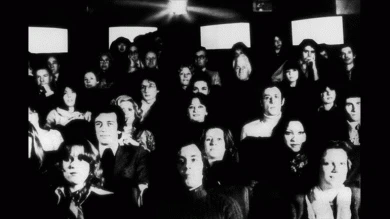
In “Esthétique du cinéma”, published in Ion No. 1 in April 1952, Isidore Isou wrote: “When the screening was supposed to start, Debord had to get up on stage to say a few introductory words. He simply had to say: ‘there is no film to screen’. I thought about intervening and associating his destructive scandal with the constructive theory of pure debate. Debord should have said: ‘Film is dead. There can be no more films. If you want, let’s proceed to the debate’”.
In barely a year, between the springs of 1951 and 1952, a series of films and filmic performances were presented in France which even today, in retrospect, can be seen among the most radical points of rebuttal towards the cinema institution. Isidore Isou, the founder of Lettrism — a movement which synthesised much of the energy in the post-Second World War avant-garde in France — presented, at Cannes Film Festival, the first version of his film Traité de bave et d’eternité (1951), which revolved around a complete separation of the image track and soundtrack; “discrepant editing”, in his own terminology. The screening unleashed a storm of controversy since the last third of the film was sound only and showed a black screen, opening the way for an even more radical practice by other young film-makers: in the two months that followed, different Lettrists conducted exhaustive research into the key components of the cinema device. Aspects to be vehemently desecrated were: the film screen and image in L’Anticoncept (Gil J Wolman, 1952); the film theatre and screening device in Tambours du jugement premier (François Dufrêne, 1952); and the support and public reception in Hurlements en faveur de Sade (Guy Debord, 1952). The last of these would also cause a rift to run through the group, and would definitively split the paths of Debord and the other Lettrists.
Although only recognised as such on a few occasions, Guy Debord wanted to be known as a film-maker. The central role cinema played in the “spectacular” society in the second half of the 20th century, which he would describe with acuity, afforded him the chance to become its only “accursed film-maker”. Therefore, Debord aligned his film practice with the permanent rejection of the institution — a practice which meant experimentally applying the Situationist directive of transcending art. His first public action entailed screening an imageless film, while his last rested on depriving the world of the chance to see his films, which actually occurred in the last ten years of his life. The publication, in book form, of the comments in his films (Oeuvres cinématographiques complètes, Gallimard, 2005) or the barren film version of his most acclaimed work (La societé du spectacle, 1973) were part of Debord’s calculated strategy to undermine the foundations of film culture and the society of the spectacle — the image — favouring instead its age-old adversary, the text.
The film work of René Viénet represents a counterpoint to Guy Debord’s abstractions and challenges in the Situationist movement. In his films, restored for this season, the film-maker takes detournement, or deviation, to the extreme, appropriating and re-signifying newsreels, Maoist documentaries and karate films to question, in a perpetually humorous and playful way, bureaucratised society.
Curatorship
Manuel Asín and Chema González
With the support of
Force line
Avant-gardes
Organised by
Museo Reina Sofía and Círculo de Bellas Artes
Más actividades
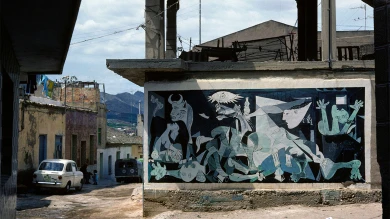
Rethinking Guernica
Monday and Sunday - Check times
This guided tour activates the microsite Rethinking Guernica, a research project developed by the Museo Reina Sofía’s Collections Area, Conservation and Restoration Department and the Digital Projects Area of the Editorial Activities Department, assembling around 2,000 documents, interviews and counter-archives related to Pablo Picasso’s painting Guernica (1937).
The visit sets out an in-situ dialogue between the works hung around the painting and a selection of key documents, selected by the Museo’s Education Team and essential to gaining an idea of the picture’s historical background. Therefore, the tour looks to contribute to activating critical thought around this iconic and perpetually represented work and seeks to foster an approach which refreshes our gaze before the painting, thereby establishing a link with the present. Essentially revisiting to rethink Guernica.
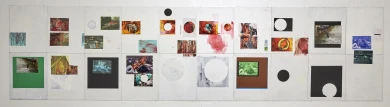
Difficulty. Forms and Political Effects of Deviation in Writing and Contemporary Art
23 February – 14 December 2026 – Check programme
Difficulty. Forms and Political Effects of Deviation in Writing and Contemporary Art is a study group aligned towards thinking about how certain contemporary artistic and cultural practices resist the referentiality that dominates the logics of production and the consumption of present-day art. At the centre of this proposal are the concepts of difficulty and deviation, under which it brings together any procedure capable of preventing artistic forms from being absorbed by a meaning that appears previous to and independent from its expression. By ensuring the perceptibility of their languages, difficulty invites us to think of meaning as the effect of a signifying tension; that is, as a productive and creative activity which, from the materiality of art objects, frees aesthetic experience from the representational mandate and those who participate in it from the passiveness associated with tasks of mimesis and decoding.
The economy of the referential norm translates the social logic of capitalism, where insidious forms of capturing subjectivity and meaning operate. In the early 1980s, and adopting a Marxist framework, poet Ron Silliman highlighted how this logic entailed separating language from any mark, gesture, script, form or syntax that might link it to the conditions of its production, rendering it fetichised (as if without a subject) and alienating its users in a use for which they are not responsible. This double dispossession encodes the political strategy of referential objectivity: with no subject and no trace of its own consistency, language is merely an object, that reality in which it disappears.
The political uses of referentiality, more sophisticated today than ever before, sustain the neoliberal-extractivist phase of capitalism that crosses through present-day societies politically, economically and aesthetically. Against them, fugitive artistic practices emerge which, drawing from Black and Queer studies and other subaltern critical positions, reject the objective limits of what exists, invent forms to name what lies outside what has already been named, and return to subjects the capacity to participate in processes of emission and interpretation.
Read from the standpoint of artistic work, the objective capture of referentiality may be called transparency. Viewed from a social contract that reproduces inequality in fixed identity positions, transparent in this objectivity are, precisely, the discourses that maintain the status quo of domination. Opposite the inferno of these discourses, this group aims to collectively explore, through deviant or fugitive works, the paradise of language that Monique Wittig encountered in the estranged practices of literature. For the political potency of difficulty — that is, its contribution to the utopia of a free language among equals — depends on making visible, first, its own deviations; from there, the norm that those deviations transgress; and finally, the narrowness of a norm which in no way exhausts the possibilities ofsaying, signifying, referring and producing a world.
From this denouncement of referential alienation, fetishisation and capture, Difficulty. Forms and Political Effects of Deviation in Writing and Contemporary Art turns its attention to the strategies of resistance deployed by contemporary artists and poets. Its interest is directed towards proposals as evidently difficult or evasive as those of Gertrude Stein, Lyn Hejinian, Theresa Hak Kyung Cha, Kameelah Janan Rasheed, Kathy Acker, María Salgado and Ricardo Carreira, and as seemingly simple as those of Fernanda Laguna, Felix Gonzalez Torres and Cecilia Vicuña, among other examples that can be added according to the desires and dynamics of the group.
The ten study group sessions, held between February and December, combine theoretical seminars, work with artworks from the Museo Reina Sofía’s Collections and exhibitions, reading workshops and public programs. All these formats serve as spaces of encounter to think commonly about certain problems of poetics — that is, certain political questions — of contemporary writing and art.
Difficulty. Forms and Political Effects of Deviation in Writing and Contemporary Art inaugurates the research line Goodbye, Representation, through which the Museo Reina Sofía’s Studies Directorship seeks to explore the emergence of contemporary artistic and cultural practices which move away from representation as a dominant aesthetic-political strategy and redirect their attention toward artistic languages that question the tendency to point, name and fix, advocating instead for fugitive aesthetics. Over its three-year duration, this research line materializes in study groups, seminars, screenings and other forms of public programming.

CLINIC 2628. A Community of Writing and Research in the Arts
February – October 2026
Clinic 2628 is a project which supports and brings together writings which stem from the intention to offer a space and sustainable time for research work in art and culture. Framed within an academic context which is increasingly less receptive to the forms in which thinking happens and is expressed, the aim is to rescue the academic from its neoliberal trappings and thus recover the alliance between precision and intuition, work and desire. A further goal is to return writing to a commons which makes this possible through the monitoring of processes and the collectivisation of ideas, stances, references and strategies.
The endeavour, rooted in a collaboration between the Museo Reina Sofía’s Studies Directorship and the Artea research group, via the i+D Experimenta project, is shaped by three annual editions conceived as spaces of experimentation, discussion and a demonstration of writings critical of what is put forward by today’s academia.
What forces, forms and processes are at play when writing about art and aesthetics? In academia, in museums and in other cultural institutions, the practice of writing is traversed by productivist logics which jeopardise rhythms of research and experimentation. The imposition of both scientism inherent in the structure of “the paper” and the quantifying of results which demand a criterion of quality and visibility sterilise and smoothen, from the outset, the coarseness that is particular to writing understood from the concrete part of language: phonic, graphic, syntactic and grammatical resistance connecting the language user to the community the language unites and activates. They also sterilise the roughness enmeshed in the same desire to write, the intuitive, clear and confusing pathways that once again connect the writer to those reading and writing, participating in a common good that is at once discovered and produced.
The progressive commercialisation of knowledge propelled by cognitive capitalism moves further away from the research and production of knowledge in artworks and artistic languages and practices. The work of curators and archive, criticism, performances and essays formerly saw a horizon of formal and emotional possibilities, of imagination that was much broader when not developed in circumstances of competition, indexing and impact. Today, would it be possible to regain, critically not nostalgically, these ways; namely, recovering by forms, and by written forms, the proximity between art thinking and its objects? How to write in another way, to another rhythm, with no more demands than those with which an artwork moves towards different ways of seeing, reading and being in the world?
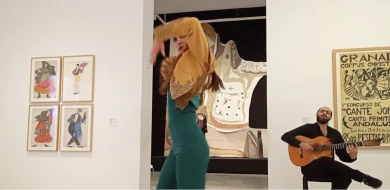
Take Shelter in Culture 2026
Mondays, from 6 July to 24 August 2026 – 3pm
This summer, the Museo Reina Sofía participates, for the third year running, in Take Shelter in Culture. The campaign features performances by distinguished figures from flamenco guitar and dance in the rooms of The Spanish Night. Flamenco, Avant-Garde and Popular Culture, to the backdrop of Alberto’s work La romería de los cornudos (The Pilgrimage of the Cuckolds), on the second floor of the Sabatini Building, close to Picasso’s Guernica.
Every Monday, starting on Monday, 6 July and ending on 24 August, at 3pm different flamenco artists will perform, offering a different way of visiting the works in the Museo Reina Sofía Collections.
This programme of cultural activities, promoted from Madrid City Council’s Area of Culture, Tourism and Sport, allows people visiting the Museo in the hottest hours of the day during the summer months to enjoy a space in which to shelter from extreme temperatures.
equipoMotor
Jueves alternos, 23 de octubre, 2025 - 11 de junio, 2026 - 17:30 h
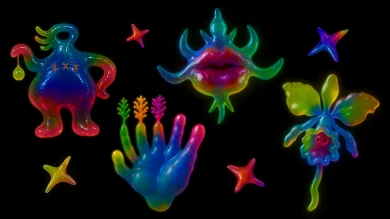
El programa equipoMotor regresa en su edición 25-26 con un aire espectral y mutante para lanzar la pregunta: ¿y si el Museo fuera «un poco más Frankenstein»? Inspirándose en dicho monstruo y en todas aquellas criaturas que desafían la norma desde los márgenes, el proyecto de mediación cultural Galaxxia diseña y acompaña una edición incisiva, intergeneracional y descentralizadora, donde saberes invisibilizados, cuerpos raros y deseos molestos se entrelazan para generar nuevas formas de imaginación crítica y radical. En los sótanos y corredores del Museo —un particular laboratorio— las dudas no se esconden: son materia prima.
Así, para este curso el equipoMotor convoca a personas de todas las edades que hayan participado en ediciones anteriores de los distintos equipos del Área de Educación a recorrer el Museo como quien manipula un cuerpo abierto: descoyuntando algunas de sus categorías teóricas y artísticas —la necropolítica, lo crip-cuir, la lucha de clases, las políticas del malestar, la decolonialidad, la temporalidad cuir, la descentralización institucional o el feísmo— para articular un relato díscolo, remendado y palpitante.
El programa se estructura en bloques temáticos sobre lo freak como metodología, el trabajo cultural, la intergeneracionalidad y la diversidad territorial. Cada bloque a su vez se despliega en sesiones que combinan disparadores teóricos y estéticos, visitas a exposiciones y espacios liminales del Museo, talleres artísticos con artistas, ejercicios de curaduría audiovisual colectiva y de relatoría radiofónica, así como instancias de activación pública, mediante proyecciones de cine experimental y coloquios compartidos con el público, en complicidad con el archivo Hamaca y el Área de Cine y Nuevos Medios del Museo.
De este modo, la presente edición incorpora una particularidad: el grupo de participantes irá transformándose en un «colectivo curatorial audiovisual temporalmente autónomo», con capacidad de incidir en la programación del Museo y de abrir la conversación de equipoMotor al público general, cuestionando y expandiendo así los límites entre las cabezas que deciden, las manos que producen y los cuerpos y presencias que habitan la institución. Las personas seleccionadas en la modalidad oyente serán invitadas a las proyecciones públicas, así como a otras activaciones y momentos de apertura del equipoMotor.
Frente al relato de un museo homogéneo, pulcro y lineal, apostamos por un Museo disidente, contradictorio y lleno de vida residual. Un Museo que no tema hacerse preguntas incómodas ni mostrar sus cicatrices. equipoMotor. Un poco más Frankenstein no busca repensar el cuerpo de la institución, sino habitarlo en sus desgarros, tal como es: híbrido, inacabado, infecto, fantasmagórico… y cargado de esporas y chispas por venir.