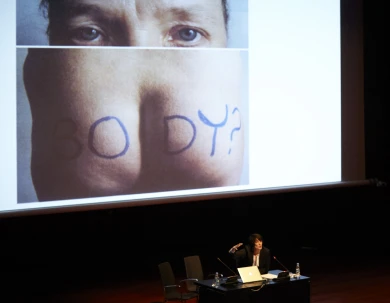
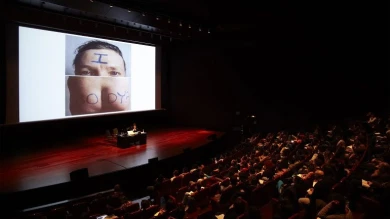
Held on 09 Mar 2013
In The Birth of the Clinic (1963), Michel Foucault suggested that for each model of power there was a healthy body and a diseased body, a specific way of organising sexuality and reproduction, a spatialization of differences in the city and a utopian ideal of national immunity. What would the model of somatopolitical administration be in the case of contemporary neoliberal societies?
On the one hand, the techniques of appropriation and slavery, the management of syphilis and the pathologization of insanity and homosexuality – characteristics of the 18th and 19th century – have been displaced by new techniques for the management of migration, of the seropositive body and also by the pathologization and media's production of disability, autism, obesity, infertility, intersexuality and transexuality. Heterosexuality as the naturalized and politically-legitimised procreation technique has given way to the commercialisation of technofluids and genetic material. The figure of the indebted body, as Maurizio Lazzarato has written, emerges from the neoliberal condition.
Feminist and homosexual politics of the 1970s were characterised by their efforts to understand what Foucault called “the birth of the clinic,” in an attempt to dismantle its disciplinary institutions: the family, the school, the hospital, the prison or the factory.
However, the political context has changed radically: the new neoliberal condition, the economy of debt and the cutbacks in social services portend an untimely death for the clinic. Paradoxically, this collapse of the disciplinary institutions forebode a strange process of privatisation and transformation of the clinic into a pharmacopornographic industry.
How are we to understand this displacement? What are the new forms of activism and the critical languages capable of responding to it? This lecture examines this situation and inaugurates the public activities of Somatheque 2013, and will be followed with interventions by Annie Sprinkle and Elizabeth Stephens.
Sponsorship

Participants
Beatriz Preciado is a philosopher and activist. She has published Manifiesto Contra-Sexual (Balland, 2000), Testo Yonqui (Espasa Calpe, 2008), Terror Anal (epilogue to El Deseo Homosexual by Guy Hocquenghem, Melusina, 2009) and Pornotopía. Arquitectura y Sexualidad en Playboy durante la Guerra Fría (Anagrama, 2010). She teaches political history of the body and queer theory in the Critical Practices Program at Museo Reina Sofía and in MACBA's Independent Studies Program, and also at University of Paris VIII.

Más actividades
![Mike Nichols, The Graduate [El graduado], 1967, película](https://recursos.museoreinasofia.es/styles/small_landscape/public/Actividades/ciclocine-piscinas-9_0.jpg.webp)
Mike Nichols. The Graduate
Friday, 31 July 2026
Benjamin Braddock (Dustin Hoffman) is a young graduate from a wealthy California family. After returning home he meets Mrs Robinson (Anne Bancroft), who seduces him in successive encounters and shows him things that can’t be read in books. Mrs Robinson’s daughter, Elaine (Katharine Ross), enters his life to turn his feelings upside down.
Anne Bancroft’s remarkable performance shows the need to feel alive in a world gone stale, and the weapons sex possesses opposite romantic love. This is the learning curve young Ben experiences, and it is the time he spends drifting in the swimming pool that takes him from bewilderment to lucidity. He goes from a fool in a wetsuit lost at the bottom of the pool, to letting himself sway on the waters of pleasure or to see the mantle of the pool covered in fallen leaves with the arrival of love. The swimming pool is the place that initiates a change of state: an awakening of life forces.
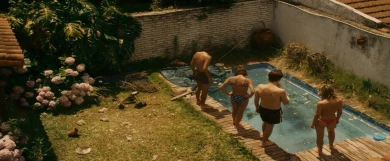
Sol Iglesias. The Swimmers
Saturday, 1 August 2026
The end of the world, caused by climate change, is here and a group of friends wander from swimming pool to swimming pool at the height of a long, hot summer in Buenos Aires. From pool to pool, they cross the city, drifting leisurely and agreeably. In this transit they encounter different survivors searching desperately for water until their journey ends.
In echoing Frank Perry and Sydney Pollack’s film The Swimmer, Sol Iglesias’s The Swimmers is, equally, a path towards first light. The swimming pools symbolise, on this sunburnt stage, a metaphor at once for shelter and death by asphyxiation. It is the extreme heat that turns it into a fresh and pleasurable ending. The swimming pool, moreover, represents the lethargy of a youth tired of fighting against something they see as “inevitable”. As the young people trespass on a neighbourhood’s private property — rather than in public space — the pool is a stronghold of intimacy that must be seized: the false paradise of a collapsed society. The film brings the viewer closer to another film to feature in this series, La ciénaga (The Swamp, 2001) by Lucrecia Martel, in which bodies search for recesses of stagnant water.
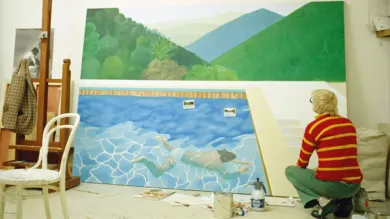
Jack Hazan. A Bigger Splash
Friday, 7 August 2026
Painting endows a fleeting and unique moment with permanence and stability. This was the vision of the late David Hockney when, brushstroke by brushstroke, he returned to the swimming pool in A Bigger Splash: the great dive into a Californian pool which freezes a sense of happiness. A splash made by Peter Schlesinger, the painter’s partner from whom he has just separated.
In the film A Bigger Splash, Jack Hazan portrays the world of a successful artist, art-market and art-dealer pressure, the tension between the ego and personal frailty, and the obligation to continue with a style and iconography which, despite its instantly recognisable artistic imprint, creates doubts for the painter. In a grey, rainy London, a glum Hockney, the victim of soured love, keeps returning to the Californian swimming pool that holds the promise of happiness, in the form of a homosexual Arcadia in which the painter lives with his young partner and a group of equally glowing and attractive friends. Ultimately, the pool, as Jack Hazan recalls in this pioneering artist’s documentary, is a simile for the same painting in its original intention: hang onto fleetingness to lend it a permanence for the beholder, despite it not existing. Hockney, as one of the last great painters, knew his medium remained largely unchanged across hundreds of years of history.
Six Swimming Pools. A Dive into Experimental Film
Saturday, 8 August 2026
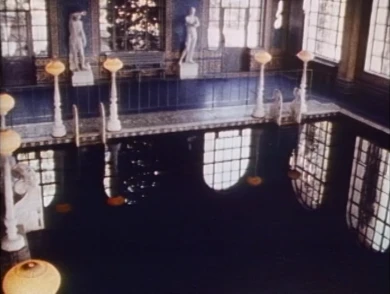
For the first time, the Museo’s summer cinema programme includes an experimental film section, centred on the experience and feeling of bodies under water. This session glides between the ostentatious aquatic architecture of Barbara Hammer and Barbara Klutinis and Jakobois’s fantasies, fleeting contact and wet, sexualised bodies. Six completely different swimming pools — private, public, transparent, bottomless, indoor, outdoor — all designed for leisure, competition and desire, nonetheless. A journey ranging from the monumentality of architecture to the intimacy of wet bodies.
Pools, by Barbara Hammer and Barbara Klutinis, turns swimming pools designed by pioneering architect Julia Morgan for the castle of tycoon William Randolph Hearst — the inspiration for Citizen Kane — into a space of play, bodily exploration and queer appropriation, an excuse to dive into a scene reserved for privilege. In An Algorithm, Bette Gordon fragments a series of headfirst dives and turns the sporting gesture into a visual score of repetitions, variations and rhythms. Tony Hill’s Water Work seduces with perspective, reflections and depth — the swimming pool as optical illusion, as an unstable surface which distorts and multiplies the gaze. Cheap Imitation “They Walk and I Walk”, by Rickard Eklund, submerges the camera to capture a choreography of synchronized bodies, a dance suspended under water. Naked bodies that dodge, twist and embrace in a space seemingly with no gravity combine in Gunilla Leander’s All Under. Passage du désir, by Jakobois, closes the programme with a montage in which water is no longer an environment, becoming instead a territory of desire.

Dominga Sotomayor. Debajo and Thais Fujinaga. A Felicidade das Coisas
Friday 14 August 2026
Two gems, from two new voices in Latin American cinema, which swing between families, swimming pools, reencounters and status. In Debajo, a short film on youth by Chilean director Dominga Sotomayor, an abstract yet powerful bird’s-eye view of a swimming pool co-exists with the relationships of a crisis-stricken family, gathered to see an eclipse. Sotomayor’s distinctive film-making of care and affects shares a similar space to the daily naturalism of Thais Fujinaga’s A Felicidade das Coisas. In the director’s first feature film, the swimming pool is not a horizontal basin for swimmers’ immersion; rather it is a huge vertical monolith, a kind of an anti-monument, anchored in the garden of a middle-class family. The film conveys the efforts and challenges of a mother of two children to build a swimming pool in their modest summer house, a mother who, alone, comes up against a hypermasculine world. Equally, the film speaks of family love, and the search for status, with the swimming pool a languishing totem of the Brazilian middle class during the years of Bolsonarism.