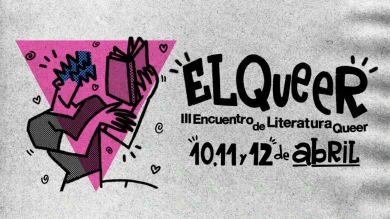
Held on 10, 11, 12 Apr 2025
Queer L.E. The Queer Literature Encounter features, in this its third edition, the most current output in queer and transfeminist literature. From an intersectional perspective, the encounter has developed to become a key event which mobilises LGBTQIA+ communities around knowledge production and creation.
More than thirty participants debate themes such as virtuality, resistance in the city, building the future and the literary industry by way of formats in parallel with these round tables of thought.
This edition, in which the memory of Roberta Marrero (1972–2024) elicits a twisted poetry recital in homage to this writer, poet and artist, a pivotal figure Spain’s trans scene, is the first to feature the live recording of a podcast focused on the importance of disseminating the queer collective’s struggle and will include a storytelling session and a performance.
Comisariado
Sandra Cendal, Ana Murillo y Óscar Romero
Accesibilidad
Organised by
Museo Reina Sofía
Agenda
jueves 10 abr 2025 a las 17:00
Digital Survival
— Encounter with Silvia Agüero, Cristina Fallarás and Marta G. Franco
Supported by: Margot Rot
Our lives also exist and co-exist in virtuality, and we would like to think of the internet and social media as potential places of politicisation, encounter, genealogy and struggle for our communities, as an opportunity to confront fascism, sexism and LGBTQIA+ phobia.
jueves 10 abr 2025 a las 19:00
The Right to the City
— Encounter with Sarah Babiker, Christo Casas and Ana Geranios
Supported by: Silvia Nanclares
Speculation and processes of gentrification backed by neoliberal polices drive us out of cities for the sake of capital and diminish public services. Therefore, we must strengthen mutual support, among residents and locally, as a form of resistance and to take a stance which allows us to live our lives as they should be lived, even in the most hostile cities.
viernes 11 abr 2025 a las 17:00
Imperfect Utopias
— Encounter between Ira Hybris, Alicia Valdés and Lara Alonso Corona
Supported by: Layla Martínez
With the rise of more conservative ideologies and a present in which there is a deliberate attempt to seize rights gained by minorities, there is an urgent need to think about the common horizons in which hope and encounter give rise to utopias which are, to some degree, imperfect.
viernes 11 abr 2025 a las 19:00
Why Birds Drink
— Poetry recital
An homage to artist and poet Roberta Marrero (1972–2024) by poets Ava Cívico, Eva Gallud, Rodrigo García Marina, Juanpe López Sánchez and Ángelo Nestore, with the participation of Mario Espinoza, Víctor Mora, Carolina Meloni and Inés Plasencia. Curated by: Laura Casielles.
sábado 12 abr 2025 a las 12:00
Queer Folkloric and Herstoric Memories
— A live podcast by Sangre Fucsia with Eugenia Tenenbaum, Mikel Herrán (Puto Mikel) and Lidia García
Sangre Fucsia becomes immersed in queer literature by way of the copla and camp aesthetics as spaces of resistance in the history of sexual dissidence and the lives and works of women in art. A live podcast to vindicate queerness across history.
sábado 12 abr 2025 a las 12:00
Storytelling session: Drag Story Hour
— Storytelling with Margarita Kalifata, Hunky Mattel, Ariel Rec, Barda Petarda and Stella Marinera
An inclusive education initiative which brings drag queens and drag kings together to read children’s stories in libraries, bookshops and community spaces. Events that aim to celebrate diversity, encourage a love for reading and create safe and welcoming spaces.
sábado 12 abr 2025 a las 17:00
Literary Survival
— Encounter between Bibiana Collado, Ana Flecha Marco, Claudia Muñiz, Alana S. Portero and Sara Torres
Supported by: Sabina Urraca
The book industry in Spain is currently in a period of rejuvenation. Tables overflowing with new releases and one literary event after another. This round table seeks to address questions which are still pertinent today: Can we truly make a living from literature? And if so, who can do it? Editors, writers, translators…?
sábado 12 abr 2025 a las 19:30
One Woman Show
Gad Yola, the most hated and loved Peruvian drag artist in Spain, presents her solo show for audiences of every stripe. The show beams us back to the psychedelic Lima of her childhood, to technocumbia, to soap-opera glamour, via a trip to Europe and the migrant fate to come in the 2000s. Failed romances and institutional racism arrive with her leap to stardom, making her this brown transvestite phenomenon, both viral and necessary.
Participants
Silvia Agüero Fernández is a mixed-race Roma woman, a feminist, lactactivist, anti-racist, communicator, essayist, co-playwright and actress who promotes campaigns against obstetrical violence and platforms for Romani memory. She is the author of feminismo es gitano (2022) and co-author of Resistencias Gitanas (2020), among other titles, and is currently the protagonist of the monologue No soy tu gitana.
Lara Alonso Corona is a queer writer and translator from Gijón who has worked predominantly in London throughout her career. Her fiction, essays and poetry in English have been published by independent publishing houses such as Dostoyevsky Wannabe and Pilot Press. She has written for a number of publications since her return to Spain in 2021 and combines political activism with organising reading groups, performances, conversations and round-table discussions in places such as the Círculo de Bellas Artes and Ateneo in Madrid, and conferences such as Maricorners, Post Sexualidades and Historical Materialism. Her first novel in Spanish, a sci-fi-rooted rewriting of Invisible Cities, will be published soon by La Niña Azul.
Sarah Babiker is a journalist and anthropologist who has contributed to different media and has been part of El Salto Diario in recent years. As a communicator, her concerns have centred on inequality from an intersectional perspective. In 2024 she published the essay La Nada Fértil (Continta me tienes) and the novel Café Abismo (La Oveja Roja).
Christo Casas is a journalist and anthropologist and, above all, a working-class queer who hopes for the abolition of work. Based in Barcelona, he has written for different publications and, from time to time, writes works from a gender and class perspective, for instance El Power Ranger rosa (Niños gratis, 2020) and Maricas malas (Paidós, 2023).
Laura Casielles is a journalist and writer who has published poetry books such as Los idiomas comunes (Hiperión, 2010), Las señales que hacemos en los mapas (Libros de la Herida, 2014) and Más adentro (Letraversal, 2025), and the essay Arena en los ojos. Memoria y silencio de la colonización española en Marruecos y el Sáhara Occidental (Libros del K.O., 2024). She currently runs creative writing workshops and works in political and cultural communication, as well as collaborating in different projects, particularly with the magazines La Marea and Climática.
Ava Cívico is a poet, journalist and actress whose literary journey began with the anthology Vagos y Maleantes (Egales, 2019) and the poetry collection Amen (Flores Raras, 2020). More recently she published her second collection, exhibir al monstruo (Disbauxa, 2024), with her poetry also featuring in literary magazines such as Casapaís, Zéjel, DigoPalabraTXT, Revista Phantasma and Revista Ceniza.
Bibiana Collado Cabrera holds a PhD in Hispano-American Literature and is a lecturer in Language and Literature. Within the sphere of poetic writing, her books have garnered widespread acclaim, for instance Como si nunca antes (Pre-Textos, 2013), El recelo del agua (Rialp, 2017) and Certeza del colapso (Ediciones Complutense, 2018), and her poetry book Violencia (La Bella Varsovia, 2020) has been repeatedly republished. Yeguas exhaustas (Pepitas de calabaza, 2025) is her first novel. Moreover, she recently published the poetry collection Chispitas de carne (La Bella Varsovia, 2024) and was awarded the Emerging Writer Award at Fira del Llibre de València.
Mario Espinoza is a philosopher, researcher and Marxist of mixed race. He co-wrote, with Raquel Rodríguez, De la especulación al derecho a la vivienda (Traficantes de sueños, 2018), and in 2023 published his poetry collection Cautivos (Lastura Ediciones, 2023).
Cristina Fallarás is a Spanish writer and journalist known for defending women’s rights and for her activism in advocating historical memory in Spain. On 26 April 2018 she launched the hashtag #Cuéntalo (#TellYourStory), an international phenomenon through which thousands of women have reported the sexual assaults they have been the victims of. Her most recent books are No publiques mi nombre (Siglo XXI España, 2024) and El evangelio según María Magdalena (Ediciones B, 2021).
Ana Flecha Marco is the author of Dos novelitas nórdicas (Mrs. Danvers, 2019), La niña búho y el fantástico viaje en balde (Menoslobos & Eolas, 2020), Piso compartido (Mrs. Danvers, 2021) and Planeta solitario (Mrs. Danvers, 2024). She also edited the collection of epistolary books vía postal (Mr. Griffin), and translates from Norwegian, English and French into Spanish. In 2024 she received the Esther Benítez Translation Prize.
Marta G. Franco has inhabited the internet since1999 via hack meetings, hack labs, the 15M anti-austerity movement and municipalism in Madrid. She has worked in journalism, cultural mediation and political communication and with social organisations from the collective La Intersección in an ongoing search to make the internet habitable. She recently published Las redes son nuestras (consonni, 2024).
Eva Gallud is a writer and translator. She has translated works by poets such as Emily Dickinson, H. D., and Amy Lowell and writers such as Mary Austin, Edith Wharton and Kate Chopin. Her recent publications include Todo rojo por dentro (Dieciséis, 2023), Los años oscuros (Dieciséis, 2020) and the poetry collections Letanía del frío (Ya lo dijo Casimiro Parker, 2021), Raíz de ave (Ya lo dijo Casimiro Parker, 2018) and El taxidermista (Ediciones Bancarrota, 2016).
Lidia García García is a researcher and educator who holds a PhD in Art History. She has worked on the programmes Cine de Barrio for Televisión Española, Mañana más for Radio Nacional de España and La Ventana de La Sery, and is behind the podcast ¡Ay, campaneras! and the same-titled book (Plan B, 2022). Her second book, Tarantela sevillana (Ediciones B, 2024), is the outcome of a research grant from the Real Academia de España en Roma.
Rodrigo García Marina studied at the Professional Conservatory of Viola and obtained degrees in Medicine and Philosophy, as well as an MA in Cultural Theory and Criticism. His published work includes La caricia de las amapolas (ULPGC, 2016), Aureus (Bandaàparte Editores, 2017), Edad (Ediciones Hiperión, 2019), El libro de los arquitectos (UNED, 2021), Desear la Casa (Editorial Cántico, 2021) and Los prodigiosos gatos monteses (Letraversal, 2023).
Ana Geranios is a journalist and writer. Her published work includes the diary-essay Verano sin vacaciones. Las hijas de la Costa del Sol (Piedra Papel Libros, 2023) and the poetic-photographic diary Prometo. Fragmentos para volver a entender del mundo (Ediciones Fantasma, 2023). Geranios has also trained in engraving, ceramics and theatre of the oppressed.
Mikel Herrán holds a PhD in Archaeology and combines his work with the dissemination of history and archaeology on social media, radio and television. The internet knows him under the pseudonym PutoMikel, where he employs performance and drag to speak of history from more inclusive perspectives and from the construction of past discourses. He has published the books La historia no es la que es, es la que te cuentan (Planeta, 2022) and Sodomitas, vagas y maleantes: Historia de la España desviada de Atapuerca a Chueca (Planeta, 2024).
Ira Hybris is a transfeminist and queer communist thinker, a member of the LGBTQIA+ area of dissidences in Anticapitalistas, coordinator of the anthology Las degeneradas trans acaban con la familia (Kaótika, 2022), and author of the essay Mutantes y divinas (Kaótica, 2023). Moreover, Hybris combines trans liberation with socialist strategy to make futures of communised care collectively possible.
Margarita Kalifata is a drag queen from Córdoba who has gained popularity in Spain’s drag scene, catching the eye for her unique style and charisma. She also won the second edition of Regias del Drag, and is known for her standout talent in performance, theatre, comedy and character creation.
Stella Marinera is a drag queen from Madrid whose flawless style and energy can transform any space into a bona fide dance hall that everyone can revel in and let the rhythm take them. Marinera is personable, attentive and always has a kind word to say, making everyone that crosses her path feel special.
Layla Martínez is an editor and writer. Her published work includes the essay Utopía no es una isla (Episkaia, 2020) and the novel Carcoma (Amor de Madre, 2021). At present, she is in the process of editing her second essay, El reino intermedio, and writing her second novel.
Hunky Mattel is a drag queen from Madrid with great energy who specialises in acrobatics and dance. A participant in the second season of Regias del Drag, she bullishly fights against the cis hetero patriarchy in emotion-filled performances.
Carolina Meloni is a philosopher, writer, researcher and transfeminist activist. She is a Philosophy lecturer at the University of Alcalá, and her most recent publications include Transterradas: el exilio infantil y juvenil como lugar de memoria (Tren en movimiento, 2019), with M. González de Oleaga and C. Saiegh, Sueño y Revolución (Continta Me Tienes, 2021), Feminismos fronterizos. Mestizas, perras y abyectas (Kaótica Libros, 2021) and La instancia subversiva. Decir lo femenino, ¿es posible? (Akal, 2025).
Víctor Mora holds a PhD in Cultural Studies and is a lecturer at Universidad Carlos III and a writer and contributor with different media outlets and programmes, for instance El Ojo Crítico on RTVE and the newspaper 20 Minutos. His research revolves around historical memory, sexuality and gender studies, and notable among his books is ¿Quién teme a lo queer? (Con tinta me tines, 2022).
Claudia Muñiz is a writer, producer and actress. Her work in film most notably encompasses her screenwriting and lead roles in different independent Cuban feature films. Con sana alegría, a short film she wrote, directed and produced, touches on themes that run through her body of work, such as loneliness, sacrifice, desire, the feminine and daily forms of violence. Over the past ten years, after deciding to emigrate, she has lived in New York, and currently lives in Madrid. During this period her life experiences have diversified, starting from being a chef at major events to being a Playboy Bunny. Her first novel, Rom com, was published in 2024 by Caballo de Troya, and edited by Sabina Urraca.
Silvia Nanclares holds a degree in Dramaturgy from the Real Escuela Superior de Arte Dramático. She is one half of the podcast Tomo y Lomo and a columnist with Diario Público. She has also worked with different media and has been part of different performing arts projects, as well as publishing the novel Quién quiere ser madre (Alfaguara, 2017) and working on children’s albums. Nunca voló tan alto tu televisor (Lengua de trapo, 2025) is her most recent publication.
Ángelo Néstore is a non-binary artist whose work revolves around the poetic understood as a queer territory in which the poem hybridises with music, performance, publishing and cultural management. Néstore has published the poetry books Deseo de ser árbol (Espasa, 2022), Hágase mi voluntad (Pre-Textos, 2020), Actos impuros (Hiperión, 2017), and has taken his poems to the stage. He runs the poetry publishing house Letraversal and co-directs the Irreconciliables International Festival.
Barda Petarda is a drag queen from Barcelona. Her over-the-top style, experience with puppeteering and absurd comedy create a cartoonesque fantasy. She has no fear of ridicule and is a standard bearer in the fight against gender stereotypes.
Inés Plasencia is a researcher, teacher and writer. Currently, her concerns revolve around research and writing on fear and the limits of the real and fiction to assimilate death.
Alana S. Portero is a historian specialised in the Middle Ages, and a playwright, stage director and writer. She regularly contributes to Público and El Diario, and occasionally to Vogue and SModa. She is the author of four poetry collections, a play, and the novel La mala costumbre (Seix Barral, 2023), a literary phenomenon translated into seventeen languages.
Ariel Rec is a drag queen from Madrid. She was a contestant on the second season of Drag Race España and is a pioneer in making drag more visible on social media more than ten years ago. She actively campaigns for social causes against bullying and works with different foundations, including Apoyo Positivo and Fundación Eddy. Her love for cosplay and cartoons makes her shows a big bundle of fun.
Margot Rot is a writer and philosopher specialised in cultural theory and criticism. She has collaborated with universities, festivals, cultural centres and museums, and writes for different media outlets. Moreover, her prose and poetry have featured in different anthologies and magazines, and she has published the essay Infoxicación. Identidad, afectos y memoria; o sobre la mutación tecnocultural (Paidós, 2023).
Juanpe Sánchez López is a writer and academic researcher. His published work includes Desde las gradas (Letraversal, 2021), Superemocional. Una defensa del amor (Continta Me Tienes, 2023) and Tonterías (Letraversal, 2024). Furthermore, he has anthologised, with Berta García Faet, Estrellas vivas. Antología de poesía cursi (Letraversal, 2024) and has contributed to (h)amor7 roto (Continta Me Tienes, 2022) and Antología de Poesía Queer (Espasa, 2024).
Sangre Fucsia is a sound fanzine which came into being in Madrid in 2013, created by a group of women and dissidents who advocated a radio project from a place of autonomy and joy. More than ten years later, this collaborative podcast continues to set its feminist gaze, dealing with themes that interest and intersect.
Eugenia Tenenbaum is an art historian specialised in gender perspective. Her work focuses on cultural dissemination and art criticism on social media, and she conducts guided tours, talks and workshops on art and feminisms. Her published work includes La mirada inquieta (Planeta, 2022) and the fictional work Las mujeres detrás de Picasso (Lunwerg Editores, 2023).
Sara Torres is a writer who centres her theoretical-creative work on analysing desire, the body and discourse through a feminist and interdisciplinary critical apparatus that interweaves psychoanalysis, new materialisms and queer studies. She holds a PhD from Queen Mary University in London, and her thesis is entitled The Lesbian Text: Fetish, Fantasy and Queer Becomings. Her published work includes La otra genealogía (Torremozas, 2014), Conjuros y cantos (Kriller71, 2016), Phantasmagoria (La Bella Varsovia, 2019), El ritual del baño (La Bella Varsovia, 2021), Lo que hay (Reservoir Books, 2022), Deseo de perro (Letraversal, 2023) and La seducción (Reservoir Books, 2024).
Sabina Urraca is a writer and editor. Her most recent published work includes Chachachá (Dueto) (Comisura, 2023), El celo (Alfaguara, 2024) and Escribir antes (Comisura, 2025), and she is a contributor with different media outlets, such as El País, El Cultural and Zenda. Furthermore, she has served as resident editor of Caballo de Troya and was awarded an MFA in Spanish Creative Writing grant from the University of Iowa.
Alicia Valdés approaches resistance from new perceptions of subjectivity, identities and desire, and her work encompasses writing, performance, curating and bodily experimentation. She is the author of Política del malestar. Por qué no deseamos alternativas al presente (Debate, 2024) and Towards a Feminist Lacanian Left. Psychoanalytical Theory and Intersectional Politics (Routledge, 2022).
Gad Yola is a multidisciplinary artist with a degree in Audiovisual Communication who, through her drag practice, creates a critical discourse around heteronormativity and European whiteness. Born in Lima and raised in Madrid, she joins forces to disrupt and rethink institutions, exhibition rooms and Spanish pop culture. In 2024 she released the record Travesti del Perú, an homage to activist and transvestite Giuseppe Campuzano, who died in 2014.


Más actividades
![Mike Nichols, The Graduate [El graduado], 1967, película](https://recursos.museoreinasofia.es/styles/small_landscape/public/Actividades/ciclocine-piscinas-9_0.jpg.webp)
Mike Nichols. The Graduate
Friday, 31 July 2026
Benjamin Braddock (Dustin Hoffman) is a young graduate from a wealthy California family. After returning home he meets Mrs Robinson (Anne Bancroft), who seduces him in successive encounters and shows him things that can’t be read in books. Mrs Robinson’s daughter, Elaine (Katharine Ross), enters his life to turn his feelings upside down.
Anne Bancroft’s remarkable performance shows the need to feel alive in a world gone stale, and the weapons sex possesses opposite romantic love. This is the learning curve young Ben experiences, and it is the time he spends drifting in the swimming pool that takes him from bewilderment to lucidity. He goes from a fool in a wetsuit lost at the bottom of the pool, to letting himself sway on the waters of pleasure or to see the mantle of the pool covered in fallen leaves with the arrival of love. The swimming pool is the place that initiates a change of state: an awakening of life forces.
Sol Iglesias. The Swimmers
Saturday, 1 August 2026
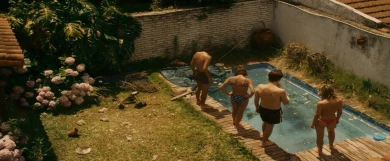
The end of the world, caused by climate change, is here and a group of friends wander from swimming pool to swimming pool at the height of a long, hot summer in Buenos Aires. From pool to pool, they cross the city, drifting leisurely and agreeably. In this transit they encounter different survivors searching desperately for water until their journey ends.
In echoing Frank Perry and Sydney Pollack’s film The Swimmer, Sol Iglesias’s The Swimmers is, equally, a path towards first light. The swimming pools symbolise, on this sunburnt stage, a metaphor at once for shelter and death by asphyxiation. It is the extreme heat that turns it into a fresh and pleasurable ending. The swimming pool, moreover, represents the lethargy of a youth tired of fighting against something they see as “inevitable”. As the young people trespass on a neighbourhood’s private property — rather than in public space — the pool is a stronghold of intimacy that must be seized: the false paradise of a collapsed society. The film brings the viewer closer to another film to feature in this series, La ciénaga (The Swamp, 2001) by Lucrecia Martel, in which bodies search for recesses of stagnant water.
Jack Hazan. A Bigger Splash
Friday, 7 August 2026
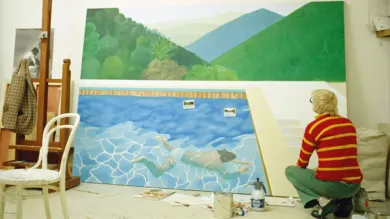
Painting endows a fleeting and unique moment with permanence and stability. This was the vision of the late David Hockney when, brushstroke by brushstroke, he returned to the swimming pool in A Bigger Splash: the great dive into a Californian pool which freezes a sense of happiness. A splash made by Peter Schlesinger, the painter’s partner from whom he has just separated.
In the film A Bigger Splash, Jack Hazan portrays the world of a successful artist, art-market and art-dealer pressure, the tension between the ego and personal frailty, and the obligation to continue with a style and iconography which, despite its instantly recognisable artistic imprint, creates doubts for the painter. In a grey, rainy London, a glum Hockney, the victim of soured love, keeps returning to the Californian swimming pool that holds the promise of happiness, in the form of a homosexual Arcadia in which the painter lives with his young partner and a group of equally glowing and attractive friends. Ultimately, the pool, as Jack Hazan recalls in this pioneering artist’s documentary, is a simile for the same painting in its original intention: hang onto fleetingness to lend it a permanence for the beholder, despite it not existing. Hockney, as one of the last great painters, knew his medium remained largely unchanged across hundreds of years of history.
Six Swimming Pools. A Dive into Experimental Film
Saturday, 8 August 2026
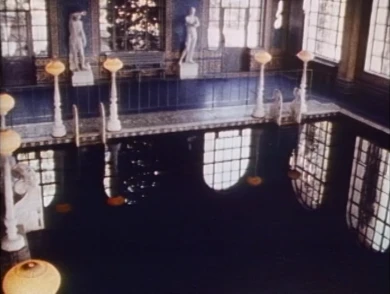
For the first time, the Museo’s summer cinema programme includes an experimental film section, centred on the experience and feeling of bodies under water. This session glides between the ostentatious aquatic architecture of Barbara Hammer and Barbara Klutinis and Jakobois’s fantasies, fleeting contact and wet, sexualised bodies. Six completely different swimming pools — private, public, transparent, bottomless, indoor, outdoor — all designed for leisure, competition and desire, nonetheless. A journey ranging from the monumentality of architecture to the intimacy of wet bodies.
Pools, by Barbara Hammer and Barbara Klutinis, turns swimming pools designed by pioneering architect Julia Morgan for the castle of tycoon William Randolph Hearst — the inspiration for Citizen Kane — into a space of play, bodily exploration and queer appropriation, an excuse to dive into a scene reserved for privilege. In An Algorithm, Bette Gordon fragments a series of headfirst dives and turns the sporting gesture into a visual score of repetitions, variations and rhythms. Tony Hill’s Water Work seduces with perspective, reflections and depth — the swimming pool as optical illusion, as an unstable surface which distorts and multiplies the gaze. Cheap Imitation “They Walk and I Walk”, by Rickard Eklund, submerges the camera to capture a choreography of synchronized bodies, a dance suspended under water. Naked bodies that dodge, twist and embrace in a space seemingly with no gravity combine in Gunilla Leander’s All Under. Passage du désir, by Jakobois, closes the programme with a montage in which water is no longer an environment, becoming instead a territory of desire.
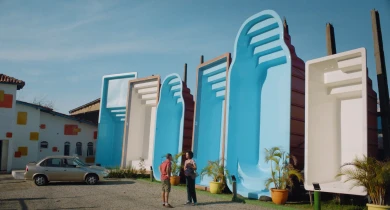
Dominga Sotomayor. Debajo and Thais Fujinaga. A Felicidade das Coisas
Friday 14 August 2026
Two gems, from two new voices in Latin American cinema, which swing between families, swimming pools, reencounters and status. In Debajo, a short film on youth by Chilean director Dominga Sotomayor, an abstract yet powerful bird’s-eye view of a swimming pool co-exists with the relationships of a crisis-stricken family, gathered to see an eclipse. Sotomayor’s distinctive film-making of care and affects shares a similar space to the daily naturalism of Thais Fujinaga’s A Felicidade das Coisas. In the director’s first feature film, the swimming pool is not a horizontal basin for swimmers’ immersion; rather it is a huge vertical monolith, a kind of an anti-monument, anchored in the garden of a middle-class family. The film conveys the efforts and challenges of a mother of two children to build a swimming pool in their modest summer house, a mother who, alone, comes up against a hypermasculine world. Equally, the film speaks of family love, and the search for status, with the swimming pool a languishing totem of the Brazilian middle class during the years of Bolsonarism.