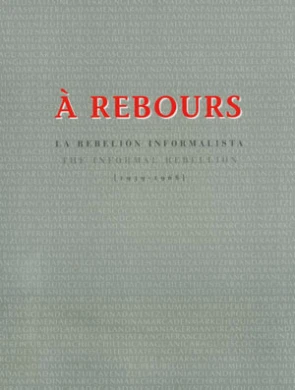
À rebours. La rebelión informalista 1939-1968

<p></p>
The starting point is the invalidity of historical avant-garde assumptions after the dramatic experience of the Second World War, an era dominated by widespread pessimism and by the crisis and liberation from subjectivity. Ashton proposes the term "lingua franca", to define the new pictorial grammar (fundamentally abstract) of the informal movement, which is based on a radical change of attitude towards the practice of art and media. In this way the artist is considered as the content of his own work and form and matter are key elements of the piece. At the same time the renunciation of painting understood as a vehicle for intellectual discourse is apparent, as well as openness to inspiration outside the Western rationalism.
The dismantling of the structures of European thought, the ultimate emphasis on chance as a creative factor -defended by Stéphane Mallarmé and August Strindberg in the late nineteenth century- the rejection of categorisations and Pablo Picasso’s "jumping into the unknown" in each piece, are elements that become a model for action. All this results in other terms that have a bearing on artistic behaviour: freedom of conception and language that exemplifies Joan Miró or the practices of pictorial automatism from Surrealist roots are some events that fuel the fighting spirit of the artists in the post-war period.
Dore Ashton has not forgotten the importance of critical literature, philosophy and poetry that accompanies Informalism: Georges Duthuit, Jean Paulhan, Francis Ponge, Yves Bonnefoy, Jean Paul Sartre, Harold Rosenberg, Lawrence Alloway and Samuel Beckett. Ashton points out how the controversy over the purpose of language, the impossibility of naming, writing or artistically referring to a subjective reality, affects the environment to create.
However, if the use of language demonstrates the cultural gulf separating nations, it is the very artists who diffuse the paradox of local and national identity. Artists from the School of New York recognise the influence of Latin American art through Wifredo Lam and Roberto Matta mainly and Emilio Vedova affirms that his Venetian heritage is the true source of the expressionist and informal, European and American movements.
Therefore, Dore Ashton addresses and presents Informalism as an international phenomenon, a rebellion of artists facing the concept of modern painting, as an advance in formal experimentation and continuous collective achievement.
Artists
Centro Atlántico de Arte Moderno, Las Palmas de Gran Canaria (April 20 - June 13, 1999)
Organised by
Centro Atlántico de Arte Moderno, Las Palmas, in collaboration with Museo Nacional Centro de Arte Reina Sofía
Image gallery
Itinerary
Centro Atlántico de Arte Moderno, Las Palmas
20 April, 1999 - 13 June, 1999
Museo Nacional Centro de Arte Reina Sofía
6 July, 1999 - 11 October, 1999