Fernando Sánchez Castillo
The Wayward Pearl
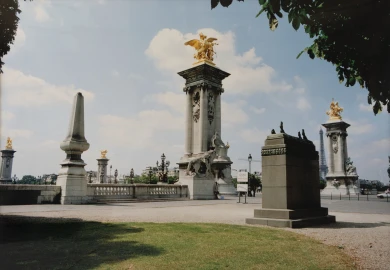
Fernando Sánchez Castillo, Ciudad sin héroes: Bolívar [City without heroes: Bolívar], 2001. Artist's studio
Photo: Fátima Sanz
Fernando Sánchez Castillo (Madrid, 1970) maintains that “art is a force that makes state narratives tremble”. Starting from this premise, he acts upon the forms through which power represents itself, dismantling its symbols and revealing the fragile narratives that sustain it. Primarily through sculpture, he displaces this iconography from its solemnity to underscore its constructed, precarious and deeply contested nature. In analysing monuments, images, gestures, and legends, he shows that history is not a stable narrative but a permanently conflictive field which also affects the present. His work, and its installation in this show, acts as a critical device which intervenes in the imaginaries from which power builds its authority, prompting viewers to question the reason for its order and its contradictions.
The artist works from the remains of history, from the alteration of materials, scale and uses that subvert the relationship to them and activate new layers of meaning. A monumental sculpture becomes a child’s swing, robots become tools of abstraction, two riot trucks dance a pas de deux. By altering their original purpose, these pieces question the forms of accepted normality and reveal the extent to which many forms of authority, obedience and representation are presented as natural. At the same time, the works enter into dialogue with key passages from art history, from the Baroque to twentieth-century avant-garde, Minimalism and Conceptual Art.
The exhibition The Wayward Pearl takes its title from a famous jewel, La Perla Peregrina, discovered in Panama in the sixteenth century, the history of which condenses a close connection with the concepts of singularity, value and authority. Some legends tell of a slave who found the pearl and used it to buy freedom for his partner, dying for his efforts. Its name comes from its unusual, unique and distinctive shape. The pearl soon travelled to the court of Philip II of Spain, and thereafter remained in circles of power, almost as a symbol of dynastic authority. Diego Velázquez and his studio depicted it on Philip III’s hat and on Isabella of Bourbon’s waist, and at times alongside the Estanque (the Pond) as a diamond of exceptional beauty. After nearly three centuries carefully preserved at the Madrid Court, it was taken from Spain by Joseph Bonaparte, setting it on a journey as turbulent as contemporary history itself. After being handed from one person to the next and disappearing without a trace, a pearl believed to be La Peregrina was acquired at auction in 1969 by Richard Burton, as a gift for Elizabeth Taylor. After a further auction in 2011, its whereabouts today are unknown.
Pearls are born of intrusion. A foreign body, often minuscule, enters the inside of a mollusc, its balance altered. In response, the organism coats it with successive layers of nacre, transforming an initial aggression into a unique form. As such, all pearls are the result of a negotiation between damage and form, between violence and beauty. History operates in a similar fashion. Every foundational act of violence accretes layers of narratives, images and rituals that allow societies to move forward without looking directly at the wound. Art, like Sánchez Castillo’s work and pearls, does not cancel trauma or dissolve it into tradition; rather, it isolates and transforms it, returning it to us in an unexpected and unique form.
Fernando Sánchez Castillo
The Wayward Pearl
Artists
Curator
Ferran Barenblit
Organised by
Museo Reina Sofía