Alberto Greco
Viva el arte vivo
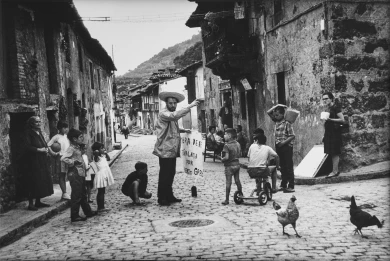
Acto vivo-dito by Alberto Greco in Piedralaves, 1963
Colección / Archivo Galería del Infinito. Fotograph: Montserrat Santamaría
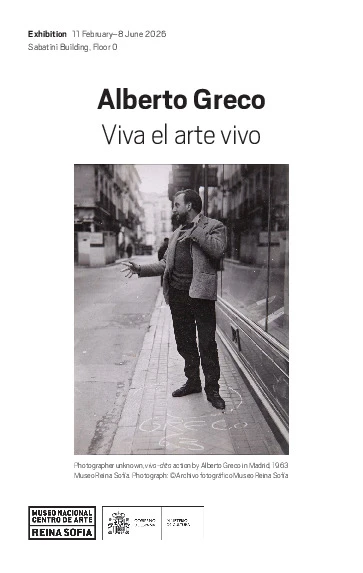
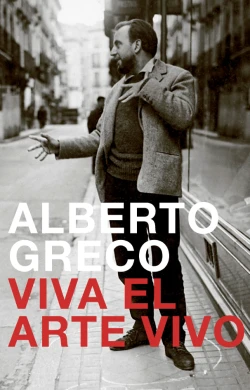
Alberto Greco (Buenos Aires, 1931 – Barcelona, 1965) was a pivotal figure in the experimental avant-garde. His trajectory can be described as a twisted pathway, closer to a drift, misstep and disorientation than the stability of a steered aesthetic programme. An informalist painter and MC of tombolas and “rolling exhibitions”, a poet and sometime actor, a queer flâneur and founder of arte vivo, Greco turned the public exhibition of his own life into a space of aesthetic invention modulated between histrionic exhibitionism, media event and street rumour.
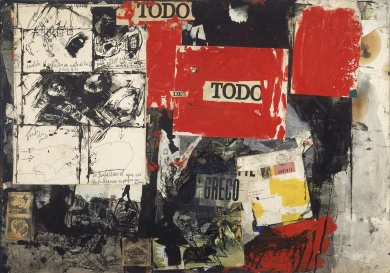
Viva el arte vivo is an exhibition that renders an account, retrospectively, of the short yet intense journey of Greco’s life and art. His actions were bound inseparably to the migrant route he embarked upon in 1950: from Buenos Aires to the Puna de Atacama and Humahuaca, from Paris to Rio de Janeiro and São Paulo, from Genoa and Rome to Madrid and Piedralaves, from New York to Ibiza and Barcelona. Consequently, the works gathered in the show stretch from 1949 to 1965, from his early writings and informalist paintings — in which he propelled the possibilities of matter, shaking it up with tensions and spillages — to his actions and objets vivants; his Madrid drawings; the collages he called “self-propaganda”; and, finally, the novel Besos brujos (Bewitching Kisses), written shortly before he took his own life.
In arte vivo, which Greco founded in Paris in March of 1962, the fugitive mobility of life in its occurrence becomes the subject matter for art. Under the slogans of arte vivo — which he also subsequently called vivo-dito — the artist made people, markets and bathrooms the subjects of his work, declared Buenos Aires and Piedralaves works of art, and wrote the proclamation “Long Live Arte Vivo” in chalk around and on the streets and walls of Rome. In his Manifiesto dito dell´arte vivo (Dito Arte-Vivo Manifesto), which he pasted on the walls of Genoa, he encouraged engagement “with the living elements of our reality: movement, time, people, conversations, smells, rumours, places, situations”. Once in Madrid, he invoked a “vivo-dito moment”, culminating in the burning of a canvas painted collectively, as well as executing his “incorporations of personages on the canvas”, tracing the silhouettes of real models on large-scale canvases. Greco arrived in Madrid in 1963 and, aside from a few isolated occasions, remained in Spain until his death two years later.
Greco’s arte vivo also seeped into his drawings and collages, with the co-existence of mainstream sensibilities, mass-media references and affective modulations linked to the childish, the kitsch and the camp. These works are often traversed by writing that records the intensities of the body and vicissitudes of the quotidian and the artist’s transit around the city, with the confluence of street vagrancy and verbena, the readymade and religious celebration, pop montage and a notebook of obscenities.
Alberto Greco understood arte vivo as an art of the future, but not so much an aesthetic programme oriented towards its progressive consumption as an open adventure of the unpredictable. As an untimely gesture in which art and life — with their mobility, their possibilities for transformation, their interruptions, their overflows — were encouraged to be wholly confused.
Alberto Greco
Viva el arte vivo
Artists
Colabora