-
8 and 23 April
Chris Marker and Alain Resnais, Statues Also Die
1953. 35 mm, b/w, 30’. Original version (Spanish subtitles). Screening: DVD
Shot around collections of African tribal sculpture in London’s British Museum, the Musée du Congo Belge in Brussels and the Musée de l'Homme, Paris, this film alludes to how the museum separates the artwork from the world it belongs to, introducing it into the formal and discursive territory of art history, connected to other historical artefacts dispossessed of their function. The film opens with the words “When men die they enter into history; when statues die they enter into art.” Marker and Resnais disarm the logic of primitivism, showing how behind early avant-garde movements’ visual fascination with African sculpture there lurks a process of neutralisation, in which the dominant value of ritual, magic and worship is replaced with an aesthetic and exhibition value. In this operation of resignification, the museum does not participate in isolation but instead is inserted into a complex framework which gives form to European colonialism and its efforts to erase the Other and its otherness.
-
9 and 24 April
Roberto Rossellini. Le Centre Georges Pompidou
1977. 35 mm, colour, 57’. Original version (Spanish subtitles). Screening format: Digital archive
The last film by the Neo-realist director, produced for television and commissioned by the French Ministry of Foreign Affairs, shows, at a distance, the redefinition of the museum as a major culture factory at the end of the 1970s. The film opens with the cinematography of Spaniard Néstor Almendros, showing the colossal and formless structure rising above the historic city while crowds wait expectantly at the entrance. A far cry from the museum illustrated as a laic and civilising ritual, or the modern museum as an independent and individualistic space, Rossellini seems to outline a new post-modern museum: massive, fetishised and characterised by the predominance of unconnected views facing discursive narration. The once encyclopaedic space of the collection is subsumed by a new industrial order, where art co-exists with its own reproducibility under equal conditions. The media library, library or collection are equivalent orders in this new multidisciplinary regime, replacing historical time with the present continuous. “People confuse culture with refinement, […] the Beaubourg is the exhibition of refinement at any price,” declares the film-maker.
-
10 and 27 April, 2015
Danièle Huillet and Jean-Marie Straub. A Visit to the Louvre
2003. 35 mm, colour, 44’. Original version (Spanish subtitles). Screening format: Blu-Ray
This film synthesises a radical interpretation of cinema as a translation exercise between text and image, as transformative pedagogy – also distant and hermetic – a style that characterised the work of Danièle Huillet and Jean-Marie Straub for over four decades. Cézanne’s opinions before the masterpieces in the Louvre work as a heterodox guide to this tour around the museum. They are read out by the feminine voice of Danièle Huillet, with the subjective judgements of the painter on works ranging from the Winged Victory of Samothrace to Courbet and Delacroix, via Giorgione, Tintoretto and Murillo, representing the birth of taste and a modern vision, whilst also verbally translating the dense and fragmented pictorial surface of the post-Impressionist painter. Cézanne’s words resonate around an empty museum that is without concessions to the architecture or the presence of the public; the works are shown directly and head-on, lacking any mediation except for the thoughts of the painter himself. Thus the film-makers look to update the relevance of these reflections, which document modern consciousness and uphold, against the grain, the museum as a space where this is shown in its most virtuous state.
-
15 and 30 April, 2015
Pere Portabella. Mudanza
2008. Digital HD, colour, 20’. Screening format: Blu-ray
Mudanza depicts the moving of furniture and objects from the Federico García Lorca’s house museum in Granada until it is completely empty. The simple and continuous gesture opens up a deeper wound concerning the vacuum of memory, the production of recollections and the role of the museum in these operations of remembrance. Filmed at a time of social and political debate in Spanish society surrounding the historical amnesia of victims of the Civil War, Portabella looks into memory without consciousness, into the dedramatised celebration of the figure of the poet. “The resurgence of memory comes with the resurgence of forgetting,” writes Andreas Huyssen. The successive dismantling of the museum exhibits this fictitious consensus of memory – the journey around its empty walls alludes to the ghostly presence of the amnesia of civil society and its institutions.
-
16 April and 4 May, 2015
Jem Cohen. Museum Hours
2012. Super 16/ 2K / HD, colour, 106’. Original version (Spanish subtitles). Screening format: Blu-ray
Museum Hours narrates the encounter between a museum guard and a visitor whilst also unfurling an interpretation of the way the world is perceived through observing the museum. Experimental film-maker Jem Cohen’s first fictional film incorporates a number of ideas from his previous work – reflecting on landscape, the correspondence between moods and the limits between fiction and documentary – in a story where the Kunsthistorisches museum in Vienna becomes a space for learning through experience and observation. The sequence of moments and gestures, or the balance between control and chance, not only marks all the architecture in the film, it also constructs the museum and its collection as a space of small epiphanies and revelations that transform daily life.
-
17 April and 8 May, 2015
James Benning. Natural History
2014. Digital HD, colour, 77’. Original version (without dialogue). Screening format: Digital archive
Filmed in Vienna’s Museum of Natural History, a series of long shots featuring offices, storerooms, corridors and exhibited beings depicts the museum as if it were participating in the geological time of the fossils it exhibits, demonstrating how an encased specimen survives its own era. Together with this slow and mineral time, Benning envisages the expanse of shots by way of a complex mathematical formula that looks to represent a viewer’s contemplation time in front of an artwork. At the same time, in a poetic and structuralist sense, Natural History superimposes two time scales: the visitor’s and the museum’s confrontation with time itself.
-
18 April and 11 May, 2015
Frederick Wiseman. National Gallery
2014. Digital HD, colour, 175’. Original version (Spanish subtitles). Screening format: Blu-ray
Implying a critique of the institutions that shape education, welfare, punishment and health in the public sphere (for instance schools, universities, housing, prisons, hospitals), Frederick Wiseman’s frank and direct film-making analyses, in this instance, the contradictions of the contemporary museum. Shot in London’s National Gallery, the film demonstrates the tension between the interpretation of artworks throughout history, the efforts of the museum to narrate to and educate the public-citizen and negotiations with business interests that begin to determine the activity of cultural institutions. Thus, the auratic account of the masters of European painting is contrasted against the bureaucratisation of daily management or the curators’ submission to relationships with high societies and potential trustees. National Gallery is the work of a sceptic who uses the perfected mechanism of documentary to place the function of the museum in crisis.
The Shape of Time. Museums in Film

Held on 08, 09, 10, 15, 16, 17, 18, 23, 24, 27, 30 Apr, 04, 08, 11 May 2015
This series explores how the museum has been conceived, represented and questioned in different film poetics. Filming the museum institution entails not only a discussion on how art is exhibited and its mechanism of interpretation, but also how other past times in the present are inserted and reactivated, articulating an amalgamation of transience, inside and outside the present, that is specific to the museum and its narrations.
This series, in relation to the exhibition devoted to the Kunstmuseum Basel, also encompasses the different “species” of museums throughout their recent history: the museum as a space of encyclopaedic knowledge and discourse, the museum as a huge institutional mechanism, the museum linked to accumulation as the dispossession of European colonialism, the museum as a Trojan Horse in operations of “reordering” and “embellishing” the contemporary city, and also the museum as one of the few contemporary spaces to rediscover memory and identity.
Más actividades
Files of Tropical Revolutions
Sábado 20 y 27 de junio, 2026 - 19:00 H
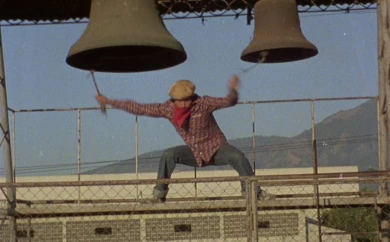
The Reframing Banana Imagery series concludes with two works that condense the height and twilight of this period in history, epic sagas that cross borders and registers to embody experiences of armed struggle in the region. Cameras mix with firearms, borders between nations blur and patience reaches breaking point. This is where the tipping point lies, where the bloodshed weighs heavy and the murmurings of regional brotherhood are buried in the ground again.
Pan y dignidad (Carta abierta de Nicaragua) [Bread and Dignity (An Open Letter to Nicaragua)] recounts the historical records and process of national reconstruction in Nicaragua via the Sandinista popular uprising. Historias prohibidas de Pulgarcito (Forbidden Tales of Tom Thumb) places the camera at the heart of the El Salvador revolutionary struggle, interspersing testimonies of daily violence with the verses of the poet Roque Dalton.
Both works understand the armed revolution as an open file under construction. The insurgent brotherhood, although dissolved, still resounds in regional history.
Circling Over Exploited Bodies
Friday, 19 and 26 June 2026 - 7pm
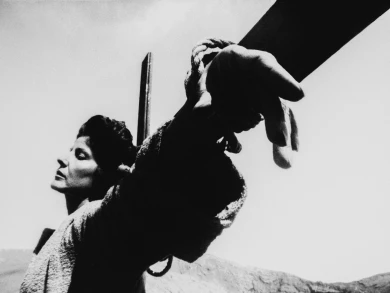
When forms of violence are inflicted on society, film responds from urgency. Images become abstract, sounds fade and the register of dissidence comes from the gut. La zona intertidal (The Intertidal Zone) is an essayistic and poetic approach to the repression of teachers in El Salvador in the 1970s — a teacher studies the biodiversity of the El Salvador coast as a boy finds a body on the same beach. A propósito de la mujer (About Women) interweaves testimonies of misery and rage towards patriarchal structures with fictional scenes of a symbolic procession through a harsh desert.
Both films understand the body as a target of violence and a territory of insurrection, a space where the blood shed by militancy and the patriarchal yoke turn pain into denouncement and existence outside the status quo into an act of political dissidence.
Central American Designation of Origin
Thursday, 18 and 25 June 2026 - 7pm
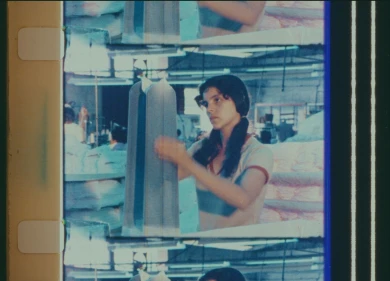
Fertile lands, farmers’ hands, rural faces. This first programme in the series Reframing Banana Imagery understands the foundations of the Central American experience from exploitation, extractivism and displacement, and from the organisation and resistance that emerged as a reaction. The four films within extend from a lyrical documentary on farmers’ solidarity to the playful subversion of the institutional format of the United Fruit Company.
Bananeras (Banana Growers) is a combative portrait of the inhumane conditions of the American banana plantations located in Nicaragua through much of the twentieth century. Costa Rica Banana Republic is a perspicacious satire via an institutional documentary of banana production, spotlighting the extractive nature of this agro-exporting model in the 1970s. Organización Campesina (Farmers’ Organisation) frames rural resistance in Honduras from a direct depiction and lyrical documentary, while Dos veces mujer (Two Times a Woman) dissects the invisibility of the double-shift working day Central American women farmers endure: working in the countryside and working in the home. As a whole, the works here present the earth at once as a wounded body and a space of dignity.

Cinema, for the First Time
7 and 14 June 2026 – 12:00 pm
The final session in this Moon Projector season contemplates the feeling around the first experience of cinema — cinema as revelation, magic, fantasy and mystery from the first gaze, from the first contact with the medium, and imagery etched on the retina of childhood. The programme shows Émile Cohl’s landmark Fantasmagorie (1908), the first ever hand-drawn animation, and Ignacio Agüero’s Cien niños esperando un tren (One Hundred Children Waiting for a Train, 1988), a feature-length film on play and the origins of cinema.
Fantasmagorie (1908)by Émile Cohl (Paris, 1857– Villejuif, 1938) is the first expression in the history of animated drawing. Émile Cohl was an illustrator who belonged to the Parisian art group Arts incohérents (1882–1895), who was bestowed with an absurdist and pre-Surrealist talent. Whereas the Lumière brothers were able get audiences out of their seats as they witnessed a train moving towards them in 1895, Fantasmagorie is a supernatural experience, akin to an apparition yet also innocuous and entertaining — the inanimate comes to life out of nothing and figures seemingly move with little sense. From the outset, animation was related to caricature, fabulation and the comical, a sweet spot for the dreams of the youngest audience.
From the discovery of new imagery arising from the animated line to knowledge of the world through a screen, Cien niños esperando un tren (1988), by Chilean director Ignacio Agüero (Santiago, 1952), narrates a group of young people’s discovery of cinema in a workshop on the origins of the medium in a poverty-stricken town on the outskirts of Santiago de Chile. Play, fun and learning combine with a fascination with images, as viewing Émile Cohl’s Fantasmagorie (1908) in the workshop becomes an act of freedom.
Elisa González and Leah Pattem. Soy Tribulete 7
13 JUN 2026
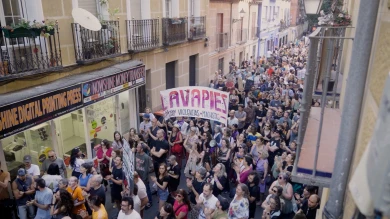
Framed inside this year’s Neighbourhood Picnic is the screening, in the Museo’s Cinema, of a film related to the life and protests of the Lavapiés neighbourhood, addressing issues of gentrification and the right to housing: Soy Tribulete 7 (I Am Tribulete 7, 2026), directed by Elisa González and Leah Pattem.
As the Spanish housing crisis takes hold in Lavapiés, this story begins in February 2024, when the residents of Calle Tribulete, 7, a block of apartments on a street in this Madrid barrio, receive a letter informing them that their building has been sold to a vulture fund. The news spreads quickly around the neighbourhood and, when it comes to the attention of González and Pattem, they grab their cameras and head straight for the building, where they encounter one hundred or so residents still in shock. The film Soy Tribulete 7 flows into the building and the daily lives of a community united, whose looming eviction occasions the fight of their lives. Ultimately, a path of resistance that will turn the community into a symbol of struggle for the right to housing.
Both film-makers worked closely with a group of tenants — Cris, Nani, Blanca, José, María Jesús and Antonia — to tell the story of how the building became the most creative stage of resistance ever witnessed in the area. The work presents the daily life of these residents in Madrid’s now-iconic “building fighting eviction”, depicting their collective struggle and the violent disruption to their lives. Through personal interviews, observational footage, archive material, music and a narration by eighty-year-old actress Ana Martín García, the film casts light on the human stories behind a community struggle.
The Neighbourhood Picnic is an annual gathering of festivities organised by Museo Situado, a network made up of associations, activists and residents from Lavapiés, a racially diverse, working-class neighbourhood where the Museo Reina Sofía is located.