Held on 07 Nov 2020
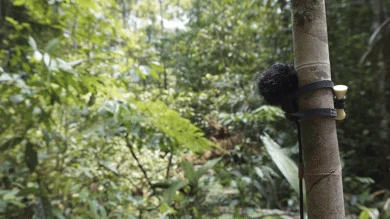
In August and September of 2015, Pablo Sanz carried out fieldwork in the Amanã and Mamirauá reserves of Brazil’s Central Amazonia. Working in collaboration with local inhabitants, he made several hundred hours of audio recordings in different terra firme and flooded forest areas, focusing on everyday nonhuman activity. Those environmental sound recordings are featured in entangled, a project experienced as a series of ambisonic multichannel installations and shared listening events.
At the Museo Reina Sofía, the project is presented as a concert for an immersive spatial audio system of sixteen speakers, specially configured for the occasion. The listener-participants will find themselves in almost total darkness, invited to engage in a profound, active and sustained listening experience.
entangled is an innovative exploration of phonography (field recording) and environmental composition as a creative practice. It reconsiders established experimental music concepts such as “soundscape” and “sound object” through the lens of contemporary ecological thought. Some of these ideas are elaborated in the accompanying text on the Museo Reina Sofía website.
Curatorship
José Luis Espejo
Force line
Contemporary Disturbances and Avantgardes
Production support
The Mamirauá Institute for Sustainable Development. Tefé, Amazonas, Brazil
Sonic Arts Research Centre (SARC), Queen’s University Belfast
Santander Mobility Award
Laboratório de Acústica e Artes Sonoras (LASom), Instituto de Artes da Unicamp, São Paulo
T-37 (Madrid)
Sound and Music, London, United Kingdom
The Arts Council of Northern Ireland
Organised by
Museo Reina Sofía
Sponsorship

Participants
Pablo Sanz is an artist, composer and researcher. His body of work includes site-specific and public art projects, immersive installations, multichannel live performances, exhibitions, releases, and pieces for broadcast and headphone listening. His practice is an open-ended investigation of listening, space-time, materiality, nonhuman vitality and otherness, with a focus on the limits and thresholds of perception and attention. His works propose listening as a political act, intended to resist dominant tendencies in contemporary societies, cultivating alternative forms of being and thinking.
He holds a PhD in Experimental Electroacoustic Music Composition and Sonic Arts by the Sonic Arts Research Centre (SARC) at Queen’s University Belfast and a Bachelor of Fine Arts from the University of the Arts of The Hague, specialising in ArtScience and Sonology. He is a co-founding member of the Mediateletipos.net platform and was artistic director of the 11th Festival Sensxperiment: Sensory Immersion (2009-2011), held in Córdoba (Spain). His work has been experienced internationally in diverse contexts.
Resources
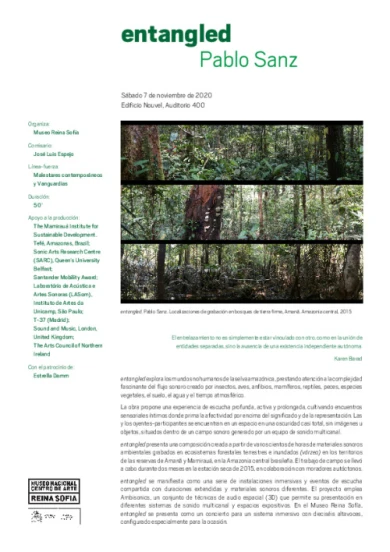
Exhibition information sheet entangled. Pablo Sanz
Exhibtion information sheet entangled. Pablo Sanz


Más actividades
Institutional Decentralisation
Thursday, 21 May 2026 – 5:30pm
This series is organised by equipoMotor, a group of teenagers, young people and older people who have participated in the Museo Reina Sofía’s previous community education projects, and is structured around four themed blocks that pivot on the monstrous.
This fourth and final session centres on films that take the museum away from its axis and make it gaze from the edges. Pieces that work with that which is normally left out: peripheral territories, unpolished aesthetics, clumsy gestures full of intent. Instead of possessing an institutional lustre, here they are rough, precarious and strange in appearance, legitimate forms of making and showing culture. The idea is to think about what happens when central authority is displaced, when the ugly and the uncomfortable are not hidden, when they are recognised as part of the commons. Film that does not seek to be to one’s liking, but to open space and allow other ways of seeing and inhabiting the museum to enter stage.
![Tracey Rose, The Black Sun Black Star and Moon [La luna estrella negro y negro sol], 2014.](https://recursos.museoreinasofia.es/styles/small_landscape/public/Obra/AD07091_2.jpg.webp)
On Black Study: Towards a Black Poethics of Contamination
Monday 27, Tuesday 28 and Wednesday 29 of April, 2026 – 16:00 h
The seminar On Black Study: Towards a Black Poethics of Contamination proposes Black Study as a critical and methodological practice that has emerged in and against racial capitalism, colonial modernity and institutional capture. Framed through what the invited researcher and practitioner Ishy Pryce-Parchment terms a Black poethics of contamination, the seminar considers what it might mean to think Blackness (and therefore Black Study) as contagious, diffuse and spreadable matter. To do so, it enacts a constellation of diasporic methodologies and black aesthetic practices that harbor “contamination” -ideas that travel through texts, geographies, bodies and histories- as a method and as a condition.
If Blackness enters Western modernity from the position of the Middle Passage and its afterlives, it also names a condition from which alternative modes of being, knowing and relating are continually forged. From within this errant boundarylessness, Black creative-intellectual practice unfolds as what might be called a history of touches: transmissions, residues and socialities that unsettle the fantasy of pure or self-contained knowledge.
Situated within Black radical aesthetics, Black feminist theory and diasporic poetics, the seminar traces a genealogy of Black Study not as an object of analysis but as methodological propositions that continue to shape contemporary aesthetic and political life. Against mastery as the horizon of study, the group shifts attention from what we know to how we know. It foregrounds creative Black methodological practices—fahima ife’s anindex (via Fred Moten), Katherine McKittrick’s expansive use of the footnote, citation as relational and loving labour, the aesthetics of Black miscellanea, and Christina Sharpe’s practices of annotation—as procedures that disorganise dominant regimes of knowledge. In this sense, Black Study is approached not as a discrete academic field but as a feel for knowing and knowledge: a constellation of insurgent practices—reading, gathering, listening, annotating, refusing, world-making—that operate both within and beyond the university.
The study sessions propose to experiment with form in order to embrace how ‘black people have always used interdisciplinary methodologies to explain, explore, and story the world.’ Through engagements with thinkers and practitioners such as Katherine McKittrick, C.L.R. James, Sylvia Wynter, Christina Sharpe, Fred Moten, Tina Campt, Hilton Als, John Akomfrah, fahima ife and Dionne Brand, we ask: What might it mean to study together, incompletely and without recourse to individuation? How might aesthetic practice function as a poethical intervention in the ongoing work of what Sylvia Wynter calls the practice of doing humanness?
Intergenerationality
Thursday, 9 April 2026 – 5:30pm
This series is organised by equipoMotor, a group of teenagers, young people and older people who have participated in the Museo Reina Sofía’s previous community education projects, and is structured around four themed blocks that pivot on the monstrous.
The third session gazes at film as a place from which to dismantle the idea of one sole history and one sole time. From a decolonial and queer perspective, it explores films which break the straight line of past-present-future, which mix memories, slow progress and leave space for rhythms which customarily make no room for official accounts. Here the images open cracks through which bodies, voices and affects appear, disrupting archive and questioning who narrates, and from where and for whom. The proposal is at once simple and ambitious: use film to imagine other modes of remembering, belonging and projecting futures we have not yet been able to live.
Remedios Zafra
Thursday March 19, 2026 - 19:00 h
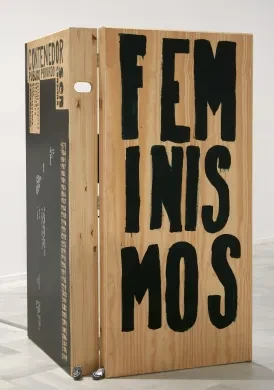
The José Luis Brea Chair, dedicated to reflecting on the image and the epistemology of visuality in contemporary culture, opens its program with an inaugural lecture by essayist and thinker Remedios Zafra.
“That the contemporary antifeminist upsurge is constructed as an anti-intellectual drive is no coincidence; the two feed into one another. To advance a reactionary discourse that defends inequality, it is necessary to challenge gender studies and gender-equality policies, but also to devalue the very foundations of knowledge in which these have been most intensely developed over recent decades—while also undermining their institutional support: universities, art and research centers, and academic culture.
Feminism has been deeply linked to the affirmation of the most committed humanist thought. Periods of enlightenment and moments of transition toward more just social forms—sustained by education—have been when feminist demands have emerged most strongly. Awareness and achievements in equality increase when education plays a leading social role; thus, devaluing intellectual work also contributes to harming feminism, and vice versa, insofar as the bond between knowledge and feminism is not only conceptual and historical, but also intimate and political.
Today, antifeminism is used globally as the symbolic adhesive of far-right movements, in parallel with the devaluation of forms of knowledge emerging from the university and from science—mistreated by hoaxes and disinformation on social networks and through the spectacularization of life mediated by screens. These are consequences bound up with the primacy of a scopic value that for some time has been denigrating thought and positioning what is most seen as what is most valuable within the normalized mediation of technology. This inertia coexists with techno-libertarian proclamations that reactivate a patriarchy that uses the resentment of many men as a seductive and cohesive force to preserve and inflame privileges in the new world as techno-scenario.
This lecture will address this epochal context, delving into the synchronicity of these upsurges through an additional parallel between forms of patriarchal domination and techno-labor domination. A parallel in which feminism and intellectual work are both being harmed, while also sending signals that in both lie emancipatory responses to today’s reactionary turns and the neutralization of critique. This consonance would also speak to how the perverse patriarchal basis that turns women into sustainers of their own subordination finds its equivalent in the encouraged self-exploitation of cultural workers; in the legitimation of affective capital and symbolic capital as sufficient forms of payment; in the blurring of boundaries between life and work and in domestic isolation; or in the pressure to please and comply as an extended patriarchal form—today linked to the feigned enthusiasm of precarious workers, but also to technological adulation. In response to possible resistance and intellectual action, patriarchy has associated feminists with a future foretold as unhappy for them, equating “thought and consciousness” with unhappiness—where these have in fact been (and continue to be) levers of autonomy and emancipation.”
— Remedios Zafra
27th Contemporary Art Conservation Conference
Wednesday, 4, and Thursday, 5 March 2026
The 27th Contemporary Art Conservation Conference, organised by the Museo Reina Sofía’s Department of Conservation and Restoration, with the sponsorship of the Mapfre Foundation, is held on 4 and 5 March 2026. This international encounter sets out to share and debate experience and research, open new channels of study and reflect on conservation and the professional practice of restorers.
This edition will be held with in-person and online attendance formats, occurring simultaneously, via twenty-minute interventions followed by a five-minute Q&A.