-
Nouvel Building, Auditorium 400
Saturday, 23 February 2019
Lucinda Childs’ Solos, Performed by Ruth Childs
Lucinda Childs is one of postmodern dance's pre-eminent icons, and a founding member of the Judson Dance Theater. She also happens to be my aunt. We decided to work on a revival project of three solos that she choreographed and performed herself in the 1960s at the Judson Dance Theater in New York: Pastime, Carnation and Museum Piece.
We revived these three solos to be as close as possible to the original versions, knowing that there are no film archives of her solos during the Judson period. Lucinda gave me very exact choreographic indications. She shared anecdotes and archives from that period. She then left me with room to explore my own way to perform these three solos.
With the exception of Carnation, these solos are quite unknown and have never been presented outside of the USA. This work of revival, handing-down and re-creation is essential because it allows a new generation of audiences to discover these historic pieces.
(Ruth Childs)
7pm
Calico Mingling (1973), 10’, film
Filmed in a large plaza in New York, four performers execute a series of circular and linear trajectories forwards and backwards, repeating them infinitely in complete silence.Pastime (1963), 10’
This short solo, Lucinda Childs’ first, explores the relationship between movement and object. The piece plays with – and distorts – the typical postures of postmodern dance through a piece of stretchable fabric which is pulled across the shoulders, to the tips of the toes, thus evoking a boat, cradle or bathtub.Carnation (1964), 20’
This work is the upshot of a decision: to conceive a choreography and all possibilities of movement – excluding those which belong to dance – with everyday objects: sponges, hair rollers and rubbish bags. Here, the three objects are used to create a method, not a story.Katema (1978), 10’, film
This video, recorded at Kunsthaus Zürich, offers a personal and intimate moment with Lucinda as she revisits her work on the act of walking diagonally, forwards and backwards, until she starts again. Exhausting all possibilities and finding value in repetition, it reveals a poetic flow upheld by a simple and insistent work material.Museum Piece (1965), 10’
More than a choreographed dance, this solo is an artistic performance or ironic lecture that deconstructs and transforms dance. Adhering to artist Marcel Duchamp and his idea of the objet trouvé, the found object, Lucinda takes Georges Seurat’s work Le Cirque (1891) and, with a touch of humour, places herself inside the painting in order to discover itCredits:
Pastime, Carnation and Museum Piece credits:
Choreography: Lucinda Childs
Performance: Ruth Childs
Lighting design: Eric Wurtz
Technical manager: Pierre Montessuit
Touring: Tutu ProductionCaliclo Mingling (film) credits:
Choreography: Lucinda Childs
Performance: Susan Brody, Lucinda Childs, Nancy Fuller and Judy Padow.
Film-maker: Babette Mangolte
Location: Robert Moses Plaza, Fordham University, New York.Katema (film) credits:
Choreography: Lucinda Childs
Performance: Lucinda Childs
Film-maker: Renato Berta
Location: Kunsthaus Zürich
Production: SCARLETT’S
Co-production: ADC - Association pour la danse contemporaine
Support: the city of Geneva, the Stanley Johnson Foundation, Loterie Romande, Fondation Nestlé pour l’art and the L. Vuitton Foundation, Corodis, and the State of Geneva.8pm
Encounter: a conversation between Lucinda Childs and Ruth Childs, presented and moderated by Lou Forster. -
Sabatini Building, Room 102
Sunday, 24 February 2019
Presentation of the solo Katema
11am and 1pm – Presentation of the solo Katema (performed by Ruth Childs), in two sessions:
Katema (1978) 12’
The collaboration between Lucinda and Ruth Childs began in 2015, leading to the recreation of the three solos presented in the previous session, and carried on two years later with a second series of performances from the 1970s, among them Katema (1978). This solo is part of the aesthetic transition of choreography that gave rise to ensemble pieces like Dance (1979), presented in Teatros del Canal as part of this programme. Lucinda created Katema for herself after participating in collective projects, seeking to regain focus on the body and its movements – the piece explores the act of walking diagonally, always returning to the same point of anchorage, which, nevertheless, yields and moves with each iteration.
Credits:
Choreography: Lucinda Childs
Performance: Ruth Childs
Assistant: Ty Boomershine
Lighting design: Joana Oliveira
Wardrobe: Severine Besson
Production: SCARLETT’S
Production representative and touring: Tutu Production
Co-production: La Bâtie Festival de Genève, Arsenic - Centre d’art scénique contemporain, Lausanne.
Support: the city of Geneva, Pro Helvetia, Fondation Suisse des Artistes
Interprètes, Fond Mécénat SIG, Fondation Nestlé pour l’art, the Stanley Thomas Johnson Foundation, Ernst Göhner Stiftung, Corodis, Loterie Romande.
Touring support: Pro Helvetia, Canton de Genève, Corodis, Loterie Romande, Pour-cent culturel Migros.

Ruth Childs, Pastime, by Lucinda Childs © Gregory Batardon
Held on 23 Feb 2019
Museo Reina Sofía presents a selection of solos, held across two sessions, by Lucinda Childs, a pre-eminent choreographer from so-called minimalist dance and founder of New York’s Judson Dance Theater.
The Judson Dance Theater, in operation from 1962 to 1964, was a choreographic collective of dancers such as Trisha Brown, Simone Forti, Deborah Hay and Lucinda Childs and artists like Robert Rauschenberg, Carolee Schneemann and Robert Morris, who moulded the foundations of postmodern dance. During that period, the majority of these artists regularly attended Anna Halprin’s workshops in San Francisco, made up of creators from an array of disciplines to establish influences and displacements between practices. They would also attend the composition classes given by Robert Dunn, who, in collaboration with Merce Cunningham, developed new choreographic and composition methods, drawing inspiration from the ideas of John Cage.
In the first session, Ruth Childs, Lucinda Childs’ niece, will perform the pieces Pastime (1963), Carnation (1964) and Museum Piece (1965), which render an account of the initial investigations that gestated from dialogue and the intersection of dance, performance and sculpture – fertile ground for experimentation, such was New York in the 1960s. Moreover, a recording of two other pieces, Calico Mingling (1973) and Katema (1978), will be screened, followed by a coda to the session in the form of a conversation between choreographer and performer, presented and moderated by Lou Forster.
Sunday’s session will conclude the programme with a presentation, also by Ruth Childs, of the aforementioned Katema, which, created more than a decade after the three initial solos, augured subsequent ensemble choreographies.
Curatorship
Isabel de Naverán
Organised by
Museo Reina Sofía
Participants
Lucinda Childs (New York, 1940) began her career as a choreographer in 1963 at the Judson Dance Theater collective in New York. Since forming her dance company in 1973, she has created over fifty works, both solo and ensemble. In 1976, she collaborated with Robert Wilson and Philip Glass on the acclaimed opera Einstein on the Beach as principal choreographer and dancer. Since 1979, she has collaborated with numerous composers and designers to create several now-emblematic pieces, for example Dance (1979). The great many awards she has received throughout her career include: the Bessie Award for Sustained Achievement in 2001; her elevation from the rank of Officier (1996) to Commandeur in France’s Ordre des Arts et des Lettres (2004); and the NEA/NEFA American Masterpiece Award (2006). In 2016 the National Center for Dance in Paris held the first retrospective on her work, entitled Lucinda Childs. Nothing Personal 1963-1989, organised by Lou Forster, in collaboration with the Thaddaeus Ropac gallery and inside the framework of the Festival d'Automne. More recently, in 2017, she received the Golden Lion award at the Venice Biennale in recognition of her body of work.
Ruth Childs (London, 1984) British-American dancer and performer. She grew up in the United States where she studied dance (classical and contemporary) and music (violin). In 2003 she moved to Geneva to finish her dance training with the Ballet Junior de Genève. Following this, she started working with many internationally known choreographers and directors including Foofwa d’Imobilité, La Ribot, Gilles Jobin, Massimo Furlan, Marco Berrettini and Yasmine Hugonnet. In 2014 she founded her company SCARLETT’S in order to develop her own work through dance, performance, film and music and collaborates with Stéphane Vecchione on musical project “SCARLETT’S FALL”. This same year she inherited the reproduction rights for the three Lucinda Childs solos presented in this programme, and was also invited by La Ribot to perform the second series of the Piezas distinguidas( Distinguished Pieces), entitled Más distinguidas (More Distinguished). In 2016 the state of Geneva awarded her a scholarship and research residency in Berlin of 6 months to develop her own work. Her first stage piece in collaboration with Stéphane Vecchione, The Goldfish and the Inner Tube, premiered in April 2018. She will premiere fantasia, her first solo at the ADC, Geneva in October 2019
Lou Forster (Paris, 1988) has worked as a critic for the magazines A prior and Art21, co-directing the latter in 2012 and 2013. He has worked with Jeanne Revel and Joris Lacoste in the development of the W method, a critical, practical and theoretical approach to representing actions. Since 2010, he has collaborated with Lënio Kaklea, creating O, a platform to produce choreographic pieces, programmes, publications and exhibitions, including Lucinda Childs. Nothing Personal 1963-1989, a retrospective on the choreographer held in the Paris National Dance Centre in the autumn of 2016.


Más actividades
![Binka Zhelyazkova, Baseynat [La piscina], 1977, película](https://recursos.museoreinasofia.es/styles/small_landscape/public/Actividades/ciclocine-piscinas-17_00.png.webp)
Binka Zhelyazkova. The Swimming Pool
Viernes 28 de agosto, 2026
The young, bright Bella (Yanina Kasheva), after unforeseen heartbreak at her graduation party, meets Apostol (Kosta Tsonev), a reserved architect, and Boyan (Kliment Denchev), a comedy actor who is cynical about his country. The three characters climb up to a diving board in a municipal swimming pool, where they begin a strange relationship of friendship, love and despair which reflects a generational clash.
Binka Zhelyazkova, the great enfant terrible of Eastern European cinema, critic of the communist system and widely acclaimed film-maker beyond Bulgarian borders, made in The Swimming Pool a masterly metaphor for a country in decline. The public pool symbolises a closed, immovable enclosure where society is festering. From the height of a diving board she sees, in a panoptic view, the different generations living underneath a limited space. On one side, older people attempt to preserve the old revolutionary spirit with constant collective swimming exercises while, on the other, young people don’t hide the desire for freedom that remains unrealised. The result is an ideological clash in how to act and move in the enclosure, unearthing vast hypocrisy in the lost ideals of socialism, reflected in the total apathy of youth. The Swimming Pool for Zhelyazkova is a reflection of the disillusionment and existential void of a whole country and system.
![Jacques Deray, La piscine [La piscina], 1969, película](https://recursos.museoreinasofia.es/styles/small_landscape/public/Actividades/ciclocine-piscinas-18.jpg.webp)
Jacques Deray. The Swimming Pool
Saturday, 29 August 2026
The characters played by Alain Delon (Jean-Paul) and Romy Schneider (Marianne) experience their love in apparent splendour. A sun-drenched house, a blissful swimming pool, beautiful bodies, sexuality in abundance. The visit of Harry (Maurice Ronet), a successful musician, friend of Jean-Paul and ex-lover of Marianne, accompanied by his young and beautiful daughter Penélope (Jane Birkin), rocks their relationship, bringing to light the jealousy and insecurities of each one in a dark game of possession and male rivalry.
If there was a definition of the glistening blue pool in this sexual thriller, it would be the paradise of Adam and Eve, represented by the shots of happiness of Romy Schneider and Alain Delon in this swimming pool on France’s Côte d’Azur. The appearance of these two beautiful creatures kissing semi-naked by the water is one of film’s resonant images. The paradise cannot be fractured, not even by death. As in the crossing of the Tigris and Euphrates rivers, where humanity’s first lovers bathed naked in the water, innocent to their imminent end, the reflection of the crystalline water of The Swimming Pool shows this game, and the deep traumas which, under this mantle, are hidden in the amorous relationships and limits that only love is capable of breaking to solve.
In this session both endings to the film are screened: the original version, open and symbolic, and the Spanish version, marked by censorship during Francoism, and its sequence for a Spanish premiere — a stereotypical and reductive vision reflecting the sociological condition of the country.
Transnational Perspectives on Aurèlia Muñoz and Fibre Art
Wednesday, 2 September 2026
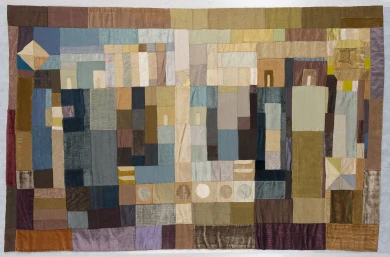
Coinciding with the end of the Aurèlia Muñoz. Beings exhibition, this study day gathers international experts to explore the connections and affinities between the different movements that renovated languages of contemporary Textile Art from the late 1960s. Movements such as Nouvelle Tapisserie and Fibre Art found, from that decade onwards, epicentres in places as diverse as Lausanne, Warsaw, New York, São Paulo and Barcelona, their key figures, including Aurèlia Muñoz, embodying a community of artists engaged in constant dialogue and formal evolution.
The study day Transnational Perspectives on Aurèlia Muñoz and Fibre Art offers, by way of experts and the show’s curatorial team, keys to situating the artist’s work within a framework crossed by major debates — both eco-political and aesthetic — that resonate strongly in today’s artistic dynamics.

University Micro-Credential in Intercultural and Multilingual Mediation within Artistic Contexts
Miércoles, del 12 de septiembre al 16 de diciembre, 2026
Micro-credentials are short-term learning experiences (up to 150 hours/15 ECTS) which are certified at a European level. They aim to certify key competences of lifelong learning through eminently practical proposals, and with an active methodological approach.
The University Micro-Credential in Intercultural and Multilingual Mediation within Artistic Contexts, organised by the Autonomous University of Madrid (UAM), in a collaboration with the Museo Reina Sofía, seeks to develop knowledge around intercultural mediation to be practised in museum and art contexts, and from a perspective which integrates linguistic diversity to impart a more just, diverse and plural experience of contemporary art and culture. The micro-credential goes towards a university qualification issued by UAM.
This initiative is the outcome of a shared research undertaking of linguistic justice between the Museo Reina Sofía’s Studies Directorship and UAM’s Centre for Research in Multilingualism, Discourse and Communication (MIRCo). Following over twenty years of experience as a research group, MIRCo established itself in 2021 as an open science and citizen-engagement space that drives research on multilingual practices, speech and speakers in diaspora, interrelations between discourse and power, intercultural communication and the transformation of space via communicative linguistic spaces.
This common interest materialises through ReDes_Ling, an interdisciplinary research and action project that studies language as a vehicle which reproduces social inequality, seeking to design actions that reduce its effects in society. The creation of this micro-credential constitutes one of these actions.
Furthermore, the programme is rooted in the experience of the Aissatou Ndiaye School of Situated Mediation, propelled since 2022 by Museo Situado, in collaboration with teams from the Museo Reina Sofía’s Tentacular Museum and Education Department. By way of contact with works conserved in the Museo and with different professionals from the cultural sphere and social activists, mediators from this school will develop their own routes in different languages, including Spanish, Wolof, Bengali, Darija, Arabic, Tagalog and French, enriching the narratives in the Museo Reina Sofía Collections. Therefore, the school is encompassed within a reflection on and continuing work with cultural mediation to dissolve any barriers that stand in the way of practices, discourses and contemporary artworks and people of any age or social status.
The convergence of these experiences makes the micro-credential a space of training which blends academic reflection, professional practice and a commitment to linguistic justice and cultural rights.
Blueprints. Paper Constellations of Lavapiés’ Memory
Friday 25 September, 2026 – 6:00 pm
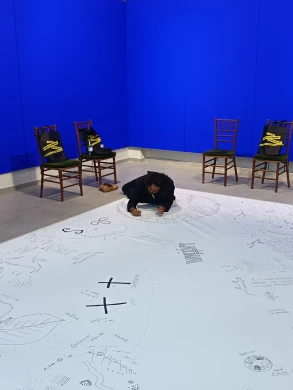
As part of his research residency at the Museum, Olivier Marboeuf explores how communities can be gathered through the telling and retelling of stories, in a process in which narratives are continually reshaped, giving rise to a collective tale that is always open, unfinished and imprecise.
This workshop, conceived for the communities of Lavapiés, brings together storytelling, writing, drawing and embodied movement to create a collective map of life in the neighbourhood. Individual stories and gestures become part of a shared composition, opening up spaces for encounter, friction and exchange.
The aim of Blueprints. Paper Constellations of Lavapiés’ Memory is to create a graphic score for a conversation in many voices, connecting words with the traces of movements, encounters, accidents and coincidences registered on paper as prints of each participant. These individual movements come together in a choreography inscribed in a mural of interwoven stories, shaped not only by consensus and attentive listening, but also by cacophony, disagreement and contradiction. In doing so, the workshop explores the idea of transition in two interconnected senses: as physical movement or migration from one place to another, and as a process of change and transformation—such as the transformation a story undergoes as it is told, translated and passed from one person to another.