-
Wednesdays from June 14 - July 5, 2015 Nouvel Building, Auditorium 200
The lecture programme: Words + Images
-
June 17, 2015
Jaime Conde-Salazar
La mirada sin límites (The Limitless Gaze)
Conde-Salazar questions the construction of our gaze and its limits via a journey through the images art has created throughout history.
“Throughout time our gaze has been composed as a system that searches for and produces certainties. We appear in the world through frames/windows, establishing viewpoints and creating vanishing points. These limits promise and assure us that nothing will escape our gaze, yet we know that the reality is multiple and fragmentary; it’s out of our control and always brushes up against uncertainty. Art History is full of examples that call into question the visual system that shapes us socially and culturally and these cracks signal a gaze that is affirmed as a physical reality profoundly joined to each of our bodies; in other words, a gaze that knows part of the world and which, therefore, does not need to impose any limit. That gaze is the one we have to conquer together right now.”
Jaime Conde-Salazar
Jaime Conde-Salazar has a BA in Art History from the Complutense University of Madrid (UCM). He obtained an MA in Performance Studies in 2002 from New York University through an MEC-Fulbright scholarship. In 2003 he presented the research assignment Narratives of Modernity in the Critique of American Dance (Department of Art History III. Faculty of Geography and History, UCM), for which he obtained a Diploma of Advanced Studies. Between 2003 and 2006 he directed the Estrella Casero Dance Class at the University of Alcalá de Henares. He has also regularly worked as a dance critic, and has collaborated as a dramatist with Marsha Gall, Pablo Assumpçao, Rodrigo Tisi, Claudia Faci, Martín Padrón, Ben Benauisse, I-Chen Zuffelato, Gregorye Auger, Filipe Viegas, Idoia Zabaleta, Antonio Taglairini and Miguel Pereira in diverse processes of creation. At present, most of his energy is put into continuumlivearts, a project for the dissemination and critique of live arts, in which he regularly works alongside El Graner (Barcelona) and Azala Espacio de Creación (Vitoria).
-
June 24, 2015
Pedro G. Romero
La Pel.lícula (The Film)
Pedro G. Romero invites us to view La Pel.lícula (The Fil.lm), an open reflection about José Antonio de la Loma’s Perros Callejeros (Stray Dogs), and to pinpoint the iconoclastic operations enclosing its shots.
“I believe this is the right framework for carrying out this work, La Pel.lícula (The Fil.lm). In 2005 I invited Beatriz Preciado, Marina Garcés, Marisa García, Valeria Bergalli, Deborah Fernández, Eva Serrats and Pamela Sepúlveda to re-watch the film Perros callejeros (Stray Dogs), made by José Antonio de la Loma en 1976. I asked for their views, comments and discourses, and with those recordings I put together an alternative soundtrack that was ‘played’ with the film in one of the balconies of La ciudad vacía , the labyrinthine scaffolding that houses a series of works by Archivo F.X. in Badia del Vallés, in the Fundació Antoni Tàpies in Barcelona. This whole theatricality pursued nothing other that to speak about those images: the violence of space in the modern city, the political response of marginalised criminals, the productivism of the urban underclass. The whole film hastily moves towards the final expression of castration; there was no need to discuss iconoclasm. Someone said, condemning me, that it was about turning a B movie into an art and essay film. No doubt.”
Pedro G. Romero
Pedro G. Romero has been operating as an artist since 1985. He is currently working in two large mechanisms, Archivo F.X. and Máquina P.H. He participates in UNIA arteypensamiento (artandthought) and PRPC (The Platform of Reflection on Cultural Politics), in Seville. He was the curator of Tratado de Paz (Peace Treaty) for the Capital of Culture DSS2016. With Archivo F.X. he has presented, among others, the project La Comunidad vacía. Política (The Empty Community. Politics) for the Fundació Antoni Tàpies in Barcelona and Economía Picasso (Economy: Picasso) for the Museo Picasso in Barcelona. Recently he has displayed his work at La Escuela Moderna for the 31 st Biennial of São Paulo. The German publishing house, Spector Books, has published Wirtschaft, Ökonomie, Komjunktur, based on his exhibition in Wirtschaft, Ökonomie, Konjunktur, Stuttgart. In Máquina P.H. he has promoted the Independent Platform of Modern and Contemporary Flamenco Studies . Furthermore, he is the artistic director of the flamenco dancer Israel Galván, and has worked with a range of artists, from Rocío Márquez to Tomás de Perrate, for instance. He curated the project Ocaña. Acciones, actuaciones, activismo 1973-1983 (Ocaña. Actions, Acts, Activism 1973–1983) for the Virreina, Barcelona, and Centro de Arte Montehermoso, in Vitoria. The publishing house mudito has recently released his book Exaltación de la vision (Exaltation of Vision) about the films of Val del Omar.
-
July 1, 2015
Terrorismo de autor
Los límites del deseo (o) el peligro de estar vivos (The Limits of Desire (or) the Danger of Being Alive)
Escaping between the limited and the limitless. Jumping from the impossible to the possible. Running from impulse until it is released. Desires between life and death. Terrorismo de autor originates from different filmscapes and soundscapes circulated and inhabited by desire.
Terrorismo de autor is an anonymous-delirious collective that came into being in 2012. Through political and social audiovisual pieces, they endeavour to play a present-day leading role in an aesthetic and ideological remake of May ’68 in France. Combining humour, online viral potential, activism and nouvelle vague, they put forward revolutionary action that is neither violent nor passive, but creative. They primarily work online, although some of their projects have been on view in spaces like La Casa Encendida (Madrid), CA2M (Madrid, Picnic sessions), CCCB (Barcelona, Pantalla CCCB: one month, one artist) and Teatro Pradillo (Madrid, Ironies of Increase). They have also participated in festivals from different spheres, for instance: ¿Y si dejamos de ser (artistas)? [And if we stop being (artists)?] (Madrid); Doc Next Network/Radical Democracy, (Warsaw); Projector, International Festival of Video Art, IBAFF (Murcia); OVNI (Barcelona) and the Lima Independiente International Film Festival.
-
Sundays from June 14 - July 5, 2015 Nouvel Building, Auditorium 200
Sunday Vermouth Programme
June 14
Conversation between Rodrigo García and Rubén GutiérrezRodrigo García is an author, set designer and stage director. In 1989 he created the company La Carnicería Teatro, executing numerous experimental mise en scènes based on the search for a personal language that is distanced from traditional theatre. His influences are unclassifiable and range from Quevedo to Beckett, Céline to Thomas Bernhard, or also Buñuel or Goya’s black paintings. Since January 2014 he has been director of the Centre Dramatique National Languedoc-Roussillon Montpellier, renamed hTh, hTh, “Humain trop humain” (Human, too human).
Rubén Gutiérrez has a degree in Economics and an MA in Cultural Affairs. He has developed his professional career as an economist specialised in the culture sector, leading studies related to cultural habits and practices, analyses of cultural policies, cultural indicators, etc. He works with different fanzines and magazines, community and national radio and various culture and art associations and collectives.
June 21
Conversation between Tanya Beyeler, Pablo Gisbert (El Conde de Torrefiel) and Roberto FratiniTanya Beyeler and Pablo Gisbert run the art project El Conde de Torrefiel, whose performance pieces possess a visual and textual aesthetic where literature, plastic arts and choreography co-exist as they look to move beyond the parameters of verbal language. The proposals work with the stage from an immediate temporality, formulating a hypothesis that can respond to the unknown quantities this 21st century formulates. The beginning of the company’s professional background dates back to 2010 with the premiere of La historia del rey vencido por el aburrimiento (The Story of the King Defeated by Boredom), followed by Observen cómo el cansancio derrota el pensamiento (Look how Tiredness Defeats Thought, 2011) and Escenas para una conversación después del visionado de una película de Michael Haneke (Scenes for a Conversation After Watching a Michael Haneke film, 2012). These last two works have seen the company gain national and international recognition, presenting their work at theatres and festivals in Spain and participating in programmes from theatres and festivals in Latin America and European platforms. They also form part of the art team of the dance company La Veronal, which is in charge of textual and drama compositions.
Roberto Fratini is a professor of Dance Theory at the University of Pisa and the Institut del Teatre, Barcelona, and of Critical Methodology at the University of L’Aquila. Since 1995 he has collaborated with choreographers in the capacity of director and dramatist, both in dance and lyric opera (Ensemble of Micha van Hoecke, Substanz, Caterina Sagna Dance Company). He has conducted master classes, performances and lectures on dance in many European theatres, while his written work spans poetry, essays and dramatic literature. His montage Basso Ostinato was given the performance of the year award in 2009 by the Association of French Critics and in 2013 he won the FAD Sebastià Guash award for his artistic and intellectual career as a whole. A contracuento. La danza y las derivas del danzar (Counter-tale. Dance and the Drifts of Dancing) is the title of his latest book.
June 28
Coversation between La Ribot, Juan Domínguez and Juan Loriente, with Patricia Esteban, Fran MM Cabeza de Vaca, Josep-Maria Martín, María Salgado and Rafael Sánchez-MateosLa Ribot is a dancer, choreographer and visual artist. She has lived and worked in Geneva, Switzerland, since 2004. She was part of the development of new dance in Spain in the mid 1980s, a period in which she embarked upon her own choreographic work. From the 1990s onwards, she has lead her work in a new direction, creating Piezas distinguidas (Distinguished Pieces), the generic title of a fragmented choreographic work in units, conceived in a series and executed in different formats (live, videos, books, installations). Between 1997 and 2004 she lived in London, producing pieces that bestowed broadness and international recognition upon her work. In 2014 La Ribot created El Triunfo de La Libertad (The Triumph of Freedom), together with the choreographer Juan Domínguez and the actor Juan Loriente.
Juan Domínguez is a performer, choreographer and producer. He lives and works between between Berlin, Brussels, Mexico City and Madrid. Since 1992 his work has been based on questions surrounding the theatre medium, the parameters of dance: space and time, and the production of knowledge through its unique way of understanding fiction. Exploring the relationship between different codes, his works pose the dissolution between fiction and reality. As an artist in residence in PODEWIL (Berlin) between 2004–2005, he was artistic director at the Festival In-Presentable (La Casa Encendida, Madrid, 2003–12). Since 2010 he has bee co-designer of the Living Room Festival (Madrid/Berlin), a tutor in the MA in Performing Arts Practices and Visual Culture (UAH/ARTEA), in 2010, and director of the unit “performing arts creation and audiovisual mediums” in the same MA in 2011–2012
Juan Loriente had a career as a professional tennis player before discovering theatre. He trained at the Aula de Teatro at the University of Cantabria, with Torgeir Wethal at the Odin Teatret (Denmark) and in the project of the international exchange of Dramatic Art, the “Natasha Project”. Between 1990 and 2000 he participated in performances directed by La Fura dels Baus, Carlos Marquerie, La Ribot and Ana Vallés. In turn, he has also worked with artists such as Jadranka Angelic, Zsuzsanna Varkony, Lena Ekhem, Nekane Santamaría, Francisco Valcárcel, Pati Domenech and Isaac Cuende and directed radio and theatre research projects and workshops in training centres. Together with Nekane Santamaría, he created the platform Encuentro de dos intimidades (Encounter of Two Intimacies) and has worked as an actor and collaborated with the author and director Rodrigo García, debuting together with the solo Borges in 1999.
Patricia Esteban is a poet and doctor of Hispanic Philology. She has published the poetry book El rescate invisible (The Invisible Rescue, 2005) and her work is included in the anthologies Todo es poesía menos la poesía. 22 poetas desde Madrid (Everything Is Poetry Except Poetry. 22 Poets from Madrid, 2004), Hilanderas (Spinners, 2006), Fuga de la nada (Escape from Nowhere, 2009) and Antología de cuentistas madrileñas (Anthology of Madrid Storytellers, 2006). She has presented her poetry in diverse spaces and festivals such as the international Festival of Poetry Voix Vives in Sète (France, 2010). In 2007, alongside Sandra Santana, she started the experimental publishing project El águila ediciones, devoted to the viability of writing outside the book. She is part of the collective Demodrama-faces, which has worked to develop applied technology tools for performance since 2009. Together with María Salgado she also set up the Euraca seminar.
Fran MM Cabeza de Vaca is a musician and composer. He has performed instrumental and electroacoustic music at a number of festivals in Spain and worldwide and has participated as a composer and interpreter in diverse performances, collaborating with choreographers such as Michelle Man, Guillermo Weickert, Fernando Lima and María Cabeza de Vaca. His noteworthy audiovisual work includes three feature-length documentaries alongside José Luis Tirado and the soundtrack to Paco León’s feature film Carmina y Amén. Moreover, he has participated in the collective ZEMOS98 and has also created and directed the performance Veo una Voz (I See A Voice) with the actress Ana Barcia, and the experimental opera Todos Caníbales (All Cannibals) with the Nou Ensemble and artists Christian Fernández Mirón and Roberto Martínez. For the past two years he has explored textual pieces alongside María Salgado.
Josep-Maria Martín lives and works between Barcelona, Perpignan and Geneva. As a visual artist he is used to collaborating with other professionals and/or “ordinary citizens” that could be linked to the project: artists, architects, writers, social workers, designers, doctors, nurses, researchers, etc. His work involves opening up a participatory processes of research and analysis in specific contexts, searching for cracks in social or personal systems, from which he negotiates and creates practical prototypes, using them to make a revelatory experience.
María Salgado is a low-tech poet. Her published work includes ferias (Fairs, 2007), 31 poemas (31 Poems, 2010) and ready (Arrebato, 2012), and she investigates contemporary forms of writing and recital. She creates zines and bands and is involved in plans like Euraca, a research seminar on language and poetry, within the Escuela 404 in Matadero-Madrid. She has also written globorapido.blogspot.com and for the past two years she has carried out sound explorations with Fran MM Cabeza de Vaca.
Rafael Sánchez-Mateos Paniagua is an artist and student who normally works collectively (Luddotek, Cunctatio, Straubinger Foundation, Euraca Seminar...) and with other groups and people (Susana Velasco, Jordi Carmona, Miriam Martín, Carmen Rivera, Fernando Baena, Antonio Ballester, María Íñigo, Gloria G. Durán, Tor Navjord, Paz Rojo, Gisele Ribeiro, Emilio Tomé, Oliver Ressler, c.a.s.i.t.a., ysidejamos, Marianela León, Zo Brinviyer, Lucía Vilanova, Seminario Jacotot, María Salgado, Alejandro Simón, Eneas Bernal, Ajoblanco, Marta G. Franco, Mafe Moscoso, Germán Labrador) in different places (Liquidación Total, LCE, COAM, Matadero-Intermediae, Documenta XII, Prótesis Institucional del EACC, Steirischer Herbst, Walden 3, Dentro Fuera, CSA Tabacalera, Antimuseo, MUSAC, Esto es una plaza, Space 4235, Cruce, Elevate Festival, MNCARS, La Malatesta, Artium, La Lenta, Carabanleft, La Trasera de BBAA, and in the street…).
July 5
Conversation between Federico León and Óscar CornagoFederico León is a dramatist and film-maker from Buenos Aires who has written and directed the plays Cachetazo de campo (Country Slap), Museo Miguel Ángel Boezzio (Miguel Ángel Boezzio Museum), Mil quinientos metros sobre el nivel de Jack (One Thousand Five Hundred Metres Above Jack’s Level), El adolescente (The Teenager), Yo en el Futuro (Me in the Future) and Las Multitudes (Crowds), as well as the films Todo juntos (All Together), in which he participated as an actor, and in 2007, together with Marcos Martínez, Estrellas (Stars). In 2009, with Martín Rejtman, he wrote and directed Entrenamiento elemental para actores (Elementary Training for Actors), and in 2014 he produced La última película (The Last Film), a series of interventions in former cinemas transformed into parking lots. His work has also brought him numerous distinctions: First Prize of dramaturgy from the National Theatre Institute, the Konex Arward 2004 in literature for the quinquennium production, the National Arts Fund, First National Prize of Dramaturgy, 1996–1999, among others. His works and films have been exhibited in theatres and festivals in numerous countries in Europe, America, Asia and Australia.
Óscar Cornago works in the Centre of Human and Social Sciences from the Consejo Superior de Investigaciones Científicas (High Council for Scientific Research), Madrid. He has published various books on the history and theory of performing arts and philosophy in the media. He currently directs the project “Performing arts as a social form of knowledge. A critical approach to the idea of participation.” His books also include La vanguardia teatral en España (1965-1975): del ritual al juego (Avant-garde Theatre in Spain (1965–1975): From Ritual to Play); Pensar la teatralidad y Resistir en la era de los medios: estrategias performativas en literatura, teatro, cine y television, (Thinking About Theatricality and Resisting in the Media Era: Performance Strategies in Literature, Theatre, Film and Television). He is a member of ARTEA and Archivo Virtual de las Artes Escénicas (Virtual Archive of Performing Arts) and has studied and documented the work of different contemporary creators in Spain and Latin America.

Held on 14, 17, 21, 24, 28 Jun, 01, 05 Jul 2015
The Limitless Place is the first collaboration between Museo Reina Sofía and the Centro Dramático Nacional (National Drama Centre) and Teatro Pradillo, with the latter conducting a programme of performances, lectures and encounters. It comes about from the desire to question the forms and language of the stage: How can we talk about our present? What does it tell us right now? What vocabularies are we inventing? What words, sounds, music and dances are calling us? What is dramaturgy in motion? Essentially political questions that are born with the will to think about, alongside the most diverse range of citizens possible, the theatre we actually want; what is, in short, the world we strive to build our society upon.
A programme of stage performances will also be joined by spaces of creation and encounter, places to reflect and bring artists closer to one another and the public.
Inside The Limitless Place the Museo Reina Sofía offers three lectures that aim to enclose the limitless and bring us face to face with margins, borders and possible ruptures, summoning us on a journey between words and images: images that are discussed, perverted, dislocated and jumbled; words against images and images against words; the discourse and images built in fertile estrangement, at an unexpected crossroads. The limit of the frame, the canvas and the still appear to us as the perfect excuse for thinking about excesses and displacements. Furthermore, every Sunday the Museo offers the chance to drink a glass of vermouth while attending the dialogue with the artists, who will present their performances in the corresponding week with a speaker of their choice; a call to conversation and listening in order to delve deeper into processes, interests and creative universes.
Co-organized with

Más actividades
Files of Tropical Revolutions
Sábado 20 y 27 de junio, 2026 - 19:00 H
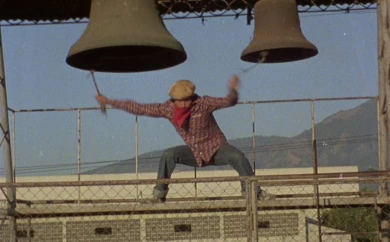
The Reframing Banana Imagery series concludes with two works that condense the height and twilight of this period in history, epic sagas that cross borders and registers to embody experiences of armed struggle in the region. Cameras mix with firearms, borders between nations blur and patience reaches breaking point. This is where the tipping point lies, where the bloodshed weighs heavy and the murmurings of regional brotherhood are buried in the ground again.
Pan y dignidad (Carta abierta de Nicaragua) [Bread and Dignity (An Open Letter to Nicaragua)] recounts the historical records and process of national reconstruction in Nicaragua via the Sandinista popular uprising. Historias prohibidas de Pulgarcito (Forbidden Tales of Tom Thumb) places the camera at the heart of the El Salvador revolutionary struggle, interspersing testimonies of daily violence with the verses of the poet Roque Dalton.
Both works understand the armed revolution as an open file under construction. The insurgent brotherhood, although dissolved, still resounds in regional history.
Circling Over Exploited Bodies
Friday, 19 and 26 June 2026 - 7pm
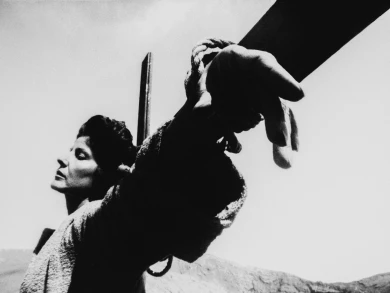
When forms of violence are inflicted on society, film responds from urgency. Images become abstract, sounds fade and the register of dissidence comes from the gut. La zona intertidal (The Intertidal Zone) is an essayistic and poetic approach to the repression of teachers in El Salvador in the 1970s — a teacher studies the biodiversity of the El Salvador coast as a boy finds a body on the same beach. A propósito de la mujer (About Women) interweaves testimonies of misery and rage towards patriarchal structures with fictional scenes of a symbolic procession through a harsh desert.
Both films understand the body as a target of violence and a territory of insurrection, a space where the blood shed by militancy and the patriarchal yoke turn pain into denouncement and existence outside the status quo into an act of political dissidence.
Robert Capa
Friday, 26 June 2026 – 6pm
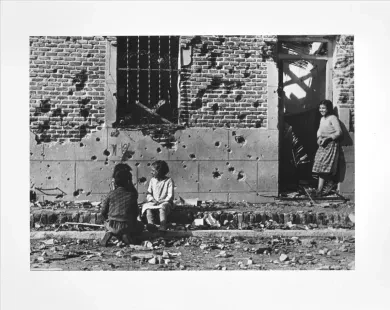
This international encounter centred on the figure of Robert Capa (Budapest, 1913 — Thai Binh, Vietnam, 1954), one of photojournalism’s pre-eminent figures, is held within the framework of the government initiative Spain and Freedom. Fifty Years and in conjunction with a cluster of three locations — the building on number 10 Calle Peironcely, the Plaza del Fotógrafo Robert Capa and the San Carlos Borromeo Parish in Vallecas — declared as a Place of Democratic Memory.
The emblematic photo Robert Capa took in 1936 of this area of Republican Madrid, featuring anonymous children talking in front of a bullet-riddled building attacked by Nazi-fascist air forces, has, in recent years, become a catalyst for impassioned collective action vindicating memory and denouncing the horrors and brutality of wars, past and present.
Within this context, representatives from cultural and academic spheres and civil society organisations from Germany, the USA and Spain discuss the legacy of Capa and photojournalism in European democratic memory, exploring in greater depth two citizen initiatives constructed by Europe from its shared memory: #SalvaPeironcely10 (#SavePeironcely10), in Entrevías (Puente de Vallecas), and the Capa Haus Initiative in the Lindenau neighbourhood of Leipzig, both united by the protection and conservation of historical heritage and by the defence of peace.
The round-table discussion features the participation of Cynthia Young, Juan Miguel Sánchez Vigil, Ulf-Dietrich Brumann and José María Uría Fernández and is moderated by Myriam Soto Lucas. Carmina Gustrán Loscos, the commissioner of Spain and Freedom. Fifty Years, will also join the discussion.
Central American Designation of Origin
Thursday, 18 and 25 June 2026 - 7pm
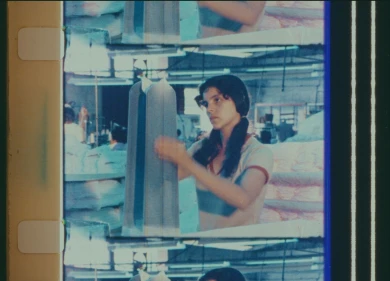
Fertile lands, farmers’ hands, rural faces. This first programme in the series Reframing Banana Imagery understands the foundations of the Central American experience from exploitation, extractivism and displacement, and from the organisation and resistance that emerged as a reaction. The four films within extend from a lyrical documentary on farmers’ solidarity to the playful subversion of the institutional format of the United Fruit Company.
Bananeras (Banana Growers) is a combative portrait of the inhumane conditions of the American banana plantations located in Nicaragua through much of the twentieth century. Costa Rica Banana Republic is a perspicacious satire via an institutional documentary of banana production, spotlighting the extractive nature of this agro-exporting model in the 1970s. Organización Campesina (Farmers’ Organisation) frames rural resistance in Honduras from a direct depiction and lyrical documentary, while Dos veces mujer (Two Times a Woman) dissects the invisibility of the double-shift working day Central American women farmers endure: working in the countryside and working in the home. As a whole, the works here present the earth at once as a wounded body and a space of dignity.
Inclusive Policies and Practices
19, 20 JUN 2026
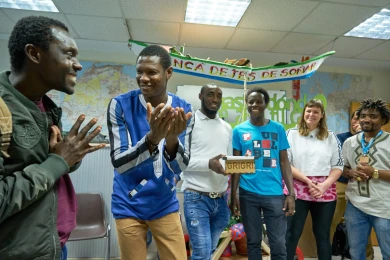
In conjunction with World Refugee Day, which takes place on 20 June 2026, Museo Situado and GRIGRI jointly organise this international encounter to foster the discussions, debates and exchange of practices which uphold solidarity with migrant people in European Union countries.
The programme, conceived as a space of exchange and the collective construction of knowledge, comprises a workshop of collaborative creation, discussions, a community meal and a film forum — activities designed by a local committee made up of young people under the age of thirty from different territories in Europe. The policy recommendations on welcoming people with migrant backgrounds and hospitality in urban contexts that arise from this encounter will be presented in Brussels at the end of 2026.
These sessions are developed within the context of the European cooperation project Bridging Borders and are framed inside the tenth anniversary of the GRIGRI Pixel project.