-
Programme 1
Museum
-
Wednesday, 22 January 2020 – 7pm
Session 1
Second session: Sunday, 26 January – 6pm
Jean-Luc Godard and Anne-Marie Miéville
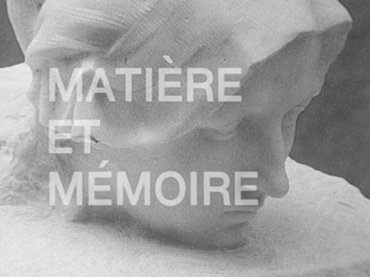
The Old Place. Small Notes Regarding the Arts at Fall of 20th Century
France and USA, 1999, colour, original version in French with Spanish subtitles, DA, 49´This film was made for MoMA and serves as a moving compendium of Godard’s and Miéville’s aesthetic thought. Posing the question of whether art is “legend” or “reality”, i.e. myth or history, images of artworks from diverse eras and disciplines materialise. All of them are contained in this “old place”, the museum, a space of memory and reflection in times of amnesia and absolute market demand. Art, Godard tells us, is one more object from this past time but, between distance and proximity (“legend” or “reality”), it still entertains hope of changing the present: it is the invention of a fragment of another possible world. Authors also write 23 theories of unique beauty and mystery that claim, at the end of the 20th century, the right to exist from art.
-
Friday, 24 January 2020 – 7pm
Session 2
Second session: Monday, 27 January – 7pm
Anne-Marie Miéville
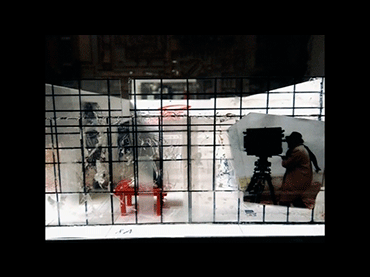
Souvenir d´utopie
France and Switzerland, 2006, colour, original version in French with Spanish subtitles, DA, 6’Jean-Luc Godard and Anne-Marie Miéville
Reportage amateur (maquette expo)
France and Switzerland, 2006, colour, original version in French with Spanish subtitles, DA, 47´At the turn of the 21st century, the Centre Pompidou undertook a project to mount an exhibition curated by one of the previous century’s great film-makers, with the initial title Collage(s) de France, archéologie du cinéma d’après JLG. Godard would not only pull out of the project, he also declared that the final exhibition, entitled Voyage(s) en utopie, Jean-Luc Godard, 1946-2006. À la recherche d’un théorème perdu (Centre Pompidou, 2006), did not represent his thinking. He also remarked that the only trace of the original show was the maquettes, which Godard made by hand and which he used to mount its curatorial discourse. The two films in this session film these maquettes, a personal imaginary museum in which Godard puts forward the most radical installation of the exhibition space. Souvenir d´utopie is a silent walk around the exhibition, with Miéville’s camera simulating the visitor’s gaze. Reportage amateur (maquette expo) sees Godard narrate the theoretical diagram of Collage(s) of France, according to the arrangement of rooms initially conceived in his project: Myth, Humanity, Camera, Film(s), The Subconscious, The Bastards, Reality, Death, The Grave. An inimitable challenge to the conditions in the museum.
-
Programme 2
Language and Catastrophe
-
Saturday, 25 January 2020 – 7pm
Session 1
Second session: Saturday, 8 February – 7pm
Jean-Luc Godard
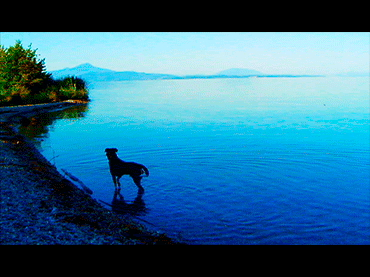
Adieu au langage (Goodbye to Language)
France, 2014, colour, original version in French, English and German with Spanish subtitles, B-R, 67´Godard’s second film in a new digital medium and 3D technology. We imagine the film-maker drawing a line under analogue film, after Histoire(s) de cinema, and trying out a new way of writing with the digital image. Goodbye to Language assumes an elegiac tone of abandonment on numerous levels: in the film medium, in the stories of lovelessness between the film’s two couples, two nostalgic and youthful remakes by Godard, and in the role of the word (language) to define the world. It is also the pure and innocent birth of a new experience, when words are left behind. How does the world speak to us when the simple and conventional code that reduces it disappears? The prominence of the dog Roxy (“the only being that will love you more than you love yourself”, a Charles Darwin quote Godard utters) and the exuberance of nature speaks of a fledgling sensibility when words become surplus.
-
Wednesday, 29 January 2020 – 7pm
Session 2
Second session: Sunday, 9 February – 6pm
Jean-Luc Godard
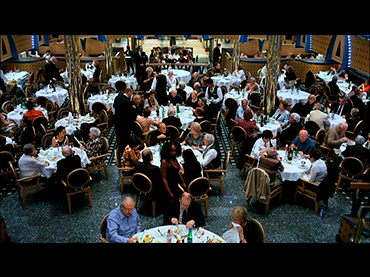
Film socialisme
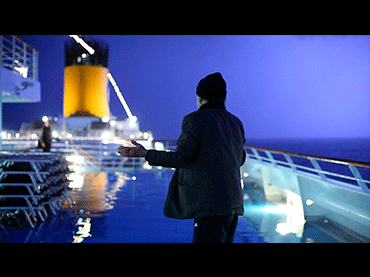
Switzerland, 2010, colour, original version in French with Spanish subtitles, DA, 97´Godard’s first feature film that is shot completely in video and fully utilises the juxtapositions, contrasts and saturation of the digital image, symptomatic of a time which is unhinged and rushed. The film-maker offers a film in three movements, in the form of a sonata: the first is quick, realised on a Mediterranean cruise with different stops; the second is slow and involves a family, a house and a petrol station in Southern France; the third, faster and shorter than the first, is a journey around some of the renowned enclaves on the shores of the Mediterranean and the Black Sea.
In the first movement, Such Things, Godard, Alain Badiou and Patti Smith share space with a motley crew of tourists who record images without looking at them — a cruise as an eroded version of the Grand Tour of the Enlightenment. In the second, Our Europe, a family is visited by two cameras while children debate liberty, equality and fraternity in a time of perpetual surveillance. The third, Our Humanities, focuses on the phrase: “the nation is not a country; it is a territory in conflict”. The approach of Film Socialisme is clear: to maintain a model of civilization alive in its fragments or delighting in the scene of its disintegration.
-
Thursday, 30 January 2020 – 7pm
Session 3
Second session: Monday, 10 February – 7pm
Paul Grivas
Film catastrophe
France, 2018, colour, original version in French with Spanish subtitles, DA, 55’First session presented by Paul Grivas.
Paul Grivas is one of four cinematographers, with François Aragno, Jean-Paul Battagia and Godard, in Film Socialisme, forming part of the group of young collaborators working closely with the director in recent years. The role of prophet has followed Jean-Luc Godard throughout his career: widely known are his prophecies from May ‘68, the fall of the Berlin Wall and the Palestinian Intifada. This is also the case with Film Socialisme, a film which astonishingly foresees the spectre of the European crisis, with the first part filmed on an ocean liner on the Mediterranean, denoting the moral debacle of old continental culture. Few could envisage this metaphor becoming international news: this liner is the Costa Concordia, the boat which capsized and sank in 2012 on the Italian coast, causing 32 deaths. In Film Catastrophe Paul Grivas captures the setting around the shooting of Film Socialisme: living alongside tourists, concerts, buffets, outdoor activities, and so on. Rituals which are inseparable from another on-board feast: tourists devouring images with their mobile phones.
-
Saturday, 1 February 2020 – 7pm
Session 4
Second session: Saturday, 15 February – 7pm
Jean-Luc Godard
Le Livre d´image (The Image Book)
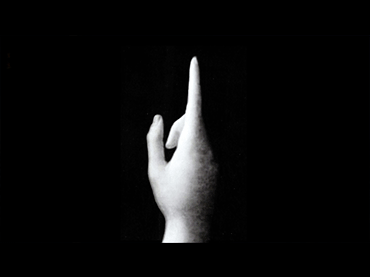
Switzerland, 2018, b/w and colour, original version in French, English, Arabic, Italian and German with Spanish subtitles, DA, 84´“The Image Book is cinema, and cinema is the lay culture that helps us against all books of the law, the Koran, the Bible, the Torah… It is the modernity of light against the darkness conveyed by those books of monotheistic religions. The image is what protects us against laws, dictatorships, rules. The image is the territory of freedom, fraternity… The principles of the republic of images. Each image is important, from those in my mobile phone to those from a sublime Hitchcock film in Hollywood. Each image is a citizenry in the republic of images, and a political model. Films are political models of co-existence, mutual solidarity, dialogue, against all rules that come from books, text, logos. All bibles are prescriptions (…). Images free us from those beliefs and prohibitions, and the way in which Jean-Luc (Godard) edits them, organises them, saves them, adds them and also disconnects them is an organisational model on how to be free,” writes Nicole Brenez, a lecturer in Film Studies at the University of Sorbonne Nouvelle-Paris 3, and a film programmer, theorist and writer.
-
Programme 3
History
-
Monday, 3 February 2020 – 7pm
Session 1
Second session: Wednesday, 12 February – 7pm
Jean-Luc Godard and Anne-Marie Miéville
De l’origine du XXIe siècle
France, 2000, b/w and colour, original version in French with Spanish subtitles, DA, 16’Moments choisis des histoire[s] du cinéma
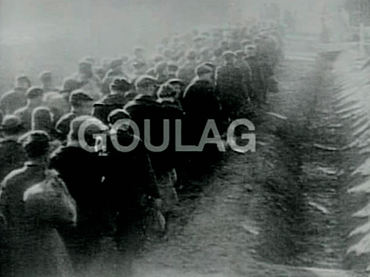
France, 2004, b/w and colour, original version in French with Spanish subtitles, 35mm, 84’This film shows the film-maker performing the role of a historian contemplating brutality and attempting to unravel its causes and motives through images, new words he writes with to produce history. De l’origine du XXIe siècle is a stream of violence, ecstasy and emotion before the legacy of the 20th century, a tumultuous and savage period. Documentary images live beside fictitious, pornographic and sacrificial ones — all, ultimately, images of history. “In search of a lost century”, recites one of the subtitles, the main characteristic of which Godard sets in the thought of Georges Bataille: the struggle between State control and the freedom of love. Moments choisis des histoire(s) du cinema, meanwhile, is a coda to the great Histoire(s) de cinéma (1988-1998). An epilogue contained in the phrase of film-maker and theorist Hollis Frampton: “No activity can become an art before its epoch has ended”. What remains of cinema after the 20th century?
-
Wednesday, 5 February 2020 – 7pm
Session 2
Second session: Friday, 14 February – 7pm
Jean-Luc Godard
Vrai faux passeport. Fiction documentaire sur des occasions de porter un jugement à propos de la façon de faire des films
France, 2006, b/w and colour, original version in French with Spanish subtitles, DA, 56’A summary trial in which Godard expounds and dismantles film-making methods of other directors and references the possible link to a true discourse or, conversely, one which is manipulated, or profoundly false. A quote from Saint Augustine opens the film like a declaration of intent: “The truth is so cherished that even the liars wish that what they say is true”. The Latin terms bonus and malus are used by the judge/film-maker as moral categories (passports) assigned without consideration. In the dock sit Quentin Tarantino, Federico Fellini, Roberto Rossellini, Jean Vigo, Chantal Akerman, Martin Scorsese and Vincent Gallo, and many others. In contrast to the analytical and totalizing reflection of Histoire(s) de cinema, Vrai faux passeport is a critique in the strictest tradition of Charles Baudelaire: passionate, subjective, uncontrollable.

-
Programme 4
Apparitions
-
Friday, 7 February 2020 – 7pm
Sesion 1
Second session: Sunday, 16 February – 6pm
Jean-Luc Godard
JLG/JLG – autoportrait de décembre (JLG/JLG – Self-Portrait in December)
France, 1995, colour, original version in French with Spanish subtitles, AD, 60´Une catastrophe
Switzerland, 2008, colour, original version in French with Spanish subtitles, DA, 1’Khan Khanne, seléction naturelle
France, 2014, b/w and colour, original version in French with Spanish subtitles, DA, 9’Remerciements de Jean-Luc Godard à son Prix d´honneur du cinéma suisse
Switzerland, 2015, colour, original version in French with Spanish subtitles, DA, 5’Bande-annonce de la 22ème édition du festival international du film documentaire de Jihlava
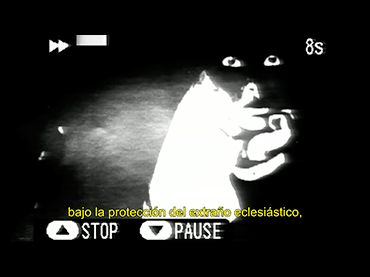
Switzerland and the Czech Republic, 2018, colour, original version in French with Spanish subtitles, DA, 1’Sought by the whole film system, considered to be one of the great artists in our life and times, and rejuvenated in the exploration of digital language, Godard has become a ubiquitous presence in the programmes and homages of renowned festivals. Yet the film-maker responds by acts of disappearance and noticeable absence to become a spectre, a ghost, one more image. This session is a two-part self-portrait: in JLG/JLG – Self-Portrait in December we see his spartan lifestyle in the Swiss town of Rolle, his refuge and centre of operations. In the other short pieces, the film-maker examines his own disappearance and theorises about his marginalised and classless role. A poet who speaks about the world from outside the world: “So I’m going home/with The Ashes of Gramsci/a poem by Pasolini/it speaks of humble corruption,” Jean-Luc Godard remarks in Remerciements de Jean-Luc Godard à son Prix d´honneur du cinéma suisse.

Held on 22, 24, 25, 26, 27, 29, 30 Jan, 01, 03, 05, 07, 08, 09, 10, 12, 14, 15, 16 Feb 2020
The Museo Reina Sofía presents a retrospective on one of the vital artists and thinkers of our time: film-maker Jean-Luc Godard (1930). The series spotlights his twenty-first-century productions and his ventures into the potential of the digital image, where film is rewritten as a present-day art.
At 89, Jean-Luc Godard sits among the most avant-garde film-makers and, rather than lingering on past roles — writer, activist, poet — he has reinvented himself as a thinker through images. In his later years, Godard has made Goya’s famous maxim his own: I’m still learning; new knowledge related to the limitless exploration of the digital image, understood not from the fetishism of a new technique, but as the possibility of engendering a new discourse, a new useful language for another experience. This period also stresses the importance of a group of his collaborators: cinematographers Fabrice Aragno and Jean-Paul Battaglia, film historian Nicole Brenez, and photographer and film-maker Anne-Marie Miéville, Godard’s companion in his exile in Rolle, Switzerland.
The series begins after Histoire(s) de cinema (1988-1998), a gargantuan project that would take him a decade and in which he would officiate the history of the 20th century through successive multiplications of film histories, stretching to his recent participation in international festivals with brief pieces, the letters by an artist celebrating his concurrent disappearance and omnipresence.
In the series, four programmes form thematic strands. Firstly, Museum: two sessions focusing on how the film-maker questions the institution, “the old place”. On one side, filming, in essay form, for MoMA, ranging over memory, time and the role of art (The Old Place, with Anne-Marie Miéville, 1999), and, on the other, exploring the installation of an exhibition at the Pompidou, in itself a history of civilization (Souvenir d´utopie, Anne-Marie Miéville, 2006, and Reportage amateur (maquette expo), with Anne-Marie Miéville, 2006).
The second programme, entitled Language and Catastrophe, encompasses the trilogy Goodbye to Language, Film Socialisme and The Image Book, three feature-length films in which a new digital vocabulary sets the scene to speak of contemporary catastrophe and hope for the future. Interspersed with this trilogy is the screening of Film Catastrophe. The third programme, History, includes the epilogue to Histoire(s) de cinema, Godard’s version of the 20th century as a legacy of brutality and, finally, a devastating critique of other film-makers through the ethics of images. To conclude, the programme Apparitions presents the director’s film portraits — in JLG/JLG – Self-Portrait in December we get a look into his austerity and isolation in Rolle; in the rest, brief letters Godard sent to festivals where he questions himself, invoking absurdity and existential solitude (Buster Keaton and Samuel Beckett) while examining the rituals of cinema.
Acknowledgements
Fabrice Aragno, CNAP (Centre national des arts plastiques, Paris) and MoMA (Museum of Modern Art, New York)
Force line
Rethinking the Museum and Avant-gardes
Curatorship
Chema González
Organised by
Museo Reina Sofía
Más actividades
Rethinking Guernica
Monday and Sunday - Check times
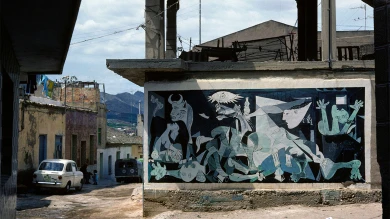
This guided tour activates the microsite Rethinking Guernica, a research project developed by the Museo Reina Sofía’s Collections Area, Conservation and Restoration Department and the Digital Projects Area of the Editorial Activities Department, assembling around 2,000 documents, interviews and counter-archives related to Pablo Picasso’s painting Guernica (1937).
The visit sets out an in-situ dialogue between the works hung around the painting and a selection of key documents, selected by the Museo’s Education Team and essential to gaining an idea of the picture’s historical background. Therefore, the tour looks to contribute to activating critical thought around this iconic and perpetually represented work and seeks to foster an approach which refreshes our gaze before the painting, thereby establishing a link with the present. Essentially revisiting to rethink Guernica.
Files of Tropical Revolutions
Sábado 20 y 27 de junio, 2026 - 19:00 H
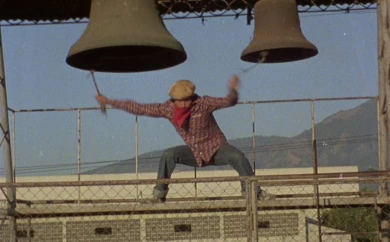
The Reframing Banana Imagery series concludes with two works that condense the height and twilight of this period in history, epic sagas that cross borders and registers to embody experiences of armed struggle in the region. Cameras mix with firearms, borders between nations blur and patience reaches breaking point. This is where the tipping point lies, where the bloodshed weighs heavy and the murmurings of regional brotherhood are buried in the ground again.
Pan y dignidad (Carta abierta de Nicaragua) [Bread and Dignity (An Open Letter to Nicaragua)] recounts the historical records and process of national reconstruction in Nicaragua via the Sandinista popular uprising. Historias prohibidas de Pulgarcito (Forbidden Tales of Tom Thumb) places the camera at the heart of the El Salvador revolutionary struggle, interspersing testimonies of daily violence with the verses of the poet Roque Dalton.
Both works understand the armed revolution as an open file under construction. The insurgent brotherhood, although dissolved, still resounds in regional history.
Circling Over Exploited Bodies
Friday, 19 and 26 June 2026 - 7pm
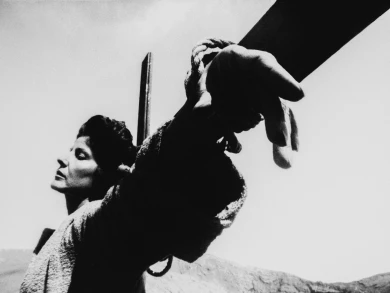
When forms of violence are inflicted on society, film responds from urgency. Images become abstract, sounds fade and the register of dissidence comes from the gut. La zona intertidal (The Intertidal Zone) is an essayistic and poetic approach to the repression of teachers in El Salvador in the 1970s — a teacher studies the biodiversity of the El Salvador coast as a boy finds a body on the same beach. A propósito de la mujer (About Women) interweaves testimonies of misery and rage towards patriarchal structures with fictional scenes of a symbolic procession through a harsh desert.
Both films understand the body as a target of violence and a territory of insurrection, a space where the blood shed by militancy and the patriarchal yoke turn pain into denouncement and existence outside the status quo into an act of political dissidence.
Central American Designation of Origin
Thursday, 18 and 25 June 2026 - 7pm
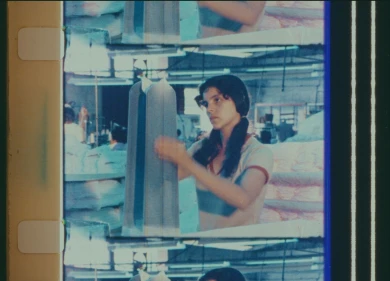
Fertile lands, farmers’ hands, rural faces. This first programme in the series Reframing Banana Imagery understands the foundations of the Central American experience from exploitation, extractivism and displacement, and from the organisation and resistance that emerged as a reaction. The four films within extend from a lyrical documentary on farmers’ solidarity to the playful subversion of the institutional format of the United Fruit Company.
Bananeras (Banana Growers) is a combative portrait of the inhumane conditions of the American banana plantations located in Nicaragua through much of the twentieth century. Costa Rica Banana Republic is a perspicacious satire via an institutional documentary of banana production, spotlighting the extractive nature of this agro-exporting model in the 1970s. Organización Campesina (Farmers’ Organisation) frames rural resistance in Honduras from a direct depiction and lyrical documentary, while Dos veces mujer (Two Times a Woman) dissects the invisibility of the double-shift working day Central American women farmers endure: working in the countryside and working in the home. As a whole, the works here present the earth at once as a wounded body and a space of dignity.
equipoMotor
Jueves alternos, 23 de octubre, 2025 - 11 de junio, 2026 - 17:30 h
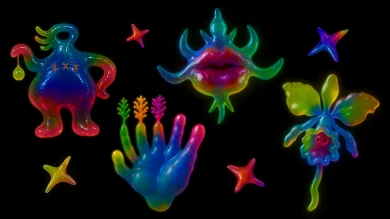
El programa equipoMotor regresa en su edición 25-26 con un aire espectral y mutante para lanzar la pregunta: ¿y si el Museo fuera «un poco más Frankenstein»? Inspirándose en dicho monstruo y en todas aquellas criaturas que desafían la norma desde los márgenes, el proyecto de mediación cultural Galaxxia diseña y acompaña una edición incisiva, intergeneracional y descentralizadora, donde saberes invisibilizados, cuerpos raros y deseos molestos se entrelazan para generar nuevas formas de imaginación crítica y radical. En los sótanos y corredores del Museo —un particular laboratorio— las dudas no se esconden: son materia prima.
Así, para este curso el equipoMotor convoca a personas de todas las edades que hayan participado en ediciones anteriores de los distintos equipos del Área de Educación a recorrer el Museo como quien manipula un cuerpo abierto: descoyuntando algunas de sus categorías teóricas y artísticas —la necropolítica, lo crip-cuir, la lucha de clases, las políticas del malestar, la decolonialidad, la temporalidad cuir, la descentralización institucional o el feísmo— para articular un relato díscolo, remendado y palpitante.
El programa se estructura en bloques temáticos sobre lo freak como metodología, el trabajo cultural, la intergeneracionalidad y la diversidad territorial. Cada bloque a su vez se despliega en sesiones que combinan disparadores teóricos y estéticos, visitas a exposiciones y espacios liminales del Museo, talleres artísticos con artistas, ejercicios de curaduría audiovisual colectiva y de relatoría radiofónica, así como instancias de activación pública, mediante proyecciones de cine experimental y coloquios compartidos con el público, en complicidad con el archivo Hamaca y el Área de Cine y Nuevos Medios del Museo.
De este modo, la presente edición incorpora una particularidad: el grupo de participantes irá transformándose en un «colectivo curatorial audiovisual temporalmente autónomo», con capacidad de incidir en la programación del Museo y de abrir la conversación de equipoMotor al público general, cuestionando y expandiendo así los límites entre las cabezas que deciden, las manos que producen y los cuerpos y presencias que habitan la institución. Las personas seleccionadas en la modalidad oyente serán invitadas a las proyecciones públicas, así como a otras activaciones y momentos de apertura del equipoMotor.
Frente al relato de un museo homogéneo, pulcro y lineal, apostamos por un Museo disidente, contradictorio y lleno de vida residual. Un Museo que no tema hacerse preguntas incómodas ni mostrar sus cicatrices. equipoMotor. Un poco más Frankenstein no busca repensar el cuerpo de la institución, sino habitarlo en sus desgarros, tal como es: híbrido, inacabado, infecto, fantasmagórico… y cargado de esporas y chispas por venir.