
Held on 14, 15 Mar 2025
Intervals is the Museo Reina Sofía’s regular programme premiering recent film work, made up of critically acclaimed films from the year in progress or the previous one. This next instalment is devoted to Morlaix (2025), the most recent film by Jaime Rosales (Barcelona, 1970) which tells the story of teenage love and its influence across our lifespan. Rosales, who directed the award-winning film La soledad (Solitary Fragments, 2007), presents the film in two sessions and takes part in a post-screening discussion in the second.
Morlaix is an existential story which demonstrates the poetics of love and the magnitude of decisions made. In a small town in Brittany, France, Gwen’s relationship with Thomas is disrupted by the sudden arrival of Jean-Luc, a worldly Parisian student with a magnetic personality. One day, when she and a group of friends go to the cinema they watch a film with a storyline which, bafflingly, seems inspired by her own life. By way of a meta-cinematic game, the director carries us along with the story of lived memory, and, via its bold formal treatment, it breaks from linearity with its alternating 35mm and 16mm editing, mixing black and white with colour.
Jaime Rosales, the director of Las horas del día (The Hours of the Day, 2003), La soledad (Solitary Fragments, 2007) and Hermosa juventud (Beautiful Youth, 2014), possesses one of the most personal gazes in Spanish cinema. The search for identity — spanning from tenderness and youth to the darkest recesses of the human mind — and formal experimentation have made his film-making an emotional revelation. He is the winner of the Goya Awards for Best Film and Best Director (La soledad, 2007), the FIPRESCI Prize at the San Sebastián Film Festival (Tiro en la cabeza [Bullet in the Head] 2008), the International Critics Award (Las horas del día, 2003) and the Ecumenical Jury’s Special Mention for Hermosa Juventud (2014) at Cannes Film Festival.
Programme
Intervals
Organised by
Museo Reina Sofía
Collaboration
illycaffèCredits
Director: Jaime Rosales
Script: Jaime Rosales, Fanny Burdino, Samuel Doux and Delphine Gleize
Production: a Spain-France co-production with Fresdeval Films, Iwaso Films, 3cat and Les Productions Balthazar
Photography: Javier Ruiz Gómez
Editing: Mariona Solé Altimira
Music: Leonor Rosales March
Sound: Cora Delgado, Anne Laure François and Nicolas Wasckowski
Cast: Aminthe Audiard, Samuel Kircher, Mélanie Thierry, Jeanne Trinité and Alex Brendemühl
Jaime Rosales, Morlaix, 2025
Trailer
Más actividades
Central American Designation of Origin
Thursday, 18 and 25 June 2026 - 7pm
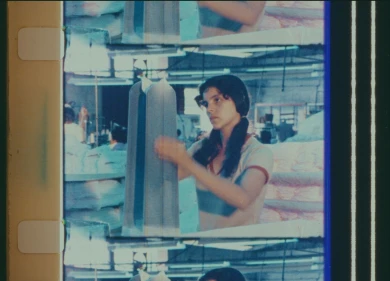
Fertile lands, farmers’ hands, rural faces. This first programme in the series Reframing Banana Imagery understands the foundations of the Central American experience from exploitation, extractivism and displacement, and from the organisation and resistance that emerged as a reaction. The four films within extend from a lyrical documentary on farmers’ solidarity to the playful subversion of the institutional format of the United Fruit Company.
Bananeras (Banana Growers) is a combative portrait of the inhumane conditions of the American banana plantations located in Nicaragua through much of the twentieth century. Costa Rica Banana Republic is a perspicacious satire via an institutional documentary of banana production, spotlighting the extractive nature of this agro-exporting model in the 1970s. Organización Campesina (Farmers’ Organisation) frames rural resistance in Honduras from a direct depiction and lyrical documentary, while Dos veces mujer (Two Times a Woman) dissects the invisibility of the double-shift working day Central American women farmers endure: working in the countryside and working in the home. As a whole, the works here present the earth at once as a wounded body and a space of dignity.

Cinema, for the First Time
7 and 14 June 2026 – 12:00 pm
The final session in this Moon Projector season contemplates the feeling around the first experience of cinema — cinema as revelation, magic, fantasy and mystery from the first gaze, from the first contact with the medium, and imagery etched on the retina of childhood. The programme shows Émile Cohl’s landmark Fantasmagorie (1908), the first ever hand-drawn animation, and Ignacio Agüero’s Cien niños esperando un tren (One Hundred Children Waiting for a Train, 1988), a feature-length film on play and the origins of cinema.
Fantasmagorie (1908)by Émile Cohl (Paris, 1857– Villejuif, 1938) is the first expression in the history of animated drawing. Émile Cohl was an illustrator who belonged to the Parisian art group Arts incohérents (1882–1895), who was bestowed with an absurdist and pre-Surrealist talent. Whereas the Lumière brothers were able get audiences out of their seats as they witnessed a train moving towards them in 1895, Fantasmagorie is a supernatural experience, akin to an apparition yet also innocuous and entertaining — the inanimate comes to life out of nothing and figures seemingly move with little sense. From the outset, animation was related to caricature, fabulation and the comical, a sweet spot for the dreams of the youngest audience.
From the discovery of new imagery arising from the animated line to knowledge of the world through a screen, Cien niños esperando un tren (1988), by Chilean director Ignacio Agüero (Santiago, 1952), narrates a group of young people’s discovery of cinema in a workshop on the origins of the medium in a poverty-stricken town on the outskirts of Santiago de Chile. Play, fun and learning combine with a fascination with images, as viewing Émile Cohl’s Fantasmagorie (1908) in the workshop becomes an act of freedom.
Elisa González and Leah Pattem. Soy Tribulete 7
13 JUN 2026
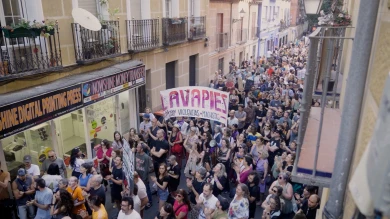
Framed inside this year’s Neighbourhood Picnic is the screening, in the Museo’s Cinema, of a film related to the life and protests of the Lavapiés neighbourhood, addressing issues of gentrification and the right to housing: Soy Tribulete 7 (I Am Tribulete 7, 2026), directed by Elisa González and Leah Pattem.
As the Spanish housing crisis takes hold in Lavapiés, this story begins in February 2024, when the residents of Calle Tribulete, 7, a block of apartments on a street in this Madrid barrio, receive a letter informing them that their building has been sold to a vulture fund. The news spreads quickly around the neighbourhood and, when it comes to the attention of González and Pattem, they grab their cameras and head straight for the building, where they encounter one hundred or so residents still in shock. The film Soy Tribulete 7 flows into the building and the daily lives of a community united, whose looming eviction occasions the fight of their lives. Ultimately, a path of resistance that will turn the community into a symbol of struggle for the right to housing.
Both film-makers worked closely with a group of tenants — Cris, Nani, Blanca, José, María Jesús and Antonia — to tell the story of how the building became the most creative stage of resistance ever witnessed in the area. The work presents the daily life of these residents in Madrid’s now-iconic “building fighting eviction”, depicting their collective struggle and the violent disruption to their lives. Through personal interviews, observational footage, archive material, music and a narration by eighty-year-old actress Ana Martín García, the film casts light on the human stories behind a community struggle.
The Neighbourhood Picnic is an annual gathering of festivities organised by Museo Situado, a network made up of associations, activists and residents from Lavapiés, a racially diverse, working-class neighbourhood where the Museo Reina Sofía is located.
Exile and Alienation
Saturday 30 May and 6 Jun, 2026 - 18:00 H
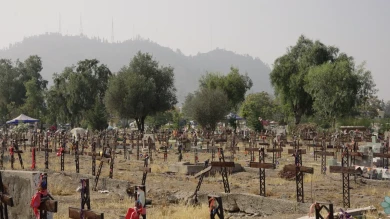
In the years of the Popular Unity Government in Chile, three young film-makers, Marilú Mallet, Valeria Sarmiento and Angelina Vázquez, went to the offices of Chile Films to present a film project. This session screens three films which convey the three directors’ experience of exile. In Dos años en Finlandia (Two Years in Finland), Angelina Vázquez depicts the social and working conditions of Chileans exiled in the Nordic country. The fictional work Lentement, directed by Marilú Mallet, follows a young Chilean exile around spaces of Montreal blighted by nostalgia and political rage. In Huellas (Fingerprints), Valeria Sarmiento returns to Chile to explore the memory of violence inflicted by Pinochet’s military dictatorship. The session culminates in a talk with the three directors, gathered here for the first time.
From North to South and South to North
Sunday 31 May and Friday 5 June, 2026
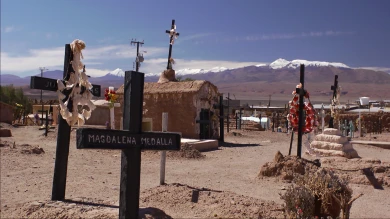
In a kind of road movie, Marilú Mallet travels across her native Chile after forty years of exile. The journey is an exploration of the dynamism of national identity, leading the film-maker to return to questions previously explored in her filmography and to search for new forms of filming the encounter between body and landscape.